Kawaii Christmas isn’t about abandoning tradition—it’s about reimagining it with tenderness, playfulness, and soft intention. Originating from Japanese pop culture’s celebration of cuteness as emotional comfort, kawaii aesthetics prioritize roundness, simplicity, gentle contrast, and childlike wonder. When applied to holiday decor, this means moving away from bold red-and-green maximalism toward blush pinks, mint greens, buttery yellows, lavender lavenders, and cloud-white accents—all softened with plush textures, hand-drawn motifs, and whimsical proportions. A kawaii tree isn’t just decorated; it’s *curated* with care, like a visual hug for your living space. This guide walks through every practical decision: selecting the right base, building depth with layered pastels, sourcing or making decor that feels authentically sweet (not saccharine), and maintaining cohesion without sacrificing personality.
Understanding the Kawaii Aesthetic Beyond “Cute”
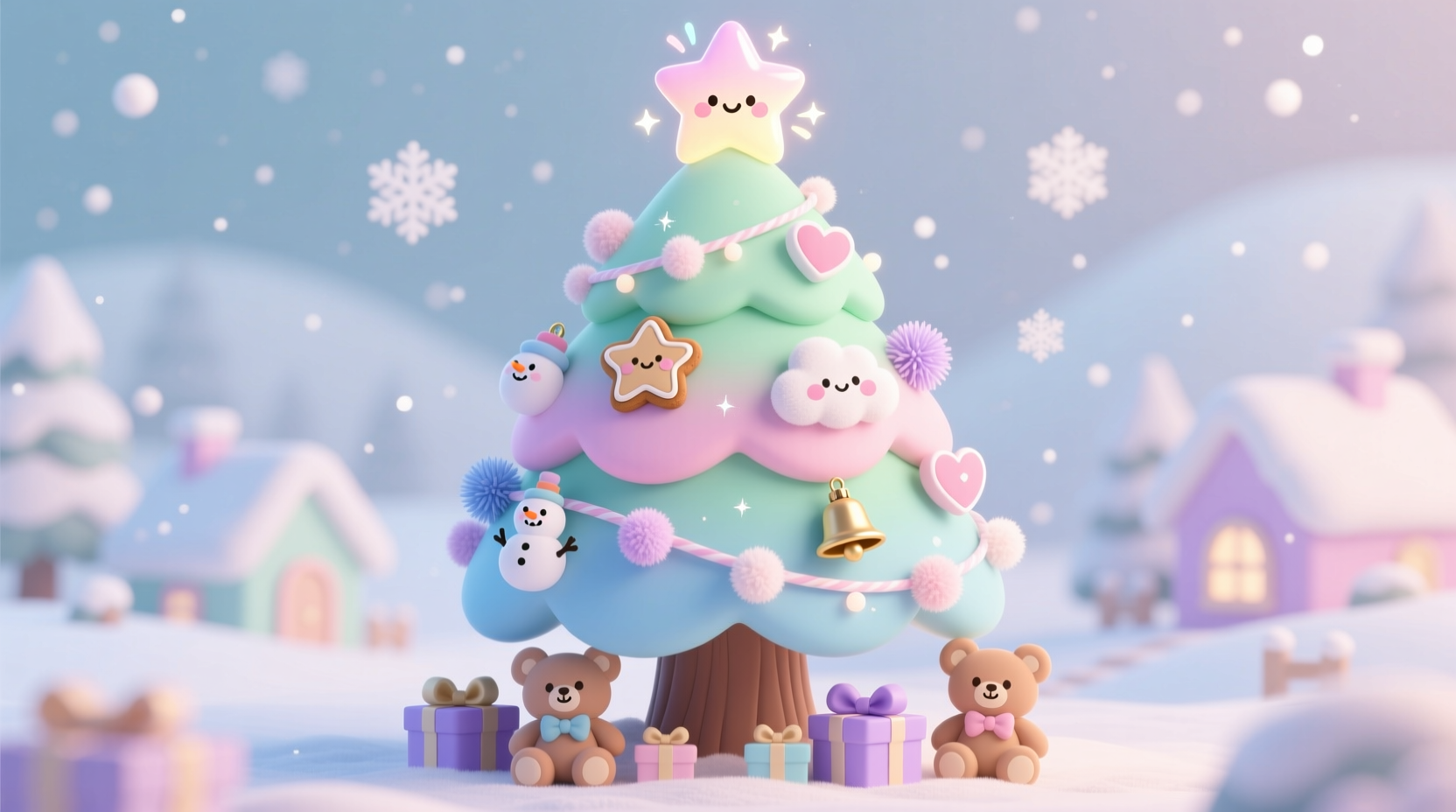
Before gathering supplies, clarify what makes decor truly kawaii—not merely pink or cartoonish. Kawaii design follows three foundational principles: shibumi (subtle, unforced elegance), marui (roundness—both literal and emotional), and yururi (gentle slowness, a sense of unhurried joy). These translate directly to tree styling: avoid sharp angles in ornaments, favor matte over high-gloss finishes, and choose motifs that evoke warmth—bears wearing scarves, smiling stars, sleeping bunnies, or steaming mugs—not generic snowflakes or aggressive slogans.
Crucially, kawaii color theory relies on low saturation and high value. That means pastels aren’t just pale versions of brights—they’re desaturated, often with a hint of grey or cream to mute intensity. For example, “kawaii pink” reads more like cotton candy at dawn than bubblegum at noon. Similarly, mint is closer to seafoam than neon green. This tonal restraint prevents visual fatigue and supports the calming, restorative function of kawaii spaces—a vital consideration during the often-overwhelming holiday season.
“Kawaii isn’t decoration for the eyes alone—it’s environmental psychology. Soft edges lower cortisol, rounded forms invite touch, and pastel palettes signal safety. Your tree becomes a sensory anchor.” — Dr. Lena Tanaka, Cultural Psychologist & Author of Cuteness as Care
Selecting and Preparing Your Tree Base
The foundation sets the tone. A kawaii tree thrives on texture and silhouette—not height or density. Avoid stiff, overly symmetrical artificial trees. Instead, opt for one with these characteristics:
- Flocked or velvet-textured tips—mimics powdered sugar or soft fur, adding tactile warmth;
- Asymmetrical branching—slight irregularity feels handmade and approachable;
- Medium height (5–6.5 feet)—keeps the tree intimate and human-scaled, not imposing;
- Matte white or pale grey trunk—avoids wood-grain realism, reinforcing the illustrative, storybook feel.
If using a real tree, skip traditional pine or spruce. Choose a Nordmann fir or Korean fir—their soft, dense needles hold lightweight ornaments without drooping, and their natural bluish-green undertone harmonizes beautifully with pastels. Never use spray-on flocking meant for craft projects; it flakes and irritates skin. Instead, lightly mist branches with diluted white fabric starch (1 part starch to 4 parts water), then gently dust with ultra-fine, biodegradable white glitter—or better yet, skip glitter entirely and rely on matte texture alone.
Tip: Before decorating, fluff each branch outward—not upward—to create a full, huggable silhouette. Then rotate the tree 90 degrees and repeat. This builds dimension and prevents flat “wallpaper” effect.Pastel Palette Planning & Layering Strategy
True kawaii harmony comes from intentional layering—not random pastel mixing. Use this three-tier system to build depth and prevent washout:
| Layer | Role | Recommended Colors | Proportion |
|---|---|---|---|
| Base | Anchors the palette; provides visual weight and warmth | Cloud white, oat milk beige, dusty rose | 45% |
| Middle | Adds interest and gentle contrast; carries main motifs | Mint, lavender, butter yellow, sky blue | 40% |
| Accent | Creates focal points and subtle sparkle; used sparingly | Matte gold foil, pearlized white, blush shimmer (not glitter) | 15% |
Never exceed four total colors—including neutrals. A common misstep is adding “just one more pastel” (e.g., baby blue + mint + lilac + peach + lemon), which dilutes cohesion. Instead, choose one base neutral (e.g., cloud white), two middle tones (e.g., mint + lavender), and one accent (e.g., matte gold). Test combinations by laying swatches on white paper under natural light—true kawaii tones should feel restful, not jarring or clinical.
Handmade & Curated Decor: What to Make vs. What to Source
Kawaii decor gains authenticity through imperfection and personal imprint. Prioritize handmade elements for core ornaments—but smartly outsource where craftsmanship matters most.
Make These (Simple, High-Impact):
- Felt food ornaments: Strawberry, donut, or matcha cake shapes cut from wool-blend felt. Hand-stitch with embroidery floss in slightly contrasting thread (e.g., mint cake with butter-yellow stitching). No glue—stitching adds visible, charming texture.
- Yarn-wrapped stars: Use wooden star blanks wrapped tightly with thin pastel yarn (hold two strands together for fluff). Leave ends loose for a “fuzzy halo” effect.
- Mini chalkboard tags: Cut smooth birch plywood into 2” circles or clouds. Paint with chalkboard paint, let cure 72 hours, then write tiny messages (“Hug me”, “Warm wishes”, “You’re sweet”) in pastel chalk.
Source These (Prioritize Quality & Ethos):
- Acrylic dome ornaments: Look for thick, distortion-free domes (3–4mm) with matte white or pastel interiors—not cheap, shiny plastic. Brands like Kawaii Collective or Sanrio Home offer ethically made options with subtle embossing (e.g., tiny hearts inside the dome).
- Stuffed animal toppers: A single, well-proportioned plush (e.g., a sleeping bunny or wide-eyed bear) in cloud-white fleece. Avoid cartoonish faces; seek soft, simplified features—two black dots for eyes, a curved line for mouth.
- Lighting: Warm-white LED micro-lights (not cool white) with fabric-covered wires. String density: 100 bulbs per foot of tree height. Drape lights *before* ornaments, wrapping gently—not tightly—to preserve branch shape.
Real Example: Mika’s Tokyo Apartment Tree
Mika, a graphic designer in Shibuya, transformed her 5-foot pre-lit Nordmann fir into a kawaii centerpiece using only materials she had at home: leftover wool felt scraps, spare embroidery thread, dried lavender buds (for sachet-style mini pouches), and repurposed ceramic buttons from an old coat. She skipped all commercial ornaments except for one set of matte-gold star-shaped lights. Her breakthrough was using lavender buds sealed in tiny muslin bags (stitched closed with pink thread) as “scented ornaments”—they added subtle texture, fragrance, and earthy contrast to the pastels. Guests consistently comment that the tree “feels like breathing deeply.” Her secret? She hung nothing heavier than 15 grams per ornament—and never placed two identical items on the same branch level.
Step-by-Step Assembly Timeline
Build your tree in stages over two days. Rushing invites imbalance and visual clutter. Follow this sequence precisely:
- Day 1, Morning (30 min): Fluff and shape the tree. Attach lights evenly, starting at the trunk and spiraling upward. Let lights stay on for 2 hours to check for dark spots or overheating.
- Day 1, Afternoon (45 min): Hang base-layer ornaments: large cloud-white felt balls (3–4”), matte-gold stars, and oversized yarn-wrapped orbs. Space them 8–10 inches apart, focusing on outer branch tips—not deep within the tree.
- Day 1, Evening (30 min): Add middle-layer decor: felt food, chalkboard tags, and lavender sachets. Vary heights deliberately—place a strawberry at eye level, a donut lower near the trunk, a tag higher up. Rotate the tree after every 5 ornaments to maintain balance.
- Day 2, Morning (20 min): Insert accent pieces: one plush topper (secure with floral wire, not tape), 3–5 acrylic domes with tiny dried flowers or pressed leaves inside, and 2–3 miniature ceramic mushrooms or bunnies nestled into branch forks.
- Final Touch (5 min): Step back. Remove any ornament that draws attention *away* from the overall softness—even if you love it individually. Kawaii is collective gentleness, not individual cuteness.
FAQ: Practical Concerns & Gentle Solutions
How do I keep pastel decorations from looking dull or washed out?
Dullness comes from insufficient contrast or poor lighting. Counteract it by anchoring your palette with a warm neutral (oat milk beige, not stark white) and using matte gold accents—not silver—which adds luminous warmth without glare. Also, ensure ambient room lighting is warm-white (2700K–3000K); cool lighting flattens pastels. A single salt lamp nearby enhances depth without competing.
Can I incorporate traditional elements like tinsel or red berries?
Yes—if radically softened. Replace metallic tinsel with hand-cut strips of matte pastel crepe paper, twisted loosely and tucked into branch tips. Swap red berries for blush-pink dried rose hips or white elderberries. The key is preserving the *feeling*, not the symbol: warmth, not heat; abundance, not excess.
What if my space is small or shared with non-kawaii adults?
Scale down intentionally. A 3-foot tabletop tree works beautifully with just 12–15 carefully chosen ornaments and no lights. Use a ceramic planter as a base instead of a stand—paint it cloud white. Place it on a shelf beside a favorite book or mug. Its power lies in quiet presence, not dominance. As interior stylist Hiroshi Yamada notes: “A kawaii tree doesn’t shout ‘look at me.’ It whispers ‘you’re safe here.’ That resonance needs no square footage.”
Conclusion: Your Tree Is an Invitation, Not a Statement
A kawaii Christmas tree is never finished—it’s tended. It invites slow mornings with tea, quiet moments of reflection, and shared laughter over handmade imperfections. It rejects the pressure to impress and chooses instead to comfort. Every felt strawberry, every yarn-wrapped star, every whispered message on a chalkboard tag is a tiny act of kindness—toward yourself, your home, and anyone who pauses beside it. You don’t need perfection. You need presence. You don’t need more decor—you need deeper intention. So begin with one branch. Choose one color. Make one ornament—not for Instagram, but for the quiet joy of your own hands shaping something soft in a loud world.
💬 Your turn: Share one word that describes the feeling you want your kawaii tree to hold this season—and tag someone who needs that feeling most. Let’s grow gentleness, together.








