Whiskey isn’t just a spirit—it’s an investment, a legacy, and often a deeply personal expression of taste and time. A single rare bottle can appreciate significantly over decades; a curated collection may hold tens of thousands in value. Yet many enthusiasts store prized bottles in unlocked cabinets, behind flimsy glass doors, or even in plain sight—vulnerable to accidental breakage, unauthorized access, or outright theft. Traditional locks offer limited visibility, no audit trail, and zero remote control. Smart locks change that. When implemented thoughtfully—not as gimmicks, but as integrated security layers—they provide verifiable access control, environmental awareness, and peace of mind without compromising aesthetics or usability. This guide details how to select, install, and manage smart locking solutions specifically for whiskey storage, grounded in real-world constraints: humidity sensitivity, cabinet design limitations, power reliability, and the human factor.
Why Standard Locks Fall Short for Whiskey Collections
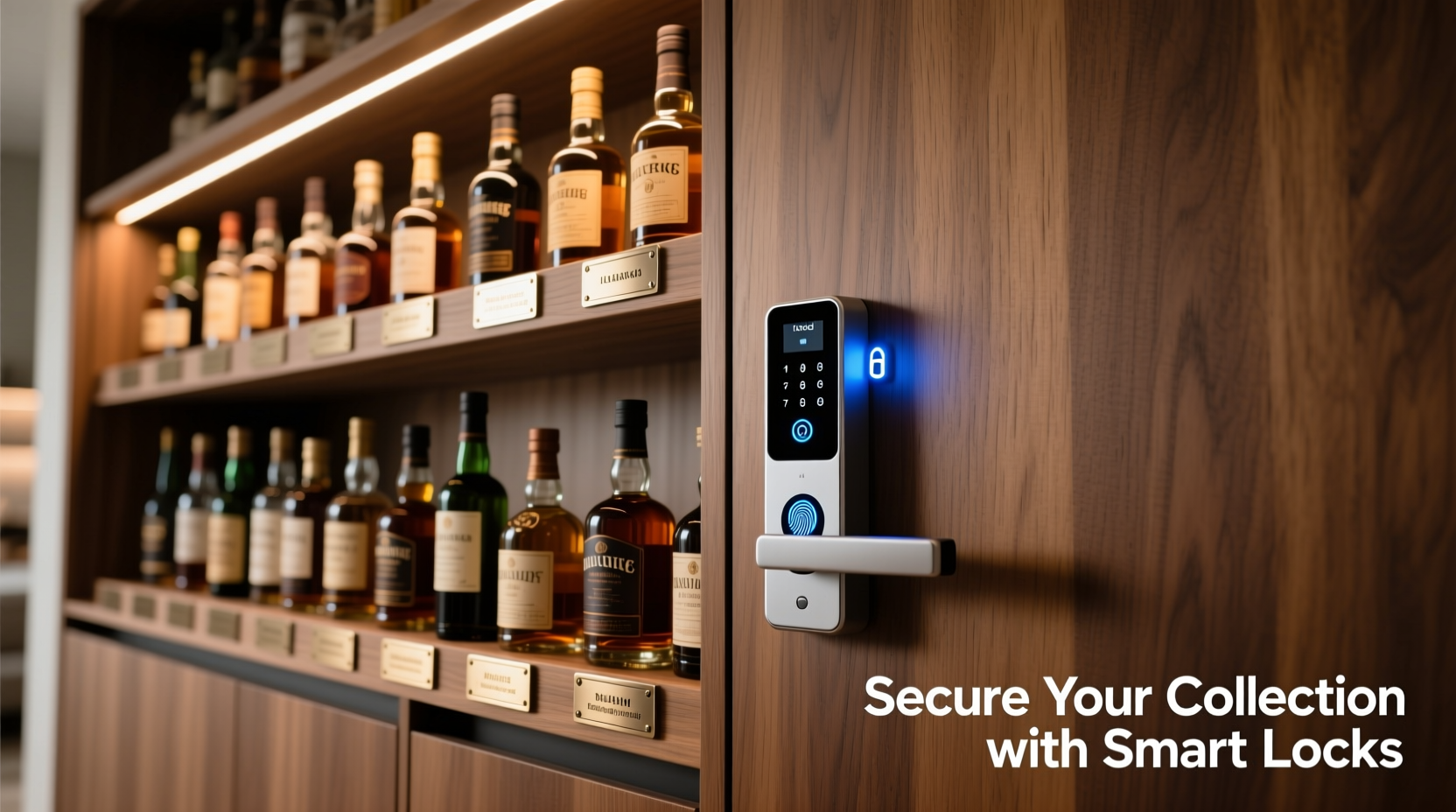
Conventional mechanical locks—cam locks, barrel bolts, or keyed cabinet latches—lack three critical capabilities essential for modern whiskey stewardship. First, they offer no record of *who* opened the cabinet or *when*. If a bottle goes missing or is disturbed, there’s no forensic trail. Second, they cannot adapt to context: a guest visiting for dinner shouldn’t have the same access level as your cellar manager—or your teenage nephew. Third, they provide no integration with environmental monitoring. Whiskey thrives between 45–65% relative humidity and 55–68°F (13–20°C). A smart lock paired with compatible sensors can trigger alerts if cabinet temperature spikes during a heatwave—or if humidity drops below safe thresholds, risking cork desiccation.
This isn’t about paranoia. In 2023, a private collector in Louisville reported the theft of seven Macallan 1989 casks—valued at $210,000—from his climate-controlled garage. The entry point? An unmonitored, non-locked liquor cabinet adjacent to the main vault, used for daily pours. The thieves bypassed high-end biometric doors but exploited the weakest link: convenience over control. Security isn’t measured by the strongest door—it’s defined by the weakest access point.
Selecting the Right Smart Lock for Your Cabinet or Vault
Not all smart locks are suited for whiskey storage. Cabinet doors vary widely: thin veneer panels, heavy solid-wood hutch doors, recessed inset frames, or glass-front display cases. Mounting options, power requirements, and physical footprint matter more than flashy app features. Below is a comparison of lock types against key whiskey-specific criteria:
| Lock Type | Best For | Whiskey-Specific Advantages | Key Limitations |
|---|---|---|---|
| Motorized Deadbolt (e.g., August Wi-Fi Smart Lock) | Freestanding whiskey cabinets with standard door frames | Strong physical barrier; integrates with home security systems; auto-relock after 30 seconds prevents accidental open-door exposure | Requires door frame modification; not suitable for glass or thin-panel cabinets |
| Smart Latch Kit (e.g., Level Bolt or Yale Assure Lock SL) | Interior cabinet doors, built-in bar units, or wine/whiskey credenzas | Minimalist installation—no exterior hardware visible; works with existing strike plates; silent operation preserves ambiance | Limited forced-entry resistance; best paired with secondary locking mechanisms for high-value collections |
| Bluetooth + Keypad Cabinet Lock (e.g., Smonet or Igloohome Smart Lock) | Small curio cabinets, wall-mounted displays, or travel cases | Battery-powered (no wiring); PIN-based access ideal for multi-user households; tamper alerts if lock is pried | No remote access without Bluetooth range; requires manual firmware updates |
| Enterprise-Grade RFID Vault Lock (e.g., Gunnebo or Securitron) | Dedicated walk-in whiskey vaults or custom-built climate rooms | UL-rated forced-entry resistance; audit logs with user ID, timestamp, and event type (unlock, forced entry attempt, low battery); supports dual authentication (card + PIN) | Professional installation required; higher cost ($450–$1,200+); overkill for under-50-bottle collections |
Crucially, avoid smart locks with external keypads exposed to ambient humidity—salt-laden air in coastal homes or steam from nearby kitchens can corrode circuits. Opt instead for models with IP54 or higher ingress protection ratings, or choose keypad-free variants (e.g., NFC tap or app-initiated unlock) mounted inside the cabinet frame.
Tip: Test fit before purchase. Measure your cabinet’s backset (distance from door edge to center of bore hole), door thickness, and clearance behind the door. Many “universal” smart locks assume 1⅜”–1¾” door thickness—common in furniture but rare in antique bar cabinets.A Real-World Implementation: The Edinburgh Collector’s Dual-Layer System
James M., a retired distillery archivist in Edinburgh, maintains a 217-bottle collection spanning 1952–2023—including six bottles of Ardbeg 1974 and a full set of Bowmore Black Rock releases. His original oak cabinet had no lock, and two bottles vanished during a house party in 2021. He responded not with isolation, but with layered, human-centered security.
First, he installed a Yale Assure Lock SL on the cabinet’s main double-door, configured with four unique access methods: his fingerprint (admin), his wife’s PIN (daily access), a temporary Bluetooth code for his sommelier (valid only 4–6 PM Tuesdays), and a physical key override stored in a fireproof safe. Second, he added a Wyze Sense motion sensor and Temp/Humidity sensor inside the cabinet, synced to the lock’s automation rules: if internal humidity falls below 52% for >12 hours, the lock disables all non-admin access until humidity stabilizes. Third, he enabled email alerts for every unlock event—and reviewed them weekly. Within three months, he noticed repeated 3:15 AM unlocks (his teenage son retrieving soda). Instead of confrontation, James created a “guest mode” PIN that only opens the top shelf (non-rare bottles) and logs duration. The system didn’t eliminate access—it made it intentional, accountable, and adaptive.
“The lock didn’t make my collection safer,” James notes. “It made *my decisions* safer. I stopped guessing who touched what—and started designing access around trust, not suspicion.”
Step-by-Step: Installing and Configuring Your Smart Lock
Proper setup prevents false alarms, access failures, and premature battery drain. Follow this sequence—whether you’re securing a $300 bar cart or a $30,000 vault:
- Evaluate cabinet integrity: Confirm hinges are tight and door doesn’t sag. A misaligned door causes latch binding—a top cause of smart lock failure. Tighten hinge screws or add shims if needed.
- Choose power strategy: Battery-only locks (4xAA or CR123) last 6–12 months but require manual replacement. Hardwired locks (12V DC) eliminate battery anxiety but need an electrician if no nearby outlet exists. For climate-controlled spaces, avoid lithium batteries near heating elements—opt for alkaline or lithium-iron phosphate (LiFePO₄) cells rated for 0–122°F.
- Install mounting hardware: Use the manufacturer’s template. Drill pilot holes first. For wood cabinets, pre-drill with a 1/16” bit to prevent splitting. For MDF or particleboard, use coarse-thread drywall anchors rated for 50+ lbs shear load.
- Pair with ecosystem: Connect to Apple HomeKit if you use iOS devices (enables Siri voice control and Home app automations). For Android users, Matter-over-Thread compatibility ensures future-proof interoperability. Avoid proprietary hubs unless they support IFTTT or Webhooks for custom integrations (e.g., “If lock unlocks, log event to Google Sheets”).
- Configure access tiers: Create at minimum three user roles: Admin (full control), Trusted User (time-limited or shelf-restricted access), and Guest (one-time or duration-limited code). Disable default “master codes” and never reuse passwords across devices.
- Test environmental triggers: Simulate low humidity by placing a desiccant pack inside the cabinet for 2 hours. Verify the lock enforces access restrictions. Repeat for temperature spikes using a hairdryer (briefly—do not exceed 85°F internally).
“Security isn’t about locking things away—it’s about enabling responsible access while preserving integrity. A well-configured smart lock turns passive storage into active stewardship.” — Dr. Lena Cho, Director of Beverage Security Research, Institute of Spirits & Distillation (ISD)
Do’s and Don’ts of Smart Lock Management for Whiskey
Maintaining long-term reliability requires discipline beyond initial setup. These practices separate functional systems from frustrating ones:
| Do | Don’t |
|---|---|
| Replace batteries proactively—when status drops to 25%, not 5%. Low voltage causes inconsistent motor engagement, leading to partial latches and false “unlocked” states. | Use generic, off-brand batteries. Voltage inconsistency damages lock motors. Stick to Energizer Ultimate Lithium or Panasonic Eneloop Pro for rechargeables. |
| Review access logs monthly. Look for patterns: repeated failed attempts, off-hours unlocks, or unusually long open durations (>8 minutes suggests forgotten open door). | Share admin credentials. Give each trusted user their own account—even if it’s just a PIN. Shared logins erase accountability. |
| Update firmware quarterly. Manufacturers patch vulnerabilities (e.g., Bluetooth spoofing) and improve battery algorithms. Enable auto-updates if available. | Ignore humidity warnings. Corks begin drying at <45% RH. If your lock disables access due to low humidity, address the root cause (add a small humidifier, seal gaps, or relocate the cabinet) before overriding. |
| Physically test the lock’s manual override (key or emergency release) every 6 months. Dust and humidity can seize mechanisms. | Mount locks directly on glass doors without reinforcement. Glass flexes; motor torque can crack panes. Use surface-mount brackets or switch to magnetic locks for glass applications. |
FAQ: Addressing Common Concerns
Will smart locks interfere with whiskey’s aging or flavor?
No. Smart locks generate negligible electromagnetic fields—far weaker than Wi-Fi routers or smartphones. They produce no heat, light, or vibration that could impact maturation (which occurs only in cask, not bottle) or chemical stability. The only physical impact is the minor vibration during motor actuation, which lasts <0.8 seconds and poses no risk to settled sediment or cork integrity.
What if the power goes out or my phone dies?
Reputable smart locks include multiple fallbacks: physical keys, mechanical keypads (with backlight), or NFC cards. Most retain full functionality on battery power for months. Crucially, they do *not* “fail open”—they default to locked state during power loss. If your model supports it, configure a “deadbolt always engaged” mode, requiring active unlock for *any* access. Never rely solely on smartphone apps for primary access.
Can I integrate smart locks with my existing home security system?
Yes—if both systems support industry standards. Look for locks certified for Apple HomeKit Secure Video, Matter, or Z-Wave 800 Series. These enable native integration with platforms like ADT, Ring Alarm, or SimpliSafe. You’ll receive unified alerts (“Cabinet unlocked during alarm arming”) and can trigger actions like turning on cabinet lighting when unlocked. Avoid brands using closed ecosystems (e.g., some early-generation locks tied exclusively to vendor apps) unless they offer robust API access.
Conclusion: Stewardship Begins With Intentional Access
Your whiskey collection represents more than monetary value. It holds stories—of distilleries visited, friendships toasted, milestones marked. Protecting it isn’t about building a fortress; it’s about honoring that significance through thoughtful, precise control. Smart locks, when chosen with purpose and managed with consistency, transform passive storage into active guardianship. They don’t eliminate human judgment—they sharpen it. They don’t replace care—they codify it. Whether you’re safeguarding a dozen bottles on a bookshelf or curating a generational archive in a climate-controlled vault, the right lock becomes less a barrier and more a quiet partner in preservation.
Start small: pick one cabinet. Audit its vulnerabilities. Choose a lock aligned with your actual usage—not marketing hype. Configure three access tiers. Review logs for one month. Notice how intention replaces assumption. That shift—from hoping nothing happens to knowing exactly what did—is where true security begins.
💬 Your turn: Share your smart lock setup, a lesson learned from an access incident, or your favorite low-tech security hack in the comments. Let’s build a smarter, more responsible whiskey community—together.








