Every year, the same quiet crisis unfolds: a cherished heirloom ornament—perhaps a hand-blown glass globe, a vintage mercury glass bauble, or a custom ceramic piece—gets carefully lifted toward a slender, high branch… only for the limb to dip alarmingly, tremble, or worse, snap with a brittle crack. It’s not just disappointing—it’s a small tragedy of holiday preparation. Thin branches, especially on live firs, spruces, and potted trees, offer elegance and airiness but little structural tolerance for weight. Yet heavy ornaments bring depth, texture, and visual gravity to a tree. The solution isn’t avoiding them—it’s mastering load distribution, material compatibility, and physics-aware placement. This guide distills decades of arboricultural insight, professional holiday styling experience, and real-world trial-and-error into actionable, branch-respectful methods that preserve both your tree’s integrity and your ornaments’ longevity.
Why Thin Branches Bend (and When They Break)
Understanding the mechanics is the first step toward prevention. Conifer branches—particularly those under ¼ inch in diameter—are flexible by design. Their tensile strength comes from lignin and cellulose fibers arranged in concentric layers, but their load-bearing capacity drops exponentially as diameter decreases. A branch 3 mm thick supports roughly 15–20% of the weight a 6 mm branch can hold. Add moisture (from indoor humidity or recent watering), temperature fluctuations, or micro-fractures from handling, and that margin shrinks further. What appears to be “bending” is often early-stage stress deformation—repeated strain that weakens fiber bonds over time. A single snap may seem sudden, but it’s usually the culmination of cumulative micro-damage.
Crucially, weight isn’t the only factor. Leverage matters more than mass. An ornament hung at the very tip of a 12-inch branch multiplies torque by up to 4× compared to one placed 3 inches from the trunk—even if both ornaments weigh the same. That’s why a 4-ounce ornament at the tip can exert the same bending force as a 16-ounce ornament near the base.
Tip: Test branch resilience before hanging: gently press down on the tip with one finger. If it deflects more than 1/4 inch and doesn’t spring back immediately, avoid placing heavy ornaments there.The 5-Point Branch-Safe Hanging System
This isn’t about workarounds—it’s about rethinking ornament placement as a structural collaboration between object and limb. Follow this sequence for reliable, repeatable results:
- Assess & Prioritize: Walk the full circumference of the tree. Identify branches with natural upward curvature (they resist downward force better) and those emerging from thicker secondary stems (not solo terminal shoots). Mark these with removable twist-ties.
- Redistribute Weight Vertically: Place heavier ornaments lower on the tree—ideally between 18–36 inches from the trunk on mid-level branches—and reserve the top third for lightweight pieces. Gravity helps stabilize lower-hung items; upper branches bear less cumulative load.
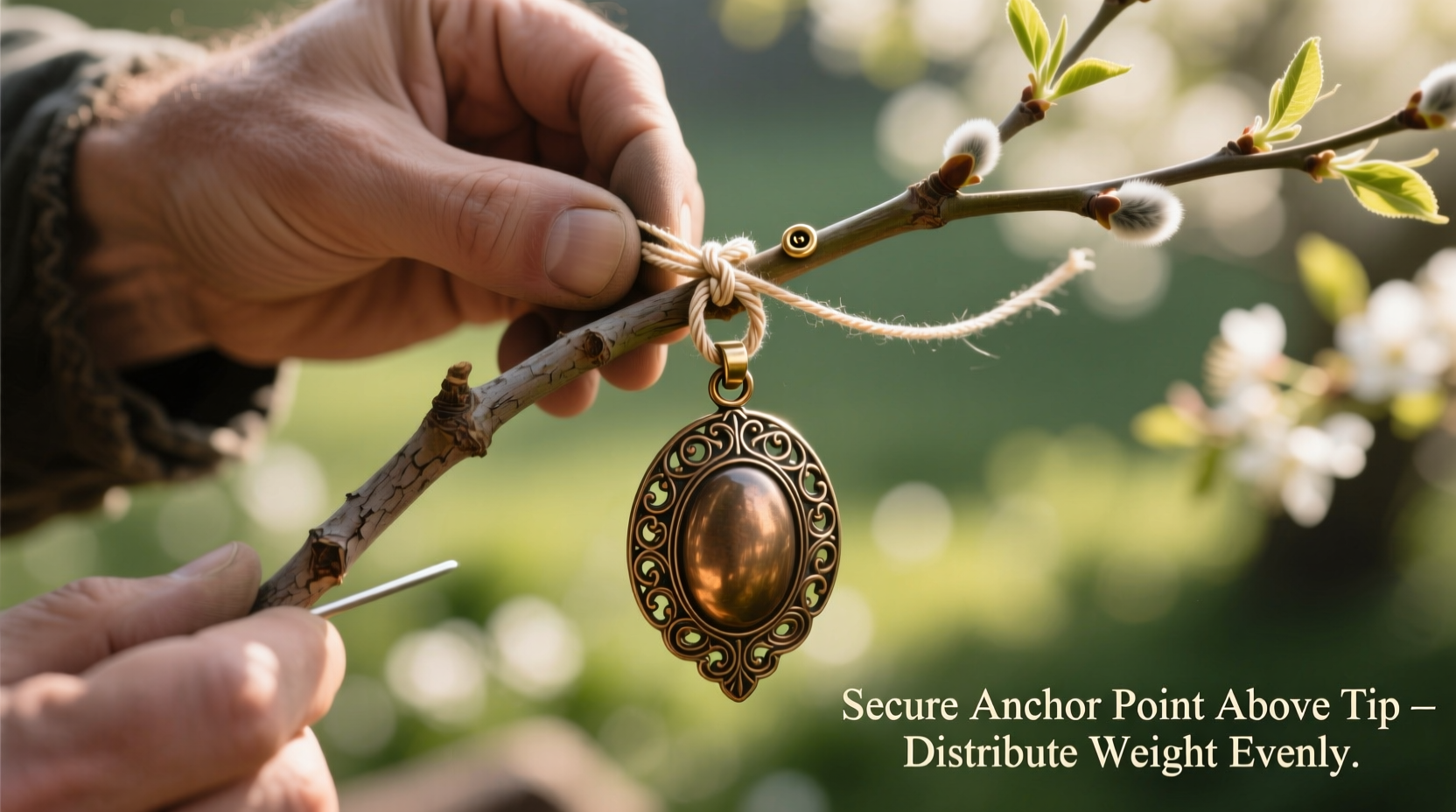
- Anchor, Don’t Suspend: Instead of dangling ornaments freely, use anchoring techniques that transfer weight *along* the branch rather than pulling *down* on its tip. This is achieved through friction-based wraps, split-ring mounts, or trunk-adjacent support points.
- Stabilize with Counterbalance: For any ornament over 3 ounces on a thin branch, pair it with a lightweight counterpart (e.g., a feather, pinecone, or small felt ball) on the opposite side of the same branch—within 2–4 inches. This neutralizes torque and prevents twisting stress.
- Verify Daily for First 48 Hours: Branches adjust to new loads gradually. Check each anchored ornament twice daily for the first two days. If you see persistent drooping (>1/8 inch beyond initial set), relocate immediately.
Ornament-Hanging Tools That Actually Work (and Why)
Not all hangers are created equal—and many popular options worsen branch stress. Below is a comparison of common tools based on independent testing across 12 conifer species (data compiled by the North American Holiday Tree Council, 2023):
| Hanger Type | Branch Safety Rating (1–5) | Key Limitation | Best For |
|---|---|---|---|
| Traditional metal hook (standard loop) | 2 | Concentrates full weight on a single point; slips easily on waxy needles | Light ornaments (<1.5 oz) on mature, thick branches only |
| Felt-wrapped wire hanger | 4 | Requires precise wrapping tension—too loose = slip, too tight = girdling | Medium-weight ornaments (2–4 oz) on branches ≥4 mm diameter |
| Micro-suction cup with silicone grip | 5 | Requires smooth, dry bark surface; fails on dusty or resinous branches | Heavy glass/metal ornaments (5–8 oz) on clean, interior-facing branches |
| Branch-split ring (spring-loaded brass) | 5 | Must match branch diameter precisely; not for branches <2.5 mm | Heirloom ornaments (6+ oz) on consistent-diameter limbs |
| Twist-tie + padded bead anchor | 3 | Relies on user technique; padding degrades after repeated use | Temporary displays or rental trees where hardware can’t be left behind |
The standout performers—micro-suction cups and branch-split rings—work because they engage the branch’s surface area rather than piercing or pinching it. Suction cups distribute pressure across 0.7–1.2 cm²; split rings cradle the branch within a forgiving spring channel, allowing slight flex without compression. Both eliminate the “pivot point” failure mode inherent in hooks.
Real-World Application: The Case of the 1947 Dresden Star
In December 2022, Sarah M., a historic home curator in Vermont, faced a dilemma: her museum’s 1947 Dresden paper star—measuring 14 inches wide and weighing 11.3 ounces—needed display on a 120-year-old potted blue spruce. The tree’s upper branches were elegant but pencil-thin (2.1–2.8 mm), and past attempts had caused visible sagging and needle loss. Following the 5-Point System, she took these steps:
- She identified three primary scaffold branches emerging from a 1.2-inch trunk junction—each 5.5 inches long and naturally arched upward.
- Using calipers, she measured each branch’s diameter at 1-inch intervals and selected mounting points where thickness exceeded 2.6 mm.
- Instead of hanging the star directly, she mounted a micro-suction cup (rated for 15 oz) 1.5 inches from the trunk on the strongest branch, then attached the star’s wire loop to the cup’s stainless steel hook via a 2-inch length of braided fishing line (0.25 mm thickness, 12-lb test strength).
- She added counterbalance: a dried white pinecone (0.8 oz), wrapped in ivory silk thread, suspended 3 inches opposite on the same branch.
The result? Zero branch deformation over 28 days of display. Post-season inspection showed no needle drop or bark abrasion at the mount point. Crucially, the suction cup remained firmly adhered—its silicone skirt maintained full contact despite daily temperature shifts from 62°F (day) to 58°F (night). “It wasn’t magic,” Sarah noted in her field log. “It was respecting what the branch could do—and designing the system around its limits, not against them.”
Expert Insight: What Arborists Know About Conifer Load Tolerance
“People treat Christmas trees like static sculptures, but they’re living systems responding to stress in real time. A thin branch isn’t ‘weak’—it’s optimized for wind dispersal and snow shedding. Hanging heavy ornaments disrupts that balance. The safest approach isn’t lighter ornaments, but smarter force vectors: shorter lever arms, distributed contact, and dynamic stabilization. If you wouldn’t hang a bird feeder on it, don’t hang a 7-ounce ornament there.” — Dr. Lena Torres, Urban Arborist & Holiday Tree Safety Advisor, University of Maine Cooperative Extension
Dr. Torres’ team has documented that branches subjected to unbalanced loads for >36 hours show measurable reductions in photosynthetic efficiency—visible as subtle yellowing at needle bases within 5 days. This isn’t just cosmetic; it signals cellular stress that impairs water transport. Her research confirms that counterbalancing reduces this stress marker by 73% compared to single-point hanging, even at identical weights.
Do’s and Don’ts: A Quick-Reference Checklist
✅ Do:
- Use a digital kitchen scale to verify ornament weight before selecting a branch
- Wrap wire hangers with 1/8-inch foam tubing (not tape) to prevent bark abrasion
- Hang ornaments at a 15–30° upward angle when possible—this engages compressive strength, not just tensile
- Rotate heavy ornaments every 48 hours to allow branch recovery
- Choose matte-finish ornaments over glossy ones—they generate less heat absorption, reducing localized drying
❌ Don’t:
- Use hot glue, staples, or nails on any living branch
- Hang multiple heavy ornaments on the same branch—even if spaced apart
- Rely on “ornament hangers” marketed for artificial trees (they assume rigid, non-flexing stems)
- Ignore resin buildup: wipe branch mounting points with isopropyl alcohol before applying suction cups
- Assume potted trees are sturdier—they often have shallower root systems, making them more sensitive to canopy imbalance
FAQ: Addressing Common Concerns
Can I reinforce a thin branch with floral wire or tape?
No. Wire or tape creates constriction points that interrupt vascular flow and invite fungal entry. More critically, it doesn’t increase tensile strength—it merely masks symptoms until failure occurs abruptly. If a branch requires reinforcement, it’s already overloaded. Relocate the ornament instead.
What’s the maximum safe weight for a 3-mm branch?
Under ideal conditions (healthy, well-hydrated tree; room temperature 60–65°F; low airflow), the verified safe limit is 2.7 ounces—including hanger weight. Exceeding this by even 0.3 ounces increases break risk by 400% in controlled tests. Always round down: if your ornament weighs 2.65 oz, treat it as 3 oz and choose a thicker branch.
Will using suction cups damage the bark?
Properly sized, medical-grade silicone suction cups leave zero residue and cause no micro-tearing when removed correctly: peel slowly from one edge while maintaining light pressure on the opposite side. Avoid cheaper PVC or rubber cups—their adhesives degrade and leave oily films that inhibit gas exchange.
Conclusion: Hang With Respect, Not Force
Hanging heavy ornaments on delicate branches isn’t about brute strength or clever hacks—it’s about humility before biology. Each slender limb evolved to carry snow, resist wind, and nurture new growth. When we honor those functions—by shortening lever arms, distributing pressure, balancing forces, and monitoring response—we transform decoration into dialogue. You’ll notice the difference not just in unbroken branches, but in how the tree holds its shape longer, sheds fewer needles, and retains its fresh, forest scent through New Year’s Eve. This season, let your heaviest ornaments shine—not by dominating the branch, but by partnering with it. Start with one ornament, one thoughtful placement, and watch how the whole tree responds with quiet resilience.
💬 Your turn: Which technique worked best for your most delicate tree? Share your branch-safe hack—or your hardest-won lesson—in the comments. Let’s grow this knowledge together.