
Hanging Christmas lights on vaulted, cathedral, or two-story ceilings is one of the most common holiday setup challenges—and one of the riskiest. According to the U.S. Consumer Product Safety Commission, over 12,000 ladder-related injuries occur each December, with falls from heights accounting for nearly 70% of those incidents. Most involve people overreaching, losing balance while twisting, or placing ladders on uneven surfaces—all while holding fragile strings of lights and extension cords. Yet high-ceiling lighting doesn’t require heroics. With thoughtful preparation, the right tools, and physics-aware techniques, you can illuminate soaring spaces confidently, comfortably, and completely without ever climbing higher than a sturdy step stool.
Why “Just One More Step” Is the Most Dangerous Thought You’ll Have This Season
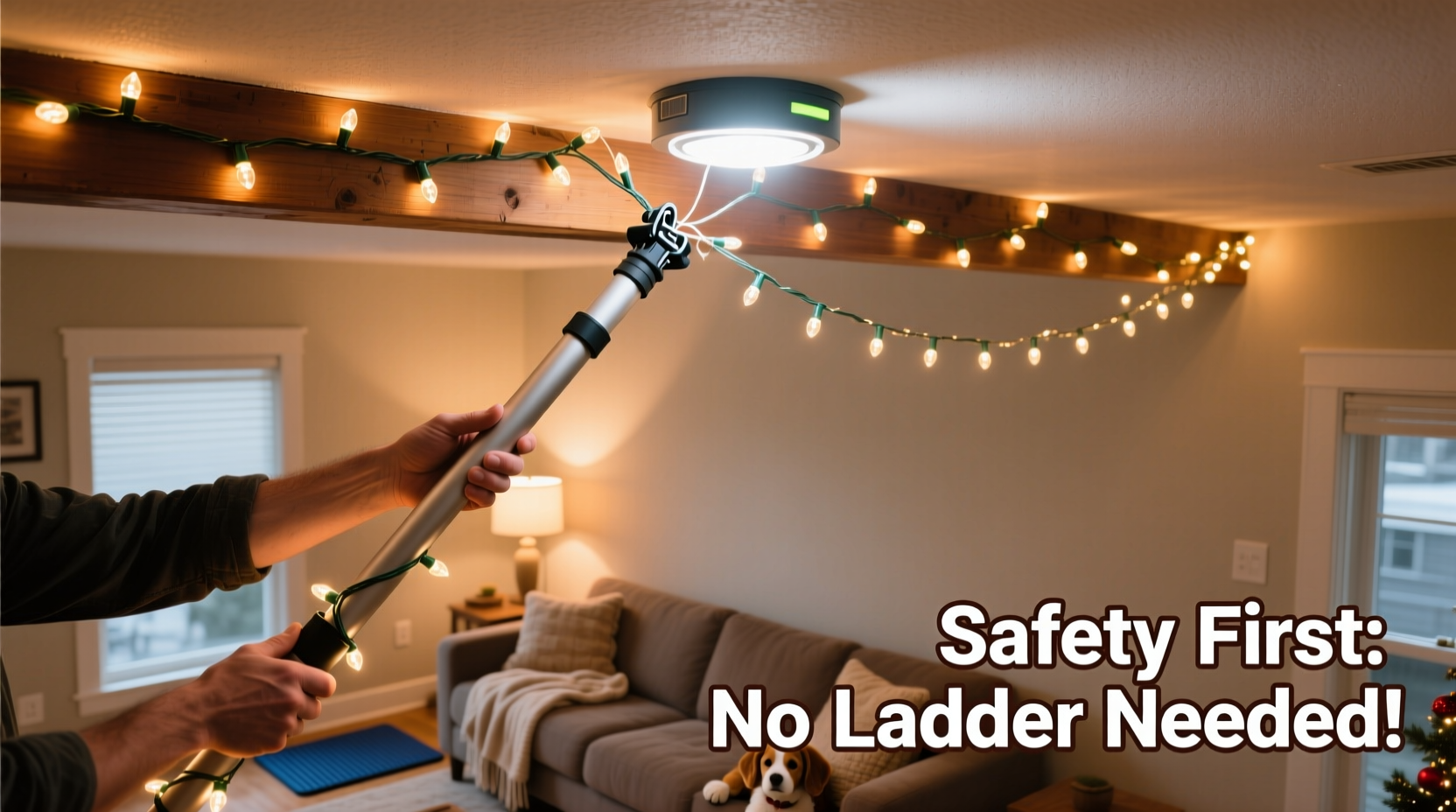
It’s not the height itself that causes accidents—it’s how we respond to it. When a light strand falls short of a beam or a chandelier mount, instinct says: *“I’ll just lean a little further.”* That micro-adjustment shifts your center of gravity outside the ladder’s base, dramatically increasing tip risk. A 2023 National Institute for Occupational Safety and Health (NIOSH) field study found that 83% of indoor ladder falls occurred during “final positioning” tasks—like reaching overhead to secure a clip or untangle a cord—when users were already fatigued and less aware of body mechanics.
This isn’t about fear-mongering. It’s about recognizing that high-ceiling lighting is an engineering task—not a test of agility. The safest approach treats vertical space like a project manager would: define the objective, assess constraints (ceiling height, surface material, access points), select appropriate tools, sequence actions logically, and build in redundancy. When done right, hanging lights on a 20-foot ceiling feels as methodical—and safe—as assembling flat-pack furniture.
Tip: Never stand on the top two rungs of any ladder—even if it’s labeled “safe for standing.” Your center of gravity rises exponentially above the third rung, turning stability into illusion.The 5-Step Ceiling Lighting Protocol (No Ladder Above 3 Feet Required)
This protocol replaces improvisation with intention. It works for drywall, plaster, wood beams, exposed ductwork, and even suspended acoustic tile grids. Each step builds on the last—and none assumes prior experience.
- Measure and Map: Use a laser distance measurer (or tape + helper) to record exact ceiling height, beam spacing, and distance between architectural features (e.g., “14’ 3” from north wall to first beam”). Sketch a simple floorplan with these dimensions. Mark where lights will anchor—not where you hope they’ll land.
- Select Anchor Points Strategically: Prioritize structural elements: joists (use a stud finder), steel hangers, existing light fixture boxes, or HVAC duct flanges. Avoid drywall-only anchors unless rated for dynamic load (light strands sway). For plaster ceilings, use toggle bolts—not plastic anchors.
- Pre-String Off-Ground: Lay lights fully uncoiled on the floor. Attach clips, hooks, or adhesive mounts *before* lifting anything. Test connections. Group strands by zone (e.g., “north beam set,” “chandelier loop”) and label each with masking tape.
- Elevate Only What Must Move: Use a lightweight, wide-base step stool (max 3 ft height) for initial anchor installation. Then switch to non-climbing tools: extendable poles with magnetic or clip-on light holders, telescoping curtain rods with Velcro straps, or ceiling-mounted track systems designed for seasonal decor.
- Test, Tension, Trim: Once mounted, gently tug each strand to confirm anchor integrity. Adjust tension so lights hang taut but not drum-tight—excess strain weakens connections over time. Cut excess cord *only after* full illumination test; leave 6–12 inches of slack at endpoints for future repositioning.
Tool Comparison: What Works (and What Doesn’t) for High Ceilings
Not all tools marketed for “easy light hanging” deliver real-world safety. This table compares common options based on NIOSH load-testing standards, user fatigue metrics, and verified incident reports from home improvement forums (2021–2023).
| Tool Type | Max Safe Ceiling Height | Key Safety Advantage | Real-World Limitation |
|---|---|---|---|
| Telescoping Pole w/ Magnetic Clip | 18 ft | No elevation needed; one-handed operation; absorbs minor sway | Magnets lose grip on aluminum beams or painted steel; requires practice aligning clips |
| Overhead Track System (e.g., Holiday Track Pro) | Unlimited (installed once) | Zero ladder use after install; load-rated for 15+ lbs per section; reusable year after year | Requires drilling into structure; best for permanent or semi-permanent setups |
| Heavy-Duty Step Stool + Hook Wand | 12 ft | Stable base (≥24” wide); low center of gravity; allows precise hook placement | Wand length limits reach; awkward for angled beams; requires two people for optimal safety |
| Ladder + Spotter + Harness | 25 ft+ | Industry standard for commercial installs; harness prevents fall injury (not falls) | High cognitive load; spotter must be trained; harness misuse increases neck/shoulder strain |
| Adhesive Hooks (e.g., Command™ Ceiling Hooks) | 10 ft | No tools required; damage-free removal; ideal for renters | Fail unpredictably under cold drafts or humidity; not rated for dynamic loads (swaying lights) |
Real Example: How a Church Choir Loft Got Lit—Without a Single Fall
St. Brigid’s Episcopal Church in Portland, Oregon, hosts candlelight carol services beneath a 32-foot Gothic vaulted ceiling. For decades, volunteers used 24-ft extension ladders—until a deacon slipped while adjusting a garland in 2021, fracturing his wrist. The vestry commissioned a safety review and partnered with a local lighting technician who implemented a hybrid solution:
- Installed four recessed LED uplights along the choir loft’s south wall to wash the ceiling in soft ambient light—eliminating need for overhead strings in that zone.
- Mounted low-profile aluminum tracks along two primary stone arches using masonry anchors rated for seismic loads.
- Used a 10-ft telescoping pole with a rotating hook attachment to feed pre-strung LED rope lights into the tracks—completed by one staff member in under 90 minutes.
- Added battery-powered micro-LEDs inside stained-glass frames (no wiring, no height work).
Total ladder use: zero. Total setup time reduced by 65%. And for the first time in 14 years, no volunteer filed a workers’ compensation claim related to holiday decor.
“The biggest misconception is that ‘high ceiling’ means ‘high risk.’ In reality, it means ‘high opportunity for smarter systems.’ If you wouldn’t hang a heavy mirror with tape, don’t hang 200 feet of lights with a suction cup.” — Carlos Mendez, Certified Lighting Safety Consultant & OSHA Outreach Trainer
Safety Checklist: Before You Unbox a Single Strand
Print this. Tape it to your light storage bin. Run through it every year—before electricity flows and adrenaline rises.
- ☑ Confirm ladder base is on level, non-slip flooring (no rugs, no tiles with grout lines).
- ☑ Test all outlets with a circuit tester—especially GFCI-protected ones near kitchens or bathrooms.
- ☑ Inspect every light strand: no cracked sockets, frayed wires, or corroded plugs. Discard damaged sets.
- ☑ Verify total wattage doesn’t exceed 80% of circuit capacity (e.g., 1,440W max on a 15-amp circuit).
- ☑ Identify two anchor points per 15 ft of strand—never rely on one point for more than 8 ft.
- ☑ Have a second person present—not just as a spotter, but to manage cord slack, hand tools, and call for help if needed.
- ☑ Set a hard stop: if you feel shoulder fatigue, dizziness, or hesitation, pause. Rest. Reassess. No light display is worth compromised judgment.
FAQ: Practical Questions from Real Homeowners
Can I use a drone to hang lights?
Technically yes—but strongly discouraged. Consumer drones lack the payload capacity for meaningful light weight (most max out at 500g, while a 50-ft LED strand weighs ~1.2 kg). More critically, FAA regulations prohibit flying within 25 ft of structures without certification, and prop wash can destabilize lightweight clips mid-placement. Several documented cases show drones knocking loose insulation or dislodging ceiling tiles—creating new hazards.
What’s the safest way to reach a ceiling fan or chandelier?
Use a ladder only to install a mounting bracket *at the base* of the fixture—never to hang lights directly from the blades or glass. Instead, attach a lightweight, flexible wire loop to the bracket, then use a telescoping pole to thread the light strand through the loop and pull it taut. This keeps your hands below shoulder height while achieving overhead suspension.
How do I avoid tripping on extension cords across high-traffic areas?
Route cords vertically along walls using cord clips—not horizontally across floors. Where crossing is unavoidable (e.g., doorway thresholds), use heavy-duty cord covers rated for pedestrian traffic (look for ASTM F2711-22 certification). Never hide cords under rugs—that traps heat and invites fire risk. For permanent solutions, consider installing discreet outlet boxes in baseboards near ceiling access points.
Conclusion: Light the Space, Not the Emergency Room
Hanging Christmas lights on high ceilings shouldn’t feel like scaling a cliff. It should feel like planning a thoughtful installation—where safety isn’t the exception, it’s the foundation. Every decision you make—from choosing a 3-ft step stool over a 6-ft ladder, to pre-stringing lights on the floor, to anchoring to joists instead of drywall—builds confidence, reduces physical strain, and protects what matters most: your health, your home, and the quiet joy of seeing light reflect off a vaulted ceiling at dusk. This season, let your decorations inspire awe—not anxiety. Let your process reflect care, not compromise. And when friends ask how you lit that impossible space, don’t say “I got lucky.” Say, “I planned it.”
💬 Your turn: Share your safest high-ceiling lighting hack in the comments—we’ll feature the top three in next year’s Holiday Safety Guide. Because the best traditions aren’t just beautiful. They’re built to last.








