
Matching holiday pajamas have become a beloved tradition for families seeking warmth, whimsy, and shared joy during the season. But when pets enter the picture—especially dogs and cats—the “matching” part requires more than just aesthetic alignment. It demands thoughtful consideration of safety, fit, material sensitivity, and behavioral comfort. A poorly chosen bandana can slip, fray, irritate skin, or even pose a choking hazard—while ill-coordinated colors or patterns may undermine the festive cohesion you’re aiming for. This isn’t about forcing your golden retriever into a turtleneck; it’s about intentional, empathetic coordination that honors both human tradition and animal well-being. Below, we break down exactly how to achieve harmonious, joyful, and responsible Christmas PJs-and-bandana unity across species.
Why Coordination Matters Beyond Aesthetics
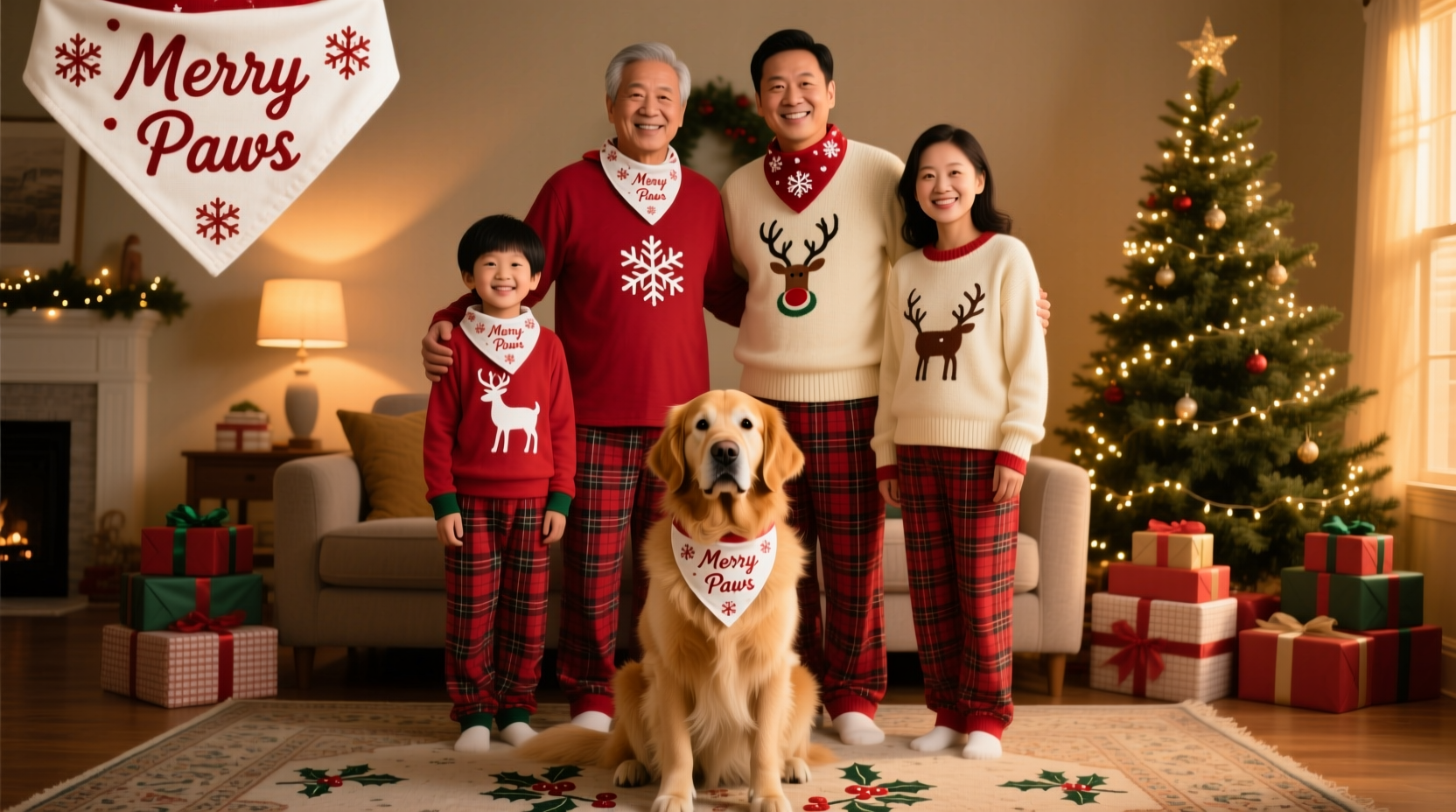
Coordinating family PJs with a pet bandana goes deeper than Instagram appeal. It reinforces belonging—pets are full members of the household, and including them in seasonal rituals strengthens emotional bonds. Research in veterinary behavioral science shows that consistent, low-stress routines (like wearing soft, familiar accessories during calm family activities) can reduce anxiety in pets during unpredictable holiday periods. Moreover, coordinated outfits often prompt gentle interaction: a child adjusting their sibling’s cuff while also checking if the dog’s bandana is snug but not tight, or a parent pausing to admire how the red plaid on Grandma’s flannel echoes the tartan pattern stitched onto the cat’s reversible bandana. These micro-moments build empathy and attentiveness—especially in children learning to read nonverbal cues from animals.
But aesthetics alone aren’t enough. According to Dr. Lena Torres, DVM and clinical behaviorist at the Midwest Animal Wellness Center, “The most successful holiday accessories for pets share three traits: breathability, adjustability, and zero reliance on adhesives or rigid fasteners. Anything that restricts head movement, traps heat, or requires constant readjustment will fail—not because the pet ‘doesn’t like it,’ but because their physiology rejects it.” That means coordination must begin with function, then flow into form.
Step-by-Step: Building Your Coordinated Set (From Concept to Couch)
- Assess Pet Readiness (Day 1–3): Observe your pet’s baseline behavior around fabrics. Does your cat tolerate being wrapped in a light towel? Does your dog stay still for ear cleaning? If not, skip the bandana this year—and opt for a festive collar charm instead. Never force wear.
- Select Human PJs First (Day 4): Choose your family’s PJs based on fabric (cotton or bamboo blends preferred), fit (roomy sleeves/ankles for easy layering), and dominant color(s). Note the primary hue, secondary accent, and any key pattern (e.g., “navy base with white snowflakes and gold thread detail”).
- Measure & Map Fit (Day 5): For dogs: measure neck circumference *loosely* (two fingers should slide comfortably under the tape). For cats: use a soft tape measure behind the ears and under the chin—never around the neck directly. Record measurements in centimeters and inches.
- Source Bandana Fabric & Cut (Day 6–7): Prioritize 100% organic cotton, bamboo jersey, or lightweight linen. Avoid polyester blends, metallic threads, or glued-on appliqués. Cut triangles (for traditional knotting) or rectangles (for loop-through styles) using your pet’s measurement + 2 cm ease.
- Finalize Coordination (Day 8): Match one element—not all. Example: If PJs are candy-cane stripe (red/white), choose a solid red bandana with white stitching. If PJs feature holly leaves, select a bandana with subtle green tonal embroidery—not literal holly prints (which may snag or overstimulate).
Do’s and Don’ts: Safety-First Coordination
| Action | Do | Don’t |
|---|---|---|
| Fabric Choice | Use breathable, natural fibers with OEKO-TEX® Standard 100 certification | Use fleece, sequined fabric, or anything with dangling trims or bells |
| Fit & Fastening | Knot loosely with 2–3 cm of slack; use Velcro-free hook-and-loop for cats | Secure with elastic bands, hair ties, or adhesive strips |
| Pattern Matching | Repeat one motif (e.g., same snowflake shape in different scales) or echo one accent color | Copy complex prints (e.g., reindeer herds, crowded Santa scenes) which create visual noise for pets |
| Wear Time | Limited to 1–2 hours during calm, supervised moments (e.g., cookie decorating, gift wrapping) | Leave on overnight, during walks, or while unsupervised |
| Care & Maintenance | Hand-wash in cold water with fragrance-free detergent; air-dry flat | Machine-wash with fabric softener or tumble-dry |
Real Example: The Anderson Family’s First Coordinated Christmas
The Andersons—a family of four with two children (ages 5 and 8), a 7-year-old beagle named Mabel, and a 3-year-old rescue cat, Juno—wanted matching holiday PJs for their annual Christmas Eve photo. Last year, they’d tried a full set: red velvet PJs for humans, and a miniature red velvet bow-tie bandana for Mabel. Within 20 minutes, Mabel had rubbed it off against the couch leg, and Juno hissed at the sight of it.
This year, they shifted strategy. They chose soft, brushed-cotton PJs in deep forest green with minimalist white pine branch embroidery. Instead of replicating the pine motif, they made Juno a tiny rectangular bandana (measured behind ears/chin) in the same green, edged with white bias binding. For Mabel, they cut a triangle from the same fabric, adding a single embroidered white pine sprig—small enough to avoid snagging, placed high on the bandana where it wouldn’t brush her eyes. Both bandanas were tied with a loose, double-knot and checked every 15 minutes. During the photo session, Mabel sat calmly beside her dad’s knee, tail thumping; Juno, draped across the youngest child’s lap, blinked slowly—her bandana staying perfectly in place. No stress. No removal. Just quiet, shared presence. As mom Sarah later reflected: “It wasn’t about looking identical. It was about feeling like part of the same quiet, warm moment.”
Expert Insight: What Veterinarians and Pet Stylists Actually Recommend
“Matching accessories only work when the pet’s comfort is non-negotiable. I’ve seen too many cases of contact dermatitis from synthetic linings or pressure sores from tight knots. If your pet licks, scratches, or shakes their head repeatedly while wearing a bandana, remove it immediately—and reconsider whether coordination serves them, or just your camera roll.” — Dr. Aris Thorne, DVM, Board-Certified Veterinary Dermatologist and founder of PetTextile Safety Initiative
“The best coordinated sets don’t shout ‘match!’ They whisper continuity. Think tonal harmony—like a navy PJ sleeve and a navy bandana with cream stitching—or rhythmic repetition, like the same scalloped edge on both human cuffs and pet bandana hems. Subtlety builds longevity.” — Maya Chen, textile designer and co-founder of Paw & Thread, a certified humane pet apparel brand
Checklist: Before You Tie the Knot (or Loop the Loop)
- ✅ Confirmed your pet tolerates head/neck handling for ≥60 seconds without lip-licking, yawning, or turning away
- ✅ Measured neck or head circumference with proper ease (not snugness)
- ✅ Chosen 100% natural, undyed or GOTS-certified fabric
- ✅ Selected one visual anchor (color, texture, or simplified motif) to echo—not replicate—the human PJs
- ✅ Prepared a backup plan: festive collar charm, paw-safe glitter spray (non-toxic, water-based), or holiday-themed pet bed blanket
- ✅ Scheduled first wear during low-stimulus time (e.g., morning coffee, not right before guests arrive)
- ✅ Identified clear exit cues: flattened ears, excessive blinking, pawing at the bandana, or hiding
FAQ: Practical Questions Answered
Can I use the same fabric I bought for human PJs to make the bandana?
Yes—if it’s 100% natural fiber, lightweight (under 180 gsm), and free of metallic threads, foil prints, or heavy embroidery. Test a scrap first: rub it gently against your inner wrist for 30 seconds. If it feels scratchy, overheats, or leaves residue, it’s unsuitable for pet skin.
My dog hates anything near his ears. Is there an alternative to a bandana?
Absolutely. Try a festive, wide-band collar overlay: a soft, removable fabric sleeve that slides over an existing breakaway collar. Or attach a single, securely sewn ornament (e.g., a felt snowflake with no stuffing or glue) to the collar’s D-ring using nylon thread. Always ensure zero dangling parts and full collar functionality remains intact.
How do I keep the bandana clean between wears without fading the color?
Spot-clean with a damp cloth and mild castile soap. For full washes, use cold water and a gentle, pH-neutral detergent (like Ecover Zero or Planet Ultra). Soak for no more than 5 minutes, rinse twice, and lay flat on a towel—never wring or twist. Dry away from direct sunlight or heaters. Store folded in a breathable cotton bag, not plastic.
Conclusion: Coordination as Care, Not Costume
Christmas pajama coordination with your pet isn’t about achieving photographic perfection. It’s about honoring the quiet dignity of your animal companion while inviting them—gently, respectfully—into the rhythm of your family’s joy. When you choose breathable fabric over shiny polyester, simplicity over cluttered motifs, and observation over assumption, you’re not just styling a holiday moment—you’re practicing interspecies empathy. You’re teaching children that inclusion means adapting to others’ needs, not demanding conformity. And you’re reinforcing, in tangible, tactile ways, that love isn’t uniform—it’s attuned.
So this season, tie that bandana loosely. Adjust the knot with patience. Watch your pet’s body language like it’s the most important text you’ll read all day. And when the photo is taken—not because everyone looks identical, but because everyone looks peacefully, authentically present—that’s the real match you’ve achieved.
💬 Your turn: Share your own pet-friendly coordination tip—or a story where going simple made all the difference—in the comments below. Let’s build a kinder, quieter, more thoughtful holiday tradition—together.








