For decades, the moment a tree topper is placed has marked the true beginning of the holiday season—not when the first ornament goes up, but when the crown settles into place. Yet many people treat this final, symbolic step as an afterthought: grabbing last year’s slightly bent star from the attic or defaulting to whatever came pre-attached to a $29 artificial tree. That approach risks undermining months of thoughtful decorating. A well-chosen topper doesn’t just sit at the top—it anchors your entire aesthetic, reinforces your story, and invites quiet reflection amid the seasonal bustle. Whether you lean traditional with a porcelain angel, embrace celestial elegance with a hammered brass star, or express irreverent joy with a felt reindeer wearing sunglasses, the right topper harmonizes scale, symbolism, material integrity, and emotional resonance. This isn’t about decoration alone; it’s about intentionality.
Understand What Your Theme Really Requires
“Theme” is often misused as shorthand for color palette—e.g., “all-white tree” or “vintage red and green.” But a meaningful theme operates on three interlocking levels: visual language, narrative tone, and emotional temperature. A minimalist Scandinavian theme isn’t just white, grey, and wood—it conveys calm, restraint, and tactile warmth. A “whimsical woodland” theme implies organic shapes, muted mossy tones, and gentle playfulness—not cartoonish mushrooms or glitter bombs. Your topper must speak the same dialect.
Consider how each classic topper type aligns with broader themes:
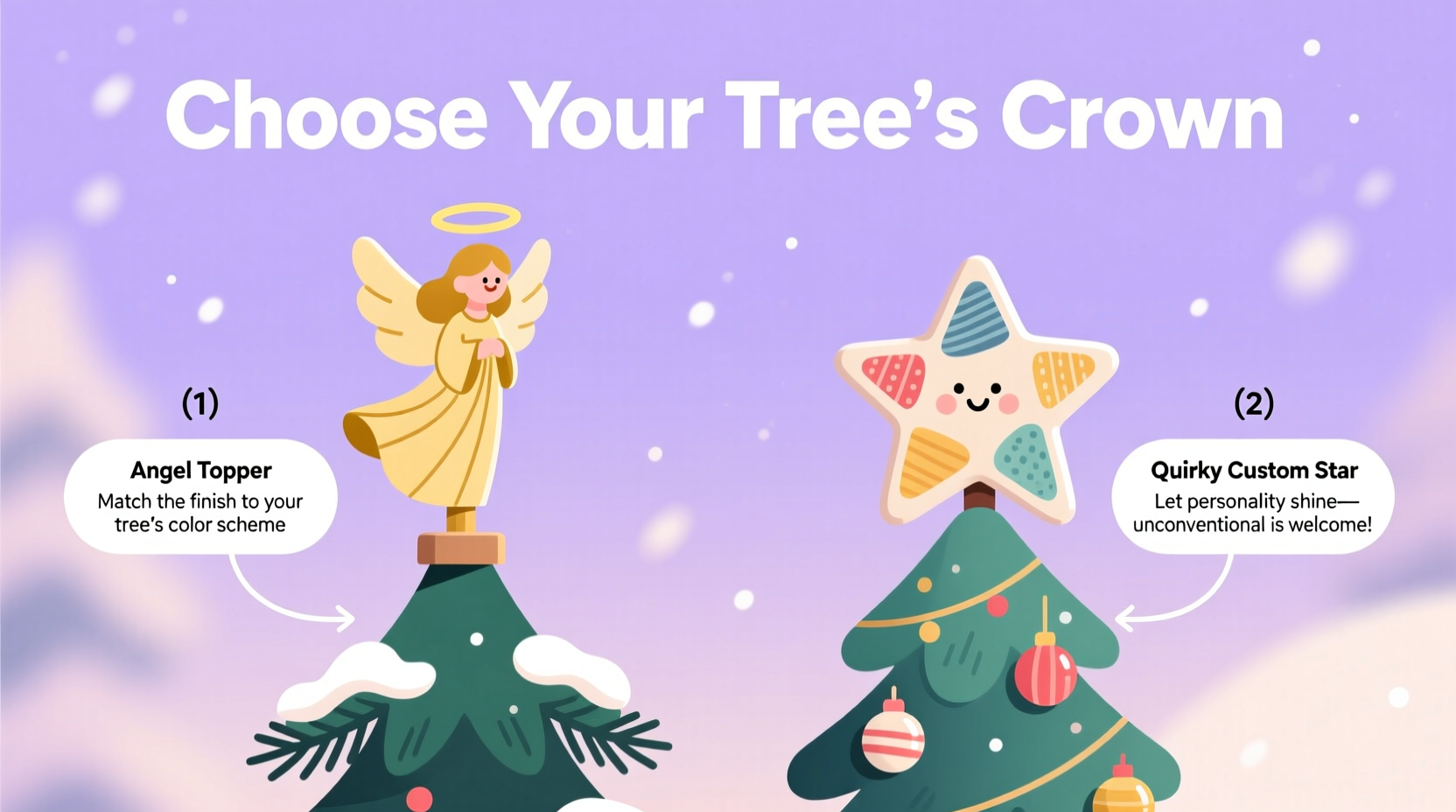
- Angels carry liturgical weight (Annunciation, divine messenger) but also secular softness—ideal for heritage, nostalgic, or spiritual themes. Porcelain, linen-wrapped wire, or hand-painted wood angels suggest reverence; glitter-dusted resin versions lean festive rather than sacred.
- Stars evoke both the Star of Bethlehem and celestial wonder. A five-pointed gold star reads traditional and stately; a geometric, asymmetrical brass star signals modernism; a frosted glass star suggests ethereal delicacy. Stars work across minimal, mid-century, or even industrial themes—if proportion and finish are calibrated.
- Quirky or custom toppers (a ceramic pineapple, a tiny book stack, a miniature hot air balloon) succeed only when they reflect a genuine personal motif—not randomness. They anchor themes like “literary Christmas,” “travel memories,” or “family inside jokes.” Their power lies in specificity, not novelty.
Scale, Proportion, and Structural Reality
A topper isn’t judged in isolation—it exists in dynamic relationship with your tree’s height, branch density, and overall silhouette. An 8-foot Nordmann fir with dense, horizontal boughs can support a 12-inch wide, 18-inch tall topper without visual collapse. A 5-foot pencil tree with sparse, upward-sweeping branches demands something under 6 inches wide and no taller than 10 inches—or it will appear comically top-heavy and risk tipping.
Use this field-tested ratio: topper width should be 1/6 to 1/8 of your tree’s total height. For a 72-inch (6-foot) tree, aim for 9–12 inches wide. Height matters too: vertical clearance between the topmost branch tip and ceiling must accommodate the topper’s full profile—including any loop, hanger, or decorative stem. Measure twice—once with the tree assembled, once with the topper held in place.
Safety is non-negotiable. Avoid toppers with sharp points, loose wire frames, or unstable bases—even if they’re beautiful. Lightweight materials (foam-core paper, thin-gauge brass, felted wool) pose fewer balance risks than heavy ceramic or solid wood. If your tree wobbles or your stand isn’t rated for extra weight at the apex, prioritize stability over statement.
| Tree Height | Max Recommended Topper Width | Ideal Weight Range | Risk Flags |
|---|---|---|---|
| 4–5 ft | 5–7 inches | Under 8 oz | Anything with a deep center-of-gravity drop or protruding arms |
| 6–7 ft | 8–11 inches | 8–16 oz | Top-heavy designs, unbalanced asymmetry, rigid metal stems that don’t flex |
| 8+ ft | 10–14 inches | 12–24 oz | Overly dense ornamentation near the top, flammable materials near lights |
Material Integrity and Long-Term Viability
Your topper will face heat from lights, dust accumulation, compression during storage, and repeated handling. Materials aren’t just about aesthetics—they dictate longevity, safety, and maintenance burden. Here’s what holds up—and what quietly fails:
- Porcelain and bisque ceramics offer heirloom dignity but chip easily. Look for pieces with reinforced necks and thick glaze. Avoid fine antique angels unless displayed behind glass—they’re museum objects, not functional decor.
- Brass, copper, and aluminum develop patina gracefully. Solid brass lasts generations; plated metals wear thin within 3–5 seasons, revealing dull base metal. Hand-forged or hammered finishes hide micro-scratches better than polished surfaces.
- Felt, wool, and high-grade paper (like German scrapbook paper) age beautifully if stored flat, away from light. Avoid craft-store “felt”—it pills and sheds. Seek wool-blend or needle-felted options with tight fiber density.
- Resin and plastic vary wildly. UV-stabilized resin resists yellowing; cheap PVC becomes brittle and discolored after two seasons. Check for a slight flexibility—if it snaps cleanly under gentle pressure, skip it.
“The best toppers aren’t ‘designed’—they’re resolved. Every curve, joint, and finish serves balance, safety, and silence. A star shouldn’t scream; it should gather light and hold space.” — Lena Voss, Studio Artist & Tree Topper Designer for The Christmas Collective since 2008
A Real-World Decision: The Anderson Family’s Shift from Star to Angel
The Andersons had used the same tarnished silver star for 17 years—first on their rental apartment’s 4-foot spruce, later on their suburban 7-foot Fraser fir. It worked. Until it didn’t. When their daughter began asking why “the shiny thing” looked sad and bent, they realized the star’s worn plating and drooping points clashed with their evolving aesthetic: warm-toned wood ornaments, dried citrus slices, and hand-thrown ceramic baubles. They wanted cohesion—not nostalgia-as-default.
They didn’t replace the star with another star. Instead, they visited a local artisan fair and found a linen-wrapped wire angel with hand-stitched wings and a single amber bead for an eye. At 9 inches tall and just 5 ounces, it sat perfectly atop their 6.5-foot Blue Spruce. Its matte texture echoed their wood elements; its quiet presence mirrored their preference for understated meaning over spectacle. Crucially, their daughter named her “Aunt Clara,” linking the topper to their late grandmother—a detail that transformed decoration into legacy. The shift wasn’t about trend; it was about alignment.
Your Actionable Selection Framework
Follow this sequence—not as rigid steps, but as iterative filters—to arrive at a topper that feels inevitable, not incidental:
- Anchor to your core theme: Revisit your three defining adjectives. Does the topper amplify or dilute them?
- Measure your tree’s real-world dimensions: Height, top branch spread, ceiling clearance, and stand stability—not catalog specs.
- Assess material honesty: Does it feel substantial without being brittle? Does its finish suggest durability, not disposability?
- Test visual weight: Hold it at arm’s length against a neutral backdrop. Does it feel balanced? Does your eye rest on it—or slide past?
- Verify emotional resonance: Does it spark recognition (“Yes—that’s us”) more than admiration (“That’s pretty”)? If it doesn’t stir something quiet and personal, set it aside.
FAQ: Practical Questions Answered
Can I mix topper styles—like a vintage angel with a modern star-shaped base?
Yes—but only if the combination serves a deliberate narrative, not visual compromise. A 1920s porcelain angel mounted on a brushed steel star frame works if your theme is “old-world craftsmanship meets contemporary line.” Random layering (e.g., a glitter star glued atop a wooden angel) creates visual noise, not depth. Ask: does this fusion tell a story I care about?
How do I secure a heavy topper safely without damaging the top branch?
Avoid wire wrapped tightly around the trunk—it girdles and kills living tissue. Instead, use a padded, adjustable tree topper clamp (available at specialty holiday shops) or a sturdy, U-shaped metal bracket screwed into a hidden dowel inserted into the trunk’s core. For artificial trees, reinforce the top pole with a ¼-inch threaded rod extending 2 inches above the cap—then screw your topper’s mounting plate directly onto it.
Is a “quirky” topper appropriate for formal or traditional homes?
It depends entirely on execution and context. A hand-blown glass owl perched on a gilded pinecone reads elegant and collected; a plastic flamingo wearing a Santa hat reads ironic and jarring. Quirk succeeds when it’s crafted with the same attention to proportion, material quality, and restraint as a classical angel or star. It’s not about the subject—it’s about the seriousness of the treatment.
Conclusion: Crown Your Intention, Not Just Your Tree
Your Christmas tree topper is the punctuation mark at the end of a carefully composed sentence. It’s where your values, memories, and aesthetic choices converge into a single, silent declaration. Choosing wisely means resisting the pull of trend, discount, or convenience—and honoring the quiet significance of that highest point. Whether you select a centuries-old angel design reinterpreted in sustainable brass, a star forged by a fourth-generation metalworker, or a custom topper shaped by your child’s drawing of “Grandma’s garden,” what matters is fidelity: to your space, your story, and your standards. Don’t rush the crown. Measure, reflect, hold it in your hands, and ask if it feels like home. Then place it—not as the final decoration, but as the first act of meaning.
💬 Your tree tells a story—what does its topper say? Share your most meaningful topper choice (and why it resonates) in the comments. Let’s inspire each other to decorate with intention, not inertia.