Living in a compact urban apartment doesn’t mean giving up on hospitality, craft cocktails, or the quiet ritual of pouring a well-chosen drink after a long day. In fact, thoughtful bar design in tight spaces can elevate daily life more than any oversized setup ever could. The key isn’t square footage—it’s intentionality. A compact bar isn’t a compromise; it’s a curated system where every bottle, tool, and surface earns its place. This guide draws from interior designers specializing in micro-living, professional bartenders who’ve built functional home bars in studio apartments, and real-world case studies across New York, Tokyo, and Berlin. What follows is not theoretical minimalism—it’s field-tested pragmatism.
1. Define Your Bar’s Core Purpose (Before You Buy Anything)
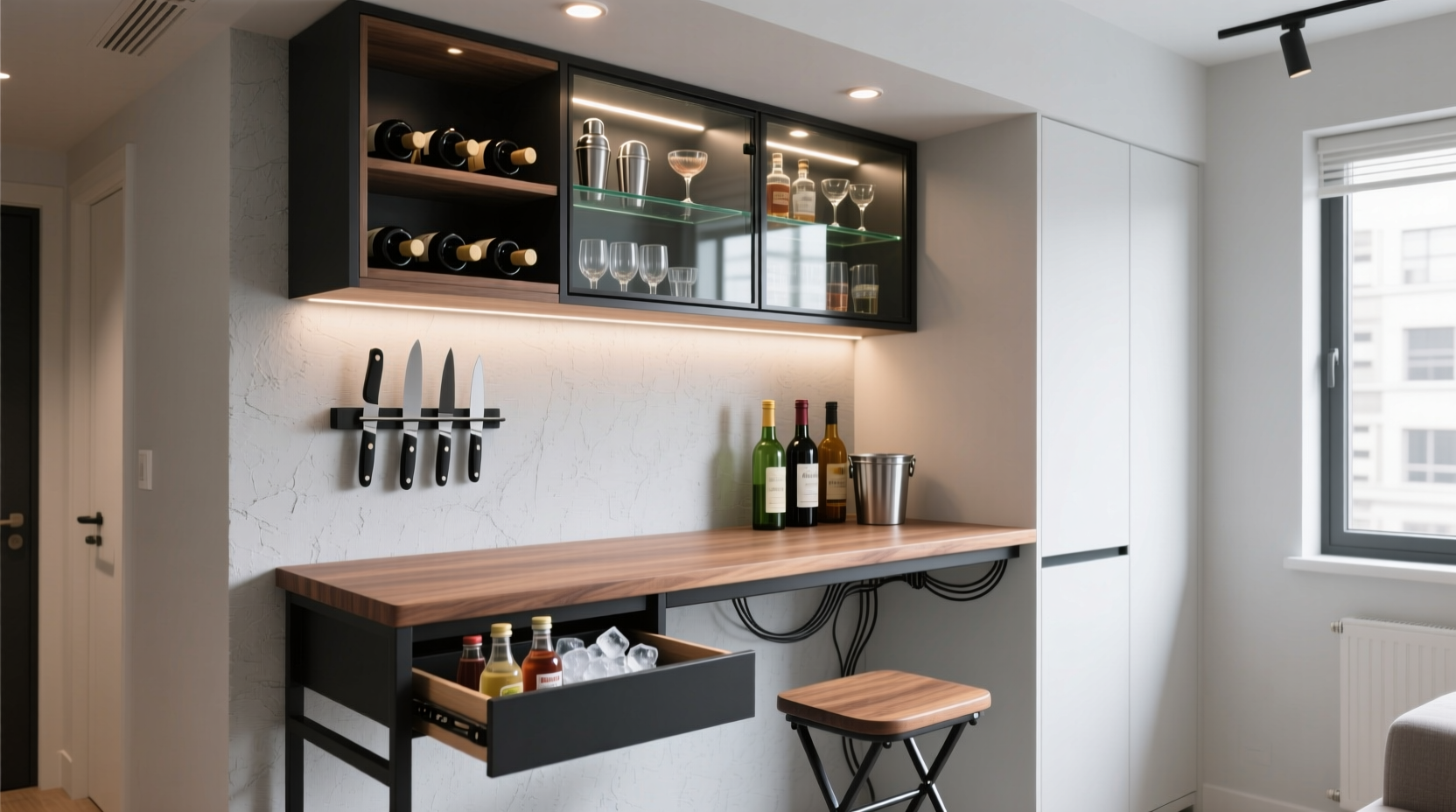
Most compact bar failures begin with misaligned expectations. Ask yourself: Is this bar primarily for solo winding-down? For hosting 2–4 guests regularly? Or for serious cocktail experimentation? Your answer determines everything—from footprint to inventory to hardware. A “solo sipper” needs little more than a 12-inch wall-mounted shelf, a double jigger, and three versatile spirits. A “host-ready hub” requires accessible glass storage, a dedicated mixing zone, and room for garnishes without cluttering countertops. Designers at Small Space Studio (Tokyo) emphasize that purpose-driven curation reduces decision fatigue and prevents impulse purchases that crowd limited surfaces.
Tip: Sketch your ideal 5-minute bar routine—e.g., “Grab glass → measure gin → shake → strain → garnish”—then map each step to physical locations. If any step requires crossing the room or opening a cabinet, revise the layout.2. Space-Smart Layout Strategies for Under 36 Inches
Forget traditional island bars. In apartments under 700 sq ft, verticality and multi-functionality win. Three proven configurations deliver full functionality within narrow footprints:
- The Wall-Mounted Command Center: A 24–30 inch wide wall section fitted with floating shelves (12–16 inches deep), a fold-down bar top (20 inches wide, hinged at the back), and integrated magnetic strips for metal tools. Ideal for studios or studio-lofts with blank walls near seating or kitchen nooks.
- The Convertible Furniture Approach: A narrow console table (18–22 inches deep) with removable trays that house tools and garnishes. When closed, it reads as a hallway accent piece; when opened, it reveals a fully equipped bar station. Works especially well in open-plan layouts where visual clutter must be minimized.
- The Kitchen Nook Integration: Repurpose the 18–24 inch gap beside your refrigerator or under a window ledge. Add a custom-cut butcher block insert (stainless steel or bamboo), recessed bottle storage below, and a pull-out drawer for glassware. This avoids dedicating floor space entirely while keeping everything within arm’s reach during meal prep or casual hosting.
Interior architect Lena Park, who designed over 200 micro-apartment bars in NYC, notes: “The most successful compact bars disappear when not in use—but reappear with zero friction. That means hinges must be silent, shelves must hold weight without sagging, and materials must resist condensation and splashes.” She recommends powder-coated steel brackets, marine-grade plywood for shelves, and matte black stainless steel for all hardware—durable, fingerprint-resistant, and visually receding.
3. The Essential Toolkit: 12 Items That Do the Work of 30
In small spaces, abundance dilutes utility. Prioritize tools that serve multiple functions, require minimal storage depth, and eliminate redundancy. Below is the non-negotiable core—tested across dozens of 300–500 sq ft apartments:
| Item | Why It’s Non-Negotiable | Space-Saving Feature |
|---|---|---|
| Japanese-style jigger (dual-sided, 0.5oz/1oz & 1oz/1.5oz) | Eliminates guesswork and ensures balance in spirit-forward drinks | Fits upright in a 1.5-inch-wide slot; no separate measuring cups needed |
| Yarai-style mixing glass (12 oz, weighted base) | Stable for stirring, doubles as a shaker when paired with a Boston tin | No separate shaker required—reduces bulk by 50% |
| Bar spoon with twisted shaft & flat muddler tip | Muddles herbs, stirs layered drinks, measures small quantities | One tool replaces muddler, spoon, and measuring spoon |
| Compact citrus squeezer (lever-style, stainless) | Fresh juice is non-negotiable for quality; bottled juice degrades flavor and adds clutter | Folds flat; stores vertically in a narrow drawer |
| Collapsible silicone strainer (fine-mesh) | Strains ice chips, pulp, and fine herbs without taking counter space | Flattens to ¼ inch thick; hangs on hook or tucks behind shelf |
| Stackable, low-profile coupe glasses (4.5 oz) | Work for martinis, manhattans, sour variations—and stack neatly | Stack 6 high in under 6 inches of vertical space |
Everything else—garnish tweezers, atomizers, specialized glassware—is optional. Start with this foundation. Add only what solves a repeated problem: e.g., if you make stirred drinks weekly, add a proper bar mat. If you host often, invest in a compact ice bucket that fits under your sink.
4. Smart Storage: Where Every Centimeter Earns Its Keep
Clutter kills compact bars faster than poor layout. Bottles, glassware, and tools must be stored *within* the bar zone—not in distant cabinets. Here’s how professionals maximize density without chaos:
- Bottle Storage: Use wall-mounted, staggered wooden racks angled at 15°—they hold 6–8 bottles in 24 inches of width and allow labels to face forward. Avoid stacked wine racks; they waste depth and hide inventory. Reserve the bottom shelf for frequently used spirits (gin, whiskey, vermouth); store bitters and liqueurs in a shallow drawer with dividers.
- Glassware: Hang stemmed glasses upside-down on slim, brushed-nickel hooks mounted beneath shelves. They dry naturally, avoid dust, and free up shelf space. For tumblers and rocks glasses, use a tiered acrylic stand that fits in a 4-inch-deep drawer—stacks 8 glasses vertically in 8 inches of height.
- Tools & Garnishes: Install a 3-inch-deep magnetic strip above the bar surface. Mount metal tools (jiggers, spoons, strainers) directly on it. Store citrus wedges in a lidded, vented ceramic dish (prevents mold, fits on a 6-inch shelf). Keep herbs like mint or rosemary in small, labeled glass jars with tight lids—refrigerate overnight, but never freeze (it ruptures cell walls).
“People think ‘small space’ means ‘fewer things.’ It actually means ‘fewer *unintentional* things.’ Every item on your bar should either be used weekly—or be beautiful enough to justify its presence when idle.” — Javier Mendez, Co-Founder of Urban Pour Design Lab, Brooklyn
5. Real-World Case Study: Maya’s 420-Sq-Ft Studio in Portland
Maya, a graphic designer and occasional host, moved into a converted 1920s walk-up with 8-foot ceilings and no dining area. Her original “bar” was a folding tray on her sofa—spilling twice a week. With a $320 budget and two weekends, she transformed a 28-inch-wide alcove beside her kitchen into a fully operational bar:
- Week 1: Mounted two 16-inch-deep oak shelves (floating brackets, hidden screws). Added a 22-inch-wide fold-down bamboo bar top with soft-close hinge.
- Storage: Installed a 3-inch magnetic strip, six brass hooks for glasses, and a recessed 12-inch drawer with cork-lined dividers for tools and bitters.
- Inventory: Selected 4 spirits (rye whiskey, London dry gin, blanco tequila, dry vermouth), 3 bitters (orange, aromatic, celery), and 2 liqueurs (Cointreau, Dolin Blanc). All fit on the lower shelf with room to spare.
- Result: She now hosts 4 friends comfortably (seated on floor cushions with low table), preps drinks in under 90 seconds, and cleans the entire bar in 4 minutes. “It doesn’t look like a bar,” she says. “It looks like part of my living room—until I flip down the top.”
6. The Compact Bar Checklist: Build in One Afternoon
Follow this sequence to avoid backtracking or buying duplicates:
- ✅ Measure your chosen wall or furniture zone—width, depth, and height clearance (including door swings)
- ✅ Identify power and water access points—if adding a mini fridge or LED lighting, confirm outlet proximity
- ✅ Choose *one* primary function (solo use / duo hosting / group entertaining) and lock it in
- ✅ Purchase only the 12 essential items listed in Section 3—no substitutions until you’ve used them for 2 weeks
- ✅ Install mounting hardware *before* placing bottles or glasses—test weight capacity with books first
- ✅ Assign one “clutter anchor”: a single lidded bin (e.g., woven seagrass) for napkins, coasters, and stray stirrers—keeps surfaces clear
7. FAQ: Real Questions from Small-Space Bar Builders
Can I store vermouth and wine-based aperitifs in the fridge—and will cold ruin them?
Yes—and you should. Once opened, dry vermouth, Lillet, and Campari oxidize rapidly at room temperature. Refrigeration slows degradation by 70%. Store upright (not on their side) to minimize cork contact, and use within 4–6 weeks. No chilling harm occurs—the slight chill actually improves texture in many aperitif cocktails.
What’s the smallest viable ice solution for apartments without freezer drawers?
A dual-compartment silicone ice tray (like the Tovolo Perfect Cube) makes dense, slow-melting cubes in standard freezers. Fill one compartment with filtered water, freeze, then flip and fill the second—yields 24 cubes per cycle without needing specialty equipment. For urgent needs, keep two trays always freezing and one pre-frozen in a sealed bag in the coldest part of your freezer.
Is it okay to skip a dedicated bar sink?
Absolutely—and recommended. In apartments under 600 sq ft, a bar sink consumes precious plumbing, adds cost, and invites mildew in tight corners. Instead, use your kitchen sink with a dedicated bar rinse basin (a 6-inch stainless bowl) and a microfiber drying towel hung nearby. Rinse glasses immediately after use, dry thoroughly, and return to hooks—eliminates water spots and odor buildup.
Conclusion
A compact bar isn’t about scaling down your standards—it’s about sharpening your focus. It asks you to choose quality over quantity, intention over accumulation, and flow over flash. When every bottle has earned its spot, every tool serves three purposes, and every surface supports movement instead of blocking it, you don’t just save space—you gain calm, confidence, and quiet pride in how thoughtfully your home serves your life. Maya didn’t build a bar to impress guests. She built one to honor her own rhythm—to pause, create, and connect, even in 420 square feet. Your version won’t look identical, but it can feel just as right.
💬 Your turn: Share your compact bar breakthrough—a clever hack, an unexpected space you repurposed, or the one tool that changed everything. Comment below and help fellow small-space makers raise a glass—to smarter living.








