Warm ambient lighting—soft, golden, low-contrast illumination from vintage-style Edison bulbs, candle-simulating LEDs, or dimmed incandescent fixtures—transforms how we perceive a Christmas tree. It doesn’t just illuminate; it reveals texture, depth, temperature, and presence. In that glow, the question isn’t merely “Which looks better?” but “Which *feels* more like memory made tangible? Which breathes with the quiet weight of tradition, not just the precision of engineering?” This distinction matters deeply—not for decorators chasing novelty, but for those who seek emotional resonance in their seasonal rituals. Authenticity under warm light is less about botanical accuracy and more about multisensory coherence: how scent, tactility, light interaction, and subtle imperfection converge to evoke the embodied experience of December.
The Physics of Warm Light and Tree Surfaces
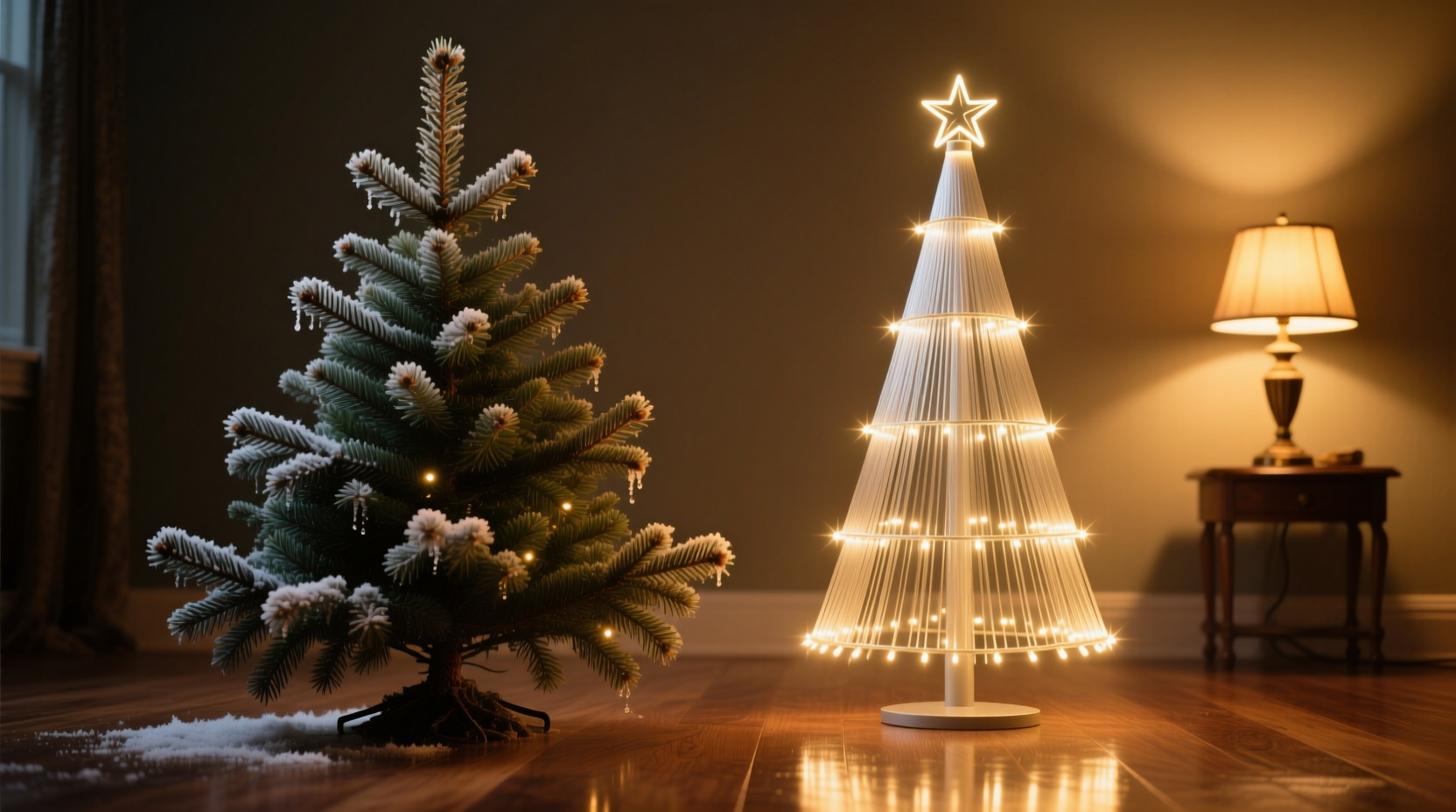
Warm ambient lighting (typically 1800K–2700K color temperature) emits longer-wavelength photons that interact differently with organic and synthetic materials. Real fir needles—especially balsam, Fraser, or noble fir—contain volatile terpenes like α-pinene and limonene. When warmed slightly by nearby lights (even low-heat LEDs), these compounds volatilize, releasing a faint, resinous aroma that registers subconsciously before cognition catches up. That scent primes the brain for “realness.” Simultaneously, the matte, micro-textured surface of fir needles scatters warm light diffusely. Light doesn’t bounce cleanly—it sinks into the needle’s waxy cuticle and cellular structure, creating soft halos around branch tips and gentle shadow gradations along the trunk. There are no hotspots, no glare, only layered luminosity.
In contrast, fiber optic trees use bundles of acrylic or glass filaments that transmit light from a central illuminator. Under warm-toned LEDs, the light travels internally with minimal scattering. The result is pinpoint brightness: each fiber tip glows with uniform intensity, like tiny stars suspended in darkness. While visually striking, this emission lacks the optical complexity of organic reflection. There’s no diffusion, no variation in luminance across adjacent branches, no interplay between light and moisture or dust settling naturally on surfaces. The light feels *projected*, not *emanated*.
Tip: For maximum warmth authenticity, pair real firs with 2200K–2400K filament-style LEDs on dimmers—and avoid cool-white accent lighting anywhere in the room. Consistency in color temperature preserves perceptual continuity.Tactile Memory and Thermal Presence
Authenticity isn’t visual alone. It’s tactile memory encoded over decades: the slight resistance of a fir branch bending under ornament weight, the crisp snap of a dry needle detaching, the cool-damp weight of bundled boughs carried indoors. Under warm ambient light, these qualities become perceptible through contrast. A real fir retains ambient humidity longer than heated indoor air; its branches hold subtle thermal inertia. When you reach toward a lit branch, your hand senses the micro-coolness radiating from dense foliage—even as light warms the room. That thermal duality—warm light, cool surface—is biologically familiar. It mirrors winter itself: sunlit snow that still chills the air.
Fiber optic trees, by design, are thermally inert. Their plastic trunks and PVC branches conduct heat minimally and uniformly. They feel neither cool nor warm to the touch—just neutral, stable, and smooth. There’s no give in the branches, no natural flex. Ornaments hang on rigid hooks or molded sockets, eliminating the slight tension and organic placement variability of real boughs. Over time, users report a subtle psychological dissonance: the eyes see festive light, but the hands register absence—the missing friction of pine resin, the whisper of static from dry needles brushing skin, the faint stickiness of sap near cut ends.
Aroma, Decay, and the Honesty of Impermanence
Real firs release scent most robustly in the first 3–5 days after cutting—peaking when ambient temperatures hover near 18–20°C and relative humidity stays above 40%. Under warm ambient lighting, that scent profile deepens: the sharp top notes of limonene soften, revealing earthier, balsamic undertones from abietic acid oxidation. This evolution isn’t flaw—it’s fidelity. It mirrors human memory, where recollections gain warmth and nuance over time, never staying frozen in perfect clarity.
Fiber optic trees offer none of this olfactory narrative. Some models include optional scent diffusers, but these deliver isolated, linear fragrance—often generic “pine” oil lacking the complex terpene matrix of live conifers. Worse, they decouple scent from source: the aroma floats detached from branch or trunk, breaking the sensory link that makes memory cohesive. As horticulturist Dr. Lena Torres observes, “The scent of a real fir isn’t just chemical—it’s temporal. Its rise, plateau, and gentle fade map onto our lived experience of the season. Artificial fragrance has no arc. It’s either on or off.”
“The most authentic trees don’t look perfect under warm light—they look *lived-in*. A few dropped needles near the stand, a branch slightly lower on one side, the faintest ambering at needle tips by week two. That’s not decay. It’s testimony.” — Dr. Lena Torres, Senior Arborist, North American Conifer Institute
Light Interaction: Reflection, Refraction, and Human Perception
Under warm ambient lighting, real firs demonstrate three distinct optical behaviors simultaneously:
- Diffuse reflection off waxy epidermal layers creates soft, directional highlights;
- Subsurface scattering within translucent needle tissue produces gentle internal glow, especially visible at branch peripheries;
- Micro-refraction across dew-like resin droplets or ambient humidity condensation adds fleeting, localized sparkle—unpredictable and unrepeatable.
Fiber optic trees operate on a single principle: total internal reflection. Light enters the fiber core, bounces repeatedly off the cladding interface, and exits only at the tip. The result is high-efficiency transmission—but zero optical complexity. Every illuminated tip emits identical intensity and chromaticity. No variation occurs from branch to branch, day to day, or even hour to hour. Human vision, evolved to detect subtle biological variation, registers this uniformity as artificial—even if unconsciously. Studies in perceptual psychology show viewers consistently rate uniformly lit synthetic objects as “less trustworthy” under low-contrast, warm lighting conditions, precisely because biological systems rarely emit light with such statistical perfection.
| Characteristic | Real Fir Under Warm Ambient Light | Fiber Optic Tree Under Warm Ambient Light |
|---|---|---|
| Light Emission | Diffuse, scattered, variable intensity | Point-source, uniform, high-intensity tips |
| Scent Profile | Dynamic: peaks then evolves; resinous, woody, slightly sweet | Static (if present): singular, synthetic, non-evolving |
| Tactile Feedback | Crisp, slightly resistant, cool-damp surface; natural flex | Smooth, rigid, thermally neutral; fixed geometry |
| Temporal Behavior | Changes daily: scent fades, needles dry, color deepens | Unchanging for years: no aging, no variation |
| Imperfection Integration | Dropped needles, asymmetrical growth, minor browning enhance realism | Flawlessness reads as manufactured; deviations feel like defects |
Mini Case Study: The Anderson Family’s 12-Year Comparison
Since 2012, the Andersons of Portland, Oregon, have alternated annually between a sustainably harvested noble fir and a premium fiber optic tree (1.8m, 700-filament, warm-white LED base). Each December, they use identical lighting: 24 vintage-style 2200K LED bulbs strung in concentric rings, dimmed to 65% output, supplemented by three beeswax taper candles on the mantel. They document sensory impressions nightly in a shared journal.
In years with the real fir, entries consistently reference “the way light pools in the hollows where branches cross,” “how the scent shifts after the third evening—less sharp, more like old books and cedar chests,” and “reaching up to adjust an ornament and feeling the slight give, then the tiny prickle of a dry needle.” In fiber optic years, notes read: “stunning first night—like a constellation,” “by night four, it feels… quieter. Less there,” and “I keep expecting to smell something, but the air stays clean and empty.”
Their conclusion, written in 2023: “The fiber optic tree wins on convenience and longevity. But authenticity? That belongs to the fir—not because it’s ‘natural,’ but because it *participates* in the season. It changes with us. It breathes the same air. Under warm light, it doesn’t just occupy space. It holds memory.”
Practical Decision Framework: Choosing Based on Your Values
Authenticity isn’t universal—it’s personal. Use this step-by-step guide to align your choice with your deepest seasonal priorities:
- Identify your primary sensory anchor: Is it scent (choose real fir), visual spectacle (fiber optic excels), tactile engagement (fir), or long-term practicality (fiber optic)?
- Assess your lighting environment: Do you use exclusively warm-toned, dimmable sources? If cool-white task lighting dominates your living space, neither tree achieves full authenticity—address lighting first.
- Evaluate maintenance tolerance: Real firs require daily water checks, floor protection, and post-season cleanup. Fiber optics need dusting and storage—but no hydration anxiety.
- Consider temporal intention: Do you want the tree to mark time (fir’s gradual transformation) or remain a stable focal point (fiber optic’s consistency)?
- Test the “hand test”: Before purchasing, hold a real fir branch and a fiber optic branch under your actual room lighting at night. Note which feels more resonant—not prettier, but *more like home*.
FAQ
Can I make a fiber optic tree feel more authentic with accessories?
Yes—but selectively. Add real pinecones, dried orange slices, or cinnamon sticks to the base (not on branches, where heat buildup could warp materials). Use fabric ribbons instead of plastic bows. Avoid artificial pine-scented sprays; they clash with warm light’s subtlety. Most effective: place a small dish of real fir clippings (refresh weekly) on a nearby shelf—the scent will diffuse naturally without competing with the tree’s visual role.
Does needle drop ruin the authentic feel of a real fir?
Not if managed intentionally. A few needles near the stand mimic natural forest floors. Place a woven jute mat beneath the tree—it absorbs drops while adding organic texture. Vacuum fallen needles daily with a soft brush attachment; don’t let them accumulate into a slippery layer. The ritual of tending drop reinforces presence far more than preventing it ever could.
Are there hybrid options that balance both worlds?
Limited, but promising. Some specialty growers now offer “cut-and-come-again” potted firs—live trees you bring indoors for 10–12 days, then return to nursery care for regrowth. Paired with warm ambient lighting, they deliver full sensory authenticity with near-zero waste. Alternatively, high-end fiber optic models with integrated, slow-release essential oil capsules (using real fir distillate, not synthetics) offer a compromise—though scent remains disembodied from the light source.
Conclusion
Under warm ambient lighting, authenticity isn’t bestowed by marketing claims or technical specifications. It emerges from the quiet conversation between light and life: the way warmth coaxes scent from dormant resin, how shadow deepens in the crook of a living branch, the faint thermal signature of photosynthetic tissue holding memory of forest air. A fiber optic tree dazzles. A real fir *inhabits*. One satisfies the eye; the other engages the nervous system, the limbic system, the part of us that remembers childhood kitchens smelling of sugar and sap, of parents’ hands brushing pine needles from sweaters, of light catching the dust motes dancing above a tree that felt, unmistakably, like a guest in the room—not an object in it.
If you choose a real fir this year, treat it not as decoration but as a temporary companion: water it faithfully, speak to it occasionally (yes, really—sound vibrations stimulate stomatal response), and let its gradual quieting be part of your season’s rhythm. If you choose fiber optic, honor its strengths—its reliability, its artistry—and enhance it with genuine organic accents that ground its light in the physical world. Either way, the warmth you create isn’t just in the bulbs. It’s in the intention behind the choice.
💬 Your turn: Did a particular sensory detail—scent, sound, texture—tip your decision this year? Share your authentic moment in the comments. Let’s build a living archive of what “real” means, one warm-lit memory at a time.