Dry vermouth is a cornerstone of classic cocktails—think Martinis, Manhattans, and Negronis—but it’s also one of the most commonly mismanaged ingredients behind the bar. Unlike spirits such as gin or whiskey, vermouth is a fortified wine: it begins as white wine, is infused with botanicals, then strengthened with neutral grape spirit (typically 16–22% ABV). That wine base is the critical vulnerability. Once opened, exposure to oxygen, light, and heat triggers rapid chemical degradation—flavor flattens, aromas dull, and bitterness intensifies. Many home mixologists pour from bottles they’ve had for months—or even years—unaware that their “dry” vermouth has quietly turned into something closer to stale herbal tea. The truth? An unrefrigerated, opened bottle of dry vermouth loses meaningful quality in under two weeks. Even refrigerated, it rarely remains optimal beyond four to six weeks. This isn’t speculation—it’s chemistry, confirmed by winemakers, sommeliers, and cocktail historians alike.
Why Dry Vermouth Spoils Faster Than You Expect
The misconception that “it’s fortified, so it lasts” overlooks a fundamental distinction: fortification preserves *unopened* vermouth for years, but once the seal breaks, oxidation becomes the dominant force. Dry vermouth contains minimal residual sugar (typically under 4 g/L), offering little microbial resistance compared to sweet vermouth. Its delicate floral, citrus, and chamomile notes are highly volatile—easily muted by ambient warmth or airborne contaminants. A 2022 stability study published in the Journal of the American Society of Enology and Viticulture tracked 12 commercial dry vermouths over eight weeks post-opening. Results showed measurable declines in ester concentration (key to citrus and floral aroma) within 72 hours at room temperature—and a 40% average loss of volatile aromatic compounds by Day 14. Refrigeration slowed the decline by roughly 65%, but did not halt it. Crucially, sensory panels consistently identified “sherry-like nuttiness,” “wet cardboard,” and “damp hay” as early off-note markers—not sourness or mold, but subtle, insidious shifts in character.
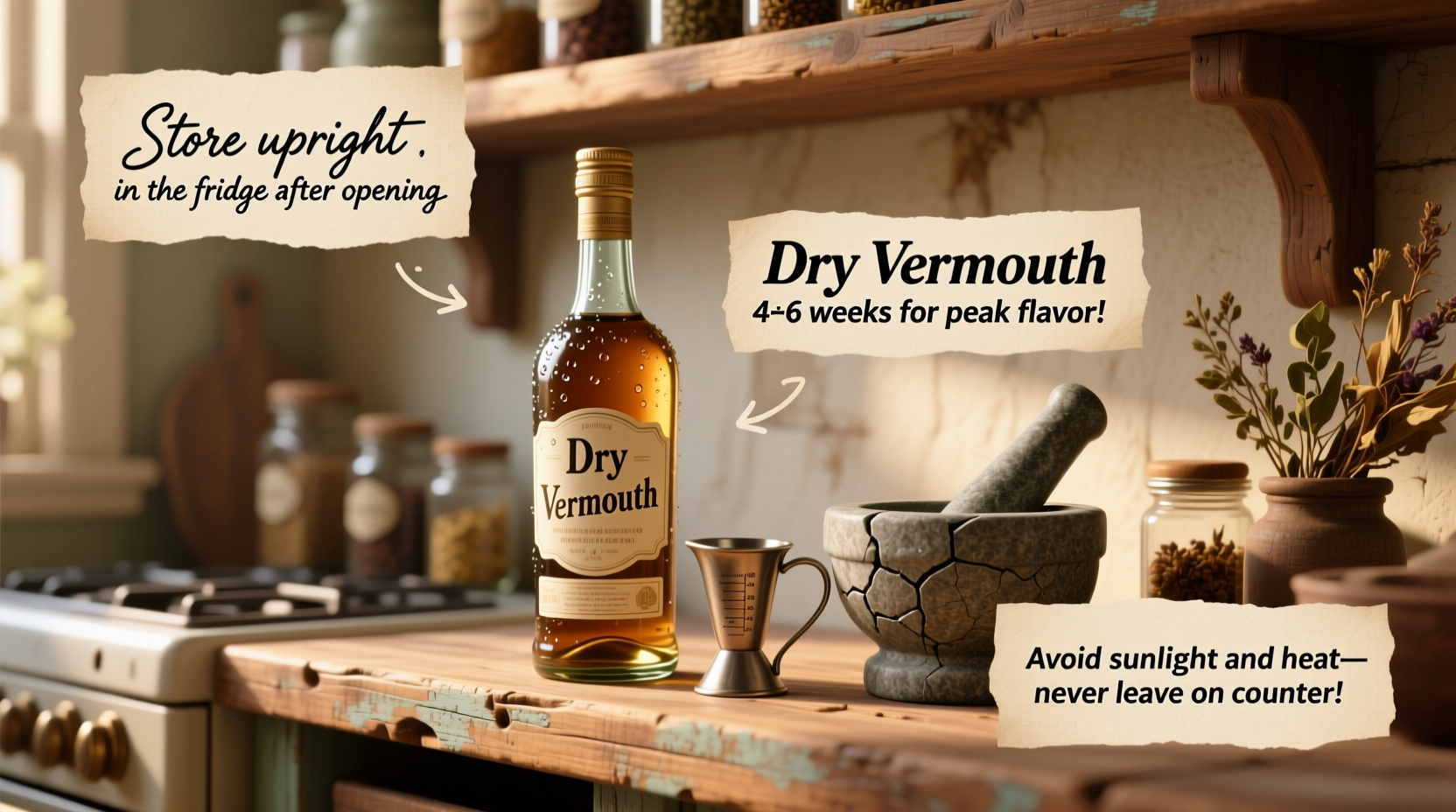
Tip: Treat dry vermouth like fresh juice—not like whiskey. Refrigerate immediately after opening, and never leave it on the counter overnight.Optimal Storage: Temperature, Light, and Air Are Non-Negotiable
Three environmental factors govern vermouth longevity: temperature, light exposure, and oxygen contact. Each must be controlled simultaneously.
Temperature is the most impactful lever. Chemical reactions double in speed with every 10°C (18°F) increase. Storing vermouth at 22°C (room temperature) accelerates oxidation nearly 4× faster than at 4°C (refrigerator temperature). Freezing is unnecessary—and potentially harmful—due to expansion risks and potential precipitation of tartrates, which can cloud the liquid without affecting safety.
Light, especially UV wavelengths, degrades phenolic compounds and promotes free radical formation. Clear or green glass bottles offer almost no protection; amber glass provides moderate shielding, but only if stored in darkness. Never keep vermouth on a windowsill, open shelf near a window, or under LED bar lighting.
Air exposure is the silent killer. Every time you pour, oxygen enters the headspace. Headspace volume matters: a half-full 750 mL bottle has twice the air-to-liquid ratio of a three-quarter-full one. That’s why smaller-format bottles (375 mL) are objectively superior for home use—they reduce unused volume and minimize repeated oxygen ingress.
Step-by-Step: How to Maximize Shelf Life From First Pour
- Choose wisely at purchase: Check the bottling date (not just the best-by date—if visible on the neck or back label). Opt for brands that print batch codes traceable to production month. Avoid dusty, warm-shelved bottles at corner stores; seek refrigerated sections in specialty wine shops.
- Open cleanly: Use a clean, non-corrosive pour spout (stainless steel or food-grade silicone). Avoid rubber or plastic spouts that may leach odors or degrade.
- Refrigerate immediately: Place the bottle upright—never on its side—in the coldest part of your fridge (typically the back, bottom shelf), away from the door’s temperature fluctuations.
- Minimize headspace: If the bottle falls below one-third full, decant the remainder into a smaller, clean, airtight container (e.g., a 125 mL amber glass Boston round with a tight-sealing cap).
- Label and track: Write the opening date on the bottle with a fine-tip oil-based marker. Set a calendar reminder for Day 21—and taste-test then.
Dry Vermouth Storage Do’s and Don’ts
| Action | Do | Don’t |
|---|---|---|
| Refrigeration | Store upright at ≤4°C (39°F) immediately after opening | Leave unrefrigerated—even for “just one night” |
| Bottle Type | Use amber glass; transfer to smaller airtight containers when volume drops | Store in clear glass or plastic; reuse old olive oil bottles |
| Handling | Wipe the lip clean before recapping; use stainless pour spouts | Touch the cork or cap interior with fingers; use wooden stoppers |
| Environment | Keep in total darkness; avoid proximity to strong-smelling foods (onions, fish) | Store near stove, dishwasher, or under fluorescent lighting |
| Long-Term Planning | Buy 375 mL bottles if using less than 2 oz/week; rotate stock | Purchase 1L+ bottles unless hosting weekly cocktail parties |
Real-World Example: The Home Bartender’s Slow Decline
Maya, a graphic designer and avid home mixer in Portland, kept the same bottle of Noilly Prat Dry for five months. She’d bought it during a holiday sale, stored it in her pantry “because it’s alcohol,” and used it intermittently for Martinis. By Week 6, she noticed her Martinis tasted “flatter”—less crisp, more vegetal. By Month 3, guests commented the drink was “bitter in a weird way.” At Month 5, she finally compared it side-by-side with a newly opened bottle: the older version lacked the signature lemon-zest lift and revealed a pronounced oxidized almond note. She poured both into separate glasses, covered them, and let them sit at room temperature for 24 hours. The new bottle retained brightness; the old one developed a faint, acrid tang—proof of advanced aldehyde formation. Maya switched to 375 mL bottles and began labeling openings. Within two months, her Martinis regained their precise, bracing clarity. Her takeaway: “I thought I was being frugal. I was actually compromising every drink.”
Expert Insight: What Winemakers and Master Distillers Say
“Vermouth is wine first, botanical infusion second. Its fragility isn’t a flaw—it’s a feature of authenticity. Any producer who tells you their dry vermouth stays perfect for six months post-opening either isn’t tasting it critically or is using stabilizers uncommon in traditional production.”
— Dr. Elena Rossi, Oenologist & Vermouth Consultant, Piemonte, Italy
“In our lab, we measure vermouth stability by tracking ethyl acetate and acetaldehyde levels. Once acetaldehyde exceeds 120 mg/L, tasters reliably detect ‘sherry fatigue’—a hollow, bruised-apple character. That threshold is typically reached in 18–22 days at 20°C, but stretches to 35–42 days at 4°C. There is no magic preservative—only physics and diligence.”
— Dr. Kenji Tanaka, Director of Beverage Science, House Spirits Co.
How to Tell If Your Dry Vermouth Has Gone Bad (Beyond the Date)
Expiry dates on vermouth are marketing tools—not reliability indicators. Trust your senses instead. Here’s what to assess:
- Aroma: Fresh dry vermouth smells bright—citrus peel, dried chamomile, faint anise, and crisp white wine. Off-notes include wet cardboard, bruised apple, stale nuts, or vinegar-like sharpness (not clean acidity, but harsh, solvent-like pungency).
- Taste: It should be dry, saline, and subtly bitter—not aggressively sour or flatly sweet. Bitterness should be herbal and clean (like gentian root), not metallic or medicinal. A “dull” or “muddy” mid-palate signals advanced oxidation.
- Appearance: Slight golden hue deepening over weeks is normal. Cloudiness, sediment (beyond fine botanical particles), or a film on the surface indicates microbial instability—discard immediately.
- Mouthfeel: Should be light-bodied and refreshing. Stickiness, oiliness, or excessive astringency suggests breakdown of tartaric acid and polysaccharides.
FAQ: Your Top Dry Vermouth Storage Questions Answered
Can I freeze dry vermouth to make it last longer?
No. Freezing causes water crystallization that disrupts colloidal stability, leading to permanent haze and texture changes. While not unsafe, frozen-and-thawed vermouth loses aromatic precision and mouthfeel integrity. Refrigeration is the only proven method for preserving quality.
Does vacuum sealing (e.g., with a Wine Saver pump) help?
Marginally—and only if combined with refrigeration. Vacuum pumps remove ~30–40% of headspace oxygen; inert gas (argon) dispensers are far more effective (~95% displacement). But even argon won’t compensate for poor temperature control. Prioritize cold + dark + minimal headspace over gadgets.
What if I only use vermouth once a month—should I buy single-serve portions?
Yes—especially if you value authenticity. Several producers (Cocchi, Carpano, Dolin) now offer 100 mL and 200 mL formats. These cost 20–35% more per mL but eliminate waste and guarantee peak freshness. For low-frequency users, this is the most economical choice long-term.
Conclusion: Respect the Wine, Elevate the Cocktail
Dry vermouth isn’t a shelf-stable mixer—it’s a living, breathing expression of terroir, botany, and craftsmanship. Treating it with the same care you’d give a bottle of Sauvignon Blanc isn’t pretentious; it’s necessary. When you refrigerate promptly, minimize air exposure, and taste critically every few weeks, you’re not just preserving liquid—you’re honoring the labor of vineyard workers, distillers, and master blenders. That extra 15 seconds spent capping tightly and returning the bottle to the chill of the fridge pays dividends in every Martini’s clarity, every Gibson’s balance, every spritz’s vibrant lift. Don’t wait for your next cocktail party to upgrade your vermouth habits. Open a fresh 375 mL bottle tonight. Taste it neat, chilled, in a small glass. Notice the lemon rind, the fennel seed, the clean mineral snap. Then commit to storing the rest like the precious, perishable ingredient it is. Your drinks—and your guests—will thank you.
💬 Have a vermouth storage hack that works for you? Share your real-world tip in the comments—we’ll feature the most practical ones in our next update.








