
As the holiday season approaches, many homeowners face the same annual dilemma: how to decorate their homes with festive lights without spending days on ladders, untangling cords, or risking electrical hazards. In recent years, projector Christmas lights have emerged as a modern alternative to traditional string lights. Marketed as a faster, easier solution, they promise dazzling displays with minimal effort. But do they actually save time? And are the trade-offs worth it? This in-depth comparison examines the real-world performance of both options, weighing setup speed, visual impact, cost, durability, and long-term convenience.
How Projector Lights Work vs. Traditional String Lights
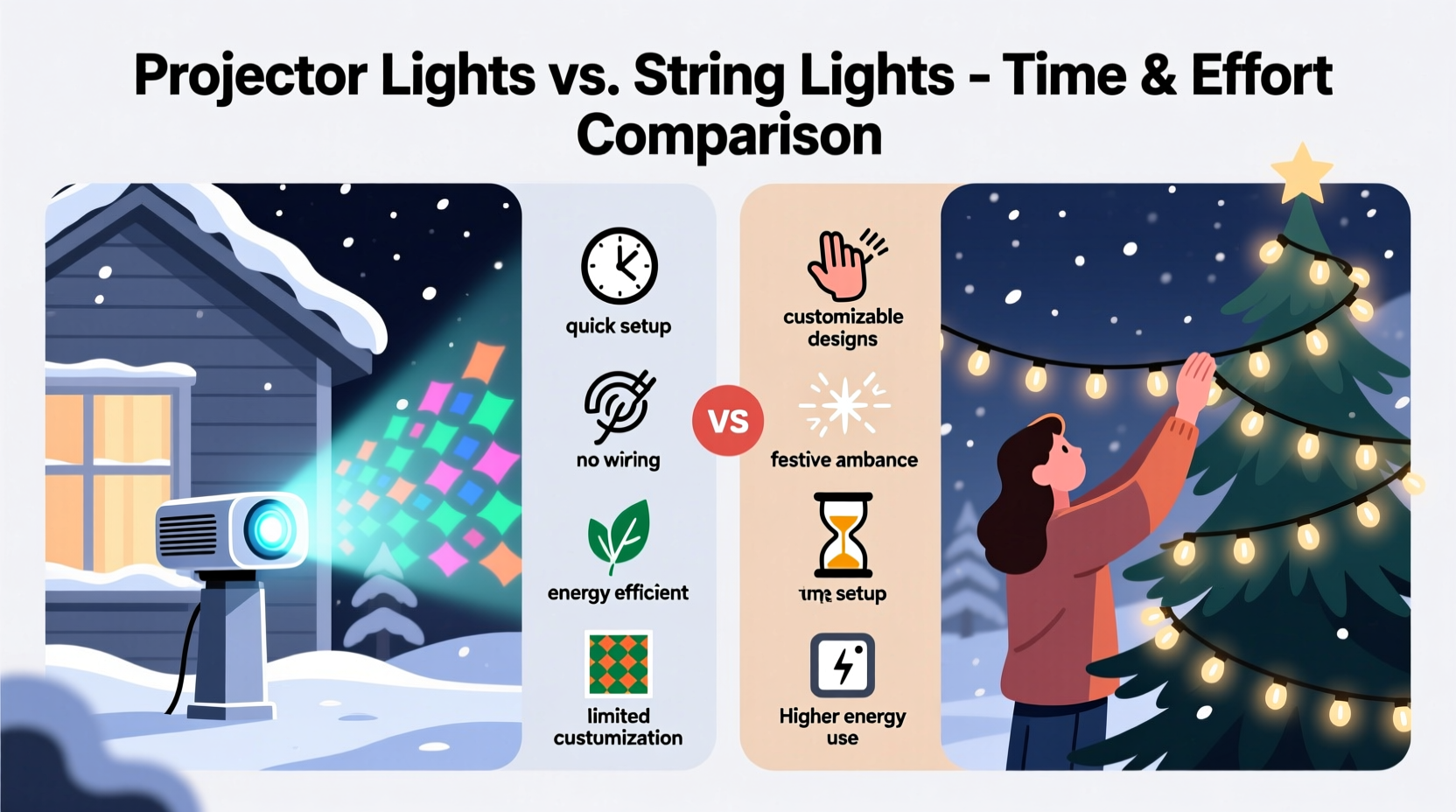
Projector Christmas lights use high-lumen LED projectors that cast patterns of light—typically resembling strings of bulbs, snowflakes, or stars—onto walls, fences, or driveways. These units plug into standard outlets and can cover large areas (up to 300 square feet per projector) from a single placement point. Most models include rotating lenses and multiple pattern settings, allowing users to switch themes without repositioning hardware.
In contrast, traditional string lights consist of connected LED or incandescent bulbs spaced at regular intervals along a wire. Installation requires draping, stapling, or clipping each strand along rooflines, trees, windows, and gutters. While more labor-intensive, this method offers precise control over lighting placement and density.
The fundamental difference lies in coverage philosophy: projectors rely on optical illusion and ambient projection, while string lights provide physical illumination at specific points. This distinction shapes every aspect of their performance—from realism to weather resistance.
Tip: For maximum projector effectiveness, aim at flat, light-colored surfaces. Dark or textured walls absorb or distort the image, reducing visibility.Time Comparison: Setup, Takedown, and Storage
Time savings are the primary selling point of projector lights. To evaluate this claim realistically, consider the full lifecycle of holiday lighting: installation, adjustment, daily operation, takedown, and storage.
Setup Time
A typical homeowner with a two-story house might spend 4–8 hours installing traditional lights, depending on home size and experience. Tasks include measuring strands, securing clips, testing connections, and ensuring even spacing. In contrast, setting up a projector takes under 15 minutes: place the unit on a stable surface, aim it, plug it in, and adjust focus. Some advanced models offer remote controls and app-based alignment, further streamlining the process.
Takedown and Storage
After the holidays, dismantling string lights can take nearly as long as setup. Untangling hundreds of feet of wire, removing clips, and properly coiling strands is tedious. Poor storage leads to next-year frustrations when lights fail to work. Projectors, being single-unit devices, unplug and stow in one container. No tangling, no missing bulbs, no damaged clips.
Maintenance During Display Period
Traditional lights require ongoing attention. Bulbs burn out, connections loosen during storms, and wind may shift strands. Spot-fixing issues often means another ladder trip. Projectors, once aligned, typically run uninterrupted unless obstructed. However, if the lens gets dirty or the unit shifts, the entire pattern degrades—requiring recalibration.
“From a time-efficiency standpoint, projectors win hands-down for average homeowners who value convenience over customization.” — Mark Reynolds, Holiday Lighting Consultant, BrightPath Designs
Pros and Cons Breakdown
To make an informed decision, it’s essential to compare both methods across key categories. The table below summarizes critical factors:
| Factor | Projector Lights | Traditional String Lights |
|---|---|---|
| Setup Time | 5–15 minutes | 3–8+ hours |
| Coverage Area | Up to 300 sq ft per unit | Limited by cord length and layout |
| Visual Realism | Moderate – appears flat, lacks depth | High – three-dimensional sparkle |
| Weather Resistance | Good (if rated for outdoors) | Varies – some LEDs withstand snow |
| Customization | Low – fixed patterns only | High – shape, color, sequence control |
| Longevity | 3–5 years (lens/clouding issues) | 5–10+ years with care |
| Cost (Initial) | $30–$80 per projector | $50–$200+ for full home |
While projectors clearly win on setup speed and simplicity, they fall short in aesthetic authenticity and adaptability. Homeowners seeking a magical, immersive glow will likely prefer the sparkle and depth of real lights. Those prioritizing speed, safety, and repeatability may find projectors ideal.
Real-World Example: The Thompson Family’s Holiday Experiment
The Thompsons, a family of four in suburban Ohio, decided to test both methods in 2023. Their colonial-style home has extensive rooflines, two tall pines, and a front porch requiring about 600 feet of lighting for full coverage.
In previous years, Mr. Thompson spent two full weekends installing lights, often working after work in cold weather. Concerned about falling (he’d slipped once before), he researched alternatives and purchased two multi-pattern projectors for $65 total.
On a Saturday morning, he set up the projectors—one aimed at the front wall, the other at the driveway. Total time: 12 minutes. The house was instantly illuminated with a “string-of-lights” pattern and flickering effect. Neighbors noticed immediately, though some commented it looked “like a movie effect” rather than real bulbs.
During a heavy snowstorm, the projector on the driveway became partially buried, distorting the image. He had to shovel around it to restore clarity. Meanwhile, his neighbor—who used traditional lights—had one strand fail due to moisture ingress but replaced it quickly.
By January 2nd, takedown took under five minutes. The projectors were wiped down and stored in a drawer. No tangled wires, no broken bulbs. The Thompsons concluded that while the look wasn’t quite as rich, the time saved and reduced physical strain made the switch worthwhile.
Step-by-Step Guide: Choosing the Right Option for Your Needs
Deciding between projector and string lights shouldn’t be based on marketing claims alone. Follow this practical timeline to determine the best fit:
- Assess Your Home’s Layout (10 min)
Walk around your property. Identify flat surfaces suitable for projection (walls, garage doors). Note areas where depth matters (trees, railings). - Determine Desired Aesthetic (5 min)
Ask: Do you want a soft ambient glow or a bright, twinkling display? Projectors suit subtle effects; strings excel at vibrancy. - Estimate Current Setup Time (Review Past Experience)
If last year took 6+ hours, consider time-saving alternatives. - Check Safety Factors (Ladder Use, Wiring Paths)
Older adults or those with mobility issues benefit significantly from ground-level projector setups. - Budget for Initial and Ongoing Costs
Compare projector price vs. cost of new string sets. Factor in potential replacements over 5 years. - Test One Projector First (Recommended)
Buy a single unit before committing. Try it on your home at night to gauge satisfaction. - Consider Hybrid Solutions
Use projectors for large walls and string lights for porches or trees—best of both worlds.
Frequently Asked Questions
Can projector lights work through trees or bushes?
No. Projector lights require a direct line of sight to a surface. Branches and foliage will block or fragment the pattern, creating shadows instead of a cohesive look. For wooded areas, traditional lights remain the only effective option.
Do projector Christmas lights use less electricity?
Yes. Most models consume 10–20 watts, comparable to a single traditional bulb. A full string setup of 500 LED bulbs uses around 50 watts, but larger displays with multiple strands can exceed 100 watts. Over a 30-day season, projectors typically cost less to operate—often under $2 in added electricity.
Are projector lights safe around children and pets?
Generally yes. Since they’re placed on the ground or low platforms, there’s no risk of electrocution from chewing cords (as with indoor strings). However, the lens emits bright light—avoid pointing directly at walkways or windows where glare could be disruptive.
Final Recommendation: Balance Speed and Authenticity
Projector Christmas lights undeniably save time—often cutting setup from hours to minutes. They reduce physical risk, simplify storage, and offer instant seasonal ambiance. For busy families, older homeowners, or renters who can’t modify exteriors, they’re a smart upgrade.
However, they lack the warmth, dimension, and craftsmanship of real lights. If your holiday tradition centers on elaborate displays, custom animations, or nostalgic charm, traditional strings still reign supreme.
The most practical approach for many is a hybrid model: use projectors for broad, hard-to-reach surfaces and supplement with targeted string lights for focal points. This balances efficiency with emotional impact, giving you more time to enjoy the season rather than manage decorations.
“The future of holiday lighting isn’t about choosing one over the other—it’s about using the right tool for each part of your home.” — Lena Park, Smart Home Integration Specialist
Take Action This Season
This year, don’t default to last year’s routine. Evaluate your priorities: Is it the magic of the lights—or the minutes in your day? Test a projector on one wall. Time your current string-light setup. Make data-driven choices that align with your lifestyle.
💬 Have you tried projector Christmas lights? Share your experience, tips, or photos in the comments—help others decide what works best for their holiday spirit!








