Christmas villages—those charming, snow-dusted miniature towns with glowing cottages, winding paths, and nostalgic storefronts—are more than decor. They’re heirlooms in the making, emotional anchors of holiday tradition, and often substantial investments. As collections grow, so does the question: must you buy a dedicated village table, or can your existing furniture do the job? The short answer is yes—you can absolutely use regular furniture—but doing so thoughtfully requires understanding weight distribution, electrical safety, thermal management, visual harmony, and long-term preservation. This isn’t about convenience alone; it’s about protecting delicate porcelain, safeguarding wiring, honoring scale integrity, and ensuring your display remains joyful—not stressful—for years.
Why “Specialty” Tables Exist (and What They Actually Solve)
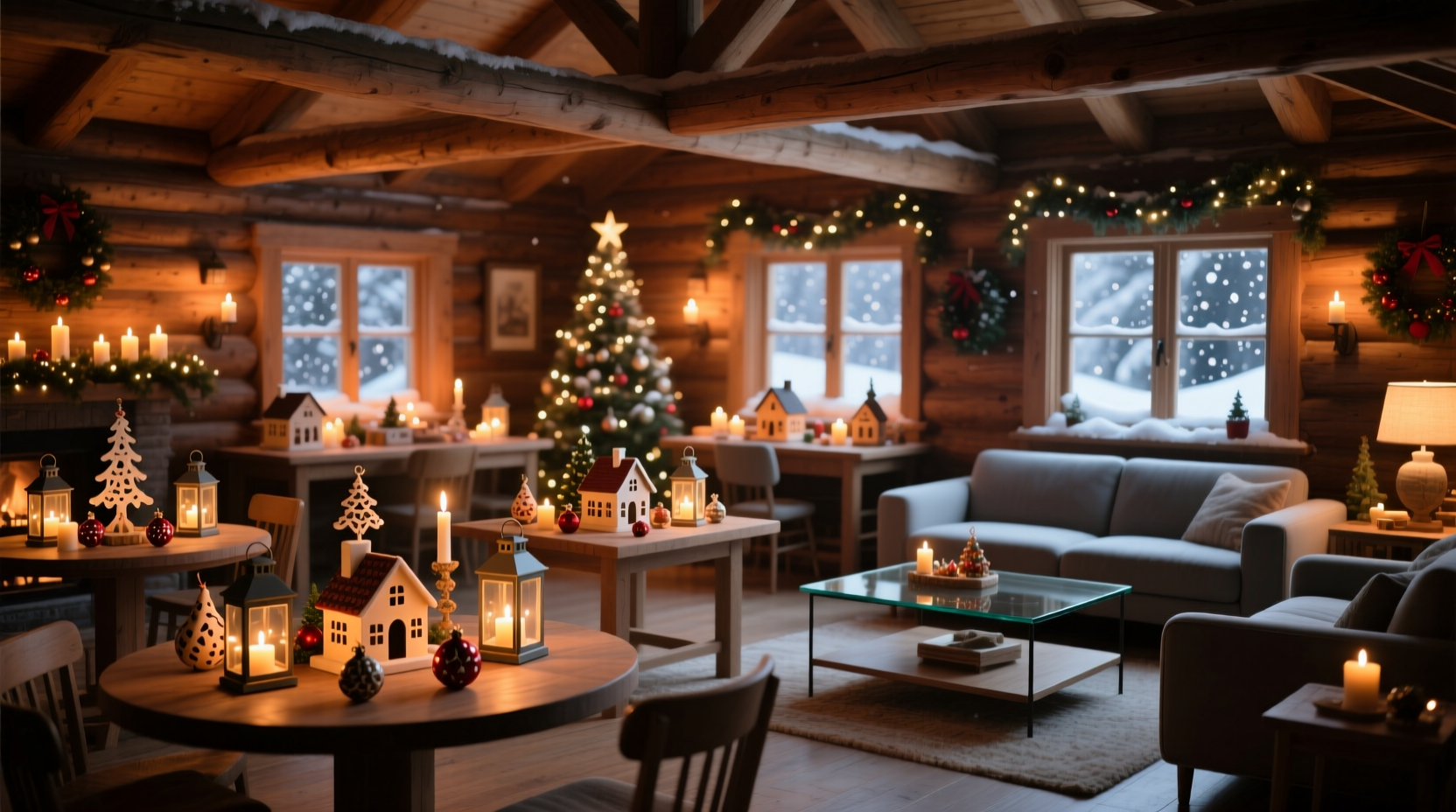
Village tables emerged not from marketing hype but from real-world pain points. Early collectors placed villages on bookshelves, coffee tables, and even dining room buffets—only to discover issues like uneven surfaces causing buildings to tilt, heat buildup from transformers melting snow base materials, or accidental bumps knocking over fragile chimneys. Specialty tables address five functional needs:
- Stability: Reinforced, level platforms prevent shifting during seasonal humidity changes or casual contact.
- Cooling: Vented undersides and elevated designs allow airflow around transformers and LED drivers, reducing thermal stress on wiring and plastic components.
- Electrical Management: Built-in cord channels, outlet strips, and transformer mounting brackets keep wiring organized and out of sight.
- Scale Consistency: Standard heights (typically 30–36 inches) position villages at eye level for optimal viewing without stooping or straining.
- Aesthetic Integration: Wood finishes, faux-fur snow skirts, and integrated lighting controls support a cohesive, immersive scene.
But none of these features are exclusive to “village-only” tables. They’re engineering solutions—and many can be replicated with thoughtful adaptation of everyday furniture.
Tip: Before buying anything new, measure your current furniture’s height, depth, and weight capacity—and check if its surface is truly level using a carpenter’s level. A 1/8-inch slope across 4 feet can cause visible building lean.What Makes Regular Furniture Work (or Fail)
Not all standard furniture is equal for village displays. Success hinges on three measurable criteria: structural integrity, thermal behavior, and spatial compatibility.
Structural integrity means the piece must hold 25–75+ pounds (depending on collection size) without flexing, sagging, or wobbling. A lightweight pine sideboard may buckle under a 40-piece village with heavy resin buildings and layered terrain. Conversely, a solid oak dining table—while oversized—offers exceptional stability and durability.
Thermal behavior is often overlooked. Villages generate heat: LED lights run warm, transformers get hot, and enclosed spaces trap that warmth. Placing a dense village on a glass-top coffee table with no ventilation underneath risks heat accumulation that degrades wire insulation and softens snow flocking. Upholstered surfaces like sofas or ottomans pose fire hazards near transformers and limit airflow.
Spatial compatibility includes both footprint and sightlines. A 72-inch-long village needs at least 84 inches of uninterrupted surface depth to accommodate snow banks, fences, and walkways without crowding edges. Height matters too: if your village sits on a 16-inch-tall chest of drawers, viewers must bend sharply to see details—breaking immersion and inviting accidental contact.
Adapting Common Furniture Types: A Practical Comparison
Below is a realistic assessment of frequently used household pieces—not as “good” or “bad,” but as *adaptable* or *high-risk*, based on real collector experience and electrical safety standards (NEC Article 400 & UL 1310).
| Furniture Type | Pros | Cons | Adaptation Strategy |
|---|---|---|---|
| Dining Table (Solid Wood) | Extremely stable; high weight capacity; easy to clean; often ideal height (28–30\") | Too large for small spaces; may lack visual framing; exposed legs create cluttered sightlines | Add a 2\" deep MDF base painted matte black or covered in velvet to define the “stage”; route a groove along the back edge for cord management; mount outlets on underside with strain relief clamps |
| Bookshelf (Open-Back, Solid Shelf) | Good height (32–36\"); open structure allows airflow; built-in vertical boundaries frame the scene | Shelves may bow under weight; gaps between shelves expose wiring; top shelf often too narrow (10–12\") | Reinforce shelves with 1/2\" plywood backing; install a removable 3\" tall fascia board to hide rear wiring; add a low-wattage LED strip behind the fascia for subtle backlighting |
| Coffee Table (Glass or Marble Top) | Central location; common height (16–18\"); aesthetically neutral | Poor heat dissipation; vibration transfer from foot traffic; reflective surface competes with village lighting | Place a 1/2\" thick cork or rubber mat beneath the entire village to dampen vibration and insulate heat; avoid placing transformers directly on glass—mount them vertically on a nearby wall bracket instead |
| Buffet or Sideboard | Appropriate height (34–36\"); enclosed storage for accessories; wood grain complements traditional villages | Top surface often narrow (14–18\"); enclosed cabinet traps heat if transformers stored inside | Use only the top surface—never store transformers or power strips inside closed cabinets; drill discreet 1/2\" vent holes in the cabinet back panel if using interior space for controllers |
| Wall-Mounted Floating Shelf | Space-saving; creates dramatic “floating village” effect; excellent airflow | Weight limits (often 25–35 lbs); mounting complexity; limited depth (usually ≤12\") | Use heavy-duty French cleat or dual-point lag bolt system into wall studs; choose shelves ≥16\" deep; limit to compact 10–15 piece villages; never mount transformers on the shelf itself—use a separate low-profile wall box below |
A Real Collector’s Adaptation: How Sarah Transformed Her Heirloom Dresser
Sarah inherited a 1920s walnut dresser with a 36\" wide, 22\" deep top—beautiful, but too low (29\") and too narrow for her growing Department 56 collection. She initially tried propping it up with books, which caused instability and scratched the finish. After researching thermal issues, she discovered her transformer was reaching 135°F on the unventilated surface.
Her solution took one weekend and under $45:
- She cut two 1\" x 4\" hardwood blocks (painted matte black) and mounted them to the dresser’s front and back legs, raising the working surface to 34\".
- She attached a 1/4\" tempered glass panel (24\" x 38\") to the top using non-slip rubber pads—creating a smooth, cool, easy-to-clean surface that diffused light evenly.
- She drilled a single 3/4\" hole through the dresser’s back panel and ran cords through flexible metal conduit to a GFCI-protected outlet mounted discreetly in the adjacent wall.
- She lined the interior drawer with silica gel packs and used it solely for storing spare bulbs and unpainted figurines—not electronics.
Two Christmases later, her village shows no signs of warping, wiring discoloration, or flocking degradation. More importantly, her grandchildren now help arrange the scene without fear of toppling buildings—a testament to thoughtful, grounded adaptation.
Step-by-Step: Converting Your Existing Furniture Safely
Follow this sequence—never skip steps—to ensure safety, stability, and longevity:
- Evaluate Load & Level: Weigh your full village (buildings + terrain + accessories). Use a digital bathroom scale if needed. Then place a carpenter’s level on the intended surface in four directions (front/back, left/right, diagonals). Note any deviation greater than 1/16\".
- Assess Heat Path: Plug in transformers and LED controllers for 30 minutes. Use an infrared thermometer (or carefully touch with fingertips) to check surface temperature at multiple points. If >110°F anywhere, airflow is insufficient.
- Map Wiring Zones: Sketch where each building plugs in. Identify the shortest path to an outlet. Avoid daisy-chaining power strips—use a single UL-listed surge protector with spaced outlets and a 15-amp circuit rating.
- Install Thermal & Vibration Buffers: Place a 1/4\" closed-cell foam pad (like EVA yoga mat material) under the entire village footprint. For glass or marble, add a 1/8\" cork underlayment beneath the foam.
- Secure & Frame: Anchor tall or top-heavy buildings with museum putty (repositionable, non-staining). Add a 2\" tall matte-black MDF fascia to the front and sides to visually ground the scene and conceal cords. Paint or stain it to match your furniture.
“Collectors who treat their furniture as a platform—not just a placeholder—see dramatically fewer failures in wiring, flocking, and structural alignment. It’s physics, not magic.” — Mark Rinaldi, Senior Product Engineer, Department 56 (retired)
FAQ: Addressing Real Concerns from Seasoned Collectors
Can I use a folding card table for my village?
Only temporarily—and with strict limits. Card tables flex under load, vibrate with foot traffic, and offer zero heat dissipation. If unavoidable, reinforce the legs with diagonal braces, place a 3/4\" plywood sheet on top, and limit your display to under 15 lightweight pieces. Never leave it unattended with transformers powered on for more than 4 hours.
Is particleboard furniture safe for villages?
Yes—if it’s thick (≥1\") and fully supported. Many modern entertainment centers use high-density particleboard with melamine coating. Avoid thin, unsupported shelves (common in budget bookcases), and never place transformers directly on particleboard—heat can cause delamination. Mount transformers on metal brackets attached to wall studs instead.
Do I need surge protection—even for LED villages?
Yes, absolutely. Modern LED villages use switching power supplies highly sensitive to voltage spikes. A single lightning-induced surge can fry multiple controllers simultaneously. Use a UL 1449-rated surge protector with a clamping voltage ≤400V and energy absorption ≥1,000 joules. Replace it every 3 years—or after any major storm—even if indicator lights remain green.
Conclusion: Your Furniture Is Already Part of the Tradition
Christmas villages thrive not in isolation, but in context—in the living rooms where carols are sung, where children kneel to examine tiny shop windows, where generations gather around shared light. That context doesn’t require a $300 specialty table. It requires intention. It asks you to see your oak sideboard not as outdated furniture, but as a stage waiting for story. To view your bookshelf not as storage, but as architecture framing memory. The most meaningful villages aren’t defined by custom bases—they’re defined by care, consistency, and the quiet pride of knowing every detail was chosen with purpose.
You already own what you need. Now go measure your surface, test its level, trace your cord paths, and make one thoughtful adaptation this season. Your village—and everyone who gathers around it—will feel the difference.
💬 Share your furniture hack! Did you convert a nightstand, repurpose a piano bench, or build a custom base from scrap wood? Tell us how—it could inspire hundreds of collectors. Leave your story in the comments below.