
Precious gemstones and natural pearls have captivated humanity for centuries, not only for their beauty but also for their cultural and symbolic significance. Among these, red agate and freshwater pearls stand out for their rich coloration and organic elegance. However, the rise of synthetic imitations and mass-produced lookalikes has made authentication a critical skill for collectors, jewelers, and buyers alike. Understanding how to distinguish genuine specimens from fakes ensures both value protection and informed purchasing. This guide provides a comprehensive, science-backed approach to verifying the authenticity of red agate and freshwater pearls with confidence.
Understanding Red Agate: Nature, Origins, and Characteristics
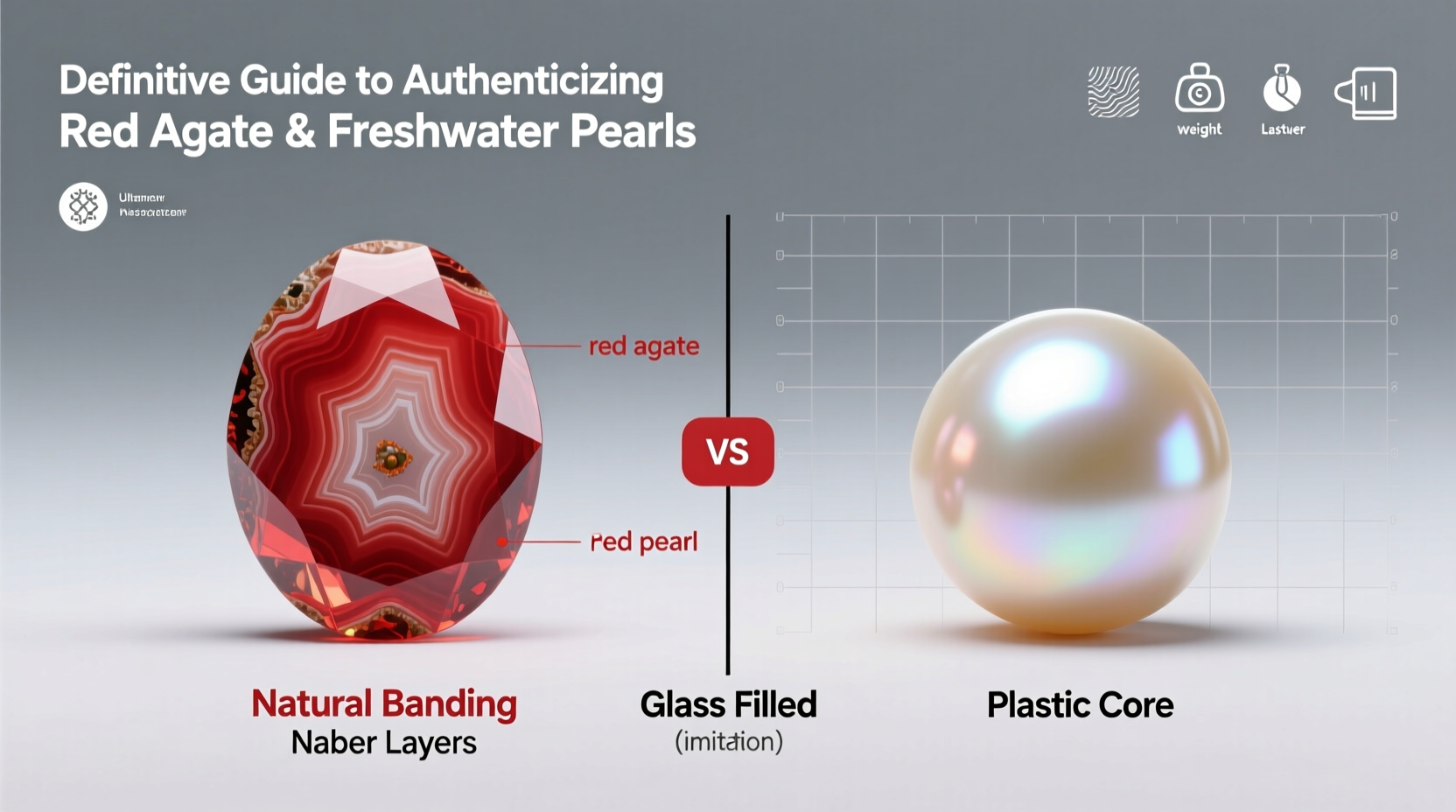
Red agate is a variety of chalcedony, a microcrystalline form of quartz. Its deep red hues come from iron oxide inclusions, often forming in concentric bands that reflect its volcanic origins. Found primarily in Brazil, Uruguay, India, and the United States, natural red agate forms over millions of years within cavities of igneous rock. Authentic specimens display subtle variations in tone, translucency, and banding patterns—no two are exactly alike.
Synthetic or dyed agates flood the market, often enhanced with pigments to intensify color. These can be difficult to identify without proper knowledge. Natural red agate tends to have a waxy luster and moderate coolness to the touch, while fake versions may feel overly smooth or plastic-like.
Tip: Hold the stone to light—genuine red agate often shows slight translucency with internal cloudiness or fine grain, unlike uniformly colored imitations.Step-by-Step Authentication of Red Agate
- Visual Inspection: Examine the surface under magnification. Real agate displays natural banding with irregular, flowing lines. Artificial agates often have perfectly uniform or repeating patterns.
- Temperature Test: Genuine agate feels cool to the touch initially and warms slowly. Plastic or glass imitations warm quickly.
- Hardness Check: On the Mohs scale, agate ranks 6.5–7. Attempt a discreet scratch test on an inconspicuous area using a steel pin (hardness ~5.5). If it scratches easily, it’s likely not real agate.
- UV Light Test: Some dyed agates fluoresce under ultraviolet light due to chemical treatments. While not conclusive alone, fluorescence suggests possible enhancement.
- Weight Assessment: Compare density. Real agate is heavier than plastic or resin fakes of similar size.
“Natural banding is the fingerprint of agate. When every layer looks machine-perfect, skepticism is warranted.” — Dr. Lena Torres, Gemologist at the International Colored Stone Association
Freshwater Pearls: How Nature Creates Elegance
Freshwater pearls are cultivated in mussels found in lakes and rivers, primarily in China. Unlike saltwater pearls, which typically produce one pearl per oyster, freshwater mussels can yield up to 40 pearls at once, making them more accessible. True freshwater pearls are composed of nacre—a crystalline substance secreted by the mollusk in response to an irritant.
Imitation pearls, commonly made from glass, plastic, or shell beads coated with pearlescent solution, dominate lower-priced markets. These lack the depth, luster, and weight of natural pearls and degrade over time.
| Feature | Genuine Freshwater Pearl | Imitation Pearl |
|---|---|---|
| Surface Texture | Slight irregularities, may show tiny pits or growth rings | Perfectly smooth, glassy finish |
| Luster | Deep, reflective glow with iridescent overtones | Flat, shiny coating without depth |
| Weight | Noticeably heavier | Lightweight |
| Tooth Test | Feels slightly gritty when rubbed against tooth | Feels smooth |
| Drill Hole Edge | Sharp, may show layered nacre | Chipped coating revealing dark core |
The Tooth Test and Other Practical Checks for Pearls
One of the most accessible field tests for pearl authenticity is the “tooth test.” Gently rub the pearl along the edge of your front tooth. Genuine pearls feel slightly gritty due to microscopic layers of nacre, while fakes feel smooth because of their uniform coating.
Another reliable method involves inspecting the drill hole. Use a magnifying glass to examine the edges. In real pearls, the nacre appears layered and consistent with the surface. Imitations often expose a dark bead core or rough substrate where the coating has worn.
For a more advanced check, consider a jeweler’s loupe (10x magnification) to look for surface irregularities. Natural pearls rarely have perfect symmetry; minor blemishes are a sign of authenticity, not defect.
Tip: Store pearls separately in soft cloth to prevent scratching. Their nacre can be damaged by harder gems or metals.Mini Case Study: The $200 Imitation Necklace
Sophia, a jewelry enthusiast from Portland, purchased a strand of \"premium red agate and pearl\" beads online for $199. Excited by the price and photos, she wore it to a family event—only to notice after a few hours that the red \"agate\" beads felt unnaturally warm and lightweight. Upon closer inspection, she noticed identical banding on multiple beads, a red flag.
She performed the tooth test on the pearls: they were completely smooth. She then used a jeweler’s loupe and saw chipped coating inside the drill holes. A visit to a local gemologist confirmed her suspicions: the entire piece was made of dyed glass and plastic-coated beads. Had Sophia applied basic authentication steps before purchase, she could have avoided the loss.
Expert Tools and When to Use Them
While visual and tactile tests are valuable, certain tools significantly increase accuracy:
- Jeweler’s Loupe (10x): Essential for examining surface texture, banding, and drill holes.
- Refractometer: Measures refractive index—agate reads between 1.530–1.540.
- Densimeter: Compares specific gravity. Agate ranges from 2.58–2.64; glass imitations often differ.
- X-ray Fluorescence (XRF): Detects trace elements like iron in red agate or calcium in pearls—used by labs.
For high-value purchases, professional certification from labs like GIA (Gemological Institute of America) or IGI provides definitive verification.
Authentication Checklist: Your Quick Reference Guide
- Inspect banding in red agate—natural, irregular patterns only.
- Perform the tooth test on pearls—gritty = real, smooth = fake.
- Check weight—authentic stones and pearls feel substantial.
- Examine drill holes for layered nacre or chipped coatings.
- Use UV light to detect dye fluorescence in agate.
- Verify temperature response—real gemstones stay cool longer.
- Consult a certified gemologist for pieces valued over $100.
Frequently Asked Questions
Can red agate be completely solid red?
Natural red agate almost always shows some banding or translucency variation. Solid, uniform red color is a strong indicator of dye treatment or imitation.
Are all freshwater pearls white?
No. While classic shades are white and pink, freshwater pearls naturally occur in lavender, peach, and even silver-gray tones. Color alone isn’t proof of authenticity.
Do real pearls lose their luster over time?
Yes, if improperly cared for. Exposure to perfume, sweat, and acidic substances can erode nacre. Wipe pearls with a soft cloth after wear and store them separately to maintain shine.
Final Thoughts: Confidence Through Knowledge
Authenticating red agate and freshwater pearls doesn’t require a laboratory or expensive equipment—just attention to detail and a willingness to question perfection. Nature is inherently imperfect, and that imperfection is what gives genuine stones and pearls their soul. By mastering simple tests and understanding the science behind these materials, you protect your investment and deepen your appreciation for true craftsmanship.
🚀 Ready to verify your collection? Start today by re-examining one piece using the tooth test and visual inspection. Share your findings or questions in the comments—let’s build a community of informed collectors.








