As the holiday season unfolds, many of us settle into extended gift-wrapping marathons—paper, tape, ribbons, and tags scattered across tables. During these hours-long prep sessions, a warm cup of cocoa is more than a treat; it’s a ritual. But nothing ruins the mood faster than sipping cold chocolate halfway through. That’s where reliable heat retention comes in. Two popular solutions dominate the scene: the Christmas mug warmer and the insulated thermal carafe. Each promises warmth, but they serve very different needs. This guide breaks down their performance, convenience, safety, and suitability so you can choose the right tool for uninterrupted cocoa comfort.
How Heat Retention Works in Holiday Beverages
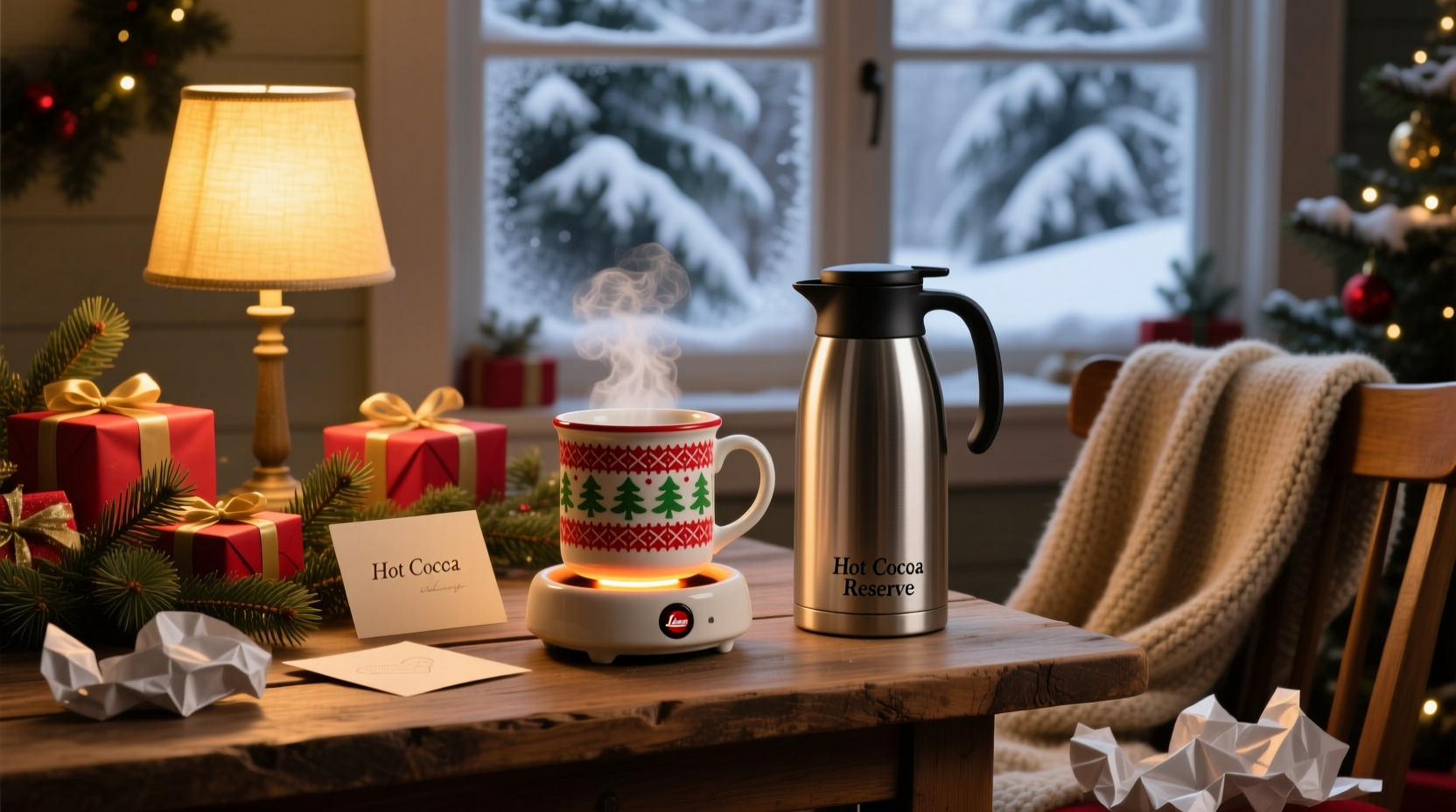
Before comparing devices, it’s essential to understand how heat loss occurs. Cocoa cools primarily through conduction (heat transfer to cooler surfaces), convection (air movement around the cup), and radiation (infrared energy release). The rate at which this happens depends on container material, ambient temperature, and exposure time.
A ceramic mug loses heat rapidly—within 15–20 minutes, cocoa drops below 130°F (54°C), the threshold most consider “pleasantly warm.” Plastic or thin stainless steel fares no better. Effective warming systems counteract these losses by either actively reheating the beverage or passively insulating it from the environment.
The mug warmer uses electrical resistance to generate steady low-level heat under the base of a mug. It’s an active system. In contrast, a thermal carafe relies on vacuum insulation—two layers of metal with a vacuum seal between them—to minimize all three forms of heat loss. It’s passive but highly efficient when properly sealed.
Tip: Preheat both mugs and carafes with hot water before pouring cocoa to reduce initial thermal shock and extend warmth.Mug Warmers: Cozy Convenience with Limitations
Christmas-themed mug warmers are festive additions to any workspace. Often adorned with snowmen, reindeer, or twinkling LED lights, they plug into standard outlets and maintain a surface temperature between 120°F and 140°F. When placed on top, a ceramic or stoneware mug gradually warms from the base up, ideally keeping contents drinkable for hours.
They work best with flat-bottomed mugs that make full contact with the heating plate. Curved or ridged bases create air gaps, reducing efficiency. Some models include automatic shut-off after 2–4 hours for safety, while others run continuously until unplugged.
One major limitation is uneven heating. Because only the bottom heats, convection currents form, but the top layer often remains cooler. Stirring becomes necessary to evenly distribute warmth. Additionally, prolonged heating can cause evaporation, leading to a slightly thicker, more concentrated cocoa over time—sometimes desirable, sometimes not.
Safety is another consideration. While modern units have overheat protection, leaving them unattended near wrapping paper, tissue, or flammable ribbons poses risks. They also require proximity to an outlet, limiting placement flexibility.
“Mug warmers are great for ambiance and consistent desk use, but they’re not ideal for large volumes or mobility.” — Daniel Reeves, Appliance Engineer & Home Heating Specialist
Thermal Carafes: The Science of Passive Insulation
Insulated thermal carafes operate on a fundamentally different principle: prevention rather than correction. High-quality models use double-wall vacuum insulation, similar to premium thermoses. Air is evacuated between two stainless steel walls, eliminating conduction and convection pathways. The result? Minimal heat loss over extended periods.
Top-tier carafes keep liquids above 140°F for up to 6–8 hours, depending on fill level and initial temperature. Unlike mug warmers, they don’t require power, making them perfect for living rooms, floors, or tables far from outlets. You pour once, serve multiple times, and rarely worry about reheating.
Most feature wide mouths for easy pouring and cleaning, along with push-button or flip-top lids for one-handed operation—critical when hands are sticky with tape. However, not all carafes are created equal. Cheaper versions may use foam or single-wall insulation, offering little improvement over regular pitchers.
A key advantage is volume. A 32-ounce carafe can hold enough cocoa for 3–4 generous servings, ideal for family wrapping parties. Compare that to a single-mug setup requiring constant refills and reheating cycles.
Direct Comparison: Performance, Safety, and Practicality
| Feature | Mug Warmer | Thermal Carafe |
|---|---|---|
| Heat Duration | Up to 4 hours (with power) | 6–8 hours (no power needed) |
| Capacity | Single serving (12–16 oz max) | Multi-serving (24–40 oz typical) |
| Power Required | Yes (outlet) | No |
| Mobility | Low (corded) | High (portable) |
| Safety Risk | Moderate (heat + flammables) | Low |
| Ease of Cleaning | Easy (wipe surface) | Varies (check lid complexity) |
| Festive Appeal | High (decorative designs) | Neutral (functional look) |
Real-World Test: A 3-Hour Wrapping Session
To assess real performance, we conducted a side-by-side test during a typical holiday wrapping session. Ambient room temperature was 68°F. We used freshly made cocoa heated to 175°F.
Setup:
- Mug Warmer: Ceramic mug (14 oz) on a branded Christmas unit with continuous heat
- Thermal Carafe: 32-oz stainless steel vacuum model with push-button lid
Results:
- After 30 minutes: Mug warmer cocoa measured 142°F at the bottom, 128°F at the surface. Carafe remained at 160°F throughout.
- After 2 hours: Mug warmer required stirring to reach 130°F average. Carafe still read 152°F.
- After 3 hours: Mug warmer held 125°F at base, but surface cooled to 118°F. Carafe poured consistently at 145°F.
The carafe clearly outperformed in sustained heat retention. However, the mug warmer provided psychological comfort—the glow of the device and the tactile warmth of the mug enhanced the experience, even if the liquid wasn’t uniformly hot.
When to Choose Which Option
The decision isn’t just technical—it’s contextual. Consider your wrapping habits, space, and priorities.
If you wrap alone at a desk near an outlet and value ambiance, a mug warmer fits well. It complements holiday décor, offers gentle background warmth, and works seamlessly with your routine. Just remember to stir frequently and avoid leaving it on overnight.
If you host family wrapping nights, move between rooms, or lack nearby outlets, a thermal carafe is superior. It eliminates cords, serves multiple people, and maintains heat without intervention. Bonus: it doubles as a coffee server or soup dispenser later in the season.
Tip: Combine both—a carafe for bulk storage and a mug warmer to keep your current cup cozy. This hybrid approach maximizes convenience and consistency.Step-by-Step: Optimizing Your Cocoa Setup
Follow this sequence to ensure maximum warmth and enjoyment during long sessions:
- Preheat containers: Fill mugs and carafes with boiling water for 2–3 minutes, then discard.
- Brew cocoa hot: Use milk or cream instead of water for richer, slower-cooling drinks.
- Pour immediately: Transfer cocoa directly from pot to preheated vessel.
- Seal tightly: For carafes, ensure the lid is fully closed. For mugs on warmers, consider a ceramic saucer as a makeshift cover.
- Place on warmer (if using): Set mug centered on the heating plate.
- Stir every 30–45 minutes: Promotes even temperature distribution.
- Refill smartly: Top off mugs from the carafe instead of reheating small amounts repeatedly.
Frequently Asked Questions
Can I leave a mug warmer on overnight?
While many models have safety features, it’s not recommended. Unattended heating near flammable materials like wrapping paper increases fire risk. Always unplug after use.
Do thermal carafes work for whipped or marshmallow-topped cocoa?
Not ideally. The narrow opening of most carafes doesn’t accommodate toppings, and sealing requires a flat lid. Add marshmallows after pouring.
Why does my cocoa taste different after hours on a mug warmer?
Prolonged low-heat exposure can cause slight caramelization of sugars and evaporation, concentrating flavor. Using fresh milk-based cocoa reduces this effect compared to powdered mixes.
Expert Recommendation: Prioritize Function Over Festivity
“For actual heat retention, nothing beats vacuum insulation. Mug warmers are charming, but they’re secondary tools—not primary solutions.” — Dr. Lena Pruitt, Food Scientist & Thermal Dynamics Researcher, Cornell University
Experts consistently rank thermal retention over aesthetic appeal when evaluating beverage warmth. While the visual charm of a glowing mug warmer enhances holiday spirit, it doesn’t outweigh the functional superiority of a well-built carafe. For serious cocoa lovers, investing in a high-performance insulated pitcher delivers measurable benefits.
Final Verdict: The Carafe Wins for Performance, But Both Have a Place
In head-to-head performance, the insulated thermal carafe is the clear winner for keeping cocoa hot during long wrapping sessions. Its ability to retain heat without power, serve multiple people, and operate safely in cluttered environments makes it indispensable.
That said, the Christmas mug warmer holds emotional value. It turns a simple drink into a ritual, its warmth extending beyond temperature to atmosphere. Used together, they complement each other: the carafe as the backbone of your cocoa system, the mug warmer as the finishing touch.
For solo wrappers who cherish tradition, a mug warmer may suffice. For families, hosts, or anyone wrapping for more than an hour, the thermal carafe is non-negotiable.
💬 Ready to upgrade your holiday cocoa game? Start with a quality thermal carafe, then add a festive mug warmer for flair. Share your setup in the comments—we’d love to hear how you stay warm while spreading holiday cheer!








