As the holiday season approaches, homeowners face a familiar dilemma: how to decorate with festive cheer without spending days untangling wires, climbing ladders, or rewiring faulty strands. The rise of Christmas light projectors has introduced a compelling alternative to traditional string lights. But when it comes down to saving time and minimizing effort, which option truly wins? This article breaks down the practical realities of both solutions — from setup and maintenance to safety and visual appeal — so you can make an informed decision that fits your lifestyle.
The Reality of Traditional Christmas Lighting
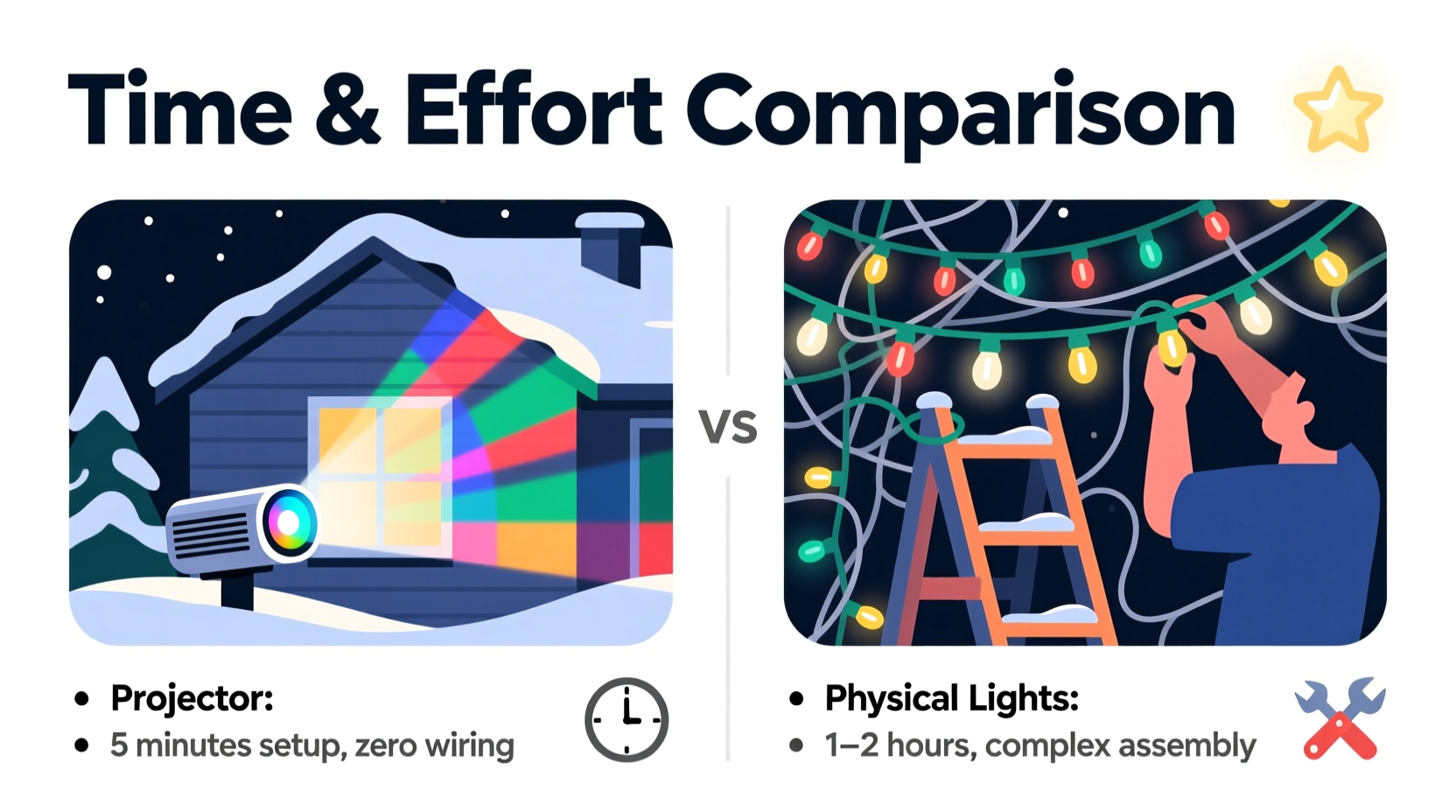
For decades, physical Christmas lights have been the go-to method for holiday decoration. Whether wrapping trees, outlining roofs, or draping across porches, these twinkling strands create a warm, nostalgic ambiance. However, their charm comes at a cost — primarily in labor and time.
Installing traditional lights involves multiple steps: purchasing enough strands, testing each one for functionality, untangling knots, securing clips or hooks, running extension cords, and ensuring everything is weatherproof. A 2022 survey by the National Retail Federation found that the average American spends between 6 to 10 hours decorating their home with physical lights alone — not including storage and post-holiday takedown.
Maintenance is another burden. Bulbs burn out, sections fail, and rodents sometimes chew through wires. Even with LED strands (which last longer and use less energy), the process remains labor-intensive.
Tip: Label your extension cords and light reels during storage to reduce confusion next season.How Christmas Light Projectors Work
Christmas light projectors are compact devices that shine pre-designed light patterns — such as snowflakes, reindeer, or classic multicolored dots — onto walls, lawns, or driveways using high-lumen LED bulbs and rotating lenses. Most models plug into standard outdoor outlets and offer remote controls, timers, and adjustable stands.
Instead of wrapping structures, users simply place the projector on a stable surface, point it toward the desired area, and turn it on. Many units cover up to 700 square feet with a single beam, and some allow dual projections for wider coverage. Because they contain no strings or fragile components, they’re immune to tangling, breakage, and seasonal degradation.
According to industry data, the average setup time for a Christmas light projector is under 15 minutes — a fraction of the time required for physical lights. One homeowner in Colorado reported switching from 12 hours of annual decoration to just 20 minutes after adopting two projectors for his front yard and garage wall.
“Projectors represent a paradigm shift in holiday lighting — they deliver maximum visual impact with minimal human input.” — Daniel Reeves, Outdoor Lighting Engineer at LuminaTech Innovations
Time and Effort Comparison: A Practical Breakdown
To determine which option saves more time and effort, consider the full lifecycle: setup, operation, maintenance, takedown, and storage.
| Task | Physical Lights (Avg. Time) | Light Projectors (Avg. Time) | Effort Level |
|---|---|---|---|
| Setup | 3–10 hours | 10–20 minutes | High vs. Low |
| Troubleshooting | 1–3 hours (testing strands, replacing bulbs) | None (if working) | High vs. None |
| Daily Operation | Timer-dependent; occasional resets | Auto-timer; rarely needs adjustment | Medium vs. Low |
| Maintenance | Weekly checks for outages | Occasional lens wipe | High vs. Minimal |
| Takedown | 2–5 hours | 5–10 minutes | High vs. Low |
| Storage | Requires large bins, careful coiling | Fits in small box | High vs. Low |
The data shows a clear trend: projectors drastically reduce time investment and physical strain. For elderly homeowners, renters, or those with limited mobility, this difference isn’t just convenient — it’s transformative.
Real-World Example: A Family’s Holiday Transition
The Thompson family in Portland, Oregon, decorated their two-story home with over 5,000 physical lights every December for 15 years. Each season began with a weekend-long effort: Mr. Thompson on the ladder, Mrs. Thompson managing cords, and their teenage son troubleshooting dead strands. By 2021, the process had become so stressful they considered skipping decorations altogether.
In 2022, they invested in three commercial-grade Christmas light projectors — one for the front facade, one for the driveway, and one for the backyard tree. Setup took less than 30 minutes. They programmed automatic on/off times and left them running for six weeks. Neighbors initially skeptical were impressed by the vibrant, dynamic displays. The family saved over 18 hours of labor and avoided one trip to urgent care after a near-fall from the roof.
“We didn’t lose the magic,” said Mrs. Thompson. “We just stopped sacrificing our weekends for it.”
Energy Use and Safety Considerations
Beyond time, energy efficiency and safety matter. Most modern Christmas light projectors consume between 20 to 40 watts — comparable to a single strand of mini LED lights. In contrast, a fully lit home with 10,000 bulbs may draw 500+ watts continuously. Over a 30-day season, that adds up to significant electricity costs.
Safety is another advantage. Installing physical lights often requires ladders, power tools, and exposure to wet surfaces. According to the U.S. Consumer Product Safety Commission, emergency rooms treat over 15,000 injuries related to holiday decorations annually — most involving falls or electrical shocks. Projectors eliminate ladder use and reduce tripping hazards from exposed cords.
Tip: Place projectors on non-slip bases or weighted platforms to prevent shifting in wind or rain.Visual Appeal and Limitations
No discussion would be complete without addressing aesthetics. While projectors excel in convenience, they don’t replicate the three-dimensional depth of real lights. String lights sparkle individually, casting subtle shadows and reflections. Projectors produce flat, uniform patterns that can appear artificial up close.
They also depend on surface texture and color. White stucco walls reflect well; dark brick or dense foliage may absorb light and reduce visibility. Some users report \"hotspots\" where brightness concentrates, or overlapping patterns that blur when misaligned.
However, technology is advancing rapidly. Newer models feature adaptive optics, motion effects, and multi-angle projection. Some even sync with music for animated light shows. For many, the trade-off in realism is worth the gains in ease and reliability.
Step-by-Step: Switching from Physical Lights to Projectors
If you're considering making the switch, follow this practical timeline:
- Assess Your Space (15 min): Walk around your property and note ideal projection surfaces — walls, fences, or flat ground areas.
- Measure Distance (10 min): Determine how far the projector will sit from the target. Most require 15–25 feet for optimal spread.
- Check Power Access (5 min): Ensure outdoor outlets are available or plan for a weatherproof extension cord.
- Select Projector Type (30 min research): Choose between static patterns, rotating designs, or programmable RGB models based on your preference.
- Test Placement (20 min): Set up the unit, adjust angle and focus, and observe the pattern at dusk.
- Secure and Program (10 min): Lock the base if needed, set timer settings, and confirm auto-on functionality.
- Evaluate Results (Ongoing): Observe the display over several nights and tweak positioning if shadows or distortion occur.
This entire process can be completed in a single afternoon — less time than untangling two old light strands.
When Physical Lights Still Make Sense
Projectors aren’t universally superior. There are scenarios where physical lights remain the better choice:
- Indoor Trees and Mantles: Projectors can't illuminate tight interior spaces effectively.
- Layered Decorations: Combining lights with garlands, ornaments, or wreaths works best with actual strands.
- Photography-Centric Displays: For social media or professional photos, real lights offer richer textures.
- Historic or HOA-Regulated Areas: Some neighborhoods ban projectors, citing light pollution or authenticity concerns.
A hybrid approach — using projectors for large exterior surfaces and physical lights for key focal points — often delivers the best balance of impact and efficiency.
Checklist: Choosing the Right Option for Your Home
Use this checklist to decide whether projectors or physical lights suit your needs:
- ☐ Do you spend more than 5 hours installing lights each year?
- ☐ Have you fallen or nearly fallen while decorating?
- ☐ Are your current strands frequently malfunctioning?
- ☐ Do you have large, flat exterior surfaces (walls, garage doors)?
- ☐ Is storage space limited?
- ☐ Are you looking to reduce electricity usage?
- ☐ Do you prioritize speed and simplicity over fine detail?
If you answered “yes” to three or more, a projector is likely a smart upgrade.
Frequently Asked Questions
Can I use a Christmas light projector indoors?
Yes, but effectiveness depends on room size and wall color. Dark walls absorb light, reducing visibility. Best results come from projecting onto white or light-colored ceilings or blank walls. Avoid placing near reflective furniture that could scatter the image.
Do projectors work in rainy or snowy conditions?
Most outdoor-rated models are weather-resistant (IP44 or higher) and can operate in light rain or snow. However, heavy precipitation may blur the lens or wash out the image. Wipe the lens periodically during storms and ensure the unit is elevated off wet ground.
Are Christmas light projectors cheaper in the long run?
Initially, projectors cost $40–$120, similar to premium light sets. But over five years, savings from reduced replacement strands, lower energy bills, and eliminated ladder equipment make them more economical. One study estimated a 60% total cost reduction compared to physical lights.
Conclusion: Prioritize Time, Not Tradition
The holidays should bring joy, not exhaustion. While physical Christmas lights carry sentimental value, they demand a level of effort that no longer aligns with modern lifestyles. Christmas light projectors offer a viable, efficient alternative that preserves festive spirit without the physical toll.
Whether you switch completely or adopt a hybrid model, the goal is the same: to celebrate with less stress and more presence. You don’t need to climb a ladder to prove your holiday spirit. Sometimes, the simplest solution shines the brightest.
🚀 Ready to simplify your holiday routine? Try a Christmas light projector this season and reclaim your weekends. Share your experience in the comments — your story might inspire someone else to make the switch.








