As the holiday season approaches, one of the most time-consuming aspects of outdoor decoration is lighting up your home. For many homeowners, the choice between Christmas light net lights and traditional individual strand placement comes down to efficiency, aesthetics, and long-term maintenance. While both options deliver festive charm, they differ significantly in installation time, adaptability, and overall labor. Understanding these differences can help you make a smarter, faster decorating decision—especially when time is short and the weather is cold.
The Reality of Holiday Decorating Time
According to a 2023 National Retail Federation survey, nearly 84% of American households decorate their homes for Christmas, with an average of 6 to 10 hours spent on exterior lighting alone. For those juggling work, family, and seasonal events, even a few saved hours can make a meaningful difference. The core challenge lies in balancing visual impact with practicality. This is where the debate between net lights and individual strands becomes critical—not just for appearance, but for real-world time investment.
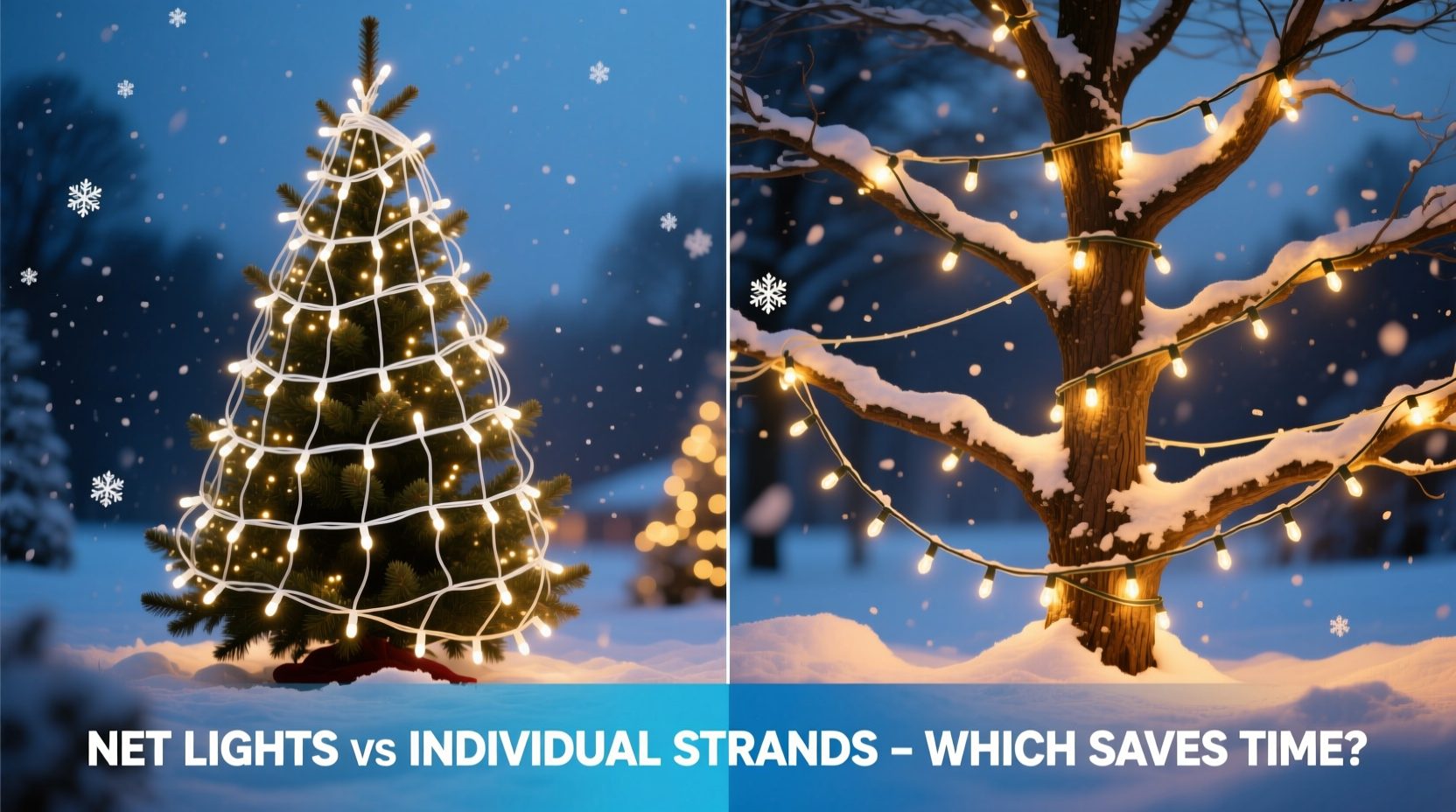
Net lights are pre-wired grids of bulbs spaced evenly across a mesh netting, designed to cover flat surfaces like bushes, shrubs, or house facades. Individual strands, on the other hand, are flexible strings of lights that can be draped, wrapped, or woven into various shapes and structures. Each has strengths, but when it comes to saving time during setup and takedown, the comparison reveals clear winners under specific conditions.
How Net Lights Save Time During Installation
Net lights are engineered for speed. Their primary advantage lies in their ready-to-deploy design. A single 5x10-foot net light panel can cover the same area that might otherwise require six to eight individual strands, each needing separate anchoring, alignment, and plug management.
Installation typically involves three steps: unrolling the net, securing it with clips or stakes, and plugging it in. There’s no need to estimate spacing, avoid dark spots, or reposition bulbs mid-process. Because the bulbs are uniformly distributed, full coverage is guaranteed from the start. This makes net lights especially effective for large, flat areas such as hedges, foundation plantings, or low walls.
Tip: Use larger net panels (e.g., 7x14 feet) for broad landscaping features to minimize the number of connections and reduce setup time by up to 40%.A 2022 consumer test conducted by Home & Garden Review found that participants installing net lights over a 200-square-foot bushy front yard averaged 47 minutes. In contrast, those using individual strands took an average of 2 hours and 13 minutes to achieve comparable density and uniformity. The gap widened further when testers attempted curved or irregular layouts, where net lights required careful draping but still avoided the tedious threading process inherent to strands.
When Individual Strands Are Worth the Extra Time
Despite their slower setup, individual light strands offer unmatched versatility. They excel in complex architectural environments—wrapping around railings, outlining rooflines, framing windows, or weaving through tree branches. If your home has multiple levels, intricate eaves, or mature trees, individual strands allow precise control over light placement, enabling custom designs that net lights simply can't replicate.
Moreover, strands are easier to repair. If one section fails, you can replace just that segment without discarding an entire net. They also allow mix-and-match color schemes and bulb types (e.g., C9s for outlines, mini-lights for fill), giving decorators creative freedom.
However, this flexibility comes at a cost: time. Laying out individual strands requires planning, measuring, testing, and frequent adjustments. You must ensure even spacing (typically 6–12 inches apart), manage voltage drop across long runs, and secure each strand independently. Mistakes often mean untangling, re-clipping, or rewiring—tasks that multiply frustration, especially in windy or wet conditions.
“Time is the hidden expense of holiday decorating. For most families, convenience isn’t a luxury—it’s a necessity.” — Marcus Reed, Lighting Designer & Author of *The Efficient Holiday Home*
Direct Comparison: Net Lights vs. Individual Strands
| Feature | Net Lights | Individual Strands |
|---|---|---|
| Average Setup Time (per 100 sq ft) | 20–30 minutes | 60–90 minutes |
| Coverage Uniformity | High – consistent spacing | Variable – depends on skill |
| Best For | Bushes, shrubs, flat walls, ground-level landscaping | Trees, railings, rooflines, custom designs |
| Storage & Takedown | Faster – fold or roll | Slower – prone to tangling |
| Repairability | Low – entire net may need replacement | High – modular sections replaceable |
| Cost (average per 100 sq ft) | $35–$50 | $25–$40 |
Step-by-Step Guide: Choosing Based on Your Yard Layout
- Map Your Lighting Zones: Walk around your property and identify areas best suited for broad coverage (bushes, lawns) versus detailed outlining (eaves, stairs).
- Measure Surface Areas: Use a tape measure or app-based tool to calculate square footage for each zone. This helps determine how many net panels or strand lengths you’ll need.
- Select Primary Method by Zone: Use net lights for zones larger than 50 sq ft with minimal depth variation. Reserve individual strands for vertical, elevated, or complex features.
- Plan Power Access: Note outlet locations. Net lights often require fewer extension cords due to integrated design; strands may need daisy-chaining, increasing cord clutter.
- Install in Order of Efficiency: Start with net lights first—they’re quicker to deploy and let you focus on precision work later with strands.
- Test Before Finalizing: Turn on all lights before securing final clips. Adjust positioning while accessible.
- Label for Next Year: Tag storage bins by location (e.g., “Front Bush Net,” “Porch Rail Strands”) to speed up future setups.
Real-World Example: The Thompson Family’s Time-Saving Switch
The Thompsons, a family of four in Portland, Oregon, used to spend two full weekends every December decorating their two-story home. Their previous method relied entirely on individual strands—over 1,200 feet total—for bushes, eaves, and trees. After years of frustration with tangled wires and uneven lighting, they decided to experiment in 2022.
They replaced their bush and shrub lighting (covering about 300 sq ft) with six large net light panels. They kept individual strands only for the roofline and porch railing. The result? Total setup time dropped from 17 hours to just 7.5 hours. Takedown was equally faster, taking under 3 hours compared to the previous 8.
“We gained back an entire weekend,” said Lisa Thompson. “And honestly, the yard looks better—no more patchy spots where we ran out of steam halfway through.”
Maximizing Time Savings: Best Practices
- Use hybrid setups: Combine net lights for bulk coverage and strands for accents. This balances speed with customization.
- Invest in durable clips: Reusable plastic or rubber-coated clips save time during both installation and removal, reducing damage to lights and surfaces.
- Pre-test lights indoors: Check functionality before heading outside. Cold hands and tangled cords are harder to fix outdoors.
- Store nets flat or rolled: Avoid folding sharply to prevent wire stress. Use labeled bins to keep sizes and colors organized.
- Consider LED net lights: They use less energy, generate less heat, and last longer—reducing replacement needs over time.
Frequently Asked Questions
Can I use net lights on trees?
It’s possible, but not ideal. Net lights work best on flat or gently curved surfaces. On dense or tall trees, they may not conform well, leaving gaps or excess bunching. Individual strands or tree-specific light wraps are more effective for conifers and large deciduous trees.
Do net lights use more electricity?
No. Energy use depends on bulb type (LED vs. incandescent) and total wattage, not the format. Most modern net lights use LED bulbs, making them energy-efficient. Always check the product’s wattage and compare total load across your display.
Are net lights reusable year after year?
Yes, if stored properly. Avoid crushing or tightly folding the netting, which can break internal wires. Store in a climate-controlled space, away from rodents. High-quality LED net lights can last 5–7 seasons or more with care.
Checklist: Quick-Start Guide for Time-Efficient Lighting
- ☐ Measure key landscaping areas (bushes, walls, flower beds)
- ☐ Choose net lights for flat, wide zones over 50 sq ft
- ☐ Keep individual strands for architectural details
- ☐ Buy LED lights for durability and lower energy use
- ☐ Acquire enough clips or stakes for fast attachment
- ☐ Test all lights indoors before installation
- ☐ Install net panels first, then add strand details
- ☐ Label storage containers by location for next year
Conclusion: Work Smarter, Not Harder This Holiday Season
The choice between Christmas light net lights and individual strand placement isn’t just about looks—it’s about how you value your time. For broad, repetitive coverage, net lights are the undisputed champion of speed and simplicity. They reduce physical strain, cut hours off setup, and deliver consistent results with minimal effort. Individual strands remain essential for custom detailing, but treating them as accents rather than the primary medium can transform your decorating experience.
By adopting a strategic, zone-based approach—using the right tool for each job—you can create a stunning, cohesive display without sacrificing your weekends. The holidays should be about joy, not exhaustion. With smarter lighting choices, you can spend less time in the cold and more time with the people who matter most.
💬 Have a time-saving decorating tip? Share your experience in the comments and help others light up their homes faster this season!








