Choosing a meaningful Christmas gift for someone passionate about psychology requires more than just aesthetic appeal—it demands relevance, utility, and emotional resonance. Among the most thoughtful options are gratitude journals infused with Stoic philosophy and emotion wheel posters. Both serve as tools for introspection, emotional regulation, and personal growth, but they cater to different aspects of psychological well-being. This guide compares these two standout gift ideas, helping you decide which aligns best with your recipient’s personality, goals, and daily habits.
The Psychology Behind Thoughtful Gifting
Gifting is not merely transactional; it's an act embedded in social cognition and emotional intelligence. According to Dr. Laurie Santos, professor of psychology at Yale and host of “The Happiness Lab,” gifts that promote self-reflection or mental well-being often have longer-lasting positive effects than material possessions. She notes:
“Experiences and tools that encourage mindfulness or emotional awareness don’t just bring momentary joy—they can rewire how people think about themselves and their lives.” — Dr. Laurie Santos, Cognitive Psychologist
This insight underscores why both gratitude journals with Stoic prompts and emotion wheel posters stand out. They aren't passive decor or fleeting novelties. Instead, they invite active engagement—daily writing or visual reference—that supports long-term psychological health.
Gratitude Journal with Stoic Prompts: A Tool for Resilience
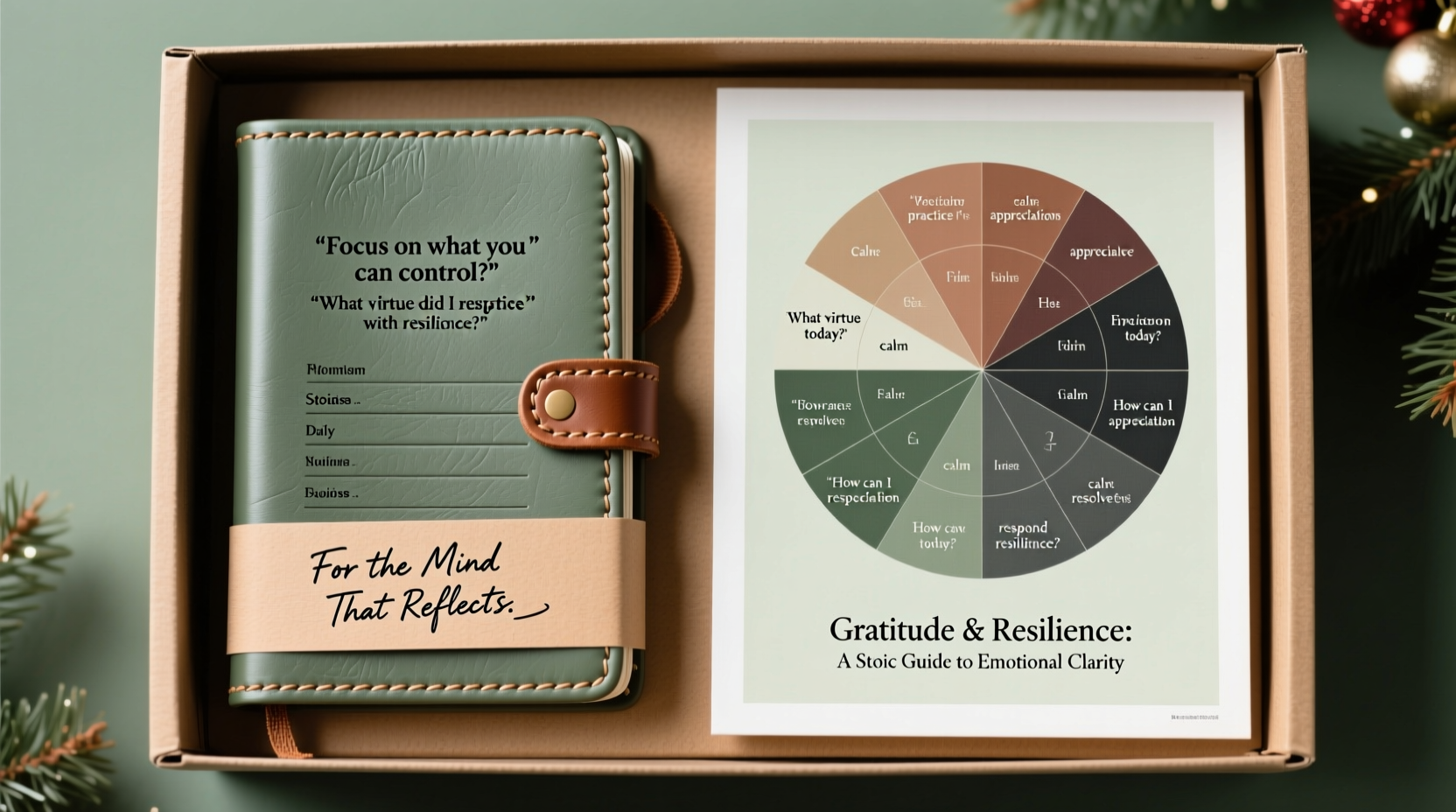
A gratitude journal tailored with Stoic principles goes beyond listing things one is thankful for. It integrates ancient philosophical frameworks from thinkers like Marcus Aurelius, Epictetus, and Seneca into structured daily reflection. These journals typically include guided prompts such as:
- What did I control today, and what did I let go of?
- How did I respond to adversity with virtue?
- Name three things you took for granted that contribute to your comfort.
- If my future self could thank me for one action today, what would it be?
The power lies in combining modern psychological research on gratitude with timeless Stoic exercises like negative visualization (premeditatio malorum) and the dichotomy of control. Studies published in the Journal of Positive Psychology show that individuals who practice gratitude journaling report lower levels of stress, improved sleep, and greater emotional resilience.
Tip: Look for journals with undated pages and ample space for writing—this reduces pressure to “catch up” and increases long-term use.Benefits of a Stoic Gratitude Journal
- Builds emotional discipline: Encourages users to distinguish between controllable and uncontrollable events.
- Promotes cognitive reframing: Helps shift focus from lack to abundance, even during hardship.
- Supports identity development: Repeated reflection strengthens values-based decision-making.
- Enhances mindfulness: Daily entries create a pause in routine, fostering present-moment awareness.
For psychology students or professionals, this journal doubles as both a personal wellness tool and a practical application of therapeutic concepts such as cognitive-behavioral therapy (CBT) and acceptance and commitment therapy (ACT).
Emotion Wheel Poster: Mapping the Inner Landscape
Developed originally by psychologist Dr. Robert Plutchik, the emotion wheel is a color-coded model that organizes primary emotions—joy, trust, fear, surprise, sadness, disgust, anger, and anticipation—and their combinations. Modern versions expand this into a detailed chart showing nuanced feelings like “nostalgia” (a blend of joy and sadness) or “aggressiveness” (anger + anticipation).
An emotion wheel poster transforms abstract internal states into tangible, visible categories. When hung in a bedroom, office, or therapy room, it becomes a reference point for emotional literacy—the ability to identify, label, and communicate feelings accurately.
Why Emotional Literacy Matters
Lack of emotional granularity—the precision with which people identify their feelings—is linked to higher anxiety, poor relationship outcomes, and increased risk of depression. A 2019 study in Emotion found that participants who could differentiate between closely related negative emotions (e.g., irritation vs. fury) were better at regulating them.
An emotion wheel poster acts as a training aid. Over time, regular exposure helps users move beyond vague labels like “I feel bad” to more specific ones like “I feel resentful” or “disappointed.” This specificity is critical in therapy settings and everyday communication.
“The more precisely we can name our emotions, the less power they have over us unconsciously.” — Dr. Susan David, Harvard Medical School, author of *Emotional Agility*
Use Cases for the Emotion Wheel Poster
- Therapists and counselors: Use it during sessions to help clients articulate complex feelings.
- Couples: Refer to it during conflicts to de-escalate misunderstandings.
- Parents: Teach children emotional vocabulary using visual cues.
- Mindfulness practitioners: Pair it with meditation to explore bodily sensations tied to emotions.
Comparative Analysis: Which Gift Is Right?
To determine whether a gratitude journal with Stoic prompts or an emotion wheel poster makes a better Christmas gift, consider the recipient’s lifestyle, learning style, and psychological needs. The following table summarizes key differences:
| Feature | Gratitude Journal with Stoic Prompts | Emotion Wheel Poster |
|---|---|---|
| Primary Function | Daily reflective practice | Visual reference & education |
| Time Commitment | 5–15 minutes per day | Instant lookup; no ongoing time needed |
| Skill Developed | Self-discipline, gratitude, perspective-taking | Emotional identification, communication |
| Best For | Writers, introspective types, CBT/ACT learners | Therapists, educators, emotionally curious individuals |
| Longevity of Use | High—if habit forms; low if abandoned | Very high—remains useful indefinitely |
| Portability | High—can carry anywhere | Low—wall-mounted or fixed display |
| Customization | Personal content grows over time | Static design; limited interactivity |
While the journal fosters deep internal work through consistent effort, the poster excels as an accessible educational tool. Neither is objectively superior—the choice depends on compatibility with the recipient’s habits and environment.
Mini Case Study: Two Gifts, Two Outcomes
Consider Maya and Julian, both psychology graduate students with overlapping interests in clinical practice and personal development.
Maya received a premium leather-bound gratitude journal with Stoic prompts. Initially excited, she committed to writing every morning. After four weeks, life became hectic—exams, clinical rotations, and research deadlines piled up. Without a system to maintain the habit, her journal sat untouched. Eight months later, she admitted only completing 37 entries. Still, those moments of reflection helped her navigate burnout and clarified her career direction.
Julian was gifted a large-format emotion wheel poster. He hung it above his desk. Though he didn’t interact with it daily, he began referencing it during supervision meetings, saying things like, “I think my client is experiencing apprehension, not just anxiety.” His peers noticed improved clarity in case conceptualizations. Therapists in his cohort asked where he got the poster and eventually ordered copies.
In both cases, the gifts had impact—but in different ways. Maya’s journal created transformative pauses in her life. Julian’s poster enhanced professional language and observational skills. One required consistency; the other offered passive reinforcement.
Step-by-Step Guide: Choosing the Right Gift
Follow this five-step process to make a confident decision:
- Assess Their Routine: Do they already journal? Meditate? Attend therapy? If yes, a gratitude journal may integrate smoothly.
- Observe Their Environment: Is there wall space in their home or office? Are they surrounded by books and quotes? A poster fits naturally in visually rich spaces.
- Evaluate Emotional Expression: Do they struggle to name feelings or tend to suppress emotions? An emotion wheel can bridge that gap.
- Consider Learning Style: Are they hands-on and reflective (journal) or visual and conceptual (poster)?
- Think Long-Term Utility: Will they return to this gift monthly? A journal loses value if unused; a poster maintains relevance passively.
Frequently Asked Questions
Can a gratitude journal really improve mental health?
Yes, when used consistently. Research shows that writing down three good things each day increases subjective well-being over time. Adding Stoic elements enhances this by promoting acceptance, responsibility, and perspective—key components in building psychological resilience.
Is the emotion wheel scientifically valid?
Yes. Dr. Robert Plutchik’s psychoevolutionary theory of emotion has been widely cited in affective science. While newer models exist, the wheel remains a respected teaching tool due to its simplicity and intuitive structure. It’s commonly used in dialectical behavior therapy (DBT) and emotional intelligence training.
Which gift is better for beginners in psychology?
Beginners often benefit more from the emotion wheel poster. It builds foundational emotional vocabulary without requiring a time investment. Once they develop curiosity about inner experience, they may naturally progress to journaling.
Checklist: Final Decision-Making Guide
Before purchasing, ask yourself:
- ✅ Does the person enjoy writing or reflective practices?
- ✅ Do they have visible wall space or prefer minimalist decor?
- ✅ Are they exploring emotional intelligence or managing stress?
- ✅ Would they appreciate subtle philosophical depth (Stoicism), or clear scientific visualization?
- ✅ Am I selecting quality? (Look for acid-free paper, durable binding, accurate color coding.)
Conclusion: Give the Gift of Insight
Whether you choose a gratitude journal with Stoic prompts or an emotion wheel poster, you're offering more than a product—you're supporting a journey toward deeper self-understanding. The journal invites daily courage to face reality with wisdom and grace. The poster empowers clarity in a world full of emotional noise. Both honor the complexity of the human mind, making them uniquely fitting for anyone fascinated by psychology.
This Christmas, move beyond generic presents. Choose a gift that doesn’t just occupy space—but transforms it. Whether through the quiet discipline of writing or the bold visibility of emotional mapping, your choice can become a catalyst for growth, healing, and insight.
💬 Have you given or received either of these gifts? Share your experience in the comments—your story might help someone make their perfect choice.








