
It’s a tempting idea: soft twinkle of red-and-green LEDs beneath the waterline, coral glowing like miniature presents, your betta darting past shimmering aqua-hued baubles. Holiday magic meets aquatic serenity. But before you drape a string of mini-lights over your tank hood or submerge them near the heater, pause. The short answer is no—you cannot safely use standard Christmas lights inside or directly submerged in a fish tank. Not even “battery-operated” or “indoor-only” varieties. This isn’t about aesthetics or convenience; it’s about physics, biology, and responsibility. In this article, we’ll go beyond the simple “no” to explain exactly why it’s dangerous, what happens when electricity meets aquarium water (even at low voltage), which lighting technologies *are* safe and effective, and how experienced aquarists have successfully—and ethically—integrated festive elements into their tanks without compromising water quality, equipment integrity, or animal welfare.
Why Standard Christmas Lights Are Unsafe—The Physics of Electricity and Water
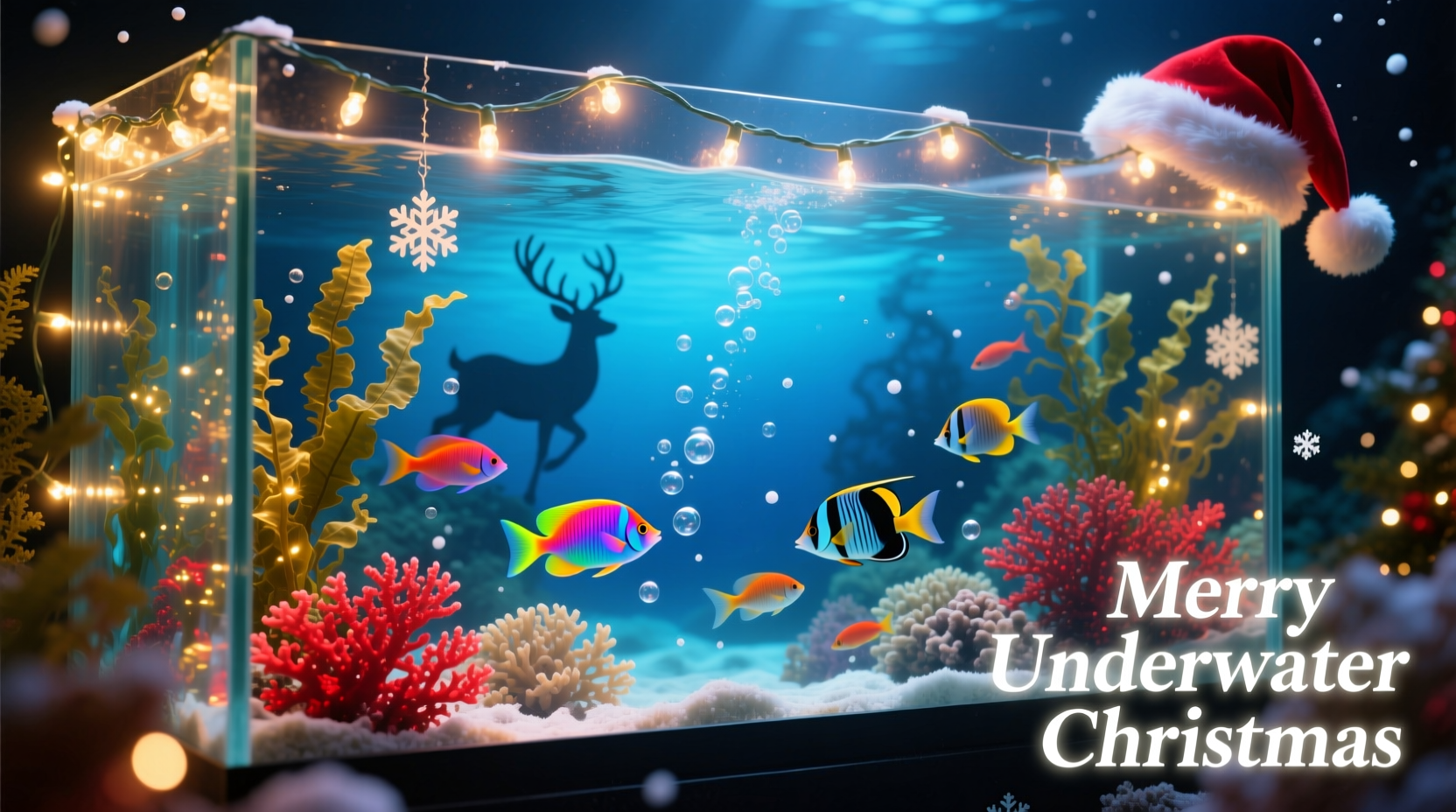
Aquariums are not decorative fountains. They’re precisely balanced ecosystems where water conductivity, temperature stability, and electrical isolation are non-negotiable. Tap water—even after dechlorination—contains dissolved minerals (calcium, magnesium, sodium) that make it a conductor of electricity. Pure distilled water is a poor conductor, but no home aquarium uses distilled water alone. The typical conductivity range for freshwater tanks is 200–1,500 µS/cm; saltwater tanks run 45,000–55,000 µS/cm. That level of conductivity transforms water into an efficient pathway for current leakage.
Most plug-in Christmas light strings operate at 120V AC (in North America) or 230V AC (in Europe). Even low-voltage LED sets marketed as “safe” often use AC-to-DC adapters that output unstable or unregulated current. Submerging any component—even a single bulb socket or frayed wire—creates immediate risk of electrocution to fish, invertebrates, and the aquarist during maintenance. More insidiously, micro-leakage from imperfectly sealed housings can introduce trace amounts of copper, lead, or plasticizers into the water column. These contaminants bioaccumulate rapidly: copper at just 0.03 ppm harms shrimp and snails; 0.1 ppm kills beneficial nitrifying bacteria. A single faulty light strand has been documented to crash a mature 40-gallon tank’s nitrogen cycle within 72 hours.
Tip: Never test “just one bulb” underwater—even briefly. If the light isn’t explicitly rated IP68 (fully submersible, continuous operation, marine-grade sealing) and certified for aquarium use by a recognized body (e.g., UL 1012, CE EN 60598-2-11), assume it is hazardous.Safer Alternatives: Lighting Technologies Designed for Aquatic Environments
The good news? You *can* achieve a captivating underwater holiday effect—without sacrificing safety. It requires using purpose-built equipment, not repurposed decor. Below is a comparison of viable options, ranked by safety, controllability, and visual impact:
| Lighting Type | Aquarium-Safe? | Max Submersion Depth | Holiday Use Notes |
|---|---|---|---|
| LED Aquarium Fixtures (e.g., AI Prime, Kessil H30, Fluval Flex) | ✅ Yes — fully integrated & sealed | Entire fixture designed for splash resistance; some models rated for partial submersion | Use programmable color modes: set slow red/green/cyan fades, simulate candle flicker, or run “snowfall” white pulses. Avoid intense blue spikes if keeping sensitive corals. |
| Dedicated Submersible LED Strips (e.g., Current USA Satellite Plus, Finnex Ray II) | ✅ Yes — IP68-rated, low-voltage DC (12–24V) | Rated for continuous submersion up to 3 meters | Mount behind acrylic backgrounds or under ledges—not directly in open water. Ideal for rim lighting or accenting hardscape. |
| Aquarium-Safe Rope Lights (e.g., Hygger RGB Submersible) | ✅ Yes — silicone-jacketed, epoxy-sealed LEDs | IP68, tested to 10m depth | Flexible, cuttable, remote-controlled. Use warm white + red/green presets. Avoid units with visible solder points or non-removable batteries. |
| Standard Battery-Powered Christmas Lights | ❌ No — battery compartment seals degrade; voltage fluctuates; no corrosion protection | Not rated for submersion | Even “waterproof” labels refer to rain resistance—not saltwater immersion. Batteries leak potassium hydroxide, which raises pH and poisons biological filters. |
| Plug-In Fairy Lights (with AC adapter) | ❌ No — risk of ground-fault, transformer failure, and stray voltage | Zero — never submerge | Can be used *outside* the tank (e.g., wrapped around stand legs or background frame), but must remain dry and grounded via GFCI outlet. |
A Real-World Example: How a Community Tank Achieved Festive Ambiance Safely
In December 2022, the “Evergreen Community Aquarium” in Portland, Oregon—a 120-gallon planted biotope housing harlequin rasboras, kuhli loaches, and Amano shrimp—wanted to host a holiday open house. Their goal: evoke a wintry forest floor underwater, with subtle light effects suggesting snow-dusted moss and frozen streams.
Instead of risky DIY solutions, they collaborated with a local aquarium technician to implement a layered approach:
- They installed two Current USA Satellite Plus 24” strips behind a custom-cut black acrylic backdrop, angled to project upward through driftwood roots.
- Using the fixture’s app, they programmed a 90-minute “dawn-to-dusk” cycle with a 20-minute twilight phase: fading from cool white (6500K) to deep indigo, then pulsing soft amber (2700K) every 12 seconds—simulating distant firelight.
- For surface sparkle, they added floating pinecone-shaped ceramic ornaments (glazed, lead-free, aquarium-safe) that caught ambient light reflections.
- No lights touched water. All wiring ran through a GFCI-protected power strip mounted 18 inches above the tank rim.
Over three weeks, water tests showed zero deviation in ammonia, nitrite, or copper levels. Fish behavior remained consistent; shrimp molted normally. Visitors described the effect as “serene, not kitschy”—a testament to restraint and technical precision. As aquarium curator Lena Torres noted afterward: “Festivity shouldn’t mean compromise. When your tank is a living system—not a vase—it demands respect for its boundaries.”
Step-by-Step: Creating Your Safe Underwater Holiday Effect
Follow this sequence to implement festive lighting responsibly. Do not skip steps—each addresses a critical safety or ecological checkpoint.
- Test Your Water First: Run full parameter tests (ammonia, nitrite, nitrate, pH, GH, KH, copper) 48 hours before introducing any new equipment. Ensure all readings are stable and within species-appropriate ranges.
- Select Only IP68-Rated, Low-Voltage DC Lights: Verify certification markings on packaging or manufacturer spec sheets. Cross-check against third-party databases like Aquatic Safety Labs’ verified product list.
- Inspect Before Installation: Examine seals for cracks, discoloration, or residue. Test lights *outside* the tank first using a multimeter to confirm no current leakage between terminals and casing.
- Mount Strategically: Place lights behind backgrounds, under hardscape overhangs, or along tank rims—never dangling into open water or near intake tubes. Maintain ≥2 cm clearance from heaters or pumps.
- Introduce Gradually: Run new lights for 2 hours on Day 1, 4 hours on Day 2, then full schedule by Day 4. Observe fish for stress indicators (rapid gilling, hiding, flashing) and test copper daily for first 72 hours.
- Maintain Rigorously: Wipe light housings weekly with vinegar-dampened cloth (not submerged); replace silicone seals annually; log all electrical additions in your tank journal.
Expert Insight: What Aquaculture Engineers Say About Holiday Modifications
Dr. Aris Thorne, Senior Electrical Engineer at the Monterey Bay Aquarium Research Institute and co-author of *Aquatic Systems Engineering Standards*, emphasizes that seasonal modifications expose common misconceptions:
“People assume ‘low voltage’ means ‘safe voltage.’ But in water, even 12V DC can cause lethal electrolysis if current paths form across gills—or corrode titanium heater elements over time. True aquarium safety isn’t about voltage alone; it’s about isolation integrity, material compatibility, and redundant fail-safes. A holiday light isn’t festive if it silently degrades your biofilter’s efficiency or stresses your fish’s immune response. Beauty and biology must coexist—not compete.” — Dr. Aris Thorne, Marine Systems Engineer
FAQ
Can I use solar-powered garden lights near my tank?
No. While solar lights eliminate wall outlets, their rechargeable NiMH or lithium batteries are not sealed against humidity. Condensation inside the unit leads to corrosion, voltage spikes, and eventual leakage of electrolytes into the air—then onto tank surfaces and into water via evaporation/condensation cycles. Additionally, most lack UV-stabilized lenses and degrade rapidly indoors, increasing failure risk.
What if I only use the lights for 30 minutes a day?
Duration doesn’t mitigate fundamental hazards. Electrolytic corrosion begins the moment current contacts water—even intermittently. A 30-minute exposure still introduces metal ions, disrupts microbial biofilms on substrate, and stresses fish neurology through unnatural photoperiod disruption. Consistency matters more than brevity.
Are fiber optic lights safe?
Yes—with caveats. Fiber optic systems separate the light source (dry, external illuminator) from the light-emitting ends (submerged fibers). Ensure the illuminator is rated for continuous operation and placed outside the tank’s splash zone. Avoid bundled fibers that trap heat; use only glass (not plastic) strands rated for aquatic use. Inspect fibers monthly for microfractures, which can channel moisture back to the illuminator.
Conclusion
Creating a holiday atmosphere in your aquarium isn’t about forcing terrestrial traditions into an aquatic space—it’s about honoring the unique beauty already present: the slow pulse of filter outflow, the gentle sway of java fern, the iridescent flash of a tetra turning in refracted light. When done thoughtfully, festive lighting enhances rather than overrides that natural rhythm. You don’t need blinking bulbs to celebrate wonder—you already steward it daily, drop by drop, fin by fin, breath by breath. So choose gear engineered for resilience, not repurposed for convenience. Prioritize the silent language of water chemistry over the fleeting glow of tinsel. And remember: the most magical underwater holiday effect isn’t manufactured—it’s witnessed. It’s the moment your shrimp emerges from moss after molting, unbothered and brilliant, under light that respects its world as deeply as you do.
💬 Your tank tells a story—what chapter will you write this season? Share your safe, creative holiday setups (with brand names and setup notes) in the comments. Let’s build a library of responsible inspiration—for aquarists who believe wonder and wisdom belong side by side.








