
As the holiday season approaches, many homeowners turn to string lights to bring warmth and cheer to their homes. Whether draping them across mantels, wrapping trees, or outlining rooftops, Christmas lights are a central part of festive decor. But what happens when your favorite strand burns out or you want to extend coverage using older sets? The natural temptation is to mix and match different types of light strands—incandescent with LED, 50-light with 100-light, or even vintage sets with modern ones. While this may seem harmless, doing so can pose electrical hazards, shorten the lifespan of your lights, or even create fire risks if not done correctly.
Understanding whether—and how—you can safely combine various Christmas light strands requires knowledge of voltage ratings, plug configurations, wattage limits, and manufacturer guidelines. This article breaks down the technical and practical aspects of mixing light types, offering clear guidance backed by electrical safety standards and real-world experience.
Understanding Christmas Light Types and Compatibility
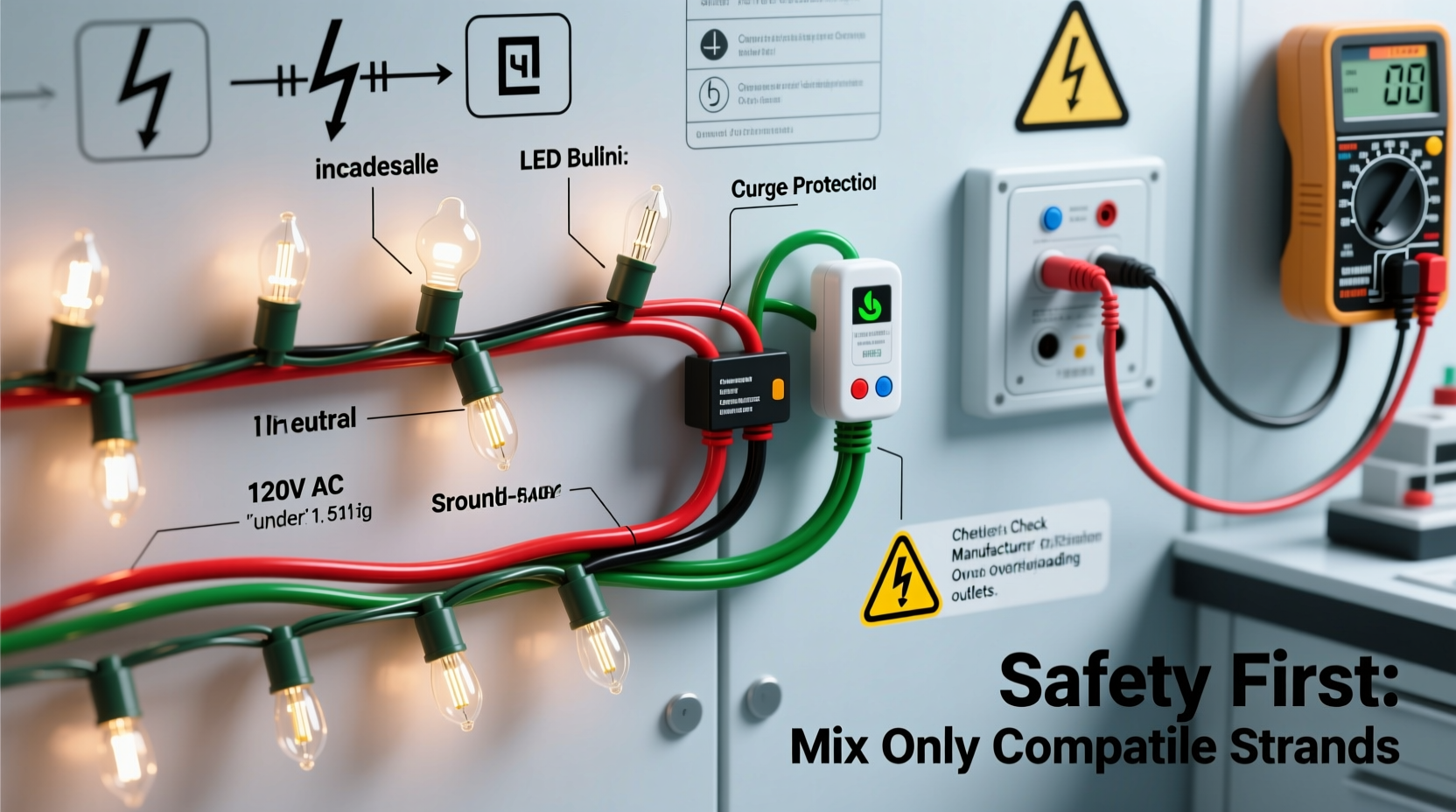
Not all Christmas lights are created equal. The two primary categories are incandescent and LED, each with distinct characteristics affecting brightness, energy use, heat output, and electrical load. Incandescent bulbs generate light by heating a filament, consuming more power and producing noticeable heat. LEDs (light-emitting diodes), on the other hand, are energy-efficient, run cooler, and last significantly longer.
These differences matter when connecting multiple strands. Most light strings are designed to be “connected” or “daisy-chained” up to a certain limit—typically three to five sets for incandescent, and up to 40 or more for LEDs, depending on the model. However, manufacturers design these limits based on uniformity: same voltage, same bulb type, and consistent wiring.
Mixing types disrupts this balance. For example, plugging an LED strand into an incandescent circuit may work initially, but differences in current draw and resistance can cause flickering, uneven brightness, or overheating at connection points. More critically, mismatched strands may exceed the amperage rating of the first set in the chain, leading to potential overload.
“Mixing incompatible light strands is one of the most common causes of holiday electrical issues. Even if it works at first, long-term stress on the circuitry increases failure risk.” — James Landon, Electrical Safety Inspector, NFPA Certified
Key Risks of Mixing Different Light Strands
The convenience of combining old and new lights must be weighed against several tangible dangers:
- Overloading circuits: Each strand has a maximum wattage and amp rating. When mixed types are daisy-chained, cumulative draw can surpass outlet or extension cord capacity.
- Voltage mismatches: Some older sets operate at lower voltages. Connecting them to modern 120V systems—even indirectly—can cause immediate burnout.
- Heat buildup: Incandescent lights generate heat. If combined with plastic connectors from LED sets not rated for higher temperatures, melting or short-circuiting can occur.
- Diminished lifespan: Mismatched electrical loads stress components, leading to premature failure in both old and new strands.
- Voided warranties and insurance: Using lights outside manufacturer specifications may invalidate product guarantees and complicate insurance claims in case of fire.
In extreme cases, improper chaining has led to house fires during the holidays. According to the U.S. Fire Administration, between 2016 and 2018, U.S. fire departments responded to an average of 160 home fires per year that began with Christmas trees, many involving decorative lighting.
Tip: Never mix light strands unless both are explicitly labeled as compatible by the manufacturer. When in doubt, use separate circuits or power strips.When It’s Safe (and Not Safe) to Mix Lights
Safety hinges on matching key electrical specifications. The table below outlines critical factors to consider before combining any two light strands:
| Factor | Safe to Mix? | Notes |
|---|---|---|
| Same brand, same series | ✅ Yes | Designed for daisy-chaining; follow included instructions. |
| LED + LED (different brands) | ⚠️ Sometimes | Check voltage, plug type, and max connectable count. Avoid mixing dimmable with non-dimmable. |
| Incandescent + Incandescent | ⚠️ With caution | Ensure same voltage and bulb count. Older sets may lack modern fuses. |
| LED + Incandescent | ❌ No | Different current draw and resistance. Risk of overheating or damage. |
| Different bulb counts (e.g., 50 vs. 100) | ✅ Only if same type | Must be same technology and within max series length. |
| Indoor + Outdoor rated | ⚠️ Only outdoors with care | Outdoor-rated cords can handle moisture, but indoor-only lights degrade quickly outside. |
One common misconception is that because two strands have the same plug shape, they’re automatically compatible. This is false. Plug compatibility does not imply electrical compatibility. Always check labels for terms like “connectable,” “linkable,” or “maximum sets allowed.”
Real Example: A Holiday Setup Gone Wrong
Consider Mark, a homeowner in Ohio, who wanted to decorate his large front porch with a combination of leftover incandescent C7 lights and new LED mini lights. Both had male-female ends and appeared similar. He connected three incandescent strands to one outlet, then added two LED strands to extend the run along the railing.
Initially, everything lit up. But after four hours, the third connector began to smoke. He unplugged the set and discovered melted insulation around the junction. An electrician later explained that the incandescent lights drew 0.5 amps per strand, while the LED controller introduced variable resistance. The mismatch caused excessive current at the weakest connection point, nearly starting a fire.
This scenario illustrates why visual inspection isn’t enough. Electrical harmony matters more than physical fit.
Step-by-Step Guide to Safely Combining Christmas Lights
If you need to use multiple light strands, follow this methodical approach to ensure safety and performance:
- Identify each strand’s specifications: Locate labels indicating voltage (usually 120V), wattage, amperage, and maximum connectable sets. Note whether they’re LED or incandescent.
- Separate by type: Group all LED strands together and incandescent separately. Do not intermix.
- Check for compatibility symbols: Look for icons showing linked strands or text like “Connect up to 5 sets.” This indicates safe daisy-chaining.
- Calculate total load: Add the wattage of all intended strands. For example, five 40-watt incandescent sets = 200 watts. Divide by voltage (120V) to get amps (~1.67A). Ensure this stays under 80% of a standard 15A circuit (i.e., under 12A).
- Use proper extension cords: Choose outdoor-rated, grounded (three-prong) cords labeled for the total load. Never run cords under rugs or through high-traffic areas.
- Test before full installation: Plug in the entire chain temporarily. Let it run for 30 minutes. Check connectors for warmth—if hot, disconnect immediately.
- Install with strain relief: Use clips or hooks to prevent pulling on connections. Gravity and weather can loosen plugs over time.
- Use timers or smart outlets: Limit runtime to 6–12 hours daily to reduce heat buildup and energy use.
By following these steps, you maintain control over electrical demands and avoid hidden risks that could compromise safety.
Expert Tips and Best Practices
Seasoned decorators and electricians recommend several strategies to simplify safe lighting without sacrificing creativity:
Tip: Label your light strands by type, location, and year of purchase. This makes future setup faster and safer.- Invest in modular systems: Brands like GE, Philips, and Home Accents offer interchangeable light platforms where different lengths and colors can be mixed safely within the same ecosystem.
- Use individual power sources: Instead of daisy-chaining, plug each strand or small group into a multi-outlet power strip with surge protection.
- Upgrade to all-LED: Over time, replace incandescent sets with LEDs. They’re safer to chain, use up to 90% less energy, and last 10x longer.
- Inspect annually: Before use, check for cracked sockets, frayed wires, or loose bulbs. Replace damaged sets immediately.
- Avoid adapters: Never use plug adapters to force incompatible connectors together. These bypass safety mechanisms.
“The safest string of lights is one that’s used within its intended design parameters. When people start ‘making things work,’ that’s when problems begin.” — Diane Patel, Consumer Product Safety Consultant
FAQ: Common Questions About Mixing Christmas Lights
Can I connect LED and incandescent lights if they’re on the same circuit?
Yes, but only if they are on separate runs plugged into different outlets or power strips. Never daisy-chain them together. Running them on the same circuit is fine as long as the total load doesn’t exceed breaker capacity.
Why do my mixed lights flicker?
Flickering often results from incompatible transformers (in LED sets), voltage drops due to overloading, or poor connections. It can also occur when mixing dimmable and non-dimmable LEDs on the same controller. Flickering is a warning sign—inspect and separate the strands.
How many light strands can I safely connect together?
For incandescent mini-lights: typically 3–5 sets. For LED mini-lights: often 20–40 sets, depending on the model. Always refer to the manufacturer’s label. When in doubt, use a power meter to measure actual draw.
Conclusion: Prioritize Safety Without Sacrificing Style
While the idea of mixing different Christmas light strands offers flexibility and nostalgia, it comes with real electrical risks if not approached carefully. Compatibility isn’t just about plug shapes—it’s about matching electrical behavior, respecting load limits, and adhering to manufacturer guidelines. By separating technologies, calculating loads, and using independent circuits when needed, you can achieve a dazzling display without compromising safety.
Holiday lighting should enhance joy, not introduce danger. Take the time to inspect, plan, and test your setup before the big reveal. Your family, your home, and your peace of mind are worth the extra effort.
💬 Have a lighting setup success story or lesson learned? Share your experience in the comments to help others decorate smarter and safer this season!








