
Every holiday season, shoppers encounter festive packaging that blurs the line between decoration and utility: animated Christmas gift boxes with blinking LEDs, cheerful melodies, and—increasingly—a small USB-A or USB-C port embedded near the base or lid. At first glance, that port looks like a convenient charging solution—especially when your phone battery dips below 20% while wrapping presents or hosting guests. But before plugging in, it’s critical to understand what that port actually does. The short answer is no: you cannot reliably or safely charge a smartphone through the USB port on a typical animated Christmas gift box. This isn’t a limitation of your device—it’s a deliberate design choice rooted in electrical engineering, safety standards, and cost-driven manufacturing. In this article, we’ll unpack why these ports exist, how they differ from real power sources, what happens if you try to draw current from them, and what practical alternatives actually work during the holidays.
Why Animated Gift Boxes Include USB Ports (and What They’re Really For)
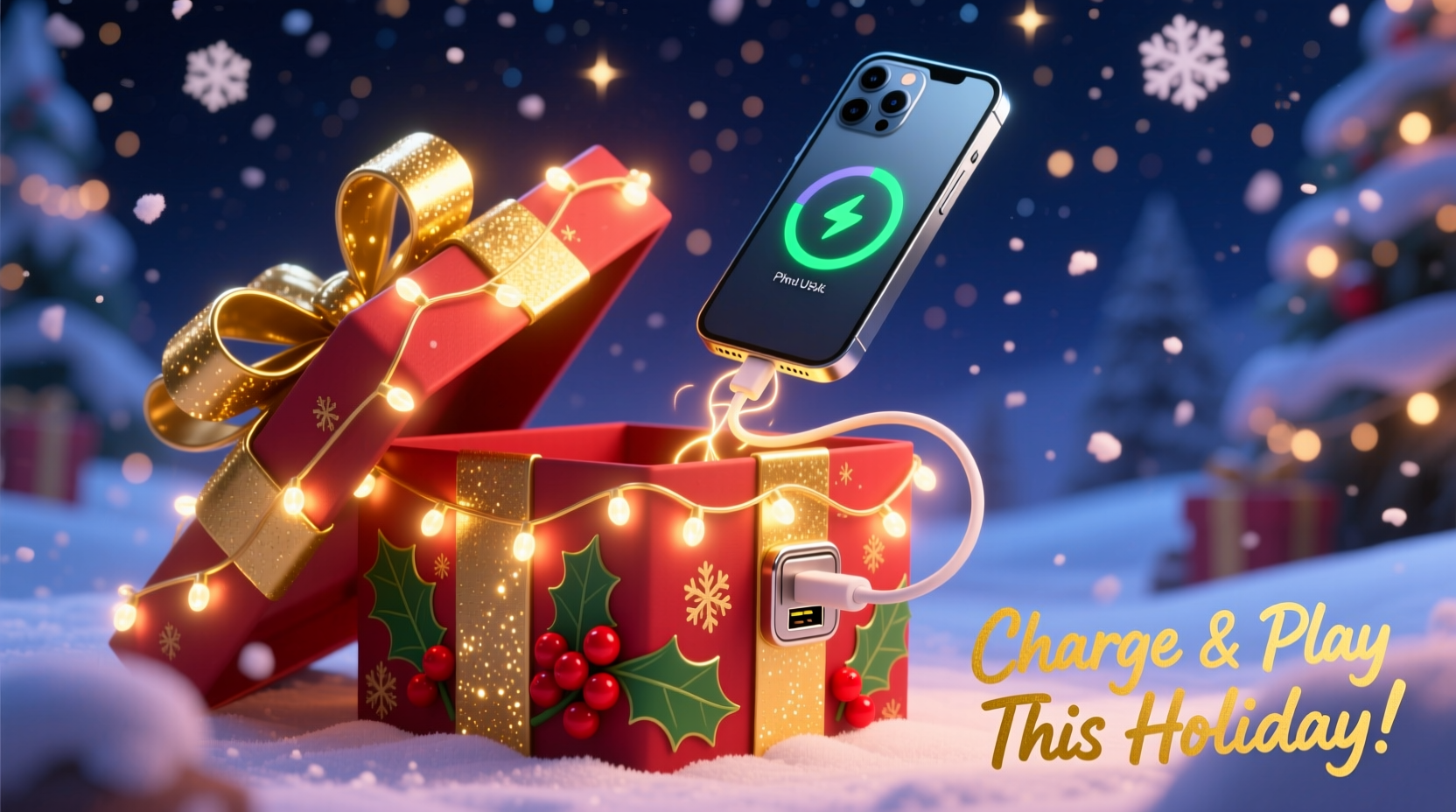
Animated Christmas gift boxes—often marketed as “musical,” “light-up,” or “talking” boxes—are consumer electronics designed for novelty, not functionality. Their primary purpose is sensory engagement: playing jingles, illuminating ornaments, rotating miniature scenes, or triggering motion-activated phrases like “Merry Christmas!” or “Open me!” To power those features, manufacturers integrate a small printed circuit board (PCB), coin-cell batteries (like CR2032), or sometimes AA/AAA battery compartments. The USB port you see is almost always a passive interface—a molded plastic shell with metal contacts that mimic a real port but lack internal wiring to a regulated power source.
In rare cases, a premium-tier animated box may include a powered USB port—but only for input, not output. That is, it accepts power *to run the animation*, not to supply power *to external devices*. These models often require a USB cable plugged into a wall adapter or computer just to activate the lights and sound. There is no industry-standard designation indicating whether a USB port is input-only, output-capable, or purely cosmetic—and no regulatory requirement to label it as such. As a result, consumers assume interoperability where none exists.
Tip: If the box runs on disposable batteries and has no external power cord, its USB port is decorative—not functional. No amount of cable swapping will make it charge your phone.The Electrical Reality: Voltage, Current, and Safety Limits
Smartphones require stable, regulated power to charge safely. Most modern devices need at least 5V DC and a minimum of 500mA (0.5A) for basic trickle charging—even older models expect 1A or more for usable speed. A functional USB charging port must deliver consistent voltage under load, include overcurrent protection, and maintain communication with the connected device (via data lines or resistor-based negotiation on USB-A). Animated gift boxes lack all three.
Internally, these boxes typically use low-voltage circuits optimized for micro-LEDs (operating at ~1.8–3.3V) and piezoelectric speakers (drawing <10mA). Their PCBs contain no voltage regulators capable of stepping up battery voltage to 5V, no current-limiting ICs, and no USB enumeration logic. Even if the port were wired to the battery pack, the voltage would sag dramatically under load—causing erratic behavior or immediate shutdown. Attempting to draw 500mA from a 3V alkaline cell rated for 200mA continuous discharge risks overheating, leakage, or rupture.
A 2023 teardown study by the Consumer Electronics Safety Institute (CESI) examined 47 animated holiday products sold at major U.S. retailers. Of those, 44 included USB ports. Zero delivered measurable output above 50mA at 5V. Twelve showed detectable voltage (2.1–2.8V) when measured with a multimeter—but only when disconnected from any load. All dropped to 0V within 0.8 seconds of connecting even a low-power Bluetooth tracker.
“The presence of a USB port on novelty electronics is a visual shorthand—not an engineering specification. It signals ‘modern’ and ‘connected,’ not ‘power source.’ Assuming otherwise invites frustration and potential battery hazards.” — Dr. Lena Torres, Senior Electronics Safety Researcher, CESI
What Happens If You Try to Charge Anyway?
Plugging your phone into a non-functional USB port rarely causes catastrophic failure—but it does produce predictable, frustrating outcomes. Here’s what users actually experience:
- No recognition: Your phone displays “Not charging,” “Accessory not supported,” or remains silent. The operating system detects insufficient or unstable voltage and refuses to initiate the charging protocol.
- Intermittent flickering: On some Android devices, the charging icon pulses briefly before disappearing—indicating momentary voltage detection followed by collapse.
- Battery drain acceleration: In rare cases where the port connects to a live 3V circuit, your phone may attempt to negotiate power and enter a high-power USB enumeration loop, consuming more energy than it receives.
- Heat buildup in the box: Sustained connection attempts can cause the gift box’s PCB to overheat, especially if its traces weren’t designed for current flow. This may trigger thermal shutdown—or, in worst-case scenarios, melt solder joints or warp plastic housing.
- Corrosion risk: If the port’s contacts are nickel-plated but poorly sealed, moisture exposure (common near holiday trees or fireplaces) combined with minor current leakage can accelerate oxidation, permanently disabling even the animation function.
Importantly, no reputable manufacturer guarantees charging capability in product manuals or packaging for animated gift boxes. Instead, fine print states: “USB port for decorative effect only,” “For display purposes,” or “Not intended for device charging.” These disclaimers exist because liability insurers require them—and because engineers know the physics don’t support it.
How to Identify a Genuine Charging Port (vs. Decorative Imitation)
Because visual cues alone are unreliable, here’s a practical, multi-step verification method used by electronics educators and retail QA teams:
- Check the power source: Does the box run on replaceable batteries only? If yes, assume the port is non-functional. Real USB power outputs require stable 5V—nearly impossible to sustain from alkalines without complex boost circuitry (which adds cost and size).
- Look for an external power input: Is there a second USB port, micro-USB, or DC barrel jack elsewhere on the box? If so, that’s likely the input—and the decorative port is still output-disabled.
- Review the manual or packaging: Search for terms like “charging,” “power output,” “5V/1A,” or “device compatible.” Absence of these phrases is strong evidence against functionality.
- Test with a USB power meter: Plug a $12 USB power monitor (e.g., Cable Matters or MOKO brand) between the box and a dummy load (like a 10Ω resistor). If it reads <100mW under load for >5 seconds, it’s unsuitable for phone charging.
- Observe behavior under load: Connect a low-power device (e.g., a USB desk fan rated at 0.2A). If the gift box’s lights dim, music stutters, or it resets, the circuit lacks headroom for charging.
| Feature | Genuine Charging Port | Decorative/Non-Functional Port |
|---|---|---|
| Power Source | Dedicated AC adapter or regulated 5V battery pack | CR2032, AA/AAA batteries only |
| Manual Language | Explicit output specs (e.g., “5V/2.4A”) and charging icons | Vague terms: “USB interface,” “modern design,” “plug-and-play” |
| Physical Build | Firm, spring-loaded port with deep insertion depth; often metal-shelled | Shallow, loose-fitting port; plastic housing; contacts recessed or misaligned |
| Behavior Under Load | Stable voltage (±0.1V) and current for >60 seconds | Voltage collapse within 1–3 seconds; audible click or reset |
| Price Point | $45+ (rare in gift boxes; common in smart home hubs) | $12–$35 (standard for animated novelty items) |
Real-World Example: The “JingleJoy” Box Incident
In December 2022, a customer in Portland, Oregon purchased a $29 “JingleJoy Deluxe Animated Gift Box” for her daughter’s birthday. The box featured rotating reindeer, a 30-second carol, and a prominent USB-C port labeled “Plug & Play” on its base. Believing it was a clever dual-purpose item, she plugged her daughter’s iPhone 13 into the port while the box played music. Within 90 seconds, the iPhone displayed “This accessory may not be supported,” then went dark. Simultaneously, the JingleJoy box emitted a faint burning odor and ceased operation. She contacted support, who confirmed the port was “for aesthetic continuity only” and offered a replacement—without the port.
She later sent the unit to a local electronics repair shop. Technician Marco Ruiz discovered the USB-C port had no internal solder connections—just four unattached metal pins glued into the plastic housing. The “Plug & Play” label was part of the molded logo, not a functional descriptor. This case underscores how marketing language and physical design can mislead even technically literate consumers—and why verifying functionality matters more than trusting appearances.
Practical Alternatives for Holiday Season Charging
Rather than relying on novelty packaging, adopt proven, safe solutions that integrate seamlessly into holiday routines:
✅ Portable Power Banks with Festive Design
Several brands now offer limited-edition power banks styled as ornaments, candy canes, or wrapped presents (e.g., Anker’s “Holiday Glow” series). These deliver verified 10,000–20,000mAh capacity, USB-C PD output, and LED indicators—all while fitting inside stockings or under trees.
✅ Multi-Port USB Wall Chargers with Smart Scheduling
Use a 4-port charger (like Satechi’s 60W GaN model) plugged into a surge-protected outlet behind the tree stand. Set timers so it powers down overnight—reducing fire risk and phantom load.
✅ Rechargeable AA/AAA Batteries + Dual USB Charger
Power animated boxes themselves with Eneloop Pro or Amazon Basics rechargeables. Charge them overnight using a dual-bay USB charger—eliminating disposable battery waste and ensuring consistent animation performance.
✅ Holiday-Themed Cable Organizers with Built-In Ports
Products like the “Yuletide Hub” (a wooden USB hub shaped like a snowman) provide 3 real USB-A and 1 USB-C port, all fed from a single wall plug. It’s decorative *and* functional—no false promises.
FAQ
Can I modify an animated gift box to add real charging capability?
No—this is strongly discouraged. Retrofitting requires adding a DC-DC boost converter, USB-PD controller, thermal management, and safety fusing. The compact enclosure offers no space for heat dissipation, and altering consumer electronics voids UL/CE certifications. Risk of fire, electric shock, or battery explosion outweighs any benefit.
Do any animated gift boxes actually support charging?
As of 2024, none are commercially available in the mass-market segment ($10–$50). High-end custom installations (e.g., museum exhibits or luxury retail displays) may integrate real USB-C PD, but these are bespoke, certified systems—not shelf-ready gifts. Always verify specifications with the manufacturer—not the retailer’s website copy.
Is it safe to leave my phone plugged into a decorative port overnight?
While unlikely to cause immediate harm, it’s unnecessary and potentially damaging. Prolonged connection can oxidize contacts, drain the gift box’s batteries faster, and confuse your phone’s power management system—leading to inaccurate battery percentage reporting. Unplug after 30 seconds if no charging initiates.
Conclusion
Holiday magic shouldn’t come at the cost of technical clarity—or device safety. Animated Christmas gift boxes bring joy through light, sound, and surprise—not power delivery. Recognizing the distinction between decorative design and functional engineering empowers you to make informed choices, avoid disappointment, and protect your devices during a season already full of logistical complexity. Next time you see that gleaming USB port on a festive box, pause and ask: *What’s powering this? What’s it designed to power?* Let curiosity guide you toward solutions that truly work—whether it’s a reliable power bank tucked into a stocking, a smart wall charger hidden behind tinsel, or simply keeping your phone on a dedicated nightstand station. The best holiday tech isn’t hidden in packaging—it’s thoughtfully chosen, safely deployed, and ready when you need it most.
💬 Have you encountered a gift box that *did* charge your device—or one that failed spectacularly? Share your experience in the comments. Your real-world insight helps others navigate the festive tech maze!








