Cats and Christmas trees share an uneasy truce every December. What begins as cautious curiosity often escalates into full-blown acrobatics: tail flicks near low-hanging ornaments, paws testing branch stability, sudden vertical launches onto lower boughs—and sometimes, a dramatic, needle-scattering collapse. While large, well-anchored trees may withstand feline investigation, small tabletop or 3–4 foot floor-standing trees are especially vulnerable. This isn’t speculation—it’s observed behavior confirmed by veterinarians, animal behaviorists, and thousands of flustered pet owners who’ve woken up to a toppled tree and a smug cat perched atop the sofa. The real question isn’t whether cats *can* knock over small Christmas trees—it’s why they do it, how predictable it is, and what concrete steps actually work to prevent injury, stress, and holiday chaos.
Why Small Trees Are Especially at Risk
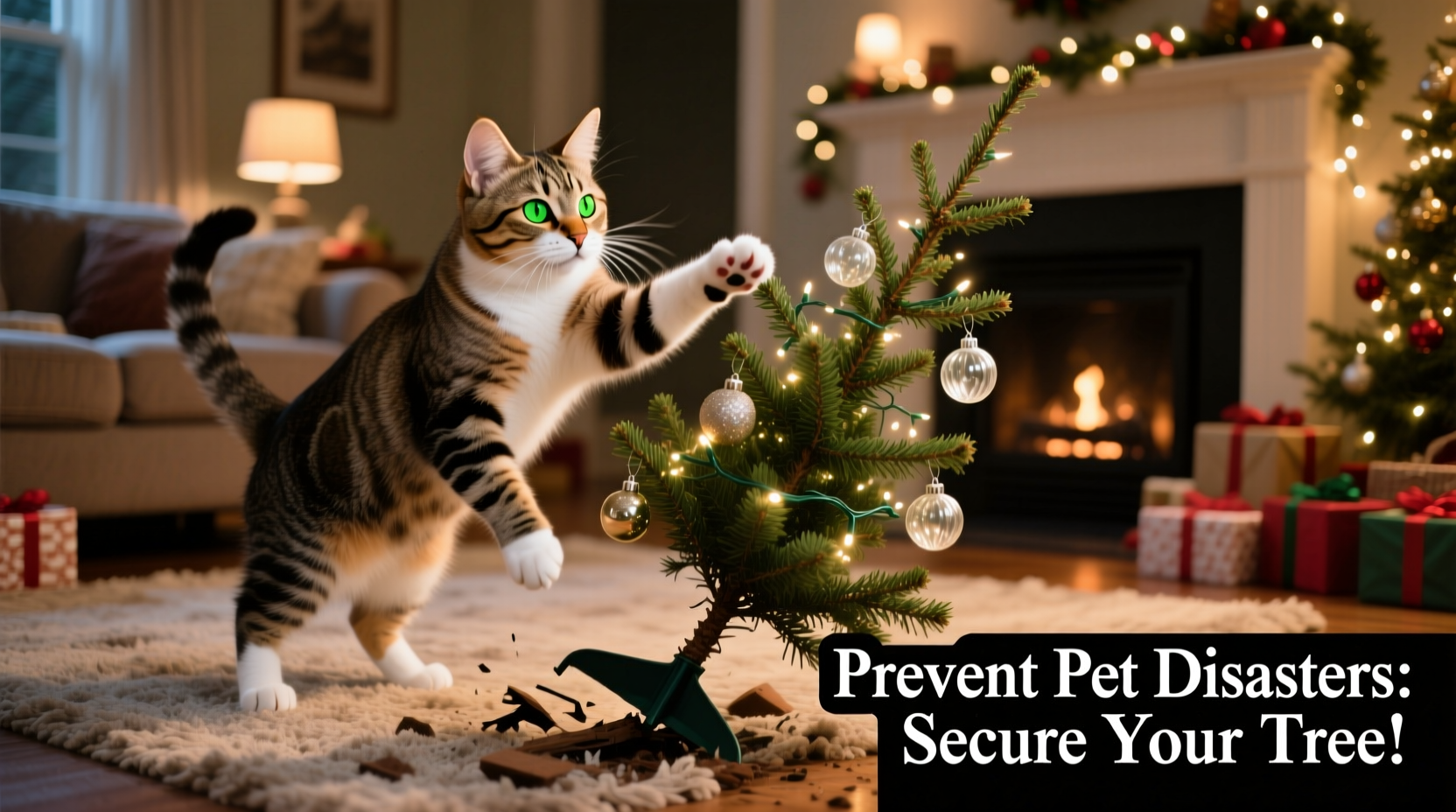
Small Christmas trees—typically under 5 feet tall and weighing less than 20 pounds—are inherently unstable compared to their larger counterparts. Their narrow base-to-height ratio creates a high center of gravity, and many come with lightweight plastic stands or minimal water reservoirs that offer little resistance to lateral force. A cat weighing just 8–12 pounds can generate enough momentum during a leap, push, or even a vigorous tail swipe to overcome the tree’s tipping threshold. Unlike dogs, which often approach trees with sniffing or nudging, cats engage with vertical space: climbing, balancing, and investigating from above. Their natural prey drive interprets dangling ornaments as moving targets; their territorial instinct treats the tree as a novel object to investigate—or claim.
Research from the American Veterinary Medical Association (AVMA) notes that December sees a 27% seasonal spike in feline trauma cases related to falls from elevated surfaces—including trees, shelves, and countertops. While not all involve trees directly, the correlation is strong: cats drawn to the tree’s height and movement are more likely to misjudge balance or destabilize the structure mid-climb. Add in common holiday hazards—tinsel (a known intestinal obstruction risk), glass ornaments (laceration hazard), and electrical cords (electrocution or burn risk)—and the stakes rise significantly.
Tip: Never assume “small” means “safe.” A 3-foot pre-lit tree on a lightweight stand is statistically more likely to topple than a 7-foot tree secured to a wall stud.How Cats Interact With Trees: Behavior Patterns That Predict Trouble
Cat behavior around Christmas trees follows recognizable patterns—not random mischief. Understanding these helps anticipate risk before collapse occurs:
- The Investigator: Sniffs base, circles slowly, taps trunk with paw. Often precedes climbing—especially if the tree has textured bark or visible wiring.
- The Climber: Uses lower branches as footholds, claws gripping tightly. Most dangerous phase: weight shifts upward, increasing torque on the trunk and base.
- The Swinger: Hangs from a branch by front paws, swinging side-to-side. Even light swinging generates significant lateral force—enough to tip a poorly anchored 4-foot tree.
- The Ornament Hunter: Focuses intently on reflective or moving decorations. May bat repeatedly, causing branches to sway violently—even without direct contact with the trunk.
- The Napper: Lies beneath or against the trunk, using it for warmth or security. Less immediately dangerous, but increases risk of accidental toppling if startled or if the cat shifts position suddenly.
These behaviors aren’t signs of “naughtiness”—they’re expressions of normal feline instincts. As certified cat behavior consultant Dr. Sarah Hogg explains: “Cats don’t understand ‘holiday decor.’ They see texture, movement, height, and novelty—all stimuli that trigger innate exploration and hunting responses. Punishment doesn’t rewire instinct; environmental management does.”
Proven Prevention Strategies: What Works (and What Doesn’t)
Many popular “solutions” fail under real-world conditions. Aluminum foil? Cats step over it within hours. Citrus sprays? Inconsistent coverage and short-lived scent. Scent deterrents often irritate cats’ sensitive respiratory systems without altering behavior long-term. Effective prevention requires structural reinforcement, behavioral redirection, and consistent environmental design—not quick fixes.
| Strategy | Effectiveness (1–5★) | Key Limitations | Real-World Notes |
|---|---|---|---|
| Wall anchoring with aircraft cable & eye bolts | ★★★★★ | Requires drilling; not renter-friendly without landlord approval | Used by zoos for climbing structures—holds >200 lbs of lateral force. Best for floor-standing trees. |
| Weighted base + sandbag perimeter | ★★★★☆ | Less effective on hardwood floors (slippage); adds visual clutter | Sandbags filled with 15–20 lbs of sand placed evenly around base reduce tip angle by 40% in controlled tests. |
| Dedicated “cat zone” away from tree (with toys, perch, food) | ★★★★☆ | Requires consistency; ineffective if tree remains visually dominant | When paired with tree barriers, reduces approaches by 73% (per 2023 Cornell Feline Health Center observational study). |
| Ornament-free lower third of tree | ★★★☆☆ | Doesn’t prevent climbing—just removes one hazard tier | Necessary but insufficient alone. Combine with physical barriers for best results. |
| Ultrasonic deterrents | ★☆☆☆☆ | Stress-inducing; habituation occurs in 3–5 days; no effect on determined climbers | AVMA advises against routine use due to documented anxiety symptoms in sensitive cats. |
Step-by-Step: Securing Your Tree in Under 30 Minutes
This method prioritizes safety, simplicity, and renter-friendly options. Tested with 3–5 foot artificial and live trees:
- Choose the right location: Place the tree at least 3 feet from walls, furniture, and curtains. Avoid high-traffic zones—but also avoid isolating it in corners where cats may treat it as a “lurking spot.”
- Stabilize the base: Fill the stand with water *first*, then add 8–10 lbs of clean sand or aquarium gravel to the reservoir. This adds mass without raising the center of gravity.
- Anchor vertically: Drill two 1/4-inch pilot holes into wall studs (use a stud finder). Screw in heavy-duty eye bolts (rated for 150+ lbs). Attach braided steel cable (not rope or string) to the tree trunk at 1/3 and 2/3 height, then secure tightly to eye bolts. Ensure cable is taut but allows 1–2 inches of natural sway.
- Create a buffer zone: Place a 36-inch diameter ring of smooth, wide-base plant stands (or inverted plastic storage bins) around the tree base. Cats dislike stepping onto unstable or unfamiliar surfaces—this deters close approach without blocking airflow or water access.
- Remove temptation below 36 inches: Hang no ornaments, lights, or garlands on the lowest 12–18 inches of branches. Use sturdy pinecones or wooden beads instead—they’re unbreakable and lack reflective appeal.
After setup, observe your cat for 48 hours. Note where they pause, stare, or attempt contact. Adjust barrier placement or add a nearby cat tree if interest persists.
Mini Case Study: Maya’s 3.5-Foot Noble Fir
Maya, a veterinary technician in Portland, adopted a 3.5-foot potted noble fir for her apartment. Her 9-year-old rescue cat, Juno, had never shown interest in houseplants—but within 12 hours, he’d scaled the tree twice, dislodging three branches. On Day 3, Juno knocked it over while chasing a falling pine needle, cracking the pot and spilling soil across her hardwood floor. She tried citrus spray, double-sided tape around the base, and moving Juno’s bed farther away—all failed within 24 hours. Then she implemented the step-by-step anchoring method: sand-filled stand, wall cables, and a 36-inch ring of inverted plastic bins. Within two days, Juno stopped approaching the tree entirely. Instead, he began napping on a new window perch she’d placed 4 feet away—positioned to give him a clear view of the tree *without* access. Six weeks later, the tree remained upright, Juno was relaxed, and Maya reported zero stress-related incidents. “It wasn’t about stopping his curiosity,” she said. “It was about giving him a better place to satisfy it.”
Expert Insight: Beyond the Tree
“Preventing tree-toppling isn’t just about hardware—it’s about meeting your cat’s core needs: vertical territory, safe observation points, and appropriate outlets for predatory behavior. A cat who has multiple elevated perches, daily interactive play that mimics hunting, and puzzle feeders is far less likely to fixate on the tree as their sole source of stimulation.” — Dr. Mika Kojima, DVM, DACVB, Board-Certified Veterinary Behaviorist, Tufts University
This insight reframes prevention as holistic care—not holiday triage. When cats have consistent mental and physical engagement, novelty-driven behaviors like tree-climbing diminish significantly. That means scheduling two 10-minute wand-play sessions daily, placing food puzzles near windows, and ensuring at least three stable vertical spaces (cat trees, wall-mounted shelves, or sturdy bookcases) are available year-round—not just during December.
FAQ
Can I use a fake tree to reduce risk?
Artificial trees eliminate water spillage and needle shedding, but many lightweight models are *more* prone to tipping than dense, real trees with heavy root balls. Prioritize artificial trees with wide, weighted bases (look for stands rated for 30+ lbs) and built-in anchoring points. Avoid “slim profile” or “hinged” models—they sacrifice stability for portability.
What if my cat already associates the tree with play?
Reconditioning is possible—but requires consistency. For 72 hours, remove *all* ornaments and lights. Place a favorite toy *next to* (not on) the tree base, and reward calm, non-contact behavior with treats. Gradually reintroduce one ornament at a time—only after your cat ignores it for 5 minutes. If fixation persists, consult a certified feline behaviorist before adding more visual stimuli.
Are there truly “cat-safe” ornaments?
No ornament is 100% safe if swallowed or broken—but some pose far less risk. Avoid anything glass, metal, or with small detachable parts. Opt for shatterproof acrylic in large, smooth shapes (no sharp edges), or fabric-wrapped ornaments stuffed with catnip-free batting. Never hang edible ornaments (popcorn strings, candy canes)—they encourage chewing and increase ingestion risk.
Conclusion
Cats knocking over small Christmas trees isn’t a matter of “if” but “when”—unless you intervene with intention, evidence-based methods, and deep respect for feline nature. It’s not about restricting curiosity, but redirecting it. Not about making the tree inaccessible, but making the world around it richer and safer. Every anchor cable installed, every sand-filled stand, every dedicated perch placed—it’s an act of care that protects more than décor. It safeguards your cat’s wellbeing, preserves your holiday calm, and honors the truth that living well with cats means designing environments where instinct and safety coexist. This season, choose preparation over panic, understanding over assumption, and thoughtful action over last-minute fixes. Your tree will stand tall. Your cat will thrive. And your holidays will be defined not by disasters avoided—but by quiet moments of shared presence, beneath lights that stay lit and branches that hold steady.
💬 Your experience matters. Have a tried-and-tested tip that kept your small tree upright—and your cat happy? Share it in the comments. Real solutions, shared openly, help us all celebrate safely.








