Every holiday season, millions of households unpack their artificial Christmas trees, bringing seasonal cheer without the mess of shedding needles. But while these trees are convenient, they often come with an invisible downside: dust. Stored in attics, basements, or garages for most of the year, artificial trees accumulate significant amounts of fine particulate matter—dust, mold spores, and even allergens—that become airborne when the tree is assembled indoors. This raises a practical question: Can air purifiers help reduce this dust effectively?
The short answer is yes—but with important caveats. Air purifiers can play a meaningful role in reducing airborne particles from artificial trees, especially when used strategically. However, their effectiveness depends on several factors, including the type of purifier, filter quality, room size, and overall cleaning practices. Understanding how these elements interact is key to maintaining cleaner indoor air during the holidays.
How Artificial Trees Contribute to Indoor Dust Levels
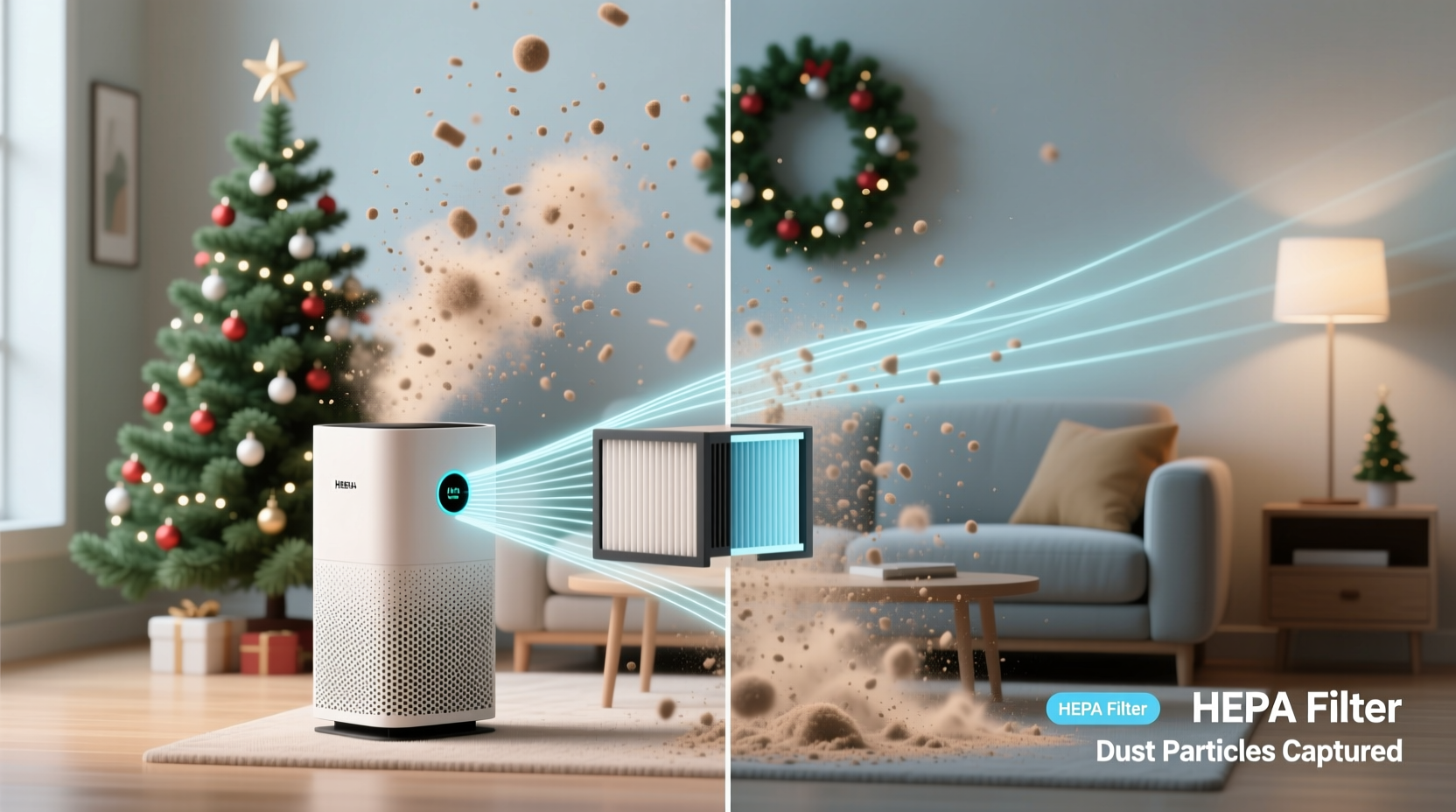
Artificial Christmas trees are typically made of PVC (polyvinyl chloride) or other synthetic materials. Over time, especially when stored in less-than-ideal conditions, these materials attract and retain dust, pet dander, and sometimes mold. When you unbox and assemble the tree, mechanical agitation dislodges these particles into the air.
A 2020 study published in the journal Indoor Air found that artificial trees stored in damp or dusty environments could release up to 30% more airborne particulates upon setup compared to clean-stored trees. These particles range in size from 0.3 microns (PM0.3) to over 10 microns (PM10), many of which are small enough to be inhaled deep into the lungs.
For individuals with allergies, asthma, or sensitivities to airborne irritants, this sudden spike in particulates can trigger symptoms such as sneezing, coughing, itchy eyes, or worsened respiratory function. Even for healthy individuals, excessive dust can contribute to a stuffy, less comfortable indoor environment.
Tip: Wipe down tree branches with a microfiber cloth before assembling to remove surface dust and reduce initial particle release.How Air Purifiers Work Against Tree Dust
Air purifiers combat airborne dust by drawing in room air and filtering out contaminants using various technologies. The most effective models for dust reduction use **HEPA (High-Efficiency Particulate Air) filters**, which are designed to capture at least 99.97% of particles as small as 0.3 microns.
Since much of the dust released from artificial trees falls within the 0.5 to 5-micron range, HEPA-equipped purifiers can significantly reduce these levels. As the purifier circulates air, it gradually removes suspended particles, improving indoor air quality over time. However, performance varies based on several technical and environmental factors.
Key Factors Affecting Purifier Effectiveness
- CADR (Clean Air Delivery Rate): Measures how quickly a purifier delivers clean air. Higher CADR values mean faster dust removal.
- Room Size Match: A purifier must be appropriately sized for the space. An undersized unit will struggle to keep up with particle load.
- Air Changes Per Hour (ACH): For dust control, aim for at least 4–5 ACH. This means the entire room’s air volume is filtered every 12–15 minutes.
- Filter Maintenance: A clogged or old filter loses efficiency. Replace filters according to manufacturer guidelines, typically every 6–12 months.
- Placement: Position the purifier near the tree but not blocked by furniture. Avoid corners where airflow is restricted.
“HEPA air purifiers are among the most reliable tools for reducing indoor particulate matter, especially during high-dust events like setting up seasonal decorations.�� — Dr. Laura Chen, Environmental Health Scientist, Harvard T.H. Chan School of Public Health
Types of Air Purifiers and Their Performance on Tree Dust
Not all air purifiers are equally effective against dust. Here's a comparison of common types and their suitability for handling dust from artificial trees:
| Type of Purifier | Dust Removal Efficiency | Best For | Limits |
|---|---|---|---|
| HEPA Filter | ★★★★★ (Excellent) | Capturing fine dust, pollen, mold spores | Does not remove odors; filters require replacement |
| Activated Carbon | ★☆☆☆☆ (Poor for dust) | Odor and VOC removal | Ineffective on particulates unless paired with HEPA |
| Electrostatic Precipitators | ★★★☆☆ (Moderate) | Reusable collection plates | Can produce ozone; efficiency drops if not cleaned regularly |
| Ionizers | ★★☆☆☆ (Low to moderate) | Quiet operation | May emit ozone; particles settle but aren’t removed |
| UV-C Light | ★☆☆☆☆ (Minimal) | Killing bacteria/viruses | No impact on dust particles |
For dust specifically, a standalone HEPA purifier—or a hybrid model combining HEPA with activated carbon—is the best choice. While carbon doesn’t trap dust, it helps neutralize any musty odors that may accompany older stored trees.
Step-by-Step Guide to Minimizing Tree Dust with an Air Purifier
Using an air purifier effectively requires more than just turning it on. Follow this timeline-based strategy to maximize dust reduction when setting up your artificial Christmas tree:
- Week Before Setup – Prepare the Space
Run your air purifier in the room where the tree will go for 2–3 days prior. This reduces baseline dust levels and improves air circulation readiness. - Day of Assembly – Control the Release
Assemble the tree outdoors if possible (e.g., garage with door open). If indoors, do so in a well-ventilated area and wipe each branch with a dry microfiber cloth to remove loose dust. - Immediately After Setup – Maximize Filtration
Place the HEPA air purifier within 3–6 feet of the tree, ensuring intake and exhaust vents are unobstructed. Set it to the highest safe fan speed for the first 2–4 hours. - First 24–48 Hours – Continuous Operation
Keep the purifier running continuously. Monitor air quality if your model has a sensor. Look for stabilization in particle counts. - Ongoing Maintenance – Weekly Checks
After the initial burst, switch to medium or auto mode. Check the filter monthly, especially during extended holiday use.
Real-World Example: The Johnson Family’s Holiday Air Quality Test
The Johnsons, a family of four in suburban Ohio, decided to test the impact of their air purifier during the 2023 holiday season. They own a 7.5-foot artificial tree stored in a plastic bin in their attic—a warm, occasionally humid space prone to dust accumulation.
Before assembly, they placed a portable air quality monitor (measuring PM2.5) in their living room and ran a mid-range HEPA purifier on low for two days. Upon assembling the tree indoors (wiping branches lightly), the monitor showed PM2.5 levels spiked from 8 µg/m³ to 47 µg/m³ within 30 minutes.
They immediately turned the purifier to high and kept doors closed. Over the next three hours, levels dropped steadily, reaching 12 µg/m³ by bedtime. By the second day, levels stabilized at 9 µg/m³—well within the EPA’s “good” air quality range.
Without the purifier, historical data from previous years showed sustained levels above 35 µg/m³ throughout the holiday period. The Johnsons reported fewer allergy symptoms and a noticeably fresher room smell.
Comprehensive Dust Reduction Checklist
To get the best results, combine air purification with proactive cleaning. Use this checklist when setting up your artificial tree:
- ✅ Store the tree in a sealed, dust-proof storage bag or container
- ✅ Wipe down each branch with a dry microfiber cloth before assembly
- ✅ Vacuum the floor and nearby surfaces after setup
- ✅ Choose a HEPA air purifier rated for your room size
- ✅ Place the purifier near the tree with clear airflow
- ✅ Run the purifier on high for the first few hours
- ✅ Replace or clean filters before and after the holiday season
- ✅ Consider pre-assembling the tree in a garage or outdoor space
Frequently Asked Questions
Do air purifiers eliminate all dust from artificial trees?
No single device eliminates all dust. Air purifiers significantly reduce airborne particles but work best when combined with physical cleaning. Surface dust must be wiped or vacuumed—it won’t become airborne long enough for the purifier to catch it all.
Can I use an air purifier with pets and children around?
Yes, but avoid models that generate ozone, such as some ionizers or electrostatic precipitators. HEPA purifiers are safe, quiet, and ideal for homes with kids and pets. Just ensure cords are secured and units are on stable surfaces.
How long should I run the air purifier after setting up the tree?
Run it continuously for the first 24 hours, especially on high speed. After that, switch to auto or medium mode. Continue daily operation during the holiday season for consistent air quality, particularly in homes with allergy sufferers.
Final Thoughts: A Proactive Approach to Cleaner Holiday Air
Artificial Christmas trees bring convenience and tradition, but they also introduce hidden dust challenges. While air purifiers alone aren’t a magic solution, they are a powerful component of a broader strategy to maintain clean indoor air.
When equipped with a true HEPA filter and properly deployed, an air purifier can reduce airborne dust from artificial trees by up to 80–90% within a few hours. Pairing this technology with simple habits—like wiping branches, storing the tree properly, and vacuuming nearby surfaces—multiplies the benefits.
This holiday season, don’t just decorate for comfort—decorate for health. Take control of your indoor air quality with a thoughtful combination of cleaning and filtration. Your lungs—and your guests—will thank you.
💬 Have experience using air purifiers with artificial trees? Share your tips, results, or questions in the comments—let’s help others enjoy cleaner, healthier holidays!








