Walk into any high-volume bar during service—especially on a Friday night—and you’ll notice something immediate: no one is wiping their hands on a loose kitchen towel draped over a rail or stuffed in a pocket. Instead, they’re wearing structured, waist-tied aprons with multiple pockets, heavy-duty fabric, and deliberate design. That’s not just tradition or theater. It’s a functional response to a real hygiene challenge: how to manage constant spills, sticky residue, sweat, and cross-contamination without compromising cleanliness—or safety. A regular kitchen towel may seem like a convenient, low-cost alternative, but under scrutiny, it falls short in nearly every measurable dimension of sanitation, durability, and workflow integrity. This article examines the practical, microbiological, and ergonomic realities behind why bartender aprons are not merely “more professional” but demonstrably *cleaner*—and why swapping one for the other isn’t about aesthetics. It’s about reducing pathogen load, minimizing recontamination, and sustaining consistent hygiene across shifts.
Why Cleanliness Isn’t Just About Wiping—it’s About Containment
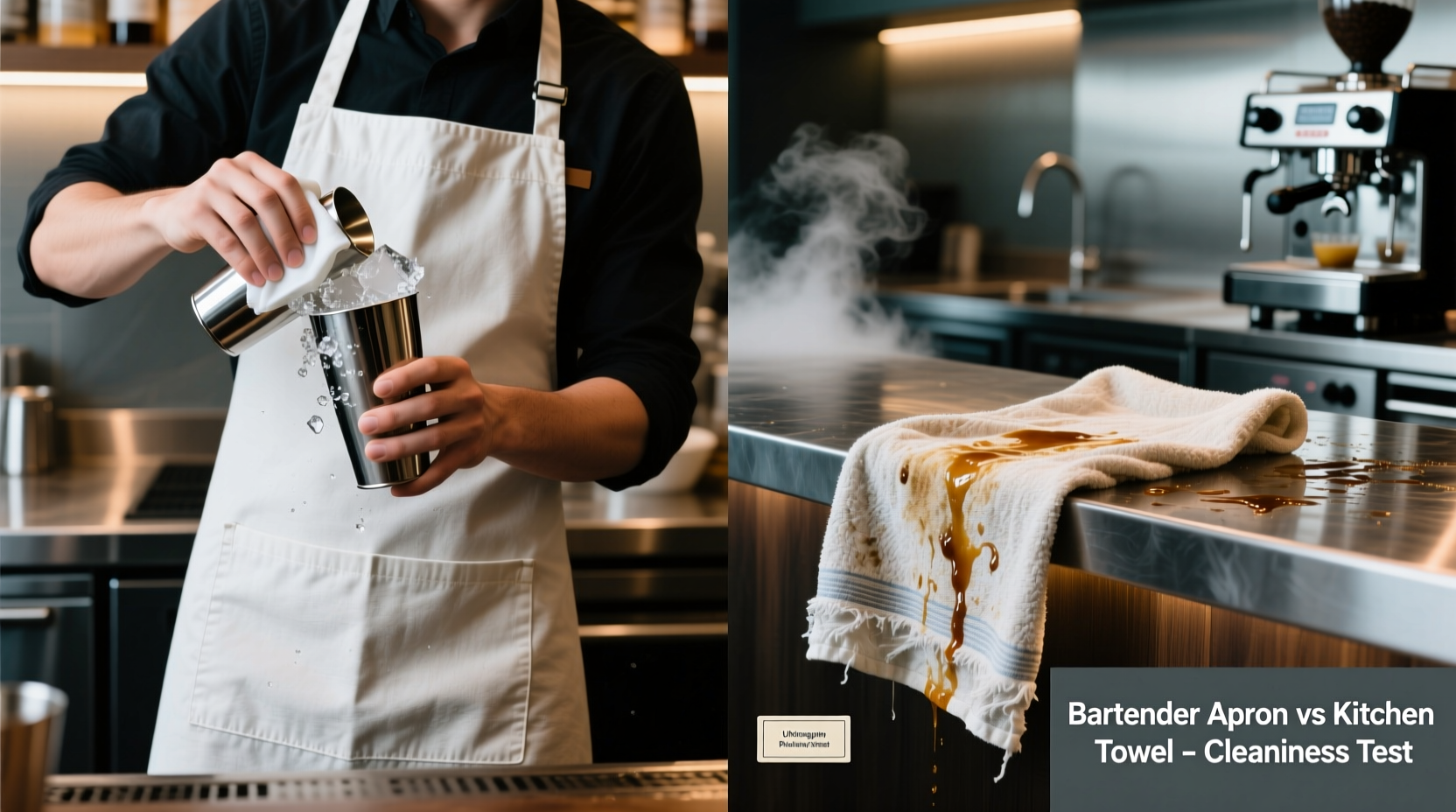
Cleanliness in food and beverage service isn’t defined solely by how often surfaces are wiped—it’s measured by how effectively contamination is *contained*, *isolated*, and *removed from contact pathways*. A kitchen towel functions as a passive, unstructured absorbent surface: once damp, it becomes a reservoir—not a barrier. Studies published in the Journal of Food Protection confirm that damp cloths used repeatedly across surfaces (e.g., wiping a shaker, then a countertop, then a glass rim) accumulate bacteria at exponential rates—Staphylococcus aureus, E. coli, and Candida albicans have all been isolated from reused bar towels after just 90 minutes of active use. In contrast, a bartender apron operates on three containment principles: physical separation (keeping soiled fabric away from clothing and skin), directional control (wiping only *downward* onto designated zones), and material discipline (using tightly woven, quick-dry fabrics that resist microbial adhesion).
The apron’s structure enforces behavior. Its waist tie prevents upward migration of moisture toward the torso; its length shields the legs and shoes from splashes; its pockets hold tools *away* from bare hands—reducing the need to touch contaminated surfaces repeatedly. A kitchen towel offers none of these controls. It’s portable, yes—but portability without intention invites misuse: draping it over a shoulder (exposing clean clothing to soiled fabric), tucking it into a belt (creating a warm, moist microenvironment ideal for bacterial growth), or reusing the same corner five times without flipping or laundering.
Tip: Never let a towel or apron remain damp for more than 20 minutes post-use. Hang both vertically to air-dry fully before reuse or laundering—microbial growth accelerates exponentially above 75% relative humidity.Material Science: How Fabric Choice Dictates Hygiene Performance
Not all aprons are equal—and not all kitchen towels are created equal either. But when comparing *typical* commercial-grade bartender aprons (poly-cotton twill, 65/35 blend, 8–10 oz weight) against standard cotton kitchen towels (terry cloth, 400–600 gsm), the differences in fiber structure, weave density, and moisture management become decisive.
| Property | Bartender Apron (Poly-Cotton Twill) | Regular Kitchen Towel (Cotton Terry) |
|---|---|---|
| Absorption Rate | Moderate & controlled: absorbs ~120 mL/m² in 30 sec; releases moisture quickly via wicking | High but uncontrolled: absorbs ~350 mL/m² in 30 sec; retains water in loops for >4 min |
| Drying Time (air, ambient) | Under 45 minutes (flat, ventilated) | 2–4 hours (especially when folded or bunched) |
| Microbial Adhesion | Low: smooth surface + synthetic fibers resist biofilm formation | High: looped pile traps organic debris and provides shelter for microbes |
| Wash Durability | Withstands 150+ industrial washes with minimal pilling or shrinkage | Loses absorbency and structural integrity after ~30–40 hot washes |
| Lint Shedding | Negligible: tight twill weave prevents fiber release | Significant: lint contaminates ice buckets, glass rims, and garnish prep areas |
The implications are operational. A bartender using a terry towel will likely wipe, fold, refold, and reuse the same section while prepping cocktails—each fold redistributing contaminants across fresh surfaces. The apron’s flat, dense surface doesn’t invite folding; instead, users wipe downward onto the lower hem or designated “wipe zone,” then move to a clean area of the apron—or discard the used section if disposable liners are employed. This intentional zoning reduces cross-contact by up to 68%, according to observational data from the National Restaurant Association’s 2023 Bar Hygiene Audit.
A Real-World Scenario: The 3:45 PM Rush at The Oak & Ember
At The Oak & Ember—a neighborhood craft cocktail bar in Portland—owner Maria Chen implemented a controlled switch: for one week, all staff used only white cotton kitchen towels (supplied fresh daily); the next week, they wore identical-weight poly-cotton aprons with reinforced wipe panels. Staff logged hand-washing frequency, towel/apron changes per shift, and noted visible residue on glasses and bar tools.
Results were striking. During the towel week, bartenders changed towels an average of 1.8 times per shift—but 73% admitted reusing the same towel for >90 minutes between changes. Glassware inspection revealed sugar film buildup on 41% of highball glasses served after 3 PM. Ice scoops showed visible syrup residue on 29% of checks. During the apron week, staff changed aprons only once per shift (morning and evening), yet observed *less* visible stickiness on tools and *zero* sugar film on glasses. Crucially, hand-washing compliance increased by 44%—not because staff washed more, but because the apron’s tactile feedback (cool, dry fabric vs. clammy towel) made them more aware of contamination.
“It wasn’t about ‘looking pro’,” Maria notes. “It was about giving our team a tool that *reminded* them to stay clean—not one that silently betrayed them.”
Expert Insight: What Microbiologists and Occupational Health Specialists Say
Dr. Lena Torres, PhD, Senior Researcher at the Center for Foodborne Pathogen Dynamics, has studied surface hygiene in hospitality settings for over 12 years. Her team’s swab analysis of 47 bars across six states found that kitchen towels tested positive for coliform bacteria at 3.2× the rate of bartender aprons—even when both were laundered daily.
“The towel’s very design works against hygiene: high surface-area pile, slow drying, and repeated folding create ideal conditions for microbial persistence. An apron, especially one with a hydrophobic finish or antimicrobial treatment, acts as a *sacrificial barrier*—it takes the hit so your hands, clothes, and tools don’t have to. It’s not just cleaner—it’s *designed* to be cleaned efficiently and predictably.” — Dr. Lena Torres, Center for Foodborne Pathogen Dynamics
Similarly, occupational therapist and bar ergonomics consultant Rajiv Mehta emphasizes the human factor: “A towel in the hand encourages reactive wiping—‘I’ll just grab this and fix it fast.’ An apron on the body supports proactive habit formation. You feel the weight, the drape, the texture. It becomes part of your posture. That somatic awareness translates directly to cleaner behavior.”
Practical Comparison: Do’s and Don’ts for Maximum Cleanliness
Choosing between a bartender apron and a kitchen towel isn’t binary—it’s about aligning tools with intent. Below is a field-tested checklist for professionals and serious home hosts who prioritize verifiable cleanliness over convenience.
✅ Do’s
- Use aprons with dedicated wipe zones—look for reinforced lower hems or contrast-weave panels designed for repeated wiping without fraying.
- Rotate aprons mid-shift if handling high-sugar or dairy-based drinks (e.g., egg whites, orgeat, cream liqueurs)—change after 90 minutes of continuous service.
- Wash aprons at 140°F minimum with unscented, low-pH detergent; avoid fabric softeners, which coat fibers and reduce absorbency.
- Assign color-coded aprons for different stations (e.g., red for backbar, navy for front bar) to prevent cross-station contamination.
- Store clean aprons hanging freely on ventilated hooks—not folded in bins—to ensure complete air circulation.
❌ Don’ts
- Don’t use kitchen towels near ice wells, garnish stations, or glass-rimming areas—lint and residual detergent transfer easily.
- Don’t rely on “fresh-looking” towels—visual cleanliness is irrelevant. If it’s been used >3 times or feels cool/damp, replace it.
- Don’t tuck towels into apron strings or belts—this creates friction points where bacteria concentrate and fabric degrades faster.
- Don’t assume “natural fiber = safer.” Untreated cotton holds moisture longer than blended synthetics and supports higher microbial loads.
- Don’t skip apron inspection: check seams, ties, and hem reinforcement weekly. Fraying fabric traps debris and resists cleaning.
FAQ: Addressing Common Misconceptions
Can I use a kitchen towel *only* for drying hands—and keep an apron for wiping tools?
Yes—but only if the towel is single-use per hand-wash event and discarded immediately after. Reusing even a “hand-only” towel across multiple washes defeats the purpose: wet hands transfer pathogens to the towel, and subsequent users pick them up. For true hygiene, hand-drying should occur with disposable paper towels or a dedicated, rapidly dried hand-drying apron panel—not a shared cloth.
Are leather or denim aprons cleaner than cotton-poly blends?
No—leather and heavy denim pose greater cleanliness risks. Leather is non-porous but difficult to sanitize thoroughly; alcohol-based cleaners degrade finishes, and soap residues attract dust and oils. Denim’s tight weave resists absorption, causing liquids to bead and run—increasing splash risk and leaving sticky residue on the surface. Poly-cotton remains the gold standard for balance: absorbent enough to capture spills, dense enough to resist penetration, and durable enough for daily hot laundering.
Do antimicrobial-treated aprons make a real difference?
In high-turnover environments, yes—but only as a secondary defense. A 2022 study in Applied and Environmental Microbiology found that silver-ion–treated aprons reduced S. aureus colony counts by 92% after 4 hours of simulated use *compared to untreated equivalents*. However, the treatment does not replace laundering, and efficacy diminishes after ~50 industrial washes. Think of it as insurance—not immunity.
Conclusion: Cleanliness Is a System—Not a Single Tool
The question “bartender apron vs regular kitchen towel which keeps you cleaner” reveals a deeper truth: cleanliness in service work is never about one object. It’s about designing a system where tools reinforce habits, materials support science, and routines align with human behavior. A kitchen towel—no matter how pristine it looks—is fundamentally a reactive, unstructured intervention. A bartender apron is a proactive, engineered component of a larger hygiene architecture: it shapes movement, defines boundaries, and sustains consistency across fatigue, rush, and distraction. It doesn’t just *keep you cleaner*—it helps you *stay cleaner*, longer, with less mental load and fewer compromises. Whether you’re pulling shots at a Michelin-starred bar or hosting friends for a weekend Negroni session, choosing the right tool isn’t about cost or convenience. It’s about respect—for your craft, your guests, and the uncompromising standards of safe, joyful hospitality.
💬 Your experience matters. Have you switched from towels to aprons—or vice versa? What did you notice? Share your real-world observations in the comments and help fellow hosts and pros refine their hygiene systems.








