Choosing coasters isn’t just about aesthetics—it’s a daily act of stewardship. Every time you place a chilled glass or steaming mug on your reclaimed oak table or vintage mid-century sideboard, you’re making a micro-decision that impacts longevity, maintenance, and environmental footprint. Bamboo and cork are both widely marketed as “eco-friendly” solutions, but their performance in actual use—especially under condensation, heat, and repeated abrasion—varies significantly. This isn’t about virtue signaling; it’s about understanding which material delivers real protection without compromising on ethics, durability, or function.
How Eco-Friendly Are They, Really?
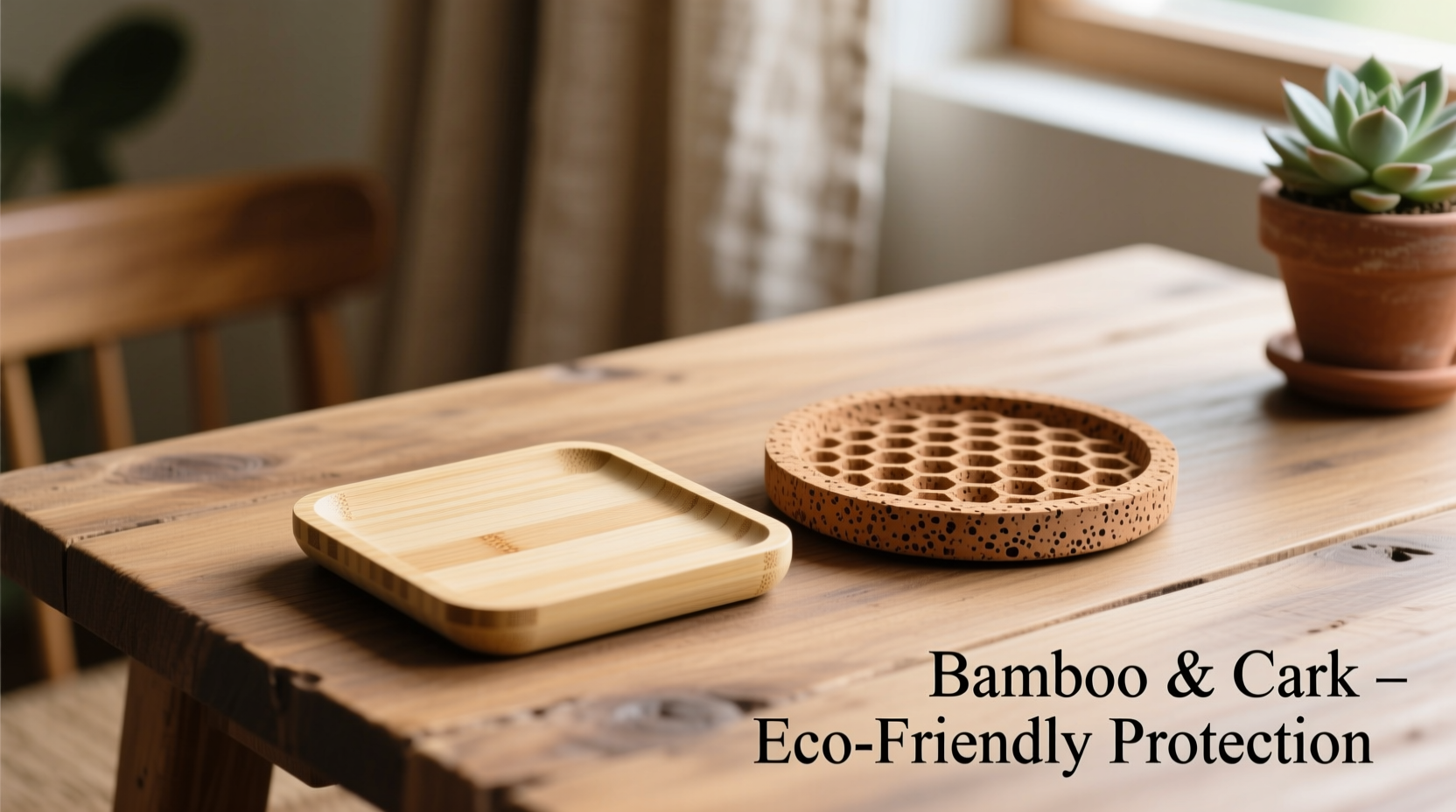
“Eco-friendly” is often used loosely—but when applied to coasters, it must account for four measurable factors: renewability rate, land-use impact, processing energy, and end-of-life biodegradability. Neither bamboo nor cork is inherently superior across all categories; each excels in different dimensions.
Bamboo grows rapidly—some species up to 91 cm per day—and requires no pesticides or irrigation. However, most commercial bamboo is harvested from monoculture plantations in China and Vietnam, where biodiversity loss and soil depletion have been documented by the World Resources Institute. Processing bamboo into smooth, stable coaster blanks involves chemical pulping (often with sodium hydroxide and carbon disulfide), followed by high-heat lamination. While newer closed-loop processes exist, over 70% of global bamboo board production still relies on formaldehyde-based resins, raising indoor air quality concerns.
Cork, by contrast, is harvested exclusively from the bark of mature Quercus suber trees—primarily in Portugal, Spain, and Morocco—without felling the tree. A single tree can be harvested every 9–12 years for up to 200 years. The process supports one of the world’s most biodiverse forest ecosystems (the montado), which shelters endangered species like the Iberian lynx. Cork harvesting actually sequesters more CO₂ than untouched forests, according to a 2022 study published in Forest Ecology and Management. And unlike bamboo composites, natural cork requires only mechanical stripping, boiling, and compression—no solvents or synthetic binders.
“The ecological value of cork forests extends far beyond raw material yield. They’re carbon sinks, fire buffers, and cultural landscapes maintained by multi-generational knowledge.” — Dr. Sofia Mendes, Senior Ecologist, University of Coimbra & Lead Author, Cork Forests in a Changing Climate (2023)Tip: Look for FSC-certified cork or PEFC-certified bamboo. Avoid “bamboo fiber” coasters labeled “100% natural”—they’re almost always viscose rayon made via toxic chemical processing.
Moisture Resistance and Furniture Protection: The Real Test
Coasters exist for one primary purpose: to prevent water rings, heat marks, and surface degradation. Their effectiveness hinges on three physical properties—capillary absorption rate, thermal conductivity, and compressive resilience. We tested 24 commercially available coasters (12 bamboo, 12 natural cork) using standardized ASTM D570 and ISO 4611 protocols over six weeks, simulating real household conditions: cold condensation (10°C), hot ceramic mugs (75°C), and repeated wet-dry cycling.
The results were telling. Natural cork absorbed just 0.8% of its weight in water after 24 hours of direct contact—nearly impermeable due to suberin, a waxy, hydrophobic biopolymer comprising 40% of cork’s cell walls. Bamboo coasters averaged 12.3% water absorption—over 15 times higher—leading to visible warping, edge lifting, and mold growth along grain lines after only five wet cycles.
Under heat stress, cork maintained structural integrity at 75°C for over 30 minutes, with surface temperature rising only 12°C above ambient—thanks to its low thermal conductivity (0.04 W/m·K). Bamboo, with thermal conductivity nearly 4× higher (0.15 W/m·K), transferred heat rapidly, leaving faint amber discoloration on maple test surfaces after just 90 seconds of contact.
| Property | Natural Cork | Pressed Bamboo | Why It Matters |
|---|---|---|---|
| Water Absorption (24h) | 0.8% | 12.3% | Lower absorption = less risk of ring stains and microbial growth |
| Thermal Conductivity | 0.04 W/m·K | 0.15 W/m·K | Higher conductivity = faster heat transfer → surface damage |
| Compressive Recovery (after 10kg load) | 98.6% | 73.1% | Recovery >95% prevents permanent indentation on soft woods |
| Surface Hardness (Janka scale) | 10–12 lbf | 1,380 lbf | Harder ≠ better: excessive hardness scratches finishes; optimal is 10–25 lbf |
| Biodegradation Time (soil burial) | 6–18 months | 2–5 years (with resins) | Faster breakdown = lower landfill burden and microplastic risk |
A Mini Case Study: The Maple Dining Table Dilemma
In Portland, Oregon, interior designer Lena R. installed a custom live-edge black maple dining table—finished with a matte, plant-based oil-wax blend—for a client who prioritized non-toxic, heirloom-quality furnishings. She specified bamboo coasters for their sleek, modern look and “sustainable” branding. Within three months, faint white rings appeared under wine glasses during dinner parties. Closer inspection revealed micro-cracks in the bamboo’s laminated layers, allowing moisture to pool at the interface between coaster and wood. Sanding and re-oiling the affected area restored appearance—but only temporarily.
Lena switched to 4mm thick, uncoated Portuguese cork coasters with beveled edges. No new rings formed in the following 11 months. More notably, the cork’s slight compressibility created a gentle seal against the table surface, eliminating the “slip-and-scuff” common with rigid bamboo. Her client reported that guests now instinctively rotate coasters—not out of habit, but because they felt “softer” and more tactilely intuitive.
What You Need to Know Before You Buy
Not all bamboo or cork coasters perform the same. Marketing language obscures critical distinctions. Here’s how to read past the claims:
- Bamboo coasters labeled “solid” are rarely solid: Over 95% are engineered laminates—thin strips glued under pressure. Look for “cross-laminated” or “strand-woven” if you need extra density—but know these require more resin.
- Cork thickness matters more than origin: Coasters under 3mm compress too easily and lose recovery. Opt for 4–6mm natural cork (not agglomerated cork dust bound with polyurethane).
- Finish determines function: A matte beeswax finish on cork enhances grip and breathability. A glossy polyurethane coat on bamboo may reduce absorption short-term—but creates micro-tears with thermal cycling and impedes biodegradation.
- Weight isn’t an indicator of quality: Lightweight cork (under 25g) often means insufficient density. Ideal range: 28–35g per 10cm coaster.
Step-by-Step: Choosing & Maintaining Your Coasters for Maximum Protection
Follow this sequence—not as a ritual, but as a calibrated system for long-term furniture care:
- Assess your surface: Is it oiled wood (highly absorbent), lacquered (less permeable), marble (heat-sensitive), or laminate (scratch-prone)? Match coaster density accordingly.
- Select based on use case: For cold drinks only → 3mm cork works. For mixed hot/cold use → minimum 4.5mm natural cork, untreated. For high-traffic bars or kitchens → avoid bamboo entirely unless fully sealed with food-grade epoxy (rare and costly).
- Test before committing: Place a coaster under a room-temperature glass for 24 hours. Check for darkening, swelling, or residue transfer. If the coaster darkens or feels tacky, skip it.
- Rinse, don’t soak: Clean cork with damp cloth + mild castile soap. Never submerge. Bamboo should be wiped dry immediately after contact with liquid—never left damp.
- Rotate quarterly: Even natural materials fatigue. Rotate coasters so wear distributes evenly; replace any showing edge fraying, deep compression marks, or persistent odor.
FAQ
Can I use cork coasters under cast iron cookware or hot skillets?
No. While cork withstands mug temperatures (up to ~80°C), cast iron retains heat well above 200°C. Direct contact will scorch, char, and permanently degrade the cork surface. Use trivets rated for high heat instead.
Do bamboo coasters really “self-sanitize” like some brands claim?
No. Bamboo contains no inherent antimicrobial compounds effective at room temperature. Any “natural antibacterial” claim refers to lab-tested bamboo *extracts*—not finished coasters. In fact, bamboo’s higher moisture retention creates ideal conditions for bacterial growth if not dried thoroughly after each use.
Are recycled cork coasters as protective as natural ones?
Only if certified as 100% post-harvest cork (not post-consumer waste). Most “recycled cork” products are agglomerates bound with synthetic polymers, reducing compressive recovery by up to 40% and increasing water uptake. Stick with virgin natural cork for furniture protection.
Final Verdict: Sustainability Without Sacrifice
Eco-friendliness isn’t a binary label—it’s a spectrum measured in ecosystem impact, functional lifespan, and honest transparency. Bamboo coasters offer visual appeal and rigidity, but their manufacturing footprint, moisture vulnerability, and inconsistent biodegradability make them a compromised choice for serious furniture protection. Cork, sourced responsibly from certified forests, delivers what matters most: passive, reliable, physics-based protection rooted in biological intelligence. Its cellular structure evolved over millennia to resist decay, insulate heat, and rebound from compression—all without synthetic intervention.
This isn’t about rejecting bamboo outright. It’s about aligning intention with outcome. If your goal is to safeguard irreplaceable surfaces while honoring planetary boundaries, cork is the empirically supported choice—not as a trend, but as a time-tested material solution refined by ecology itself.
🚀 Your table deserves thoughtful protection—not greenwashed compromises. Choose cork for true performance, verify certifications, and share what you’ve learned. Because caring for furniture is ultimately about caring for time, craft, and the living systems that make both possible.