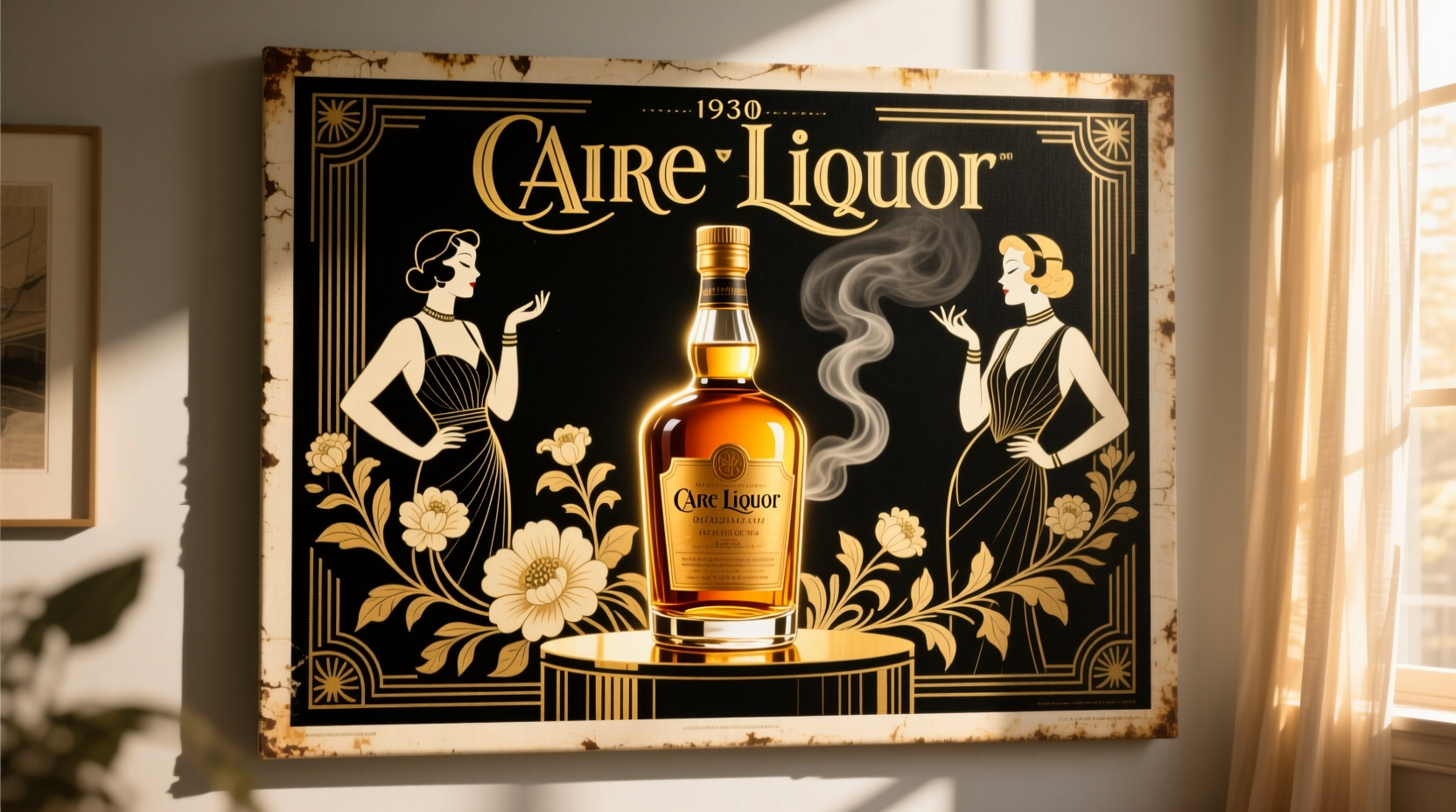
Vintage liquor advertisements—whether lithographed posters from the 1920s, enamel signs from the 1940s, or celluloid-coated cardboard displays from the 1950s—are more than decorative accents. They’re cultural artifacts: snapshots of design history, typography evolution, and shifting social attitudes toward alcohol, gender, and leisure. Collectors prize them for their graphic boldness, regional rarity, and storytelling power. Yet many owners unknowingly compromise their value—and visual impact—by hanging them where natural light pools most generously: above mantels, beside south-facing windows, or across sun-drenched gallery walls. The question isn’t whether fading *can* happen. It’s how fast it happens, which elements degrade first, and whether the damage is reversible—or preventable.
Why Sunlight Is the #1 Enemy of Vintage Print Integrity
It’s not heat or humidity alone that threatens vintage liquor ads—it’s the invisible, cumulative assault of ultraviolet (UV) radiation. Sunlight contains three types of UV rays: UVA (315–400 nm), UVB (280–315 nm), and UVC (100–280 nm). While atmospheric ozone blocks nearly all UVC, UVA and UVB penetrate glass and reach interior surfaces daily. These wavelengths carry enough photon energy to break molecular bonds in organic pigments, binders, and paper fibers.
Most vintage liquor ads were printed using pigment-based inks—often zinc white, chrome yellow, cadmium red, or organic aniline dyes—on substrates like wood-pulp paper, linen-backed poster stock, or thin tinplate. Unlike modern archival inks (e.g., pigment-based inkjet inks rated for 100+ years under museum conditions), early 20th-century inks lacked UV stabilizers. Their chromophores—the parts of molecules responsible for color—absorb UV light and enter excited states. Over repeated cycles, this leads to photochemical oxidation: irreversible cleavage of conjugated double bonds, resulting in color loss, yellowing, or hue shifts (e.g., deep cobalt blue turning slate gray).
Crucially, fading isn’t uniform. Reds and purples vanish fastest—anthraquinone and azo dyes are especially photosensitive. Blues follow closely. Yellows and greens often persist longer but may shift toward olive or khaki as underlying pigments degrade at different rates. Black ink (typically carbon-based) remains stable, which is why faded ads often retain crisp outlines while losing vibrancy in flat-color fields.
Tip: If your ad hangs near a window, test UV exposure with a simple method: place a small piece of UV-sensitive paper (or even a postcard with known color saturation) beside it for 30 days. Compare side-by-side with an identical sample kept in total darkness—if noticeable fading occurs, your display location is unsafe.Material Matters: How Substrate Determines Fade Resistance
The support material doesn’t just hold the image—it mediates how UV energy interacts with the ink layer. Below is a comparative overview of common vintage liquor ad substrates and their real-world vulnerability to sunlight:
| Substrate Type | Fade Risk (1–5) | Key Vulnerabilities | Typical Era |
|---|---|---|---|
| Uncoated wood-pulp paper posters | 5 | High acidity accelerates yellowing; ink sits on porous surface, increasing UV penetration; prone to cockling and fiber embrittlement | 1900–1930s |
| Linen-backed paper posters | 4 | Backing adds structural stability but doesn’t block UV; adhesive layers can yellow and migrate into print surface over decades | 1920s–1950s |
| Enamel-on-tin signs | 2 | Glass-like vitreous coating resists UV well; fading occurs only if enamel chips or degrades at edges; rust underneath can bleed through | 1930s–1960s |
| Cellulose acetate (early “plastic”) overlays | 5 | UV causes plasticizer migration and hydrolysis—leading to brittleness, clouding, and vinegar syndrome (acetic acid off-gassing) | 1940s–1950s |
| Lithographed cardboard displays | 4.5 | Thin board absorbs moisture and UV readily; printed inks sit atop low-opacity coatings; corners curl and fade faster than centers | 1950s–1970s |
Note: “Fade Risk” reflects observed degradation in controlled environmental studies (e.g., Smithsonian Museum Conservation Institute accelerated aging tests) and collector field reports—not theoretical ratings. Enamel signs score lowest because their fused glass surface scatters and reflects UV rather than absorbing it. Paper-based items score highest because they combine chemical instability (acidic lignin, reactive sizing) with physical porosity.
A Real Collector’s Experience: The Case of the “Old Grand-Dad” Poster
In 2019, Chicago-based collector Rafael Mendoza acquired a 1947 “Old Grand-Dad Bourbon” poster—18×24 inches, original lithograph on uncoated paper, with vibrant red lettering and a sepia-toned portrait of a bearded distiller. He hung it in his home office, centered on a north-facing wall adjacent to a large double-hung window. Though north light is cooler and less intense than southern exposure, the window lacked UV-filtering film, and afternoon sun angled directly onto the frame for 90 minutes each weekday.
Within 11 months, Rafael noticed subtle changes: the rich crimson of the bourbon bottle illustration had dulled to a dusty rose, and the sepia portrait had developed a faint yellow halo around its perimeter. By month 18, the red had shifted noticeably toward orange-brown, and fine cracks appeared in the paper’s upper left corner—where thermal expansion from solar gain was greatest. A conservator at the Midwest Paper Preservation Lab examined a microscopic cross-section and confirmed photo-oxidation of the organic red pigment, compounded by localized pH drop (from 6.2 to 4.8) due to acid migration from framing matboard.
Rafael relocated the poster to a climate-controlled display cabinet with LED lighting (UV output < 0.1 µW/lm) and replaced the acidic mat with 100% cotton rag board. After two years, no further fading occurred—and the existing damage stabilized. His takeaway: “I thought ‘north light’ meant ‘safe light.’ I learned the hard way that *any* direct or reflected sunlight is active deterioration—not passive aging.”
Proven Protection Strategies: What Actually Works (and What Doesn’t)
Not all preservation methods deliver equal results. Some popular assumptions—like “framing with regular glass is enough”—are dangerously misleading. Here’s what conservation science confirms works, ranked by efficacy:
- UV-filtering glazing: Acrylic (e.g., Optium Museum Acrylic®) or glass (e.g., Tru Vue® Conservation Clear) that blocks ≥99% of UV radiation below 400 nm. This is the single most effective intervention—reducing fade rate by up to 85% compared to standard float glass.
- Controlled illumination: Using only LED sources with correlated color temperature (CCT) ≤ 3500K and zero UV emission. Avoid halogen, fluorescent, or unshielded track lighting—even indirect bounce light contributes cumulative dose.
- Environmental buffering: Maintaining stable relative humidity (40–50% RH) and temperature (18–22°C). Fluctuations accelerate hydrolytic degradation, especially in paper and adhesives.
- Physical barriers: Closing blinds or curtains during peak UV hours (10 a.m.–4 p.m.), even on cloudy days—up to 80% of UV penetrates cloud cover.
- Rotation schedule: Displaying originals for no more than 3 months per year, then storing in dark, inert boxes with acid-free tissue interleaving.
What *doesn’t* work: Regular picture-frame glass (blocks only ~40% UV); “museum glass” without verified UV specs (many brands mislabel); applying varnish or spray fixative (can yellow, craze, or chemically interact with historic inks); storing in attics or basements (extreme RH swings); or assuming digital scans replace physical preservation needs.
“Fading is photochemical, not optical—it’s molecular decay, not dust accumulation. Once a chromophore breaks, no cleaning, no restoration, no digital enhancement brings it back. Prevention isn’t precautionary; it’s the only ethical choice for stewardship.” — Dr. Lena Cho, Senior Paper Conservator, Library of Congress Conservation Division
Your Action Plan: A 5-Step Timeline to Preserve Your Ads Long-Term
Preservation doesn’t require a museum budget—just intentionality and incremental action. Follow this realistic, calendar-based plan:
- Week 1: Audit & Document
Photograph each ad front and back with a color-calibrated camera. Note current condition: color fidelity, surface texture, edge integrity, and any existing fading or stains. Record exact display location, window orientation, and daily sun exposure duration. - Week 2–3: Upgrade Glazing
Remove each framed ad. Replace standard glass/acrylic with certified UV-filtering glazing (look for ASTM D4303 or ISO 18902 compliance). Use spacers to prevent direct contact between glazing and print surface. - Month 2: Optimize Lighting
Install dimmable, warm-white LEDs (≤3000K) positioned to avoid direct beam paths onto artwork. Add blackout roller shades with UV-blocking fabric (e.g., 99% UV-rated polyester blend) on all sun-facing windows. - Month 3: Reframe Strategically
Use 100% cotton rag matboard (pH 7–8.5) and backing board. Avoid wood pulp, foam core, or adhesives containing lignin or sulfur. Mount using Japanese tissue hinges and wheat starch paste—not pressure-sensitive tape or glue dots. - Ongoing: Rotate & Monitor
Set calendar reminders to rotate displayed pieces every 90 days. Store rotated ads flat in acid-free Solander boxes, interleaved with buffered tissue, in a dark closet maintained at stable temperature/humidity. Re-photograph annually to track change.
Frequently Asked Questions
Can I restore faded colors on a vintage liquor ad?
No—not authentically. Conservators never retouch or repaint original printed areas. Restoration focuses on structural stabilization (tear repair, deacidification, flattening) and aesthetic compensation only for losses (e.g., filling a hole with reversible watercolor that matches surrounding tone—but never altering intact pigment). “Color restoration” is commercial reprinting, not conservation.
Do LED lights really make a difference if they’re bright white?
Yes—provided they’re properly engineered. “Bright white” refers to luminance (measured in lumens), not spectral output. Quality museum-grade LEDs emit virtually no UV and minimal violet/blue light (400–450 nm), which also contributes to fading. Always verify manufacturer specifications: look for “UV-free,” “< 0.1 µW/lm UV output,” and third-party testing reports—not just marketing claims.
Is it safe to hang vintage ads in bathrooms or kitchens?
No. High humidity (common in both spaces) promotes mold growth on paper substrates and accelerates metal corrosion in enamel signs. Steam and airborne grease particles also deposit on surfaces, attracting dust and creating micro-environments for chemical reactions. Even with exhaust fans, short-term spikes in RH exceed safe thresholds for historic paper (max 60% RH, ideally 40–50%).
Conclusion: Honor the Past by Protecting Its Presence
Vintage liquor ads are time capsules rendered in ink and substrate—each one a deliberate artifact of craftsmanship, commerce, and cultural moment. To hang them in sunlight is not merely to risk aesthetic diminishment; it is to consent to the slow erasure of historical evidence. Fading isn’t cosmetic—it’s chemical amnesia. The good news is that meaningful protection is accessible, affordable, and deeply respectful. You don’t need climate-controlled vaults or six-figure framing budgets. You need awareness of UV’s silent impact, commitment to incremental upgrades, and the quiet discipline of rotation and monitoring. Every poster you shield today retains its chromatic truth for future collectors, historians, and designers who will study mid-century typography, regional branding, or the visual language of American leisure. Your care becomes part of the object’s provenance—a legacy written not in pigment, but in stewardship.
💬 Have you preserved a vintage ad through thoughtful display? Share your setup, materials used, or lessons learned in the comments—your experience could help another collector safeguard a piece of design history.








