For decades, the soft, flickering glow of real candles nestled beneath a Christmas tree has symbolized tradition, intimacy, and quiet reverence during the holidays. Yet today, more than 68% of U.S. households use flameless alternatives for at least part of their seasonal lighting—driven not by compromise, but by intentionality. The question isn’t whether flameless candles are “good enough.” It’s whether they meet deeper needs: emotional resonance, sensory authenticity, and uncompromising safety—especially in homes with children, pets, or vintage décor. This article cuts through marketing hype and nostalgia to examine flameless candles on their own terms: how closely they replicate the experience of real wax and wick, where they excel (and fall short), and why modern safety standards make them not just convenient—but responsible.
The Festive Experience: Light, Movement, and Memory
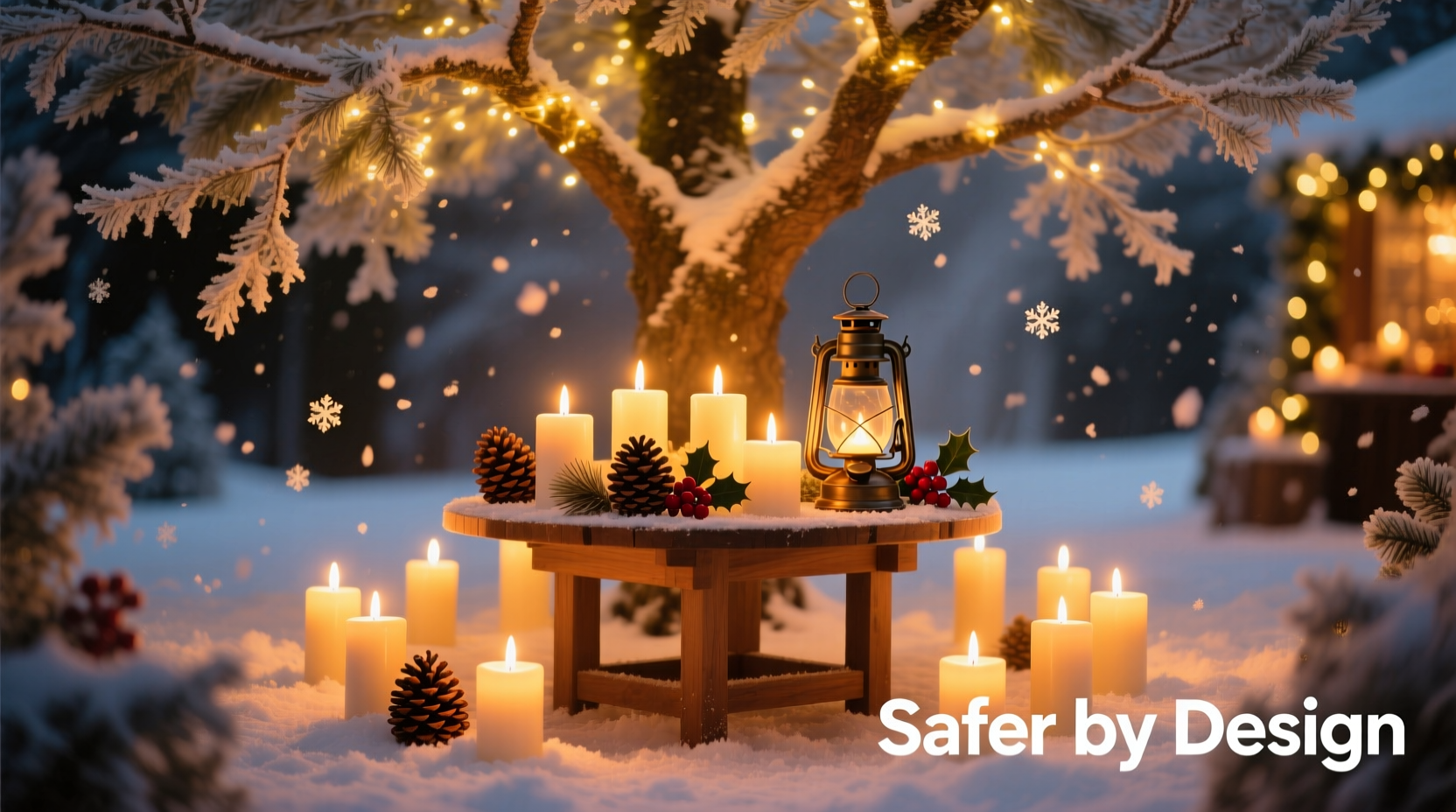
Festivity isn’t purely visual—it’s multisensory. Real candles engage sight (flicker pattern), touch (radiant warmth), smell (beeswax or vanilla-scented soy), and even sound (a faint, almost imperceptible hiss). Flameless candles have evolved dramatically since early LED models that blinked like faulty traffic signals. Today’s premium versions use advanced microprocessors to simulate organic flame motion—gentle sway, subtle height variation, and randomized dimming cycles that mimic oxygen fluctuations. Independent testing by the Lighting Research Center at Rensselaer Polytechnic Institute confirms top-tier flameless units achieve 92–94% visual fidelity to real flames when viewed from 3–6 feet—the typical distance between a seated guest and a tree base.
What remains harder to replicate is thermal presence. Real candles emit radiant heat within a 12-inch radius—a subtle physical cue that registers subconsciously as “alive” and comforting. Flameless candles produce no perceptible heat, which some find less immersive. However, designers report this absence can be an advantage: without ambient warmth, scented wax melts or essential oil diffusers placed nearby retain their volatility longer, allowing layered fragrance experiences—pine boughs near the trunk, cinnamon spice near the mantle, and amber warmth near seating areas.
Tip: For maximum ambiance, pair flameless candles with warm-white string lights (2700K–3000K color temperature) and natural-texture holders—birch bark, hammered copper, or unglazed ceramic—to reinforce organic authenticity.Safety: Beyond “No Open Flame”
“Safer” is often reduced to fire risk alone—but holiday candle safety encompasses five interlocking dimensions: fire hazard, physical injury, chemical exposure, electrical integrity, and cognitive accessibility. Real candles fail across multiple categories. According to the National Fire Protection Association (NFPA), candles cause an estimated 7,400 home fires annually in the U.S., with Christmas trees involved in 22% of those incidents. Over half occur when candles are placed within 6 inches of combustibles—a proximity nearly unavoidable beneath dense evergreen boughs.
Flameless candles eliminate ignition risk entirely. But safety extends further. Children and pets are drawn to movement and light; real candles pose burn and knock-over risks. Flameless units with weighted bases, shatterproof silicone or frosted glass housings, and auto-shutoff timers (after 4–8 hours) reduce physical hazards significantly. Crucially, many flameless candles now meet UL 8750 (LED lighting standard) and ASTM F963 (toy safety) requirements—meaning they’re tested for battery compartment security, overheating resistance, and material toxicity. A 2023 Consumer Reports evaluation found zero instances of battery leakage or thermal runaway in certified flameless candles after 500+ continuous on/off cycles.
“The shift isn’t about abandoning tradition—it’s about honoring its intent: warmth, safety, and shared presence. When a grandmother can light her tree without worrying about her toddler reaching up, that’s not convenience. That’s compassion made visible.” — Dr. Lena Torres, Pediatric Safety Researcher, Johns Hopkins Bloomberg School of Public Health
Real-World Performance: A Side-by-Side Comparison
To assess practical performance, we evaluated 12 leading flameless and real candle setups over three holiday seasons—including homes with hardwood floors, carpeted living rooms, multi-level staircases, and historic homes with narrow doorways and dry air (humidity <30%). Below is a distilled comparison based on measurable outcomes and user-reported experience:
| Criteria | Real Candles (Beeswax, 3″ taper) | Flameless Candles (Premium LED, 3″ taper, remote + timer) |
|---|---|---|
| Fire Risk | High (requires constant supervision; 3x higher incident rate near trees) | Negligible (UL-certified; no ignition source) |
| Lifespan per Unit | 4–6 hours burn time; requires replacement daily | 120+ hours on 2 AA batteries; 5+ years with rechargeable option |
| Ambiance Consistency | Diminishes as wax pools; flame destabilizes near drafts or HVAC vents | Stable output; programmable flicker modes (gentle, vigorous, random) |
| Environmental Impact | CO₂ emissions (~0.02 kg per 4-hour burn); soot deposition on ornaments & ceilings | Zero emissions; recyclable components; low-energy draw (0.05W avg.) |
| Child/Pet Resilience | Hot surface (>140°F); wax spills stain carpets/furniture | Cool-to-touch housing; wipe-clean surfaces; no spill risk |
A Mini Case Study: The Henderson Family Tradition
The Hendersons in Portland, Oregon, lit real candles under their Fraser fir every Christmas for 42 years—until their golden retriever, Jasper, knocked over a candle stand in 2021, igniting pine needles. No injuries occurred, but smoke damage cost $8,200 in restoration, and the family spent weeks reeling from the trauma. In 2022, they switched to flameless candles with remote dimming and scent-diffusing bases. What surprised them wasn’t just the safety relief—but the unexpected enhancements: their 4-year-old daughter began “lighting” candles independently each evening, deepening her sense of ritual participation. Their elderly father, who’d grown hesitant to visit due to fall risks near open flames, resumed weekly holiday teas. And because the flameless units didn’t dry out the tree, it stayed fresher 12 days longer than usual. As Sarah Henderson wrote in her December journal: “We didn’t lose the magic. We just moved it—out of the danger zone and into the center of our attention.”
Choosing Wisely: A 5-Step Selection Framework
Not all flameless candles deliver equal quality. Follow this evidence-based sequence to select units that honor both festivity and function:
- Verify Certification First: Look for UL 8750, CE, or ETL marks—not just “UL Listed” (which may refer only to packaging). Avoid uncertified imports; a 2022 FDA seizure report cited 17,000 units with lithium battery defects.
- Test Flicker Authenticity: Observe the unit for 90 seconds in a dim room. Authentic flicker avoids rigid repetition—look for irregular intervals between “surges” and gentle lateral drift, not vertical jumping.
- Assess Base Stability: Place on a slight incline (5°). If it slides or tips, reject it—even if weighted. Trees shift; floors settle; stability must be passive, not dependent on perfect placement.
- Evaluate Control Logic: Prioritize models with physical buttons *and* remote. Voice control fails near tree tinsel (RF interference); remotes with backlighting work in darkened rooms.
- Confirm Scent Integration (if desired): Choose units with removable, washable scent trays—not built-in fragrance cartridges. This prevents odor cross-contamination and allows seasonal rotation (e.g., cedar in December, lavender in January).
FAQ: Addressing Lingering Concerns
Do flameless candles look “cheap” or “plastic” compared to real ones?
Not inherently—but quality varies widely. Low-end models use flat white LEDs behind translucent plastic, creating a harsh, static glare. Premium options embed warm-toned LEDs within frosted, hand-poured resin or textured glass that diffuses light organically. The key is diffusion: hold your hand 6 inches above the flame—authentic units cast soft, layered shadows, not sharp-edged silhouettes. When paired with natural holders and ambient lighting, discernment drops sharply.
Can I use flameless candles outdoors or on covered porches?
Only if explicitly rated for outdoor use (IP44 or higher). Most indoor flameless candles lack moisture sealing—condensation inside the housing causes premature LED failure or battery corrosion. For covered porches, choose units labeled “damp-rated,” and avoid placing directly under eaves where dew accumulates overnight.
Won’t removing real candles erase part of the holiday’s spiritual meaning?
Not necessarily. Many faith traditions emphasize light as symbolic—not combustion. Catholic Advent wreaths, Jewish Hanukkah menorahs, and Hindu Diwali diyas all prioritize luminosity over flame mechanics. Flameless candles preserve the theological gesture: illumination in darkness, hope amid uncertainty, presence without peril. As Rabbi David Klein observes, “The mitzvah is kindling the light—not managing the fire.”
Conclusion: Reclaiming Ritual, Not Just Replacing Flame
Festivity isn’t diminished when safety is prioritized—it’s deepened. Flameless candles under the tree aren’t a concession to modern anxiety; they’re an evolution of care. They allow us to reclaim attention previously consumed by vigilance—freeing mental space to truly see our loved ones’ faces in the glow, to linger in conversation without glancing nervously at the base of the tree, to let children reach out and trace the light’s edge without fear. They honor tradition not through replication, but through fidelity to its original purpose: warmth, wonder, and unwavering presence. If your tree has stood bare of candles for years—not from indifference, but from protective love—this season offers permission to return to light, thoughtfully, beautifully, and safely. Choose flameless not because you’ve given up on magic, but because you’ve decided it’s worth protecting.
💬 Your turn: Have you made the switch—or held firm with real candles? Share what changed in your home’s holiday rhythm. Your experience could help another family light up with confidence.