Every holiday season, millions of households bring home freshly cut Christmas trees, only to watch them slowly dry out over the following weeks. To combat this, many turn to commercial water additives—those colorful packets or liquid solutions marketed as “tree preservatives” that promise fresher needles, stronger scent, and longer life. But do these products deliver on their claims, or are they little more than festive placebo? The answer lies in plant physiology, practical testing, and decades of research from horticultural experts.
Cut Christmas trees continue to live for a short time after being harvested. They absorb water through their trunk base, which helps maintain turgor pressure in cells, keeping needles plump and green. Once this water uptake slows or stops, dehydration begins—and with it, needle browning and drop. Additives aim to extend this hydration window. But how well do they perform compared to plain tap water?
The Science Behind Tree Hydration
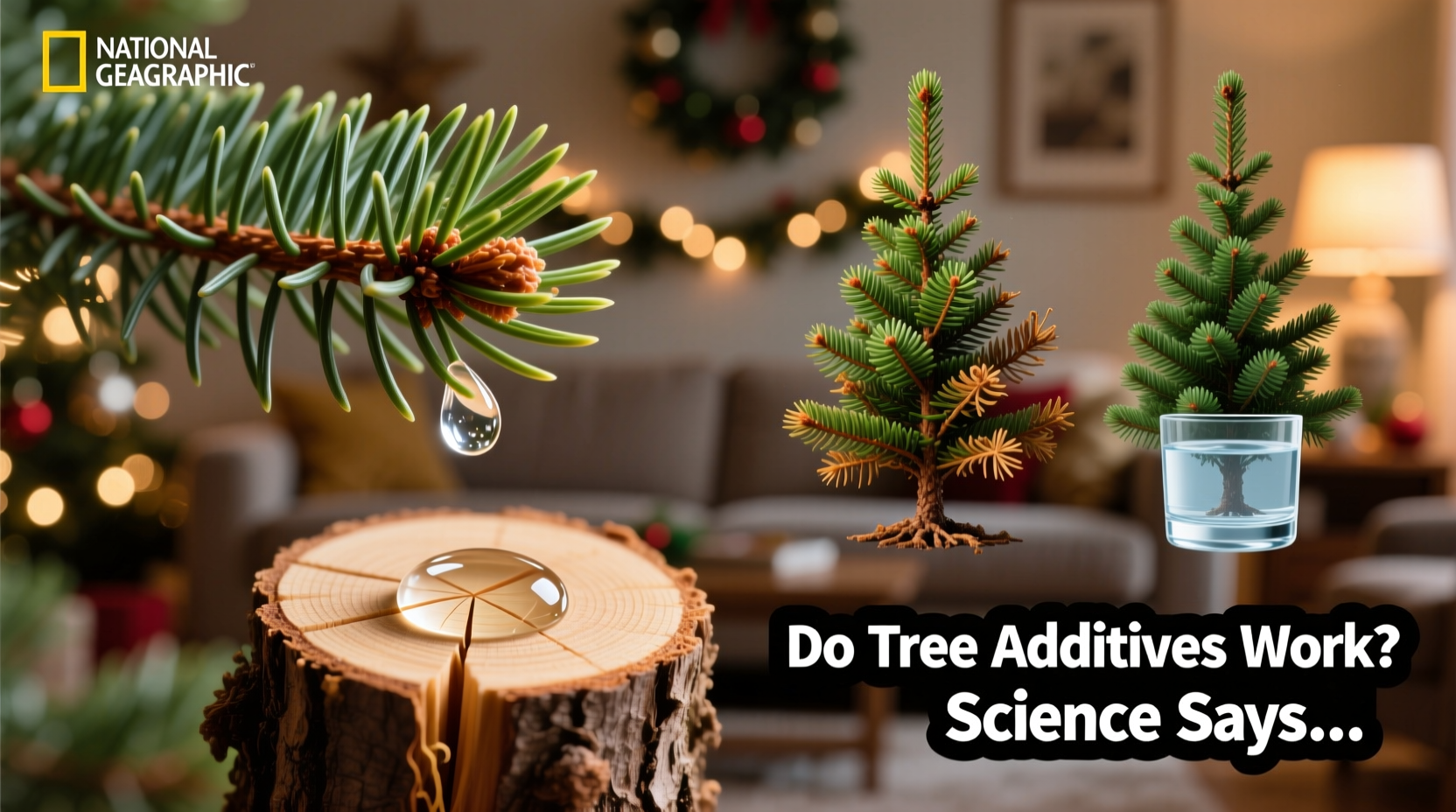
A freshly cut evergreen doesn’t photosynthesize like a potted plant—it has no roots and limited metabolic activity. However, its vascular system remains functional for several days, allowing it to draw water upward via capillary action and transpiration pull. The key challenge is preventing blockages in the xylem, the tissue responsible for water transport.
When a tree is cut, sap oozes from the stump and can oxidize within hours, forming a seal that impedes water absorption. This is why experts emphasize making a fresh cut before placing the tree in a stand. Once sealed, even the most advanced additive cannot restore flow.
Water additives typically contain three components:
- Sugars (e.g., glucose or sucrose): Intended to provide energy to living cells in the trunk and branches.
- Biocide agents (e.g., bleach or fungicides): Meant to inhibit microbial growth in stagnant water.
- Acidifiers (e.g., citric acid): Designed to lower pH and improve water uptake efficiency.
In theory, this combination supports hydration and delays senescence—the natural aging process that leads to needle loss. In practice, however, results vary widely depending on tree species, freshness at purchase, indoor environment, and timing of initial water exposure.
“After 40 years of studying conifer post-harvest physiology, I can say definitively: nothing beats immediate hydration and consistent watering. Most additives offer marginal benefits at best.” — Dr. Linda Chalker-Scott, Urban Horticulturist, Washington State University Extension
Do Additives Actually Work? Evidence from Research
Multiple university studies have tested popular Christmas tree preservatives against control groups using only water. One notable study conducted by the Department of Natural Resources at North Carolina State University evaluated Fraser firs—the most commonly sold Christmas tree in the U.S.—over a four-week period under typical living room conditions (average 70°F, 30% humidity).
Trees were divided into four groups:
- Plain tap water
- Commercial additive (brand X)
- Homemade mix (sugar + bleach + vinegar)
- No water (dry control)
Needle retention, moisture content, and water uptake were measured weekly. The findings were revealing:
| Group | Avg. Needle Retention (Week 4) | Daily Water Uptake (oz) | Visible Mold/Bacteria |
|---|---|---|---|
| Plain Water | 86% | 0.9 | Moderate |
| Commercial Additive | 89% | 1.0 | Low |
| Homemade Mix | 85% | 0.8 | Minimal |
| No Water | 42% | 0.0 | N/A |
The data shows that while commercial additives slightly improved needle retention and reduced microbial buildup, the difference was minimal—just 3 percentage points over plain water. Moreover, the homemade solution performed worse despite including all three theoretical ingredients. Researchers concluded that consistent watering mattered far more than chemical enhancements.
Another study from the University of Wisconsin-Madison found that sugar-containing solutions could actually promote bacterial growth if not balanced with sufficient biocide, potentially clogging the xylem faster than untreated water. This paradox undermines one of the core assumptions behind additive use.
Tip: Skip the additive and focus on daily water checks. A tree can drink over a quart per day initially—letting the reservoir run dry even once drastically reduces lifespan.What Really Matters: Proven Practices for Needle Retention
If additives offer only minor benefits, what should consumers prioritize instead? Experts agree on a set of evidence-based practices that make a measurable difference in tree freshness.
1. Make a Fresh Cut Before Setup
Even if your tree was pre-cut at the lot, resawing the base removes dried sap and opens the xylem for optimal water absorption. A cut of at least ¼ inch off the bottom is recommended. Do this within hours of bringing the tree home, ideally right before placing it in water.
2. Hydrate Immediately
Delaying the first watering—even by a few hours—can lead to irreversible embolism (airlock) in the stem. Always have the stand filled when you bring the tree indoors. If transportation takes longer than two hours, keep the stump wrapped in a damp towel.
3. Use a Large-Capacity Stand
Small stands dry out too quickly. Choose one that holds at least one gallon of water for an average six- to seven-foot tree. Check levels daily; never let the water fall below the base.
4. Keep Away From Heat Sources
Radiators, fireplaces, heating vents, and even clusters of incandescent lights increase transpiration and accelerate drying. Place the tree in a cooler part of the room, away from direct heat.
5. Monitor Indoor Humidity
Dry winter air pulls moisture from needles. Using a humidifier nearby can reduce desiccation and slow needle drop significantly.
6. Avoid Overloading Branches
Heavy ornaments stress limbs and may trigger premature shedding. Distribute weight evenly and avoid hanging items larger than 3 inches in diameter on thin branches.
“The single biggest mistake people make is assuming the tree will ‘last until New Year’s’ without active care. It’s not magic—it’s maintenance.” — Greg Miller, Certified Arborist and Christmas Tree Grower, Vermont
Mini Case Study: Two Trees, Two Outcomes
In December 2023, Sarah Kline in Columbus, Ohio, bought two identical eight-foot Fraser firs—one for her living room, another for her sunroom. Both came from the same farm and were cut within minutes of each other.
She treated them differently:
- Living Room Tree: Received a fresh cut, placed in a large stand with plain water, checked twice daily. Located away from vents, with LED lights only. Average room temp: 68°F.
- Sunroom Tree: No recut, placed directly into a small stand with a commercial additive. Exposed to afternoon sun and radiant floor heating. Water refilled every 3–4 days. Average temp: 74°F.
Results after 21 days:
- The living room tree retained 91% of its needles, with strong fragrance and firm branches.
- The sunroom tree lost 40% of its needles, had a musty odor, and failed the “bend test” (needles snapped rather than flexed).
Despite using an additive, the second tree deteriorated rapidly due to environmental stress and poor hydration habits. This real-world example underscores that product use cannot compensate for fundamental care errors.
Checklist: Maximize Your Tree’s Lifespan (Without Additives)
✅ Pre-Setup- Choose a tree with flexible needles and minimal shedding when shaken.
- Ensure the trunk fits securely in your stand.
- Plan to recut the base before placing in water.
- Make a fresh ¼-inch cut at a straight angle.
- Place immediately into a stand filled with room-temperature water.
- Keep out of direct sunlight and away from heat sources.
- Check water level at least once per day—twice if possible.
- Refill with plain tap water as needed.
- Inspect for mold or slimy buildup; clean stand weekly.
- Maintain room temperature below 72°F.
- Use LED holiday lights (they emit less heat).
- Run a humidifier if indoor humidity is below 40%.
Frequently Asked Questions
Can I use aspirin, soda, or flower food as a substitute for commercial additives?
While some suggest household items like Sprite (for sugar), aspirin (to lower pH), or floral preservatives, there's no scientific consensus supporting their effectiveness. In fact, sugary drinks attract insects and encourage bacterial growth. Aspirin may slightly acidify water but offers negligible benefit. Stick to plain water for safest results.
How long should a properly cared-for Christmas tree last indoors?
A freshly cut, well-maintained tree typically stays fresh for 3–5 weeks. Species matters: Fraser fir, Balsam fir, and Douglas fir tend to last longest. Scotch pine holds needles well but has less aroma. Trees showing signs of dryness before setup rarely exceed two weeks, regardless of care.
Is it worth buying a “fresh-cut” tree online with guaranteed delivery?
Yes, if shipped properly (roots packed, cold chain maintained) and delivered within 48 hours of cutting. These trees often outperform retail-lot trees that may have been sitting for weeks. However, immediate hydration upon arrival remains critical—even a high-quality tree will fail if left unwatered.
Conclusion: Prioritize Practice Over Products
Christmas tree water additives may offer slight improvements in needle retention—perhaps extending freshness by a few hours to a day—but they are no substitute for proper care. The science is clear: consistent watering, a fresh cut, and a cool environment matter infinitely more than any chemical enhancer.
Instead of spending extra on unproven formulas, invest time in monitoring your tree’s water needs and optimizing its placement. These simple, no-cost actions yield better results than any store-bought solution.
This holiday season, skip the gimmicks. Focus on fundamentals. With attentive care, your tree can remain vibrant, fragrant, and full of festive spirit through New Year’s—and maybe even beyond.
💬 Have you tested additives yourself? Did they make a visible difference? Share your experience in the comments and help others decide what really works.








