Bars are no longer just places to serve drinks—they’re immersive experiences. Across Tokyo, Seoul, and now major Western cities like Los Angeles and Berlin, a new wave of hospitality design is drawing directly from the visual language of anime. These aren’t novelty “themed” spaces with cartoon cutouts or neon logos slapped on walls. Instead, they’re thoughtfully curated environments where spatial storytelling, material authenticity, color psychology, and narrative resonance converge—just as they do in the most memorable anime settings. From the warm, wood-grained intimacy of *Kiki’s Delivery Service*’s bakery to the sleek, high-tech tension of *Ghost in the Shell*’s Niihama City bars, interior choices carry emotional weight, cultural specificity, and atmospheric precision. This article dissects how professional designers and bar owners translate those layered interior narratives into real-world hospitality spaces—without resorting to cliché, without sacrificing functionality, and with deep respect for both anime craftsmanship and bar operations.
Why Anime Interiors Work So Well for Bars
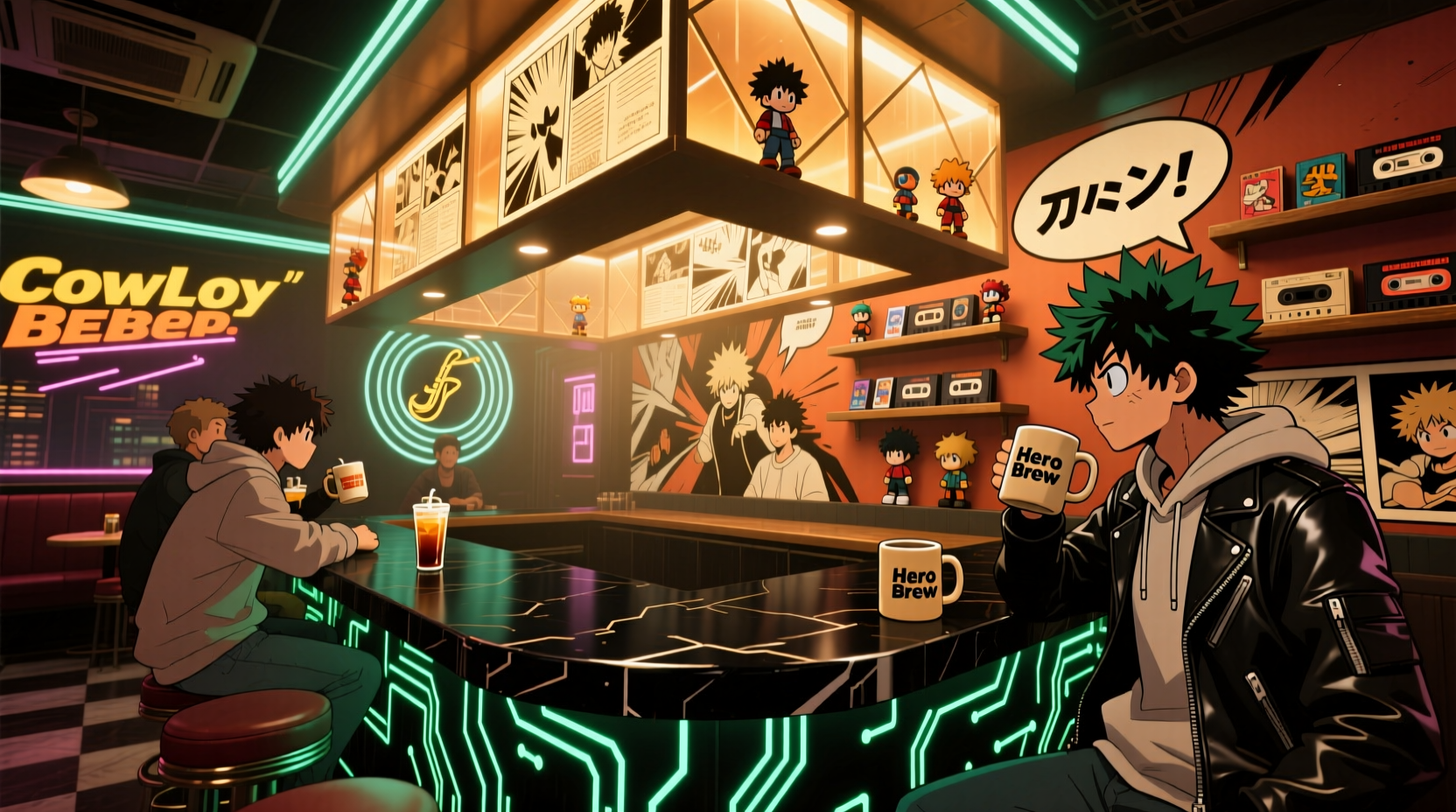
Anime studios invest extraordinary attention in environmental design—not as background filler, but as active narrative agents. A bar counter isn’t just furniture; it’s where a character reveals vulnerability (*Barakamon*), where alliances form (*Jujutsu Kaisen*’s Shibuya arc flashbacks), or where quiet introspection unfolds (*March Comes in Like a Lion*). Unlike film or live-action TV, anime allows deliberate stylization: exaggerated proportions, intentional lighting gradients, symbolic textures, and emotionally calibrated palettes—all optimized for mood over realism. That same intentionality translates powerfully to bar design, where atmosphere directly influences dwell time, perceived value, and social comfort.
Consider this: In *My Hero Academia*, U.A. High’s cafeteria isn’t just a lunchroom—it’s a microcosm of hero society: open sightlines encourage visibility (a safety cue), modular seating supports spontaneous collaboration, and warm amber lighting offsets institutional tile with human warmth. Replicating that logic—not the logo, not the quirk symbols—creates a space that feels energetically inclusive and subtly aspirational. As interior architect Kenji Tanaka explains in his 2023 monograph *Animated Space: Design Logic in Japanese Narrative Environments*: “The best anime interiors succeed because they resolve three simultaneous needs: functional clarity, psychological resonance, and cultural legibility. A bar must do the same—or risk feeling like a costume, not a context.”
Five Iconic Series & Their Translatable Interior Principles
Below is a comparative analysis of five widely recognized anime series, highlighting their defining interior traits—and, crucially, how each can be adapted into a bar environment with integrity, scalability, and operational sense. The focus is on *principles*, not props.
| Series | Signature Interior Trait | Translatable Principle | Real-World Bar Application |
|---|---|---|---|
| Kiki’s Delivery Service | Warm, tactile domesticity: exposed wood grain, hand-thrown ceramics, visible joinery, soft natural light | Material honesty + human-scale texture | Reclaimed oak bar top with visible grain and subtle oil finish; custom-glazed ceramic mugs for signature drinks; pendant lights with linen shades diffusing LED warmth |
| Ghost in the Shell | Urban liminality: reflective surfaces, layered transparency (glass, screens, fog), monochrome base with single accent color (e.g., teal) | Controlled ambiguity + technological elegance | Frosted glass partition walls with embedded low-voltage backlighting; matte black steel shelving with integrated ambient LED strips; drink menus displayed on e-ink tablets |
| Barakamon | Rural craftsmanship: imperfect plaster walls, handmade paper lanterns, asymmetrical layout, seasonal botanical accents | Intentional imperfection + temporal rhythm | Hand-troweled clay plaster on one accent wall; washi-paper pendant lights with visible fiber texture; rotating seasonal herb garnishes grown on-site in vertical planters |
| My Hero Academia | Institutional optimism: clean lines, durable materials, strategic color blocking, communal flexibility | Resilient idealism + adaptive utility | Dual-height bar (standing and seated zones); UV-resistant acrylic panels in hero-academy blue for back-bar dividers; modular banquettes with removable seat cushions for event reconfiguration |
| Serial Experiments Lain | Digital unease: fragmented geometry, low-saturation lighting, embedded tech interfaces, sound-absorbing acoustic panels disguised as data grids | Sensory modulation + interface integration | Acoustic ceiling tiles arranged in binary-pattern grids; under-counter RGB LEDs responsive to ambient noise levels; discreet tablet kiosks for drink ordering with minimalist UI inspired by early web aesthetics |
Step-by-Step: Building Your Anime-Inspired Bar (Without Licensing Pitfalls)
Creating an anime-inspired bar doesn’t require licensing characters or logos—which often trigger legal risk and creative limitation. Instead, follow this seven-step process focused on aesthetic derivation, not replication:
- Analyze the source’s spatial grammar: Watch three episodes *without sound*. Note how space is divided (open vs. enclosed), how light moves (direction, temperature, diffusion), and how objects relate to scale (e.g., oversized stools in *Gundam Build Divers* imply playful proportion).
- Identify the core emotional temperature: Is it nostalgic? Futuristic? Wistful? Urgent? Assign a single-word descriptor (e.g., “resonant,” “lucid,” “tremulous”)—this becomes your non-negotiable design filter.
- Select *one* dominant material system: Wood + clay (Ghibli), steel + glass (GIT), concrete + textile (Lain). Avoid mixing more than two primary materials to preserve cohesion.
- Define your light hierarchy: Primary (task lighting at bar), secondary (ambient wash on walls), tertiary (accent on art or greenery). Use color temperature deliberately: 2700K for warmth, 4000K for neutrality, 5000K+ only for specific tech zones.
- Design the service journey, not just the look: Map every guest touchpoint—entry threshold, coat check, bar approach, order interaction, drink delivery, exit path. Ensure anime-inspired elements support, never obstruct, flow.
- Integrate narrative through detail, not signage: A shelf styled like *K-On!*’s club room uses identical book spines (real titles, not manga) and a vintage metronome—but no band posters. Authenticity lives in behavior, not branding.
- Test with sensory benchmarks: Does the space feel *quiet enough* for conversation? Is the bar height ergonomically correct for staff *and* guests? Does the lighting allow reading a menu without squinting? If not, the aesthetic has compromised function—and fails the anime test.
Mini Case Study: “Niji no Bar” — Kyoto, Japan (2022–Present)
Niji no Bar opened in Kyoto’s Ponto-chō district with zero marketing beyond a single Instagram post showing its entrance: a narrow wooden door with a faint indigo-dyed noren curtain, slightly askew—mirroring the entrance to the café in *The Garden of Words*. Inside, there were no anime prints, no character merch, no themed cocktails named after protagonists. Instead, the space used *only* techniques seen in Makoto Shinkai’s environmental animation: rain-streaked glass windows (achieved with etched glass and programmable mist nozzles), tatami-textured acoustic wall panels, and a suspended ceiling of overlapping washi-paper discs that cast shifting shadow patterns as overhead lights cycled through dawn-to-dusk color temperatures.
The result? Within three months, Niji no Bar achieved 92% repeat visitation—driven not by fans seeking fandom, but by locals and travelers drawn to its “unplaceable calm.” A bartender noted: “Guests don’t say ‘This feels like *Weathering With You*.’ They say, ‘I finally caught my breath.’ That’s the goal.” The bar’s success validates a key principle: anime-inspired design works when it prioritizes *human experience* over iconography.
What NOT to Do: The Five Most Common Pitfalls
Even well-intentioned anime bar concepts collapse under avoidable missteps. Here’s what experienced operators consistently flag:
- Overloading with “Easter eggs”: A wall covered in subtle references (a specific train line number, a recurring food item, a background poster) overwhelms guests and dilutes focus. One resonant motif—like the recurring cherry blossom motif in *Inuyasha*’s feudal inns—carries more weight than twenty scattered nods.
- Misreading cultural context: Using shōji screens in a loud, high-energy bar contradicts their traditional purpose: quiet seclusion. Similarly, applying *Demon Slayer*’s Edo-period austerity to a 200-seat downtown venue ignores scale and social expectation.
- Ignoring material maintenance: That beautiful hand-painted mural inspired by *Princess Mononoke*’s forest spirits? If it’s on a bar rail, it will be wiped, scratched, and sanitized daily. Choose durable mediums—ceramic tile decals, UV-cured vinyl, or digitally printed tempered glass—for high-contact zones.
- Forgetting staff integration: Uniforms, service scripts, and even POS system sounds should reflect the aesthetic. A bar styled after *Haikyu!!*’s gymnasium energy requires quick-paced, encouraging service language—not hushed, formal tones. Cohesion includes behavior.
- Skipping local code adaptation: An open kitchen like *Food Wars!*’s cooking arena may violate health codes requiring physical separation between prep and service areas. Always consult municipal inspectors *before* finalizing layouts—even if the anime version looks flawless.
FAQ
Do I need official licensing to reference anime in my bar?
No—if you avoid copyrighted characters, logos, slogans, or direct scene recreation. Referencing architectural styles, color systems, lighting techniques, or material palettes falls under artistic inspiration and fair use. However, selling branded merchandise or using official artwork requires licensing.
Can anime aesthetics work in a corporate or upscale setting?
Absolutely—when translated with sophistication. *Ghost in the Shell*’s aesthetic informs high-end cocktail lounges in Singapore and London precisely because its visual language emphasizes restraint, precision, and quiet authority. The key is elevating the reference: replace plastic figurines with CNC-milled acrylic bar tools; swap anime posters for large-format photographic prints of urban architecture that mirror the series’ compositional framing.
How do I explain the concept to investors or city planners who don’t know anime?
Lead with universal design outcomes: “We’re designing a bar that balances intimacy and energy using biophilic materials and adaptive lighting—similar to how award-winning hospitality spaces in Kyoto and Copenhagen create emotional resonance through environmental storytelling.” Anchor the vision in measurable goals: dwell time, average spend, acoustic performance metrics—not fandom.
Conclusion
Anime bar aesthetics represent more than a trend—they signal a maturing dialogue between global pop culture and spatial intelligence. When executed with rigor, these spaces prove that narrative depth and functional excellence aren’t mutually exclusive. They remind us that every surface tells a story, every light fixture modulates mood, and every material choice echoes a cultural sensibility. Whether you’re a designer sketching a concept, a restaurateur planning your next venture, or a curious patron who’s felt that inexplicable calm walking into a space that “just feels right”—the power lies not in imitation, but in translation. Translate the warmth of a Ghibli hearth into the grain of your bar top. Translate the stillness of a *Mushishi* mountain lodge into your acoustic strategy. Translate the quiet confidence of a *My Hero Academia* classroom into your service rhythm.
💬 Your turn. Which anime interior has stayed with you—not as entertainment, but as an emotional blueprint? Share the scene, the feeling, and how you’d translate it into real-world space. Let’s build the next generation of bars—together.








