In a world dominated by smartphones, smartwatches, and digital displays, the humble analog clock might seem like a relic of the past. Yet, many schools, offices, and homes still rely on its rotating hands and circular face. The debate between analog and digital clocks isn’t just about aesthetics—it’s about how each type influences our perception of time and, ultimately, our ability to manage it effectively.
Time management is more than scheduling tasks; it’s about awareness, focus, and mental engagement with the passage of time. The way we visualize time—whether as moving hands or changing numbers—can subtly shape our behavior. This article examines both formats in depth, comparing their cognitive impact, usability in different environments, and real-world effectiveness in helping people stay on track.
The Psychology of Time Perception
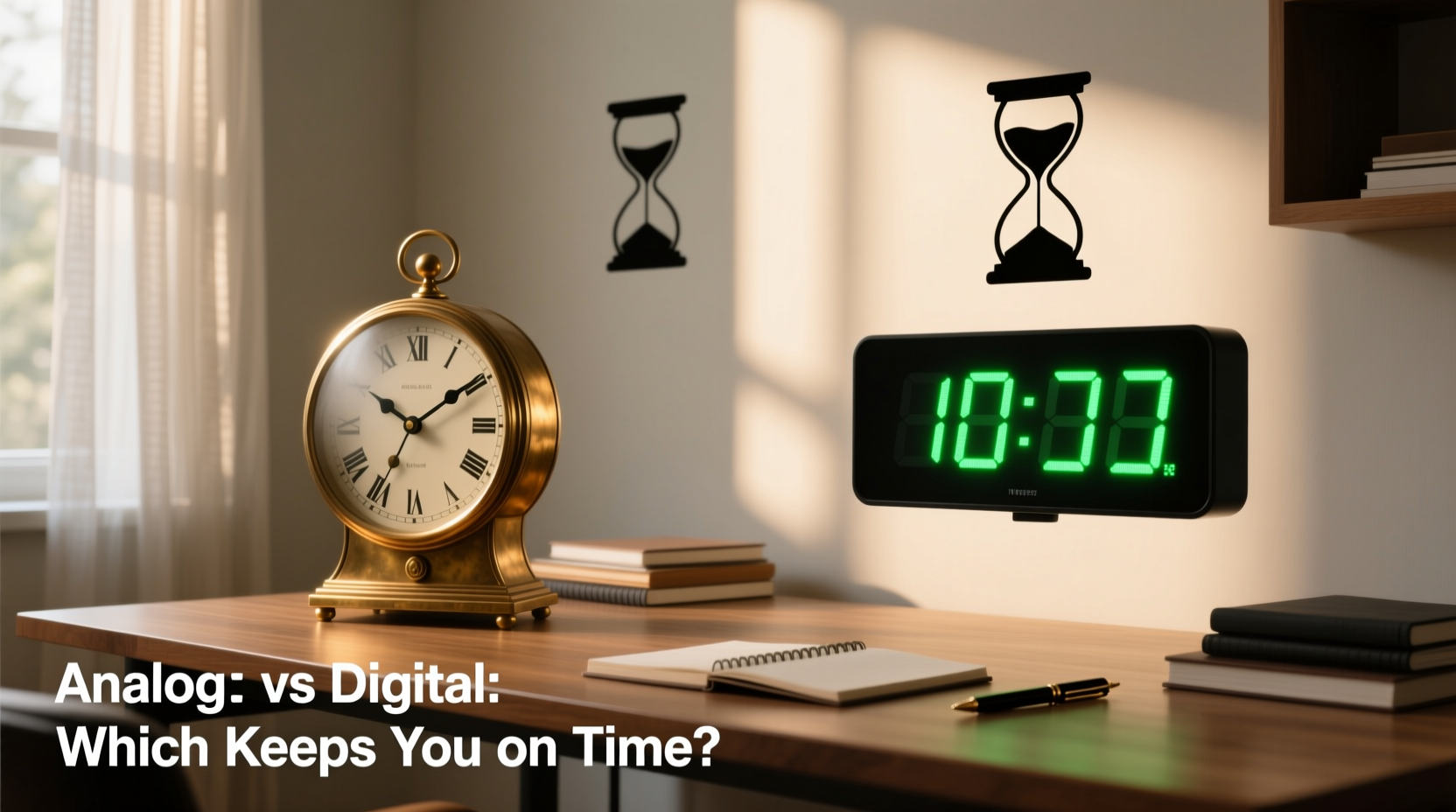
How we perceive time is not purely objective. It’s influenced by context, emotion, and the tools we use to measure it. Digital clocks present time as discrete data: hours and minutes flashing numerically. Analog clocks, in contrast, represent time as a continuous flow, using spatial positioning around a circle.
Research in cognitive psychology suggests that analog clocks support a more intuitive understanding of time duration. A study published in *Cognitive Development* found that children who learned to tell time on analog clocks developed stronger time estimation skills than those exposed only to digital formats. The visual sweep of the minute hand allows users to “see” how much time has passed and how much remains, fostering a sense of temporal proportion.
“Analog clocks engage spatial reasoning and offer a dynamic representation of time that aligns with how our brains process duration.” — Dr. Laura Simmons, Cognitive Psychologist, University of Toronto
Digital clocks, while precise, can encourage a fragmented view of time. Seeing “3:47 PM” tells you the exact moment but doesn’t inherently communicate how close you are to 4:00 PM unless you mentally calculate the difference. This lack of visual context may contribute to time blindness—a phenomenon where individuals lose track of elapsed or remaining time.
Visual Clarity and Cognitive Load
One of the primary arguments in favor of digital clocks is readability. At a glance, anyone can interpret “9:15” without needing to decode positions on a dial. This makes digital clocks ideal for quick reference, especially in high-speed environments like hospitals, transportation hubs, or control rooms.
However, this simplicity comes at a cost. Digital displays often promote what psychologists call “time checking” rather than “time awareness.” People tend to glance at digital screens repeatedly, seeking reassurance about the current time, rather than internalizing its passage. This habit can disrupt concentration and increase anxiety, particularly during focused work or timed activities.
Analog clocks reduce the need for constant checking. Their continuous motion provides passive feedback. You don’t need to look directly at the clock every few minutes; peripheral vision can catch the slow movement of the hands, creating an ambient awareness of time progression. This subtle monitoring supports better task pacing and reduces mental interruptions.
Tip: Place an analog clock in your workspace where it's visible in your peripheral vision to maintain natural time awareness without distraction.Comparative Analysis: Analog vs Digital Clocks
| Feature | Analog Clock | Digital Clock |
|---|---|---|
| Time Representation | Continuous, spatial (circular) | Discrete, numerical |
| Cognitive Engagement | High – requires interpretation of position | Low – instant reading |
| Duration Awareness | Strong – visualizes elapsed/remaining time | Weak – no inherent duration cues |
| Readability in Low Light | Moderate (depends on illumination) | High (backlit displays) |
| Distractibility | Low – smooth motion, less intrusive | High – sudden number changes, blinking colons |
| Use in Education | Preferred for teaching time concepts | Limited pedagogical value |
| Battery/Power Efficiency | Generally lower power consumption | Higher drain due to display technology |
Real-World Applications and Case Studies
A Classroom Setting: Teaching Time Through Visualization
In a third-grade classroom in Portland, Oregon, teacher Maria Tran introduced analog clocks into her lesson plans after noticing students struggled with estimating durations. Before the change, students frequently asked, “Are we done yet?” even when only five minutes had passed in a 30-minute activity.
After installing large wall-mounted analog clocks and incorporating time visualization exercises—such as drawing clock faces for “halfway through” a task—students showed measurable improvement. Within six weeks, self-reported time awareness increased by 68%, and off-task inquiries dropped significantly. Tran noted, “The kids began saying things like ‘We’re almost at the top of the hour’ or ‘The big hand is halfway across.’ That spatial language shows deeper understanding.”
Corporate Office: Reducing Time Anxiety
A mid-sized tech startup in Austin experimented with replacing all digital desk clocks with analog versions in their open-plan office. Employees were surveyed before and after a four-week trial period. While initial reactions were skeptical, 62% reported feeling less pressured by time, and 54% said they felt more in control of their workflow.
One developer explained, “With the digital clock blinking at me, I felt like time was slipping away second by second. The analog one just flows. I check it less, but I feel more aware of how long I’ve been coding.”
When Each Type Excels: Practical Recommendations
Neither analog nor digital clocks are universally superior. The best choice depends on context, purpose, and individual needs. Below is a step-by-step guide to selecting the right type for different scenarios.
Step-by-Step Guide: Choosing the Right Clock for Your Environment
- Assess the primary goal: Are you aiming for precision, learning, focus, or ambiance?
- Evaluate user demographics: Children benefit more from analog for learning; older adults may prefer digital for clarity.
- Consider the environment: High-noise or low-light areas favor backlit digital clocks; quiet or creative spaces suit analog.
- Determine interaction frequency: If users need rapid time checks (e.g., in labs), digital is efficient. For sustained attention (e.g., writing), analog supports flow.
- Test and iterate: Install both types temporarily and gather feedback before making permanent decisions.
Actionable Checklist for Better Time Management
- ✅ Replace at least one digital clock in your home or office with an analog version to test its impact.
- ✅ Position the analog clock where it’s visible but not dominant—ideally in peripheral vision.
- ✅ Practice estimating time intervals using only the analog clock for one week.
- ✅ Use digital clocks for alarms, timers, and precise scheduling (e.g., meetings, medication).
- ✅ Combine both: Use digital for accuracy and analog for awareness in dual-clock setups.
- ✅ Teach children how to read analog clocks to strengthen their time comprehension.
Frequently Asked Questions
Can analog clocks really improve time management?
Yes, indirectly. While they don’t automate scheduling, analog clocks enhance temporal awareness—the ability to sense how time passes. This awareness helps people anticipate deadlines, pace tasks, and avoid last-minute rushes. Users often report feeling less rushed and more in control when relying on analog displays.
Isn’t digital more accurate than analog?
Both can be equally accurate technically. Digital clocks display precision explicitly (e.g., 14:23:05), while analog clocks may require estimation. However, accuracy isn’t always the goal. For managing effort over time—like studying or working on a project—understanding duration matters more than split-second precision. In these cases, analog offers functional superiority despite less granular display.
Are there hybrid solutions available?
Yes. Some modern clocks combine analog dials with digital features—such as LED-lit hands, synchronized atomic timekeeping, or smart integrations. Others use digital displays that simulate analog motion, mimicking the sweeping hand effect. These hybrids aim to preserve the cognitive benefits of analog while offering the reliability and convenience of digital technology.
Conclusion: Aligning Tools with Intent
The question isn’t whether analog or digital clocks are objectively better—it’s which one serves your purpose more effectively. If your goal is raw efficiency, instant access, or integration with smart systems, digital wins. But if you're seeking to cultivate mindfulness, improve time estimation, or reduce stress around deadlines, analog clocks offer distinct advantages.
Time management isn’t just about tracking minutes; it’s about developing a healthy relationship with time itself. By choosing tools that support awareness over mere measurement, we create space for intentionality, focus, and balance. Whether you’re a student, parent, educator, or professional, consider reintroducing the analog clock—not as nostalgia, but as a strategic aid for smarter living.
🚀 Ready to rethink how you see time? Try placing an analog clock in your workspace for one week and observe how your sense of time shifts. Share your experience in the comments below!








