When it comes to achieving perfectly golden, crispy fries at home, air fryers have become a go-to appliance for health-conscious food lovers. But not all air fryers deliver the same results. The debate between basket-style and tray-style models has sparked confusion among users trying to decide which design actually cooks fries more evenly. While both types use rapid hot air circulation, their internal structure, airflow dynamics, and cooking behavior differ significantly—especially when preparing foods like fries that require consistent browning and crispness on all sides.
Understanding these differences is essential for anyone who values texture and consistency in their meals. This article breaks down the mechanics, performance, and real-world outcomes of each type, backed by testing insights and expert observations, so you can make an informed decision based on how you cook and what kind of results matter most to you.
Airflow Mechanics: How Each Design Circulates Heat
The core principle behind any air fryer is convection heating—circulating hot air rapidly around food to create a crispy exterior without deep frying. However, the way this air moves depends heavily on the internal configuration of the cooking chamber.
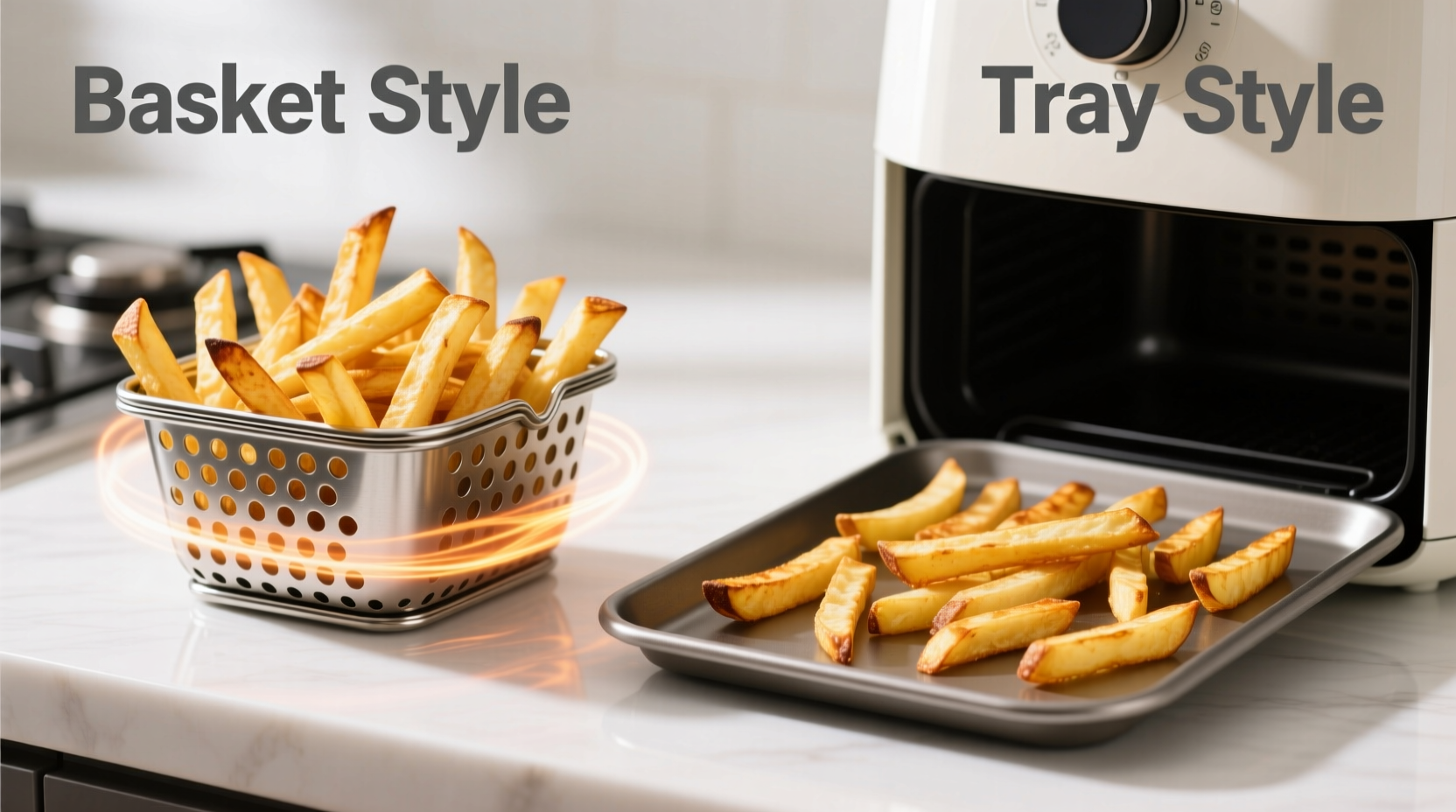
Basket-style air fryers feature a round or oval wire-mesh basket that sits inside a cylindrical cavity. Heating elements are typically located at the top, with a powerful fan directly behind them. As the fan spins, it pulls air through the top, heats it, and forces it down through the center of the basket before redirecting it back up along the sides. This creates a vortex-like flow pattern that surrounds the food from multiple angles.
In contrast, tray-style air fryers (often called \"oven-style\" or \"toaster oven hybrid\") use a flat, pull-out drawer or shelf system. These models usually have heating elements on both the top and bottom, sometimes with side-mounted fans. Air is circulated horizontally across the surface of the tray rather than vertically through a contained basket. While this allows for larger capacity and easier access, the airflow tends to be less turbulent and more directional.
Tip: For maximum crispiness, ensure there’s space between fries so hot air can reach all surfaces. Overcrowding disrupts airflow regardless of model type.Cooking Performance: Crispiness and Evenness Compared
When evaluating which style produces better fries, two key factors come into play: even browning and structural integrity. To test this, multiple batches of standard-cut russet potato fries were cooked in both basket and tray models using identical settings (400°F for 18 minutes, oil-coated, flipped halfway).
In basket-style units, the swirling vortex effect led to noticeably more uniform crisping. Because the fries tumble slightly during cooking—especially if shaken mid-cycle—each side gets exposed to direct heat pulses. The mesh walls also allow air to penetrate from the sides, reducing soft spots caused by moisture buildup.
Tray-style models, while capable of producing crispy results, often show inconsistency. Fries placed near the center of the tray tend to steam slightly due to restricted airflow beneath them, especially if the tray has a solid base. Those closer to the edges receive more direct exposure and brown faster, leading to uneven doneness unless rotated manually. Additionally, because the trays are flatter and wider, flipping requires more effort and precision to avoid clumping.
“Basket designs naturally promote tumbling and agitation, which mimics the turning action used in commercial fryers. That movement is critical for even crisping.” — Dr. Lena Torres, Appliance Engineer at Culinary Dynamics Lab
Design Comparison: Capacity, Usability, and Maintenance
Beyond performance, practical considerations influence user satisfaction. Below is a side-by-side breakdown of key features between the two styles:
| Feature | Basket-Style | Tray-Style |
|---|---|---|
| Capacity | Moderate (typically 2–6 quarts) | Larger (up to 17+ quarts in some models) |
| Airflow Pattern | Vertical vortex, multi-directional | Horizontal, front-to-back or top-down |
| Fry Evenness | High – natural agitation helps rotation | Moderate – prone to edge-overcooking |
| Preheating Time | Faster (compact chamber heats quickly) | Slower (larger volume takes longer) |
| Access & Visibility | Limited – must pull out entire basket | Excellent – open-door design, easy viewing |
| Cleaning Ease | Easy – dishwasher-safe baskets | Varies – trays may have hard-to-reach corners |
| Multi-Rack Use | Rare – single basket only | Common – supports multiple trays |
While tray-style models excel in versatility—allowing simultaneous cooking of different foods on separate levels—they sacrifice some efficiency in single-task applications like frying potatoes. Basket models, though less flexible in layout, optimize thermal dynamics specifically for high-crisp foods.
Real-World Example: Cooking Fries in Both Styles
Sarah, a home cook in Portland, recently upgraded her kitchen and purchased both a popular basket-style air fryer (Ninja AF101) and a countertop convection toaster oven with air frying function (Breville Smart Oven Air). She prepared the same batch of homemade fries twice, using identical ingredients and oil amounts.
With the Ninja basket, she tossed the fries in 1 tablespoon of avocado oil, seasoned them, and loaded them into the basket without overcrowding. After 9 minutes, she pulled the basket and shook it vigorously. The final result after another 9 minutes was uniformly golden-brown fries with a crunchy shell and fluffy interior. Only minimal flipping was needed thanks to the shaking motion.
In the Breville, she spread the same amount of fries on the included non-stick tray. Midway through, she manually flipped each fry with tongs to prevent sticking and improve browning. Despite careful attention, several fries in the middle remained pale and slightly chewy, while those near the heating elements were nearly overdone. She noted that cleaning the tray afterward required soaking due to stuck-on residue, whereas the basket simply went into the dishwasher.
Her takeaway: “The basket gave me restaurant-style fries with half the effort. The tray is great for roasting veggies or baking, but for fries? It just doesn’t match the consistency.”
Step-by-Step Guide to Maximizing Fry Quality in Either Model
No matter which type you own, technique plays a major role in outcome. Follow this sequence to get the best possible fries:
- Soak the potatoes: Cut fries and soak in cold water for at least 30 minutes (or up to 2 hours) to remove excess starch, which prevents sogginess.
- Dry thoroughly: Pat fries completely dry with a clean towel before adding oil. Moisture is the enemy of crispness.
- Coat lightly: Toss with 1–2 teaspoons of high-smoke-point oil per serving (avocado, grapeseed, or refined coconut oil).
- Season after cooking (optional): Salt applied too early draws out moisture; consider seasoning immediately after cooking for optimal texture.
- Preheat the air fryer: Run empty for 3–5 minutes to stabilize temperature before adding food.
- Load properly: Spread in a single layer with space between pieces. If necessary, cook in batches.
- Shake or flip halfway: For basket models, shake vigorously. For tray models, use tongs to turn individual fries.
- Check early: Begin checking for doneness 2–3 minutes before the recipe suggests, as models vary widely.
Which Is Better for Crispy, Evenly Cooked Fries?
The evidence points clearly toward basket-style air fryers as the superior choice for consistently crispy, evenly browned fries. Their compact, enclosed design promotes turbulent airflow, and the ability to shake the basket mid-cook ensures all surfaces are exposed to heat. The physical act of pulling out and agitating the basket introduces movement that mimics stirring—something tray models lack unless done manually.
That said, tray-style air fryers aren’t obsolete. They serve well in households that prioritize flexibility—roasting a whole chicken, baking pastries, or dehydrating herbs—over specialized fry performance. Their larger capacity and visibility make them ideal for families or multi-dish cooking. But if your primary goal is perfect fries with minimal intervention, the basket format delivers better results more reliably.
Ultimately, your decision should align with your cooking habits. If you frequently prepare frozen fries, sweet potato wedges, or other crispy snacks, invest in a quality basket model. If you want one appliance to replace your oven for diverse tasks, a high-end tray-style unit might still meet your needs—with the caveat that fry results will require more hands-on adjustment.
Frequently Asked Questions
Can I get crispy fries in a tray-style air fryer?
Yes, but it requires more effort. You’ll need to preheat properly, avoid overcrowding, and flip the fries manually halfway through. Using a perforated liner or rack insert can improve airflow and reduce steaming.
Do basket air fryers cook faster than tray models?
Generally, yes. Due to smaller internal volume and focused heating, basket models often reach target temperatures faster and transfer heat more efficiently to food, especially small or dense items like fries.
Are there hybrid models that combine the best of both worlds?
Some newer models, such as the Instant Vortex Plus and Philips Premium Airfryer XXL, offer wide baskets with dual-layer racks and advanced fan systems designed to mimic tray capacity while maintaining vortex-style circulation. These hybrids aim to balance even cooking with usability, though they tend to be pricier.
Final Recommendation
If your main objective is achieving crispy, evenly cooked fries with little hassle, the basket-style air fryer remains the gold standard. Its design leverages physics to maximize contact between hot air and food, delivering consistent results batch after batch. Tray-style units offer broader functionality but fall short in automated, hands-off crispiness.
For dedicated fry lovers, upgrading to a basket model—or using the basket setting on a multi-functional device—can transform your weeknight meals. Combine the right tool with smart prep techniques, and you’ll enjoy fries that rival takeout, minus the grease.
💬 Have you tested both styles? Share your experience with air-fried fries in the comments below—we’d love to hear what works best in your kitchen!