
The human nervous system is a complex network that allows us to move, feel, and react to our environment. At the heart of this system are the spinal nerves—31 pairs of nerves that branch off from the spinal cord and connect to nearly every part of the body. What many people don’t realize is that these nerves aren’t specialized for just one job. Instead, they are “mixed,” meaning they carry multiple types of information at once. Understanding why spinal nerves are mixed helps clarify how our bodies coordinate sensation and movement so seamlessly.
What Are Spinal Nerves?
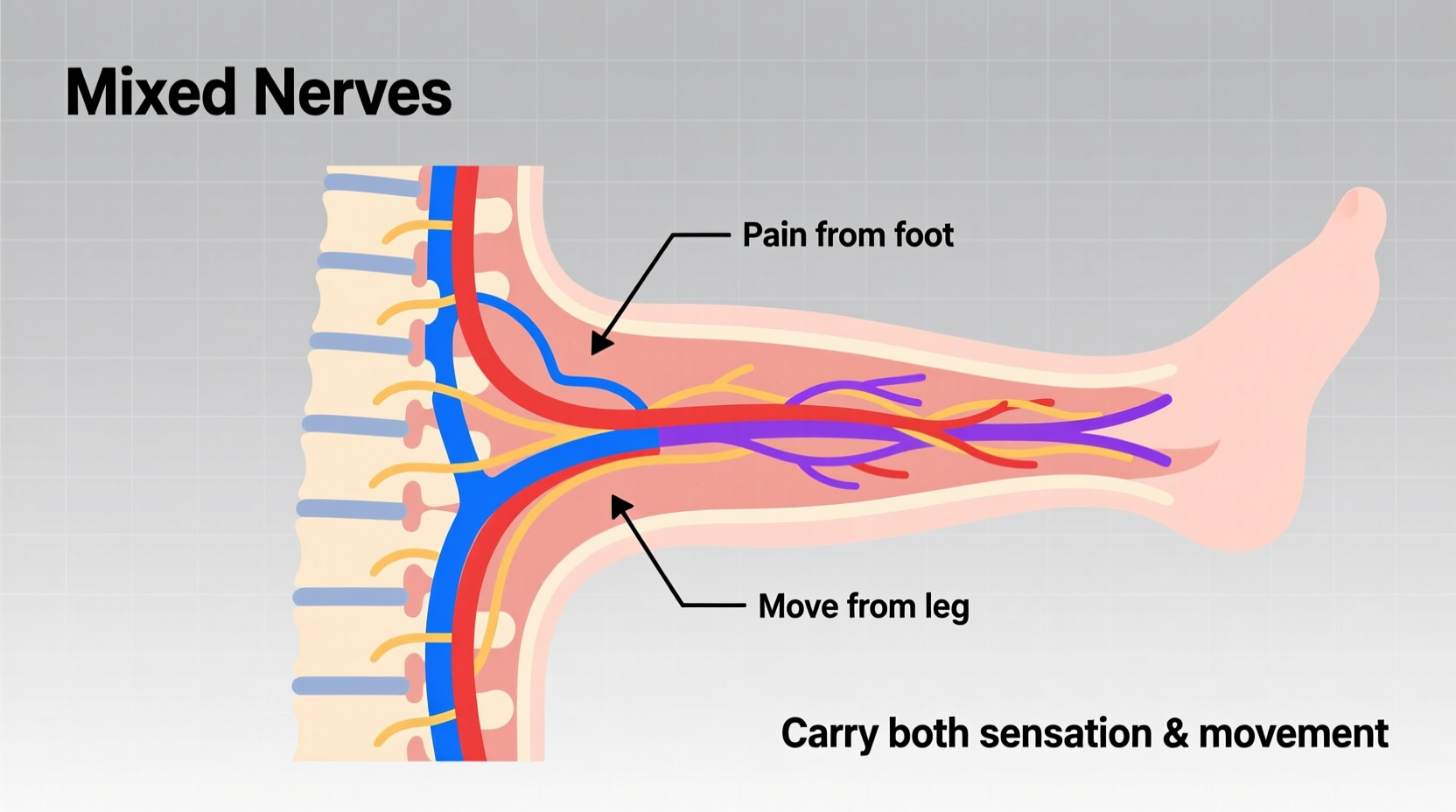
Spinal nerves emerge from the spinal cord through openings between the vertebrae. Each nerve forms when two roots join: the dorsal (posterior) root and the ventral (anterior) root. These roots originate from different regions of the spinal cord and serve distinct functions.
- Dorsal root: Carries sensory information from the skin, muscles, and organs toward the central nervous system (CNS).
- Ventral root: Transmits motor commands from the CNS to muscles and glands.
When these two roots merge, they form a single spinal nerve—a bundle containing both sensory and motor fibers. This fusion is what makes spinal nerves “mixed.” There are no purely sensory or purely motor spinal nerves in the peripheral nervous system (outside the brain and spinal cord), except in rare anatomical variations.
Why Evolution Favored Mixed Nerves
Nature tends to optimize efficiency, and the structure of spinal nerves reflects this principle. Having both sensory and motor fibers travel together in one pathway reduces the number of separate nerves needed, saving space and energy in an already crowded spinal column.
Consider reflex actions—like pulling your hand away from a hot stove. The process happens almost instantly because the sensory signal (heat pain) travels up the spinal nerve to the spinal cord, and a motor response (muscle contraction) is sent back down the same nerve. If sensory and motor pathways were completely separate, coordination would require more connections, increasing delay and complexity.
“Mixed nerves represent an elegant solution to the challenge of rapid, coordinated communication between the body and the central nervous system.” — Dr. Lena Torres, Neuroanatomy Researcher, University of CaliforniaTip: Think of mixed spinal nerves like a two-way highway—one lane for incoming data (sensation), another for outgoing commands (movement).
How Mixed Nerves Work: A Closer Look
To understand how mixed nerves function, it helps to break down their components:
| Fiber Type | Direction | Function |
|---|---|---|
| Somatic Sensory | Afferent (toward CNS) | Transmits touch, pain, temperature, and proprioception from skin and muscles |
| Somatic Motor | Efferent (away from CNS) | Controls voluntary skeletal muscle movements |
| Autonomic Sensory | Afferent | Relays internal organ status (e.g., stomach fullness) |
| Autonomic Motor | Efferent | Regulates involuntary functions like heart rate and digestion |
This combination allows each spinal nerve to support a complete feedback loop. For example, when you step on a sharp object:
- Sensory receptors in your foot detect pain.
- Signals travel via afferent fibers in the spinal nerve to the spinal cord.
- Interneurons relay the message to motor neurons.
- Motor commands travel back through efferent fibers in the same nerve.
- Muscles in your leg contract to lift your foot.
All of this occurs within milliseconds, thanks to the integrated design of mixed nerves.
Real-World Example: Sciatica and Mixed Nerve Impact
Sciatica is a common condition caused by compression or irritation of the sciatic nerve—the largest mixed nerve in the body. It originates from several spinal nerves in the lower back (L4 to S3) and runs down the leg.
In a typical case, a herniated disc presses on one of these spinal nerves. Because the nerve is mixed, the patient experiences both:
- Sensory symptoms: Burning pain, tingling, or numbness along the leg.
- Motor symptoms: Weakness in the calf or foot, difficulty lifting the foot (foot drop).
This dual presentation underscores the importance of recognizing that damage to a single mixed nerve can disrupt both feeling and movement. Treatment must address both aspects—not just pain relief but also muscle rehabilitation.
Common Misconceptions About Nerve Types
It’s easy to assume all nerves have a single purpose. However, while some cranial nerves are purely sensory (like the olfactory nerve for smell) or motor (like the trochlear nerve for eye movement), spinal nerves are almost always mixed.
Here’s a quick comparison:
| Nerve Type | Example | Function |
|---|---|---|
| Purely Sensory | Olfactory nerve (I) | Smell only |
| Purely Motor | Hypoglossal nerve (XII) | Tongue movement |
| Mixed | Spinal nerves (all) | Sensation + movement |
This distinction matters clinically. When diagnosing nerve injuries, doctors assess both sensory and motor functions in affected areas. Loss of sensation without weakness may point to a sensory-specific issue, whereas combined deficits suggest involvement of a mixed spinal nerve.
Step-by-Step: How Doctors Test Mixed Nerve Function
During a neurological exam, physicians evaluate mixed nerve integrity using a systematic approach:
- Assess sensation: Light touch, pinprick, vibration, and temperature tests check afferent pathways.
- Test muscle strength: Resistance exercises evaluate efferent motor signals.
- Check reflexes: Tendon reflexes (e.g., knee jerk) confirm intact sensory-motor loops.
- Map dermatomes and myotomes: Identify which spinal nerve levels correspond to specific skin zones and muscle groups.
- Order imaging or EMG: If dysfunction is found, further testing locates the source of nerve compromise.
This comprehensive evaluation ensures that both halves of the mixed nerve are functioning properly.
FAQ
Can a mixed spinal nerve be damaged in just one direction?
Yes. While the nerve contains both fiber types, injury can selectively affect either sensory or motor components. For instance, diabetes often damages small sensory fibers first, leading to numbness without initial weakness.
Are there any exceptions to mixed spinal nerves?
Generally, no. All 31 pairs of spinal nerves are mixed. However, some very small meningeal branches or autonomic rami may carry predominantly one type of fiber, but the main spinal nerve trunk remains mixed.
Do mixed nerves repair themselves after injury?
Peripheral nerves, including mixed spinal nerves, have some regenerative capacity. Recovery depends on the severity and location of the injury. Minor compressions often resolve with time, while severe cuts may require surgery and result in incomplete recovery.
Key Tips for Maintaining Spinal Nerve Health
Tip: Practice good posture and core strength to reduce pressure on spinal nerves and prevent conditions like pinched nerves or sciatica.- Stay active with low-impact exercise (walking, swimming).
- Avoid prolonged sitting, especially with poor lumbar support.
- Lift heavy objects with your legs, not your back.
- Manage chronic conditions like diabetes that can impair nerve function.
- Seek early medical attention for persistent numbness or weakness.
Conclusion
The fact that spinal nerves are mixed is not a flaw—it’s a feature. This dual functionality enables efficient, real-time communication between the body and the brain, supporting everything from delicate hand movements to automatic breathing adjustments. By carrying both sensory input and motor output in one compact cable, the nervous system achieves remarkable coordination with minimal wiring.
Understanding this design empowers you to appreciate how interconnected your body’s systems are—and why protecting your spine and nerves matters for overall health. Whether you're managing back pain, recovering from injury, or simply aiming to stay mobile, recognizing the role of mixed nerves can guide better choices.
💬 Have questions about nerve health or personal experiences with spinal issues? Share your thoughts below and help build a community of informed, supportive learners.








