
It’s a quiet moment of kitchen panic: you open your jar of aging kombucha vinegar—intended for shrubs, vinaigrettes, or natural cleaners—and find it’s taken on a delicate rose hue, sometimes even a dusty lavender or salmon tint. No mold, no off smell, no fizz—but that unexpected pink gives pause. Is it spoiled? Contaminated? Or something more benign—perhaps even beneficial? As fermentation gains mainstream traction, home brewers increasingly encounter this visual anomaly. The answer isn’t binary. It hinges on microbial ecology, oxidation chemistry, and careful sensory evaluation—not just color alone.
What Causes the Pink Shift? It’s Usually Not Mold—But Microbial Chemistry
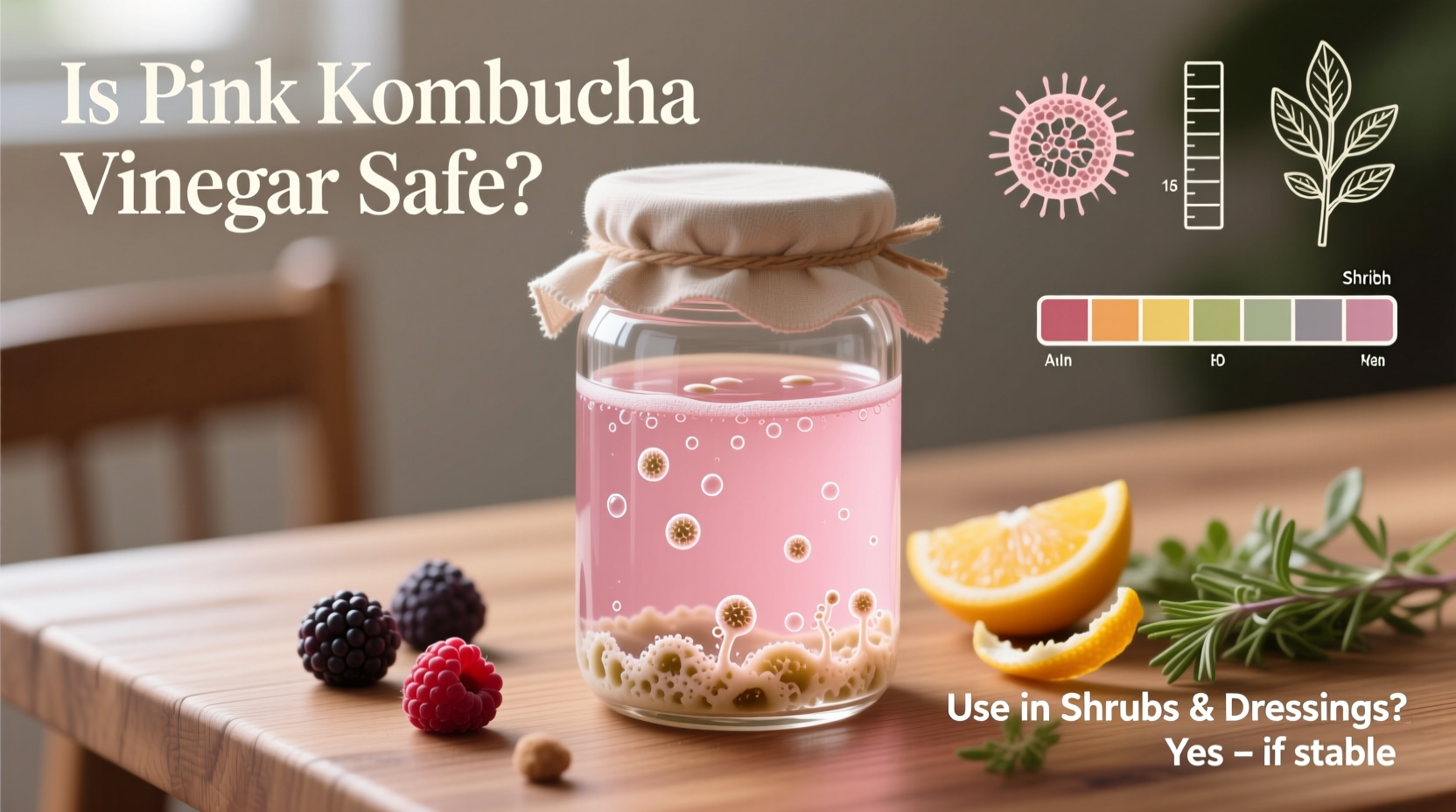
The pinkish tint in over-fermented kombucha vinegar arises most commonly from two interrelated phenomena: pigment-producing bacteria and oxidative reactions involving tea polyphenols. Unlike mold—which forms fuzzy, raised colonies with distinct textures and often emits musty, sour, or ammonia-like odors—this discoloration tends to be uniform, translucent, and suspended throughout the liquid.
Acetobacter species, especially Acetobacter aceti and Acetobacter pasteurianus, dominate the vinegar-making phase of kombucha. Under prolonged aerobic exposure (e.g., wide-mouth jars, loose cloth covers, or extended aging beyond 4–6 weeks), certain strains begin expressing carotenoid pigments—naturally occurring red-orange-yellow compounds also found in carrots, tomatoes, and flamingo feathers. These pigments are harmless, heat-stable, and pH-insensitive. They’re not indicators of spoilage; they’re metabolic byproducts of robust acetic acid production.
A secondary contributor is oxidation of tea-derived anthocyanins and catechins. Black and green teas contain flavonoids that, under acidic conditions (pH < 3.5) and ambient oxygen, can undergo structural rearrangements yielding pink-to-purple quinoidal pigments. This effect intensifies with longer aging, higher temperatures (above 24°C/75°F), and exposure to light—especially UV. Herbal infusions (hibiscus, rosehip, elderberry) dramatically accelerate this, as they’re rich in native anthocyanins.
Tip: If your pink vinegar smells clean—sharp, tangy, slightly fruity, or like crisp apple cider vinegar—and tastes bright without bitterness or funk, it’s almost certainly safe. Trust your nose and palate before dismissing color.When Is Pink Kombucha Vinegar *Not* Safe? Red Flags You Can’t Ignore
Color alone doesn’t determine safety—but it *must* be interpreted alongside sensory cues and context. Here’s what separates benign pigmentation from genuine contamination:
| Sensory Cue | Benign Pink (Safe) | Risky Pink (Discard) |
|---|---|---|
| Smell | Clean, sharp, vinegary, faintly yeasty or fruity | Foul, rotten egg (hydrogen sulfide), rancid fat, sewage, or fermented gym socks |
| Texture | Clear or lightly hazy; no film, slime, or floating particles | Thick biofilm (not SCOBY), slimy strands, fuzzy patches, or sediment that clumps or smells sour |
| Taste | Tangy, clean acidity; no lingering bitterness, metallic aftertaste, or “off” sourness | Bitter, medicinal, alcoholic burn (beyond mild ethanol), or sourness that feels “wrong”—like spoiled dairy or overripe fruit |
| pH | Consistently ≤ 3.2 (measured with calibrated pH strips or meter) | pH > 3.5 after 6+ weeks of aerobic aging—or rising pH over time |
| Visual Clues | Uniform hue; may deepen gradually over weeks; no separation or oil slicks | Pink *only* at surface with white fuzz beneath; iridescent sheen; rainbow-colored oil film; pink sediment that won’t resuspend |
Crucially, true pathogenic bacteria (e.g., E. coli, Salmonella) do not grow in properly fermented kombucha vinegar. Its low pH (<3.2), high acetic acid content (>0.5%), and antimicrobial metabolites (e.g., gluconic acid, trace ethanol) create an environment hostile to pathogens. The real risk lies in opportunistic spoilage organisms—Lactobacillus brevis producing excessive diacetyl (buttery off-flavor), wild yeasts generating volatile acidity, or aerobic molds exploiting weak covers.
Real-World Example: A Brooklyn Fermenter’s Pink Vinegar Journey
In early 2023, Maya R., a food educator and small-batch fermenter in Brooklyn, aged her black tea kombucha vinegar for 10 weeks in glass jars covered with triple-layered organic cotton. By week 7, a soft peach tint emerged. By week 10, it was consistently rosy—“like diluted hibiscus tea,” she recalls. She tested pH weekly: it dropped steadily from 3.8 to 2.9. Smell? Bright, crisp, with a hint of dried cherry. Taste? Clean, complex acidity—no funk. She used it immediately in a strawberry-rhubarb shrub and a shallot-dill vinaigrette. Both kept refrigerated for 4 months with zero degradation. Later, she replicated the batch using green tea and observed the same pink shift—confirming it wasn’t tea-type dependent but linked to oxygen exposure and acetobacter activity. Her takeaway: “Color became a marker of maturity—not contamination.”
How to Confidently Use Pink Kombucha Vinegar in Shrubs & Dressings
Once confirmed safe, pink kombucha vinegar adds nuanced acidity and subtle floral notes to culinary applications. Its lower acetic acid concentration (typically 0.5–1.2%) versus distilled white vinegar (5–6%) makes it gentler on delicate ingredients—ideal for shrubs where sugar balance matters, and dressings where harshness would overwhelm herbs or greens.
- Shrubs: Combine 1 part pink vinegar with 1 part raw honey or maple syrup and 1 part seasonal fruit (macerated 24 hours). The pigment stabilizes in the acidic-sugar matrix. Strawberry-rhubarb, blackberry-thyme, and peach-ginger shrubs benefit particularly—pink deepens to jewel tones and adds visual appeal.
- Vinaigrettes: Whisk 3 tbsp pink vinegar with 1 tsp Dijon, 1 minced garlic clove, and ¼ cup extra-virgin olive oil. The mild acidity coats greens without wilting them; the faint fruitiness complements bitter lettuces (radicchio, frisée) and roasted vegetables.
- Quick Pickles: Submerge thinly sliced onions, cucumbers, or carrots in equal parts pink vinegar and water, plus salt and spices. Refrigerate 2–4 hours. The gentle acid penetrates without overpowering; the color subtly tints the brine—a bonus for charcuterie boards.
- Drinking Vinegars: Dilute 1 tbsp pink vinegar in 8 oz sparkling water with a squeeze of lemon and a pinch of sea salt. The complexity shines here—less aggressive than standard ACV tonics.
“The pink hue in well-aged kombucha vinegar is often a sign of microbial vitality—not decline. When paired with stable low pH and clean organoleptic qualities, it represents a mature, functional acetic culture. Dismissing it on color alone overlooks centuries of empirical fermentation wisdom.” — Dr. Lena Torres, Microbial Ecologist & Co-Author of Fermented Foods and Human Health
Prevention, Control & Best Practices for Consistent Results
You don’t need to eliminate pink—many chefs and brewers now welcome it as a signature trait. But if you prefer clear vinegar, or want predictable outcomes, these steps help manage the phenomenon:
- Limit oxygen exposure: Use narrow-neck bottles with airlocks or tight-fitting lids during aging. Avoid wide-mouth jars unless actively stirring.
- Control temperature: Age between 18–22°C (64–72°F). Warmer temps accelerate both acetic fermentation and pigment formation.
- Filter early: After 4–5 weeks, strain through a fine-mesh sieve lined with cheesecloth to remove bacterial biomass before further aging.
- Avoid anthocyanin-rich teas: Skip hibiscus, rosehip, or purple basil infusions if clarity is essential. Stick to plain black, green, or roasted oolong.
- Store in darkness: Amber glass or opaque containers prevent UV-triggered oxidation of tea polyphenols.
Conversely, if you *want* to encourage stable pink development—for aesthetic or flavor reasons—introduce a small amount of hibiscus infusion (1 tsp dried flowers per quart) at the start of vinegar aging, maintain 24°C (75°F), and use wide-mouth vessels with breathable covers. Monitor pH twice weekly until it stabilizes below 3.0.
FAQ: Your Top Questions Answered
Can I still use pink kombucha vinegar if it’s been sitting for 6 months?
Yes—if pH remains ≤ 3.2, there’s no visible mold or slime, and it smells/tastes clean. Acetic acid is remarkably stable. Many brewers report excellent results with vinegar aged 8–12 months. Always retest pH before using in recipes requiring precise acidity (e.g., canning).
Does the pink color fade when cooked or mixed into dressings?
Generally, no. Carotenoid pigments are heat-stable and pH-resistant. Anthocyanin-derived pinks may shift slightly (e.g., rose → violet in alkaline dressings with baking soda traces), but won’t disappear. In shrubs, the color often intensifies and stabilizes due to sugar’s protective effect.
Is pink kombucha vinegar safe for people with histamine sensitivity?
Caution advised. Prolonged aging increases histamine levels via bacterial decarboxylation. While pink itself isn’t a histamine marker, extended vinegar fermentation (beyond 6 weeks) typically correlates with higher histamine content. Those with sensitivity should opt for younger vinegar (3–4 weeks) and avoid batches with strong umami or fishy notes—even if pink.
Conclusion: Embrace the Hue—But Never Skip the Evaluation
Pink kombucha vinegar isn’t a flaw—it’s fermentation speaking in color. It signals microbial activity, oxidative maturity, and sometimes, intentional artistry. Yet reverence for the process must never override vigilance. Safety rests not on a single hue, but on the full sensory triad: smell, taste, and texture—anchored by objective pH verification. When those align, your pink vinegar becomes a versatile, flavorful asset: brightening shrubs with layered fruit notes, lifting dressings with gentle acidity, and adding depth to pickles and marinades that commercial vinegars simply can’t match. Don’t rush to discard it. Instead, observe it. Test it. Taste it. Then use it boldly—knowing you’ve honored both science and craft.
💬 Have you brewed pink kombucha vinegar? Share your experience—how long did it age, what tea did you use, and how did you put it to work? Your story could help another fermenter trust their instincts.








