Many people reach for a glass of wine or a nightcap believing it helps them “wind down” and fall asleep faster. And it often works—at first. Within 20–30 minutes, drowsiness sets in, eyelids grow heavy, and sleep seems to arrive more easily. Yet by 2 a.m., that same person may be wide awake, restless, or plagued by vivid dreams and shallow breathing. This paradox—alcohol as both sedative and sleep saboteur—is not contradictory. It’s predictable. It’s rooted in how ethanol interacts with neurotransmitter systems, alters brainwave patterns, suppresses REM sleep, and triggers physiological stress responses hours after ingestion. Understanding this mechanism isn’t just academic; it empowers people to make informed choices about timing, dosage, and alternatives—especially if they value restorative, restful sleep.
The Immediate Sedative Effect: GABA Boost and Glutamate Suppression
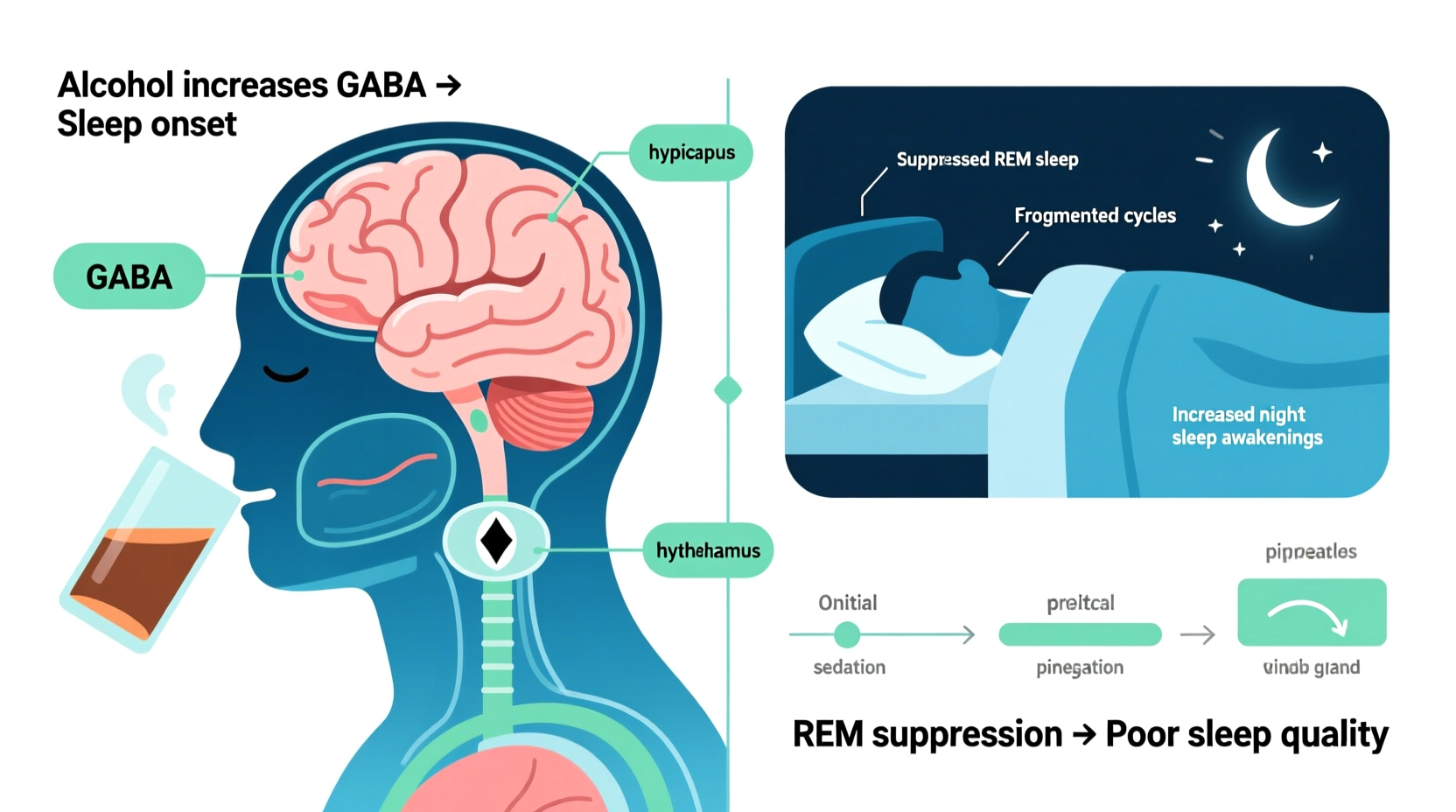
Alcohol’s initial sleep-inducing effect stems from its action on two key neurotransmitter systems: gamma-aminobutyric acid (GABA) and glutamate. GABA is the brain’s primary inhibitory neurotransmitter—it slows neural firing, reduces anxiety, and promotes calm. Ethanol enhances GABA activity at GABAA receptors, effectively “turning down the volume” on excitatory brain circuits. Simultaneously, alcohol suppresses glutamate—the brain’s main excitatory neurotransmitter—particularly at NMDA receptors. This dual action creates a rapid, dose-dependent calming effect. At low-to-moderate doses (e.g., one standard drink for women, two for men), this shift lowers arousal, slows reaction time, and impairs cognitive processing—all hallmarks of sedation.
Crucially, this effect is pharmacologically distinct from natural sleep onset. In healthy sleep, the brain transitions through coordinated stages regulated by circadian and homeostatic signals—melatonin release, adenosine accumulation, and synchronized thalamocortical oscillations. Alcohol bypasses those pathways. Instead, it forces neural inhibition, mimicking—but not replicating—the neurophysiology of true sleep. As Dr. Matt Walker, neuroscientist and author of Why We Sleep, explains:
“Alcohol doesn’t give you sleep. It gives you sedation—a state that looks like sleep but lacks the restorative power of natural, unmedicated slumber.” — Dr. Matthew Walker, UC Berkeley Sleep Research Center
This distinction becomes critical when examining what happens after the first few hours.
The Second-Half Disruption: REM Suppression, Fragmentation, and Rebound Arousal
While alcohol accelerates sleep onset, it profoundly distorts sleep architecture across the night. The most consistent and well-documented effect is suppression of rapid eye movement (REM) sleep—the stage essential for emotional regulation, memory consolidation, and creative problem-solving. During the first half of the night, REM latency increases (it takes longer to enter REM), and total REM duration drops significantly—by up to 25% after just two drinks.
By the second half of the night—typically between 2 a.m. and 6 a.m.—the body begins metabolizing alcohol. Blood alcohol concentration (BAC) falls, and the brain reacts. The prior GABA enhancement wears off, while glutamate rebound occurs: the brain overcompensates for earlier suppression by flooding synapses with excitatory neurotransmitters. This neurochemical “rebound” elevates heart rate, increases core body temperature, triggers cortisol release, and heightens sympathetic nervous system activity. The result? Frequent awakenings, lighter non-REM sleep (especially reduced slow-wave sleep), vivid or disturbing dreams, and subjective reports of non-restorative sleep—even when total sleep time appears normal.
Tip: If you choose to drink, stop at least 3–4 hours before bedtime. This allows your liver to clear ~80% of the alcohol before sleep onset—reducing both sedative intensity and subsequent rebound disruption.Physiological Consequences Beyond Brainwaves
Sleep disruption from alcohol extends far beyond fragmented EEG patterns. It triggers measurable physiological changes that compound fatigue and impair next-day function:
- Respiratory compromise: Alcohol relaxes upper airway muscles—including the genioglossus, which keeps the tongue from collapsing backward—increasing the risk of snoring, hypopnea, and apnea events, especially in those predisposed to obstructive sleep apnea (OSA). Even light drinkers without OSA report more frequent breathing pauses during sleep after alcohol consumption.
- Thermoregulatory dysregulation: Alcohol causes peripheral vasodilation, creating a false sense of warmth while accelerating core body heat loss. Since falling core temperature is a key biological signal for sleep onset and maintenance, this disruption delays and destabilizes sleep continuity.
- Dehydration and nocturia: Ethanol inhibits antidiuretic hormone (ADH), increasing urine production by up to 300%. This leads to overnight dehydration, dry mouth, headache, and frequent bathroom trips—each awakening further fragments sleep and depletes restorative slow-wave cycles.
- Reduced melatonin secretion: Studies show evening alcohol intake suppresses nocturnal melatonin release by up to 20%, blunting the natural circadian drive for sleep and delaying the onset of deep, consolidated rest.
These effects are not theoretical. They translate directly into impaired vigilance, slower reaction times, diminished working memory, and increased emotional reactivity the following day—effects comparable to mild sleep deprivation, even after eight hours in bed.
Real-World Impact: A Mini Case Study
Consider Maya, 34, a project manager who regularly consumes two glasses of red wine with dinner to “de-stress.” She consistently falls asleep within 20 minutes but wakes between 2:30 a.m. and 3:15 a.m., unable to return to sleep for 45–60 minutes. She reports morning fatigue, difficulty concentrating before noon, and heightened irritability during team meetings. After tracking her sleep with a validated wearable for three weeks—first with nightly wine, then with no alcohol for five consecutive nights—her data revealed stark contrasts:
| Measure | With Alcohol (Avg.) | Without Alcohol (Avg.) |
|---|---|---|
| Time to fall asleep | 18 min | 24 min |
| Total sleep time | 7 hr 12 min | 7 hr 28 min |
| REM sleep (% of total) | 16.3% | 22.7% |
| Awakenings >5 min | 4.2 | 1.8 |
| Next-day alertness (self-rated 1–10) | 5.1 | 7.9 |
Maya didn’t need more sleep—she needed better-quality sleep. Eliminating alcohol didn’t increase her total time in bed; it dramatically improved sleep efficiency, REM restoration, and subjective recovery. Her productivity and mood stabilized within four days.
Actionable Strategies: What You Can Do Tonight
Understanding the science is only useful if it informs behavior. Below is a step-by-step protocol grounded in sleep medicine guidelines and clinical evidence:
- Assess your baseline: For one week, log alcohol intake (type, amount, time), bedtime, wake time, and subjective sleep quality (1–10 scale). Note any nighttime awakenings, dreams, or morning symptoms (headache, dry mouth, fatigue).
- Implement a 3-night alcohol-free trial: Choose three consecutive nights with zero alcohol—no wine, beer, spirits, or mixed drinks. Maintain consistent sleep/wake times within 30 minutes, even on weekends.
- Optimize pre-sleep conditions: Replace the nightcap with non-alcoholic alternatives: tart cherry juice (natural melatonin source), magnesium glycinate (supports GABA function), or warm herbal tea (chamomile, passionflower). Dim lights 90 minutes before bed and avoid screens.
- Adjust timing if drinking continues: If you choose to drink, consume all alcohol before 8 p.m. (for a 11 p.m. bedtime). Never drink “to sleep”—this reinforces dependence on external sedation rather than building natural sleep resilience.
- Evaluate objectively: After the trial, compare your logs. Did sleep onset take longer? Did you wake less? Did next-day energy improve? Let your body—not habit—guide your decision.
Frequently Asked Questions
Does “one drink” really affect sleep?
Yes—even a single standard drink (14 g ethanol) can reduce REM sleep and increase sleep fragmentation in sensitive individuals, particularly women and adults over 40. Metabolism slows with age, and estrogen modulates alcohol’s effects on GABA receptors, making lower doses more disruptive for many.
Are some types of alcohol “better” for sleep?
No. While red wine contains melatonin and resveratrol, the net effect of ethanol dominates. Distilled spirits, beer, and wine all suppress REM and trigger rebound arousal. “Low-alcohol” or “non-alcoholic” beverages containing 0.5% ABV or less have negligible impact—but anything above that carries measurable sleep consequences.
Can I “catch up” on lost REM sleep the next night?
Not fully. While the brain attempts REM rebound after acute deprivation, chronic alcohol use leads to persistent REM suppression and reduced slow-wave sleep density—changes linked to long-term cognitive decline and mood disorders. Recovery requires sustained abstinence, not compensation.
Conclusion: Reclaiming Rest Without Reliance
Alcohol’s sedative lure is powerful—but its cost to sleep quality is steep and well-documented. It doesn’t solve insomnia; it masks it with pharmacological shortcuts that erode the very systems meant to sustain rest. The irony is profound: the substance chosen to quiet the mind ultimately amplifies neural noise when it matters most—during the vulnerable, restorative hours of deep and REM sleep. Recognizing this isn’t about moral judgment or rigid abstinence. It’s about agency. It’s understanding that true rest isn’t induced—it’s cultivated. Through consistency, timing, hydration, and respect for your body’s natural rhythms, you can replace the illusion of sleep with something far more valuable: genuine, restorative rest.
If you’ve ever woken exhausted despite “enough” hours in bed—or felt foggy, irritable, or emotionally raw after a night with alcohol—you now hold the science behind why. Use it wisely. Try one alcohol-free week. Track how you feel—not just how you sleep. Notice the clarity, the steadiness, the quiet confidence that comes from knowing your rest is earned, not engineered.
💬 Your experience matters. Have you noticed changes in your sleep after cutting back on alcohol? Share your observations in the comments—your insight could help someone else break free from the nightcap cycle.








