
It’s a familiar pattern: two glasses of wine after dinner, and your eyelids grow heavy. You drift off faster than usual—only to wake up at 3 a.m., restless and unrefreshed. While alcohol is widely perceived as a “sleep aid,” its effects on the central nervous system are far more complex—and ultimately counterproductive for healthy sleep. This isn’t mere drowsiness; it’s a cascade of neurochemical interference, receptor modulation, and circadian disruption rooted in human physiology. Understanding *why* alcohol induces initial sedation—and why that sedation masks profound sleep degradation—is essential for making informed choices about evening consumption.
How Alcohol Hijacks Your Brain’s Calming System
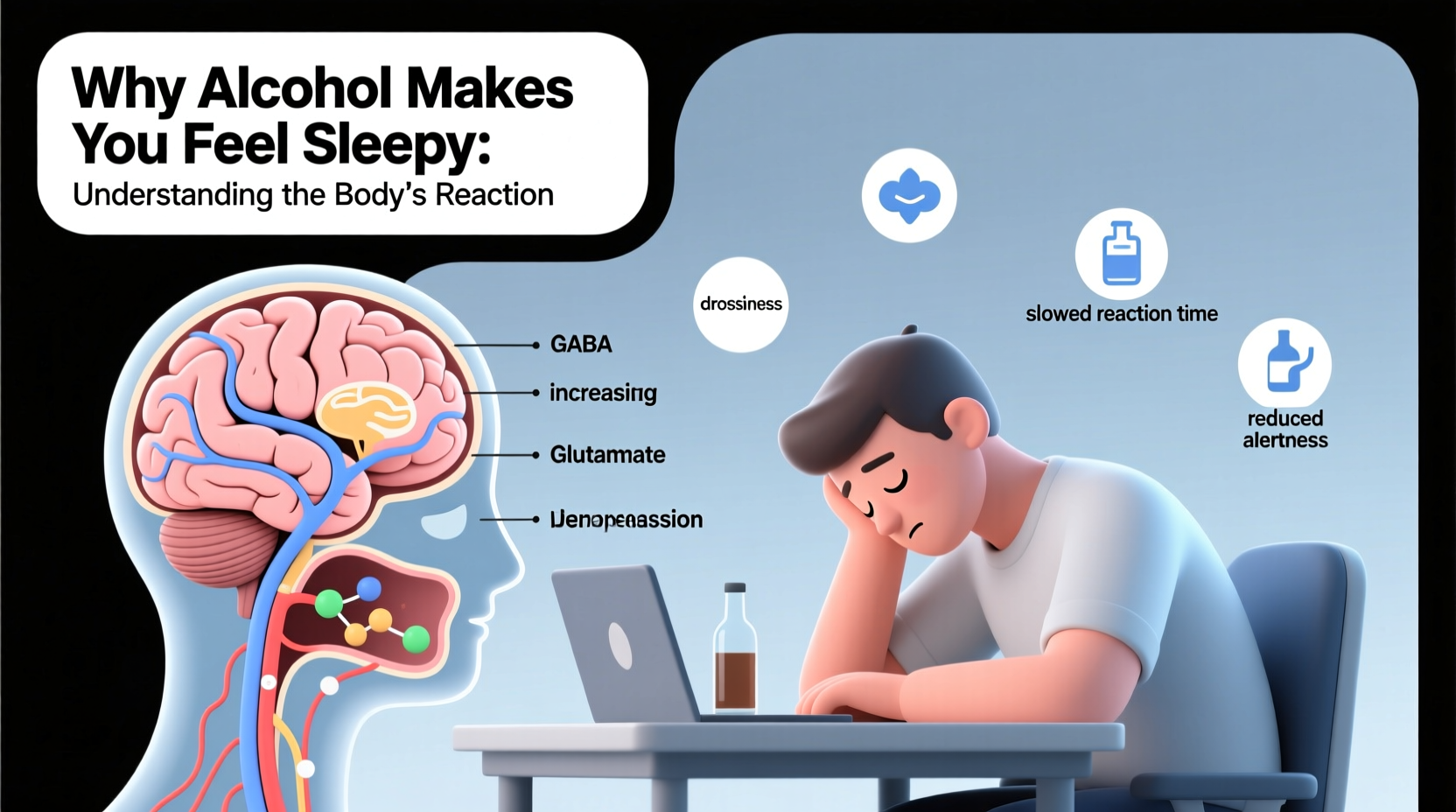
Alcohol doesn’t act on a single target. Instead, it enhances the activity of gamma-aminobutyric acid (GABA), the brain’s primary inhibitory neurotransmitter. GABA slows neural firing, reducing excitability across the cortex, thalamus, and limbic system. When ethanol binds to GABAA receptors—particularly those containing δ and α1 subunits—it increases the frequency and duration of chloride ion channel openings. This hyperpolarizes neurons, effectively “dampening” brain activity. The result? Reduced anxiety, slower reaction times, slurred speech—and yes, subjective drowsiness.
Crucially, this GABA potentiation is dose-dependent and region-specific. Low-to-moderate doses (e.g., one to two standard drinks) preferentially affect the prefrontal cortex and amygdala, blunting emotional reactivity and decision-making. As blood alcohol concentration (BAC) rises, sedation spreads to the brainstem and reticular activating system—the very networks responsible for maintaining wakefulness. That’s why many people report feeling “heavy-lidded” or “mentally foggy” within 20–40 minutes of drinking.
Yet this sedation is pharmacologically distinct from natural sleep onset. In genuine sleep, the brain transitions through organized, cyclical stages—NREM Stage 1 (light sleep), NREM Stage 2 (spindle-rich consolidation), deep NREM Stage 3 (slow-wave sleep), and REM sleep. Alcohol doesn’t replicate that progression. It forces a rapid descent into shallow, fragmented NREM sleep while suppressing the neurophysiological signatures of restorative rest.
The Hidden Cost: Why “Falling Asleep Faster” Is Misleading
Studies consistently show that alcohol reduces sleep onset latency—the time it takes to fall asleep—by 10–25%. But this apparent benefit conceals three critical deficits:
- Suppressed slow-wave sleep (SWS): Alcohol significantly diminishes the duration and amplitude of delta waves during NREM Stage 3, especially in the first half of the night. SWS is vital for physical recovery, growth hormone release, immune modulation, and glymphatic clearance—the brain’s nightly “waste removal” system.
- Fragmented second-half sleep: As alcohol metabolizes (at ~0.015% BAC per hour), withdrawal-like rebound effects emerge. GABAergic inhibition wanes while glutamate—a key excitatory neurotransmitter—surges. This neurochemical imbalance triggers frequent micro-arousals, nocturnal awakenings, and reduced total sleep time.
- REM suppression and rebound disruption: Alcohol delays the first REM period by up to 90 minutes and cuts overall REM time by 20–30%. Since REM supports emotional regulation and memory integration, its loss contributes to next-day irritability, poor recall, and heightened stress reactivity.
This biphasic effect—sedation followed by fragmentation—is why people often misattribute their fatigue to “not sleeping enough” when the real issue is *nonrestorative* sleep. Their body may log seven hours, but the brain receives the physiological equivalent of four to five hours of high-quality rest.
Tip: If you drink alcohol in the evening, stop at least 3 hours before bedtime. This allows peak BAC to decline and minimizes disruption to REM onset and sleep architecture.What Your Liver and Hormones Are Really Doing
Sleepiness isn’t only about the brain. Alcohol metabolism places immediate demands on peripheral systems—with cascading consequences for rest:
Your liver processes ethanol via two main enzymatic pathways: alcohol dehydrogenase (ADH) converts ethanol to acetaldehyde (a toxic compound), and aldehyde dehydrogenase (ALDH) then converts acetaldehyde to acetate. This process consumes nicotinamide adenine dinucleotide (NAD+), shifting the cellular redox state toward NADH dominance. That shift impairs mitochondrial function and reduces ATP production—depleting the energy reserves needed for sustained wakefulness and overnight repair.
Hormonally, alcohol suppresses melatonin secretion by up to 40%, particularly when consumed between 7 p.m. and midnight—the window when the pineal gland normally ramps up melatonin synthesis. Without this circadian signal, the body struggles to synchronize sleep-wake timing. Simultaneously, cortisol—a stress hormone that should dip at night—often exhibits an abnormal nocturnal rise after alcohol intake, further fragmenting sleep continuity.
Breathing is also affected. Alcohol relaxes upper airway muscles—including the genioglossus, which keeps the tongue from collapsing backward. This increases the risk of snoring, hypopneas (shallow breathing), and obstructive events—even in individuals without diagnosed sleep apnea. A 2022 Journal of Clinical Sleep Medicine study found that a single glass of wine increased respiratory event frequency by 25% in otherwise healthy adults.
Individual Variability: Why Reactions Differ So Sharply
Not everyone feels sleepy after alcohol—and those who do vary widely in intensity and duration. Genetics, sex, age, tolerance, and metabolic health all shape the response:
| Factor | Effect on Sleepiness & Sleep Quality | Underlying Mechanism |
|---|---|---|
| ALDH2*2 gene variant (common in East Asian populations) | Intense flushing, nausea, tachycardia—and paradoxically, less sedation due to acetaldehyde buildup | Reduced ALDH enzyme activity causes acetaldehyde accumulation, triggering sympathetic activation that opposes GABA-mediated sedation |
| Female sex | Greater sensitivity to sedative effects; higher BAC for same dose; more pronounced SWS suppression | Lower body water percentage, higher fat mass, and lower gastric ADH activity increase bioavailability and prolong exposure |
| Age > 60 | Increased drowsiness, longer sleep latency post-alcohol, greater next-day cognitive impairment | Reduced hepatic blood flow, slower metabolism, and age-related decline in GABAA receptor resilience |
| Chronic use | Diminished sedation (tolerance), but worsened sleep architecture and increased insomnia severity | Downregulation of GABAA receptors and upregulation of NMDA glutamate receptors create neuroadaptive imbalance |
These differences explain why two colleagues might have identical drinks yet one falls asleep instantly while the other stays alert—or why someone who slept soundly at 25 may wake exhausted at 45 after the same routine. Biology, not willpower, governs the response.
Mini Case Study: Maya’s “Wine Wind-Down” Experiment
Maya, 38, a project manager, had relied on a nightly 5 oz glass of pinot noir to “unwind.” She fell asleep quickly but woke at 2:47 a.m. nearly every night, unable to return to sleep. Her morning focus was brittle, and she felt emotionally raw by noon. After tracking her sleep with a validated wearable for two weeks (baseline), she eliminated alcohol for 10 days. On nights 4–10, her average sleep efficiency rose from 78% to 89%; slow-wave sleep increased by 32%; and she reported waking only once per night, if at all. Most strikingly, her afternoon cortisol levels—measured via saliva test—normalized, dropping from elevated 18.4 nmol/L to 12.1 nmol/L (within healthy diurnal range).
When she reintroduced one drink—but moved it to 6:30 p.m. instead of 9 p.m.—her sleep quality remained markedly improved versus her original routine. The key wasn’t abstinence alone; it was aligning consumption with her body’s metabolic and circadian rhythms.
Expert Insight: What Sleep Neurologists Emphasize
“Alcohol is a central nervous system depressant—not a hypnotic. It doesn’t induce sleep; it induces sedation. And sedation is not restorative. We see patients daily who believe they ‘need’ alcohol to sleep, unaware they’ve trained their brains to depend on a substance that actively erodes the very architecture their bodies require for healing.”
— Dr. Lena Torres, MD, FAASM, Director of the Center for Sleep Neurobiology, Stanford University
“The delta wave suppression caused by even moderate alcohol is measurable within one hour of ingestion. There is no ‘safe threshold’ for preserving deep sleep integrity—only gradients of impairment.”
— Dr. Rajiv Mehta, PhD, Neuropharmacologist, Harvard Medical School
Practical Action Plan: Supporting Natural Sleep Without Alcohol
If alcohol-induced drowsiness has become part of your wind-down ritual, replacing it with evidence-based alternatives restores both sleep quality and long-term resilience. Follow this step-by-step sequence over 14 days:
- Days 1–3: Awareness & Timing Audit
Log every drink—including type, volume, time consumed, and subjective sleep rating (1–10). Note awakenings, next-day fatigue, and mood. - Days 4–7: Shift the Window
Move alcohol consumption to at least 3 hours before bed. Replace the 9 p.m. glass with herbal tea (non-caffeinated chamomile or tart cherry) at 8:30 p.m. - Days 8–10: Introduce Non-Pharmacologic Anchors
Add a consistent 15-minute pre-sleep ritual: dim lights by 80%, practice 4-7-8 breathing (inhale 4 sec, hold 7 sec, exhale 8 sec), and write down one gratitude and one unresolved thought to “park” it for tomorrow. - Days 11–14: Reinforce Circadian Cues
Get 10–15 minutes of morning sunlight within 30 minutes of waking. Avoid screens 60 minutes before bed. If craving persists, sip warm almond milk with a pinch of magnesium glycinate (200 mg)—shown in RCTs to improve sleep onset and maintenance without sedation.
FAQ: Addressing Common Questions
Does “low-alcohol” or “non-alcoholic” wine cause the same sleep disruption?
Most non-alcoholic wines contain up to 0.5% ABV—too low to trigger significant GABA modulation or metabolic burden. However, some contain added sugars or histamine-releasing compounds (from fermentation) that may impair sleep in sensitive individuals. True 0.0% ABV beverages pose negligible risk—but verify labels, as “alcohol-free” regulations vary by country.
Can I “fix” alcohol’s impact with melatonin supplements?
No. Exogenous melatonin does not reverse alcohol-induced REM suppression or slow-wave deficits. In fact, combining melatonin with alcohol may intensify next-day grogginess and impair motor coordination. Melatonin helps regulate timing—not depth—of sleep. Prioritizing alcohol-free evenings yields more robust benefits than supplementation.
Why do I sometimes feel *more* alert after a drink—especially early in the evening?
This reflects alcohol’s biphasic action. At low BAC (<0.03%), dopamine and opioid system activation can produce mild euphoria and stimulation—particularly in social settings. That “lift” often precedes sedation and is more common in younger adults or those with high baseline anxiety. It does not indicate tolerance; it signals the beginning of neurochemical perturbation.
Conclusion
Feeling sleepy after alcohol isn’t a sign your body is resting—it’s a warning that your nervous system is being chemically overridden. The drowsiness is real, but it’s the sedative illusion masking deeper dysfunction: suppressed brain detoxification, fragmented memory processing, dysregulated stress hormones, and diminished physical recovery. Understanding this distinction transforms choice from habit to intention. You don’t need to eliminate alcohol entirely to honor your sleep biology—you need only align consumption with your physiology. Start tonight: delay your last drink, prioritize darkness and coolness, and notice how your mind settles without chemical assistance. Rest isn’t something you force with substances. It’s something you invite—consistently, gently, and wisely.
💬 Have you noticed changes in your sleep after adjusting alcohol timing or quantity? Share your experience in the comments—we’re building a community grounded in real-world science, not myths.








