
Within 5 to 10 minutes of consuming even a single standard drink—such as 14 grams of pure ethanol (found in 12 oz of beer, 5 oz of wine, or 1.5 oz of distilled spirits)—many people notice subtle but measurable changes: a slight sway when standing still, delayed reaction to stepping off a curb, or difficulty touching their nose with eyes closed. These aren’t just “signs of being tipsy.” They reflect rapid, targeted disruption of neural circuitry governing motor control and spatial orientation. Unlike many drugs that require metabolic activation or gradual accumulation, ethanol acts directly and swiftly on key brainstem and cerebellar structures. Understanding why this happens so fast—and what exactly is compromised—empowers safer decision-making, informs clinical assessments, and clarifies the narrow margin between social drinking and functional impairment.
The Cerebellum: Alcohol’s First Target
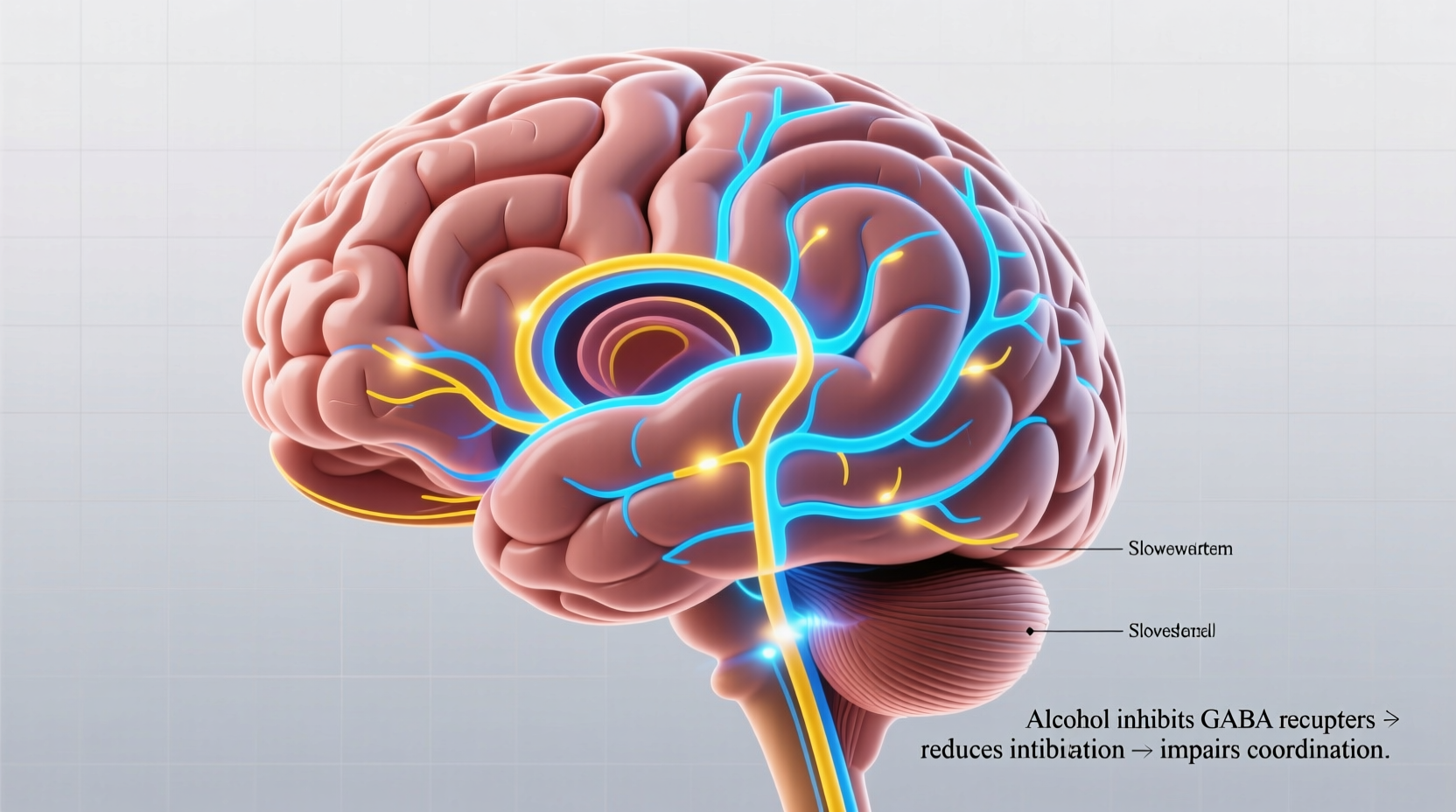
The cerebellum, located at the base of the brain behind the brainstem, is not involved in initiating movement—but it is essential for refining it. It compares intended motion (from the motor cortex) with real-time sensory feedback (from muscles, joints, and the inner ear) and makes micro-adjustments—tens of times per second—to ensure smooth, accurate, and balanced execution. Ethanol crosses the blood-brain barrier within seconds due to its high lipid solubility, and the cerebellum is especially vulnerable because it has an exceptionally dense concentration of GABAA receptors—the primary inhibitory neurotransmitter system that ethanol potentiates.
When ethanol binds to these receptors, it prolongs chloride ion influx into neurons, hyperpolarizing them and suppressing firing. In the cerebellum’s Purkinje cells—the sole output neurons of the cerebellar cortex—this inhibition degrades the precision of error-correction signals sent to the thalamus and motor cortex. The result? Movements become coarse, tremulous, and poorly timed. A person may reach for a glass and overshoot; walk in a straight line but veer left without realizing it; or blink slowly after a sudden visual stimulus. These are not signs of “slowing down” generally—they’re specific failures of sensorimotor integration.
Tip: If you feel unsteady after one drink—even without dizziness or slurred speech—it’s likely your cerebellum responding acutely. This is a reliable early warning sign that further consumption will compound impairment.The Vestibular System and Brainstem Integration
Beyond the cerebellum, ethanol rapidly infiltrates the vestibular nuclei in the brainstem—clusters of neurons that process signals from the semicircular canals and otolith organs of the inner ear. These structures detect head rotation, linear acceleration, and gravitational orientation. Ethanol alters the density of endolymph (the fluid inside the semicircular canals), creating a mismatch between actual head position and perceived motion. This is why people often report “room spinning” or lightheadedness—not only during intoxication but also upon standing quickly after drinking.
Critically, the vestibular nuclei don’t work in isolation. They integrate inputs from vision (via the superior colliculus) and proprioception (via spinal cord relays) to generate postural reflexes. Ethanol suppresses neuronal excitability across this entire network. For example, the vestibulo-ocular reflex (VOR)—which stabilizes gaze during head movement—degrades within minutes. You can observe this clinically: ask someone who’s had one drink to follow your finger horizontally while keeping their head still. Their eyes will begin to “catch up” with jerky saccades instead of smooth pursuit—a hallmark of early VOR suppression.
Why So Fast? Pharmacokinetics and Neural Vulnerability
Three interlocking factors explain alcohol’s speed of action on motor control:
- Lipid solubility: Ethanol dissolves readily in fats, allowing it to diffuse across the blood-brain barrier faster than water-soluble substances like glucose or sodium.
- Low protein binding: Over 95% of circulating ethanol remains unbound to plasma proteins, making it immediately bioavailable to neural tissue.
- High regional perfusion: The cerebellum and brainstem receive disproportionately high cerebral blood flow—up to 70 mL/100g/min—compared to ~50 mL/100g/min in the frontal cortex. This delivers ethanol to motor control centers before it fully saturates slower-perfused regions.
Importantly, this speed isn’t uniform across individuals. Genetic variations in alcohol dehydrogenase (ADH) and aldehyde dehydrogenase (ALDH) enzymes affect how quickly ethanol is metabolized—but the *initial* neurological impact depends almost entirely on absorption and distribution, not metabolism. That’s why even slow metabolizers experience rapid motor effects: the drug hits the target before the liver begins clearing it.
Real-World Impact: A Mini Case Study
Consider Maria, a 32-year-old physical therapist and licensed driver. At a colleague’s birthday dinner, she consumed one 5-oz glass of pinot noir (13% ABV) over 20 minutes—well below the legal BAC limit of 0.08%. She declined dessert and walked to her car, which was parked three blocks away. En route, she misjudged the curb height exiting the sidewalk, stumbled forward, and caught herself against a lamppost. Later, reviewing security footage, she noticed her gait lacked normal arm swing symmetry and her heel-to-toe placement was inconsistent—subtle but objective signs of cerebellar-vestibular interference. At the hospital where she works, she routinely administers the Romberg test (standing feet together, eyes closed) to assess balance. When she tried it at home that night, she swayed significantly within 15 seconds—whereas her baseline is stable for 60+ seconds.
Maria’s experience illustrates a critical point: functional impairment begins long before subjective intoxication. Her BAC peaked at approximately 0.025%, yet her postural control systems were measurably compromised. This isn’t anecdotal—it aligns with peer-reviewed data: a 2022 study in Journal of Neurophysiology found that healthy adults showed statistically significant increases in center-of-pressure sway velocity at BACs as low as 0.015%—levels achievable after half a standard drink.
What Gets Disrupted—and What Doesn’t (Yet)
Not all motor functions degrade at the same rate. The table below summarizes the relative sensitivity of key systems to low-dose ethanol exposure (BAC 0.01–0.03%). These thresholds are based on controlled laboratory assessments using force plates, eye-tracking, and reaction-time tasks.
| Neurological Function | Typical Onset (BAC) | Observable Sign | Underlying Mechanism |
|---|---|---|---|
| Cerebellar fine-motor control | 0.015% | Intention tremor, dysmetria (overshooting targets) | Purkinje cell inhibition → degraded error correction |
| Vestibulo-ocular reflex (VOR) | 0.02% | Reduced smooth pursuit, increased saccadic intrusions | Vestibular nucleus suppression → impaired gaze stabilization |
| Postural sway (Romberg test) | 0.025% | Increased sway velocity & area with eyes closed | Impaired multisensory integration in brainstem/cerebellum |
| Simple reaction time | 0.04% | ~15–25 ms delay in button press response | Slowed cortical processing in supplementary motor area |
| Speech articulation | 0.05% | Minor imprecision in consonant clusters (e.g., “spoon” → “shpoon”) | Reduced corticobulbar drive to cranial nerve nuclei |
Note that higher-order cognition—like working memory or complex decision-making—typically shows measurable decline only above 0.04%. Balance and coordination are among the *first* systems to falter because they rely on phylogenetically older, highly conserved circuits with dense inhibitory receptor expression and minimal redundancy. Evolution prioritized stability over abstract reasoning—so ethanol exploits that hierarchy.
Expert Insight: Clinical and Research Perspectives
“The idea that ‘one drink won’t affect me’ is neurologically indefensible. We see cerebellar inhibition on functional MRI within 6 minutes of ingestion—even at 0.01% BAC. What’s remarkable isn’t that alcohol impairs balance, but how exquisitely selective and rapid that impairment is. It’s less like turning down a volume knob and more like disabling a critical calibration chip in a gyroscope.”
— Dr. Lena Cho, Neuropharmacologist and Director of the Human Motor Control Lab, University of Washington School of Medicine
Dr. Cho’s team has mapped ethanol’s binding kinetics in primate models, confirming that cerebellar GABAA receptors exhibit 3.7× greater ethanol affinity than those in the prefrontal cortex. This molecular specificity explains why a person can hold a coherent conversation while failing a roadside walk-and-turn test—the brain’s language centers remain functionally intact while its balance architecture is already compromised.
Actionable Checklist: Recognize and Respond to Early Impairment
- ✅ Perform a self-Romberg test before driving or operating equipment: Stand barefoot, feet together, arms at sides, eyes closed. If you sway noticeably or need to step out within 30 seconds, your vestibulocerebellar system is impaired.
- ✅ Assess dynamic balance: Walk 10 steps heel-to-toe in a straight line. Any deviation, pause, or need to use arms for stability indicates compromised integration.
- ✅ Test ocular tracking: Hold a pen 2 feet away and move it slowly left-right. Jerky eye movements (nystagmus) suggest VOR disruption.
- ✅ Delay critical tasks for at least 90 minutes after your last drink—even if you feel “fine.” Cerebellar recovery lags behind subjective perception.
- ✅ Never combine alcohol with sedatives (benzodiazepines, sleep aids, opioids), which synergistically amplify GABAergic inhibition and dramatically increase fall risk.
FAQ
Can coffee or cold showers reverse alcohol-induced balance loss?
No. Caffeine may increase alertness but does not restore cerebellar or vestibular function. A cold shower might raise heart rate temporarily but fails to accelerate ethanol clearance from neural tissue or repair inhibited synaptic transmission. Only time and hepatic metabolism reduce impairment.
Why do some people seem “unaffected” after several drinks?
Apparent resilience usually reflects tolerance—not immunity. Chronic drinkers develop neuroadaptive changes, including downregulation of GABAA receptors and upregulation of excitatory NMDA receptors. This masks symptoms but doesn’t prevent cellular damage or increase safety: their BAC is still rising, fall risk remains elevated, and cognitive load during multitasking (e.g., driving) is significantly higher than in naïve drinkers.
Does eating before drinking prevent balance impairment?
Eating slows gastric emptying, delaying peak BAC by 30–60 minutes—but it does not eliminate early effects. Ethanol absorbed from the upper small intestine still reaches the brain rapidly. A full stomach may reduce peak BAC by 20–30%, but even a reduced peak at 0.03% is sufficient to impair cerebellar function in most adults.
Conclusion
Alcohol affects balance and coordination quickly—not because it’s “strong,” but because it’s surgically precise. Its molecular design allows it to infiltrate the brain’s oldest, most fundamental motor control centers before higher cognition even registers change. This isn’t a flaw in human biology; it’s a feature of evolutionary architecture where stability precedes sophistication. Recognizing that sway, tremor, or visual instability after one drink is not “just nerves” but measurable neural disruption transforms how we approach personal safety, clinical assessment, and public health messaging. You don’t need to wait for slurred speech or dizziness to know your coordination is compromised—you need only stand still, close your eyes, and feel the subtle shift in your center of gravity. That sensation is your cerebellum sending a clear, urgent signal. Honor it. Pause. Breathe. Choose differently—not because you’re “not handling it well,” but because your nervous system is functioning exactly as designed: sounding the earliest possible alarm.
💬 Your awareness matters—for yourself and others. Share this insight with a friend who drives after one drink, a coach who oversees athletes’ recovery protocols, or a healthcare provider who counsels patients on safe substance use. Real understanding starts with precise science—and spreads through thoughtful action.








