
Brain fog after drinking isn’t just “feeling tired.” It’s a measurable, biologically coherent state: slowed processing speed, impaired working memory, difficulty concentrating, mental fatigue, and a sense of cognitive detachment. Unlike ordinary fatigue, this fog persists even after sleep—and often worsens 8–24 hours post-drinking, peaking when blood alcohol has fully cleared. That timing is critical. It means the fog isn’t caused by alcohol itself lingering in your system. It’s caused by your brain’s *reaction* to alcohol’s withdrawal—and the cascade of neurochemical disruptions that follow. This article breaks down exactly what happens, step by step, without oversimplifying or overcomplicating. No jargon without explanation. No speculation. Just evidence-based neurochemistry, translated for real people who want to understand—not just endure—their next hangover.
1. Alcohol Doesn’t “Slow You Down”—It Hijacks Your Brain’s Brakes and Accelerators
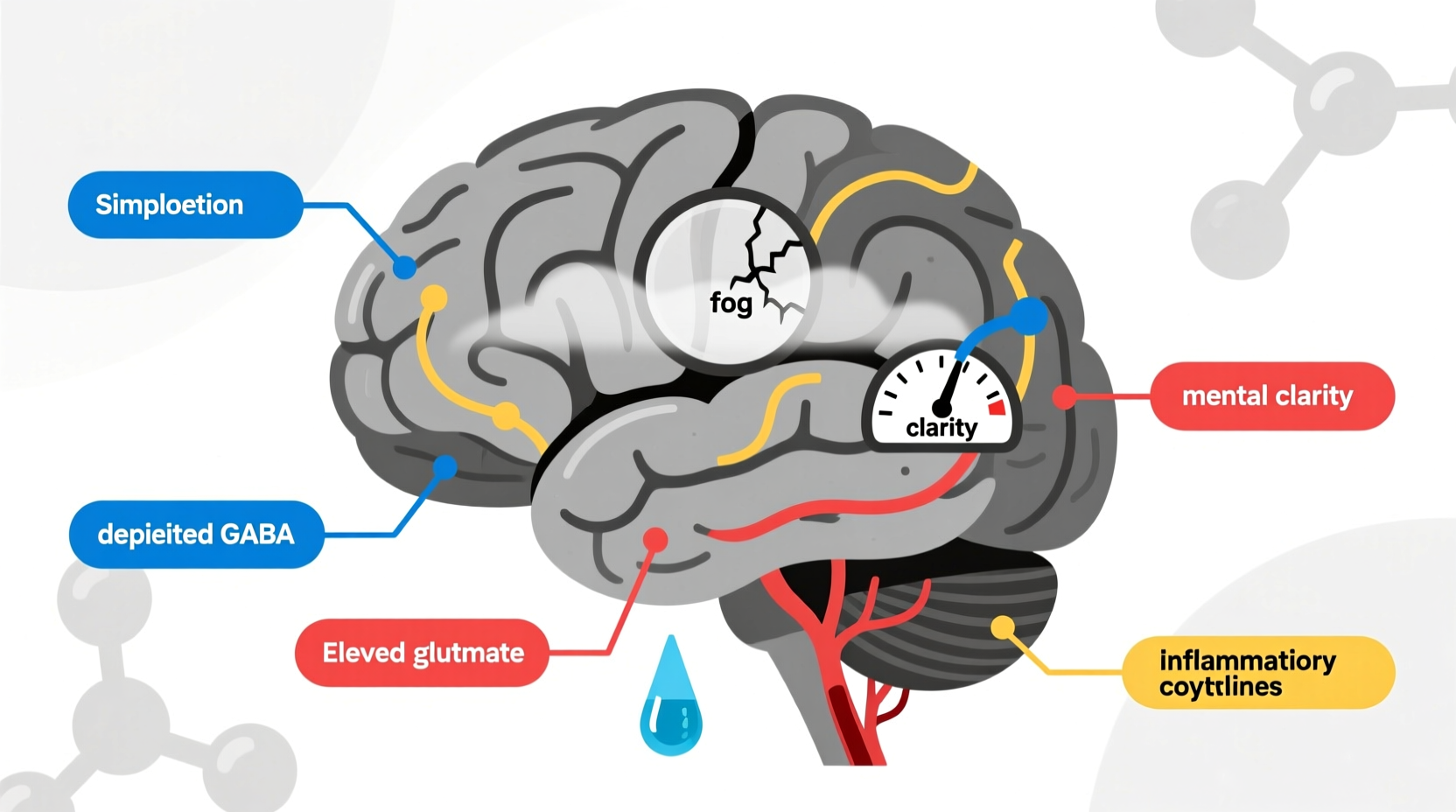
Most people think alcohol is a “depressant” that simply slows neural activity. That’s incomplete—and misleading. Ethanol doesn’t blunt brain function uniformly. Instead, it selectively amplifies inhibition *and* disinhibits excitation through two primary neurotransmitter systems: GABA and glutamate.
GABA (gamma-aminobutyric acid) is your brain’s chief inhibitory neurotransmitter—the “brake pedal.” When GABA binds to its receptors (especially GABAA), it opens chloride channels, making neurons less likely to fire. Alcohol doesn’t mimic GABA—but it *potentiates* GABAA receptors, meaning it makes GABA more effective at calming neural chatter. That’s why low-to-moderate doses feel relaxing, sociable, and sedating.
At the same time, alcohol suppresses glutamate—the brain’s main excitatory neurotransmitter—the “accelerator.” Specifically, it inhibits NMDA-type glutamate receptors, reducing synaptic excitation, learning-related plasticity, and alertness.
The result? A double-hit imbalance: enhanced inhibition + suppressed excitation = acute intoxication. But your brain adapts—fast. Within minutes of alcohol entering your bloodstream, neurons begin compensating. They reduce GABA receptor sensitivity and increase NMDA receptor expression. This is homeostatic neuroadaptation—the brain’s attempt to maintain equilibrium despite chemical interference.
Tip: The more frequently you drink—even moderately—the more your brain pre-emptively upregulates glutamate receptors and downregulates GABA function. This sets the stage for sharper, longer-lasting fog after even modest intake.2. The Rebound: Why Fog Peaks After Alcohol Is Gone
When blood alcohol drops—especially below 0.02%—the compensatory changes don’t reverse instantly. They overshoot. Your brain is now stuck with:
- Underactive GABA systems: Fewer functional GABAA receptors mean reduced inhibition capacity. You lose the “calm background hum” that normally filters out irrelevant stimuli.
- Overactive glutamate systems: Upregulated NMDA receptors flood synapses with excitatory signaling—even without external triggers. This creates neural “noise”: scattered firing, inefficient signal transmission, and metabolic strain.
This glutamate rebound is the single largest driver of hangover-related brain fog. It’s not about “toxins” or “dehydration alone.” It’s about excitotoxic stress—excessive glutamate triggering calcium influx into neurons, disrupting mitochondrial energy production, and increasing oxidative load. Functional MRI studies show reduced activation in the prefrontal cortex (PFC) during hangover—precisely where working memory, attention control, and executive function reside. The PFC is especially vulnerable to glutamate dysregulation because it’s densely packed with NMDA receptors and has high energy demands.
Dr. R. Andrew Chambers, Associate Professor of Psychiatry at Indiana University School of Medicine, explains:
“Hangover cognitive deficits aren’t ‘just fatigue.’ They reflect a transient but measurable hypofrontality—reduced metabolic activity and functional connectivity in prefrontal networks. This is directly tied to GABA/glutamate imbalance, not blood alcohol concentration.”
3. Inflammation, Oxidative Stress, and the Blood-Brain Barrier
Alcohol metabolism generates acetaldehyde—a highly reactive, neurotoxic compound. Even brief exposure triggers microglial activation—the brain’s immune cells. Activated microglia release pro-inflammatory cytokines like IL-1β, IL-6, and TNF-α. These molecules cross the blood-brain barrier (BBB) and interfere with synaptic plasticity, reduce BDNF (brain-derived neurotrophic factor), and impair hippocampal neurogenesis—processes essential for learning, memory consolidation, and mental clarity.
Simultaneously, alcohol depletes glutathione—the brain’s master antioxidant—by up to 50% in key regions like the frontal cortex and hippocampus. With diminished antioxidant capacity, reactive oxygen species (ROS) accumulate, damaging neuronal membranes, mitochondria, and DNA repair mechanisms. Mitochondria in neurons become less efficient at producing ATP, the cellular fuel required for neurotransmitter synthesis, ion pumping, and synaptic vesicle recycling.
Compounding this, alcohol increases BBB permeability—especially after repeated exposure. This allows peripheral inflammatory signals greater access to the brain, amplifying neuroinflammation and further disrupting neurotransmitter balance. A 2023 study in Neuropsychopharmacology found that individuals with higher baseline systemic inflammation reported significantly worse hangover-related cognitive symptoms—even after controlling for alcohol dose and sleep quality.
4. Dehydration, Electrolytes, and Cerebral Perfusion—Beyond the Myths
Yes, alcohol is a diuretic—it inhibits vasopressin (ADH), increasing urine output. But dehydration alone doesn’t explain brain fog. What matters more is the *electrolyte shift* and *cerebral blood flow (CBF) disruption*.
Alcohol causes rapid shifts in sodium, potassium, and magnesium—ions critical for action potential generation and synaptic transmission. Low magnesium, for example, impairs NMDA receptor regulation and reduces GABA efficacy, worsening the very imbalances driving fog. Potassium depletion slows axonal conduction velocity; sodium imbalances distort resting membrane potentials.
More importantly, alcohol acutely increases CBF—but during hangover, CBF drops significantly—up to 15% in frontal regions—according to arterial spin labeling MRI data. Reduced perfusion means less oxygen and glucose delivery precisely where high-demand cognition occurs. This isn’t “just” low blood pressure. It reflects autonomic dysregulation: alcohol disrupts baroreceptor sensitivity and vagal tone, leading to poor cerebral autoregulation—the brain’s ability to maintain steady blood flow despite blood pressure fluctuations.
| Factor | Acute Effect (While Drinking) | Hangover Effect (8–24 hrs Later) | Cognitive Impact |
|---|---|---|---|
| GABAA Function | Potentiated → calm, sedation | Downregulated → neural hyperexcitability, poor filtering | Difficulty focusing, sensory overload |
| Glutamate (NMDA) | Suppressed → slowed reaction time | Rebound hyperactivity → excitotoxic stress | Mental fatigue, slowed processing, “thought lag” |
| Neuroinflammation | Microglial priming begins | Peak cytokine release → synaptic dampening | Reduced working memory, motivation deficit |
| Mitochondrial Efficiency | Mild ROS increase | Glutathione depletion → ATP deficit in PFC | Executive function failure, decision fatigue |
| Cerebral Blood Flow | Transient increase | Frontal hypoperfusion → 10–15% drop | Reduced attention stamina, mental “heaviness” |
5. Real-World Impact: A Mini Case Study
Sarah, 32, a project manager and regular social drinker (3–4 standard drinks, 2–3 nights/week), noticed her “Monday fog” had intensified over six months. She’d wake rested but mentally sluggish—unable to hold more than two tasks in mind, misplacing keys, re-reading emails twice. Her neuropsychological screening showed intact long-term memory and vocabulary, but marked deficits in sustained attention (37% slower on continuous performance tests) and working memory (22% lower digit span). An EEG revealed elevated theta power in frontal leads—consistent with cortical idling and reduced alertness.
After eliminating alcohol for four weeks, her cognitive metrics normalized. Crucially, she didn’t just stop drinking—she adopted targeted countermeasures: daily magnesium glycinate (200 mg), consistent morning hydration with electrolytes (sodium, potassium, magnesium), and 10 minutes of brisk walking before work to boost cerebral perfusion. Within 10 days, her self-reported mental clarity improved markedly—even before full neurochemical normalization occurred.
Her experience illustrates an important truth: brain fog isn’t inevitable or irreversible. It’s a dynamic, multi-system response—one that responds to precise physiological interventions.
6. Actionable Recovery Protocol: A Step-by-Step Timeline
Recovery isn’t passive. Effective fog reduction requires timing-specific interventions aligned with the neurochemical phase you’re in:
- 0–2 hours post-last-drink: Prioritize safe rest—but avoid heavy sedation (e.g., benzodiazepines or sleeping pills), which worsen GABA adaptation. Hydrate with water + ¼ tsp sea salt + ½ tsp coconut water powder (for sodium, potassium, magnesium).
- 2–6 hours: Support mitochondrial recovery. Take 200 mg magnesium glycinate + 500 mg N-acetylcysteine (NAC)—a precursor to glutathione that crosses the BBB and reduces oxidative load.
- Upon waking: Stimulate cerebral perfusion *before* caffeine. Do 5 minutes of diaphragmatic breathing (4-7-8 pattern), then 10 minutes of brisk outdoor walking. Avoid screens for first 30 minutes.
- Morning nutrition: Eat protein + healthy fat + complex carb within 60 minutes of waking. Avoid simple sugars—they spike insulin, worsen cerebral glucose fluctuations, and amplify glutamate release.
- Midday: If fog persists, consider 100 mg L-theanine (not with caffeine if anxious)—it supports alpha-wave activity and gently enhances GABA without sedation.
7. FAQ: Clearing Common Misconceptions
Does “hair of the dog” actually fix brain fog?
No. It temporarily masks symptoms by reactivating alcohol’s GABA-potentiating effect—but delays neurochemical rebalancing and worsens glutamate rebound later. Studies show “hair of the dog” drinkers report longer, more severe fog episodes and increased risk of dependence.
Can coffee make brain fog worse?
It depends on timing and dose. Caffeine blocks adenosine receptors, boosting alertness—but it also increases glutamate release and cortisol. On hangover morning, unmodulated caffeine can amplify neural noise and anxiety. Pair it with L-theanine (100–200 mg) or wait until after perfusion-boosting activity (e.g., walking) for safer effect.
Why does brain fog last longer as I age?
Three key reasons: (1) Slower acetaldehyde clearance due to declining ALDH2 enzyme activity; (2) Age-related reduction in baseline glutathione and mitochondrial resilience; (3) Cumulative microglial priming—making neuroinflammatory responses faster and stronger with each exposure.
Conclusion
Brain fog isn’t a vague, subjective complaint. It’s a reproducible neurochemical state rooted in GABA suppression, glutamate rebound, neuroinflammation, mitochondrial stress, and disrupted cerebral perfusion. Understanding this isn’t about assigning blame—it’s about reclaiming agency. When you know *why* your thoughts feel thick and slow, you stop reaching for quick fixes and start applying precise, physiology-informed strategies. You hydrate smarter—not just more. You time magnesium and NAC for peak glutathione support. You move before you caffeinate. You protect your prefrontal cortex like the high-performance organ it is.
You don’t need to quit drinking to reduce fog. But you do need to stop treating your brain like a passive bystander. Start tonight: measure your next drink honestly, note how your focus feels tomorrow morning, and try one intervention from the timeline above. Track what shifts—even subtly. Because clarity isn’t something you wait for. It’s something you cultivate, neuron by neuron.
💬 What’s one small change you’ll try next time? Share your experiment—or your biggest “aha” moment—in the comments. Real experiences help others navigate their own neurochemistry with confidence.








