The human eye is a marvel of biological engineering, and at its core lies one of the most distinctive features: the pupil. Often mistaken for just a black dot in the center of the eye, the pupil plays a crucial role in vision. But why does it appear so consistently black, regardless of skin tone or eye color? The answer lies not in pigment, but in physics, anatomy, and the way our eyes interact with light.
Unlike the iris—the colored part surrounding the pupil—the pupil itself contains no color-producing cells. Instead, its darkness results from the way light behaves once it enters the eye. When light passes through the pupil, most of it is absorbed by the inner layers of the eye, particularly the retina, with very little reflecting back out. This absence of reflected light makes the pupil appear black to observers.
Anatomy of the Pupil and Its Role in Vision
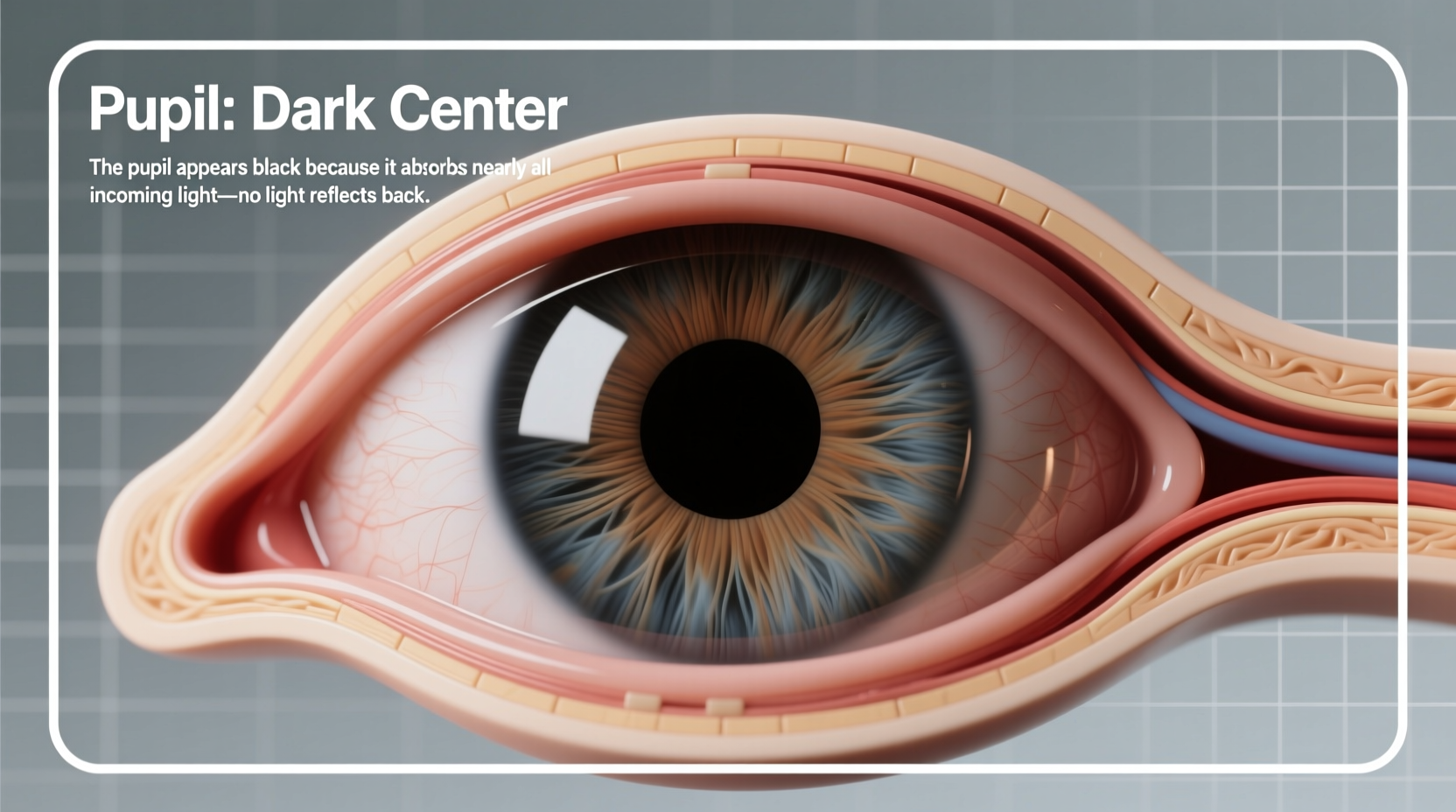
The pupil is not a structure in itself but an opening in the center of the iris. It functions much like the aperture of a camera—adjusting in size to regulate how much light reaches the retina. In bright environments, the pupil constricts (becomes smaller) to prevent excessive light from overwhelming the sensitive photoreceptors. In dim lighting, it dilates (expands) to allow more light in, improving visibility.
This dynamic adjustment is controlled by two sets of muscles within the iris: the sphincter pupillae, which contracts the pupil, and the dilator pupillae, which enlarges it. These involuntary responses are managed by the autonomic nervous system, ensuring optimal visual performance across changing conditions.
Despite variations in iris color—from blue and green to brown and hazel—the pupil remains uniformly dark across all individuals. This consistency underscores its functional nature rather than aesthetic purpose.
“Pupil size isn’t just about light control—it also reflects cognitive load, emotional state, and even interest in stimuli.” — Dr. Lena Torres, Neuro-ophthalmologist, Johns Hopkins Medicine
The Science Behind the Black Appearance
The reason pupils look black is rooted in optics. When external light enters the pupil, it travels through the vitreous humor—a clear gel filling the eyeball—and strikes the retina at the back. The retina contains photoreceptor cells (rods and cones) that absorb light to convert it into neural signals for the brain.
Because nearly all incoming light is absorbed during this process, minimal light escapes back through the pupil. Without significant reflection, the opening appears dark—similar to looking into a tunnel or a shadowed doorway. Even under strong illumination, only a faint red reflex may be visible (as seen in flash photography), caused by blood-rich tissues in the choroid layer reflecting some light.
Tip: If you shine a flashlight into someone’s eye in a dark room, you might briefly see a reddish glow—this is the \"red-eye\" effect due to retinal reflection.Why Don't Pupils Reflect Light Like Mirrors?
Surfaces that appear shiny or reflective—such as mirrors, glass, or polished metal—bounce light directly back to the observer. The interior of the eye, however, is designed for absorption, not reflection. The retinal pigment epithelium, a layer behind the photoreceptors, contains melanin that actively absorbs stray light to prevent internal scattering, which would blur vision.
This efficient light-trapping mechanism ensures clarity and contrast in what we see—but also means that from the outside, the pupil offers no luminous return, reinforcing its black appearance.
Pupil Variations and What They Reveal
While the pupil is always dark, its size, shape, and responsiveness can vary significantly between individuals and situations. These variations are not merely cosmetic; they can indicate health status, neurological function, and psychological states.
| Condition | Pupil Response | What It May Indicate |
|---|---|---|
| Bright Light | Constriction (small pupils) | Normal light regulation |
| Dark Environment | Dilation (large pupils) | Improved night vision |
| Fear or Excitement | Dilation | Autonomic nervous system activation |
| Head Injury | Unequal or non-reactive pupils | Possible brain trauma or pressure |
| Opioid Use | Pinpoint pupils | CNS depression |
Real Example: A Medical Red Flag
In a documented emergency case, a 42-year-old man arrived at the ER after a minor fall. He seemed alert, but a nurse noticed his right pupil was significantly larger than the left and did not react to light. This asymmetry—known as anisocoria—prompted immediate imaging, revealing a developing subdural hematoma pressing on the oculomotor nerve. Rapid intervention saved his life. This illustrates how pupil observation can provide critical diagnostic clues long before other symptoms arise.
Common Myths About Pupil Color and Function
Despite their prominence, several misconceptions persist about pupils:
- Myth: Pupils change color based on mood.
Reality: While pupil size changes with emotion, the pupil itself has no color and cannot shift hue. - Myth: Animals with glowing eyes have non-black pupils.
Reality: Many nocturnal animals have a reflective layer called the tapetum lucidum, which bounces light back through the retina. This causes eye-shine but doesn’t change the pupil’s fundamental darkness when viewed head-on. - Myth: You can see through the pupil to the soul.
Reality: Poetic imagery aside, the pupil simply allows light entry—it reveals nothing beyond anatomical function.
How to Support Healthy Pupil Function
Pupil response depends on overall eye and neurological health. Supporting this system involves proactive habits and awareness. Here's a checklist to maintain optimal visual and neural function:
Checklist: Supporting Pupil and Eye Health- Schedule annual eye exams to monitor optic nerve and retinal health.
- Wear UV-protective sunglasses to reduce strain and prevent cataracts.
- Avoid recreational drugs that alter pupil size (e.g., opioids, stimulants).
- Maintain stable blood sugar levels, especially if diabetic, to protect nerves.
- Seek immediate care if you notice sudden pupil asymmetry or unresponsiveness.
FAQ
Can pupils ever appear not black?
Under certain lighting conditions—especially with camera flashes—pupils may appear red due to the reflection of light off the blood-rich retina. This \"red-eye\" effect is common in photos. In rare cases of albinism, reduced pigmentation can cause a pale or pinkish hue in the pupil area due to visible underlying blood vessels.
Do all animals have black pupils?
Most do, but some species have differently shaped pupils (slits in cats, rectangles in goats) that still appear dark. However, animals with a tapetum lucidum—like dogs or deer—may seem to have glowing eyes at night, though the pupil remains functionally black when absorbing light.
Why don’t pupils look three-dimensional?
The pupil is a deep opening, but without depth cues like shadows or texture, the brain interprets it as a flat black circle. The smooth transition from iris to pupil edge enhances this illusion of a two-dimensional surface.
Conclusion
The blackness of the pupil is more than a visual trait—it’s a testament to the eye’s precision in capturing and processing light. By absorbing photons efficiently, the pupil enables clear vision while remaining inconspicuously dark. Understanding its function enriches appreciation for the subtle mechanisms behind everyday sight.
From medical diagnostics to optical design, the pupil continues to inform science and technology. Paying attention to its behavior can offer insights into both physical health and mental states. Whether you're observing your own reflection or studying human biology, recognizing the purpose behind the darkness adds depth to perception itself.
💬 Did you learn something new about your eyes today? Share this article with someone curious about how vision works—or ask a question in your next eye exam. Awareness starts with looking closely.








