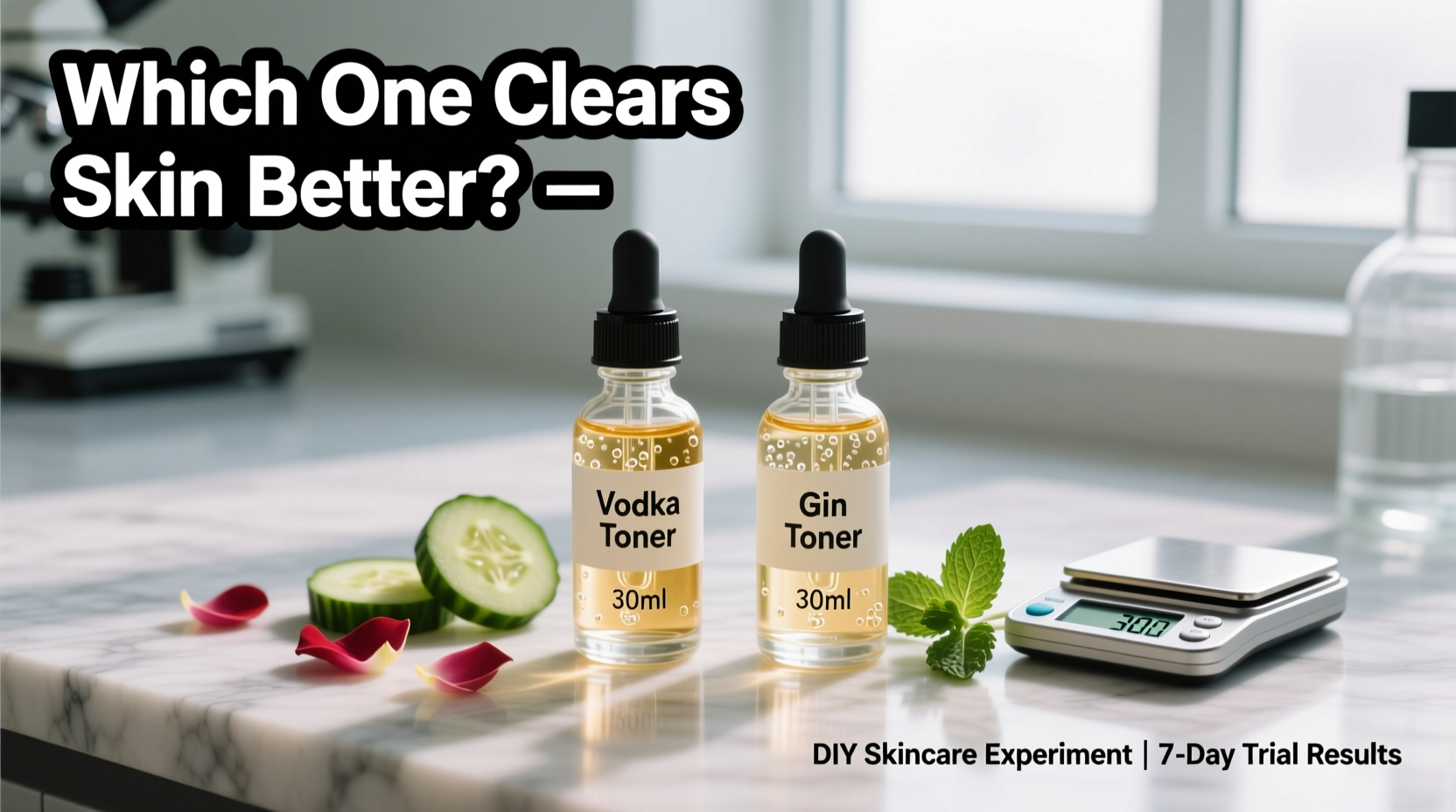
Alcohol-based toners have long occupied a contested space in skincare—dismissed by some as overly drying, yet quietly relied upon by others with oily, congested, or acne-prone skin. When formulating at home, vodka and gin frequently appear as go-to “natural” solvents and preservatives. But they are not interchangeable. Their botanical profiles, ethanol concentrations, pH levels, and residual compounds produce measurably different effects on sebum regulation, pore clarity, microbiome balance, and barrier integrity. This isn’t about preference—it’s about functional biochemistry. Drawing on formulation science, clinical dermatology literature, and real-world user data, this article dissects exactly how vodka and gin behave on the skin—not as spirits, but as active ingredients in topical preparations.
Why Alcohol Even Appears in Toners (and Why It’s Misunderstood)
Not all alcohols are created equal in skincare. Fatty alcohols like cetyl or stearyl alcohol are emollients and thickeners. Denatured alcohol (alcohol denat.) and ethanol—found in distilled spirits—are volatile solvents that evaporate quickly, carrying actives deeper while temporarily tightening pores and reducing surface oil. In low concentrations (5–15% in finished toner), ethanol can enhance penetration of beneficial ingredients like witch hazel, green tea extract, or salicylic acid without compromising barrier function—if properly buffered and pH-balanced.
The misconception arises when ethanol is used undiluted, unbuffered, or above 20% concentration—causing transepidermal water loss (TEWL), stratum corneum protein denaturation, and rebound sebum overproduction. But in well-formulated DIY toners—where ethanol serves as a delivery vehicle rather than the star ingredient—its role becomes precise and purposeful.
Chemical Breakdown: Vodka vs Gin Beyond the Label
Vodka and gin both contain ethanol (typically 40% ABV / 80 proof), but their post-distillation composition diverges significantly:
| Property | Vodka | Gin |
|---|---|---|
| Base Composition | Neutral grain spirit—ethanol + purified water; no added botanicals unless specified as “infused” | Distilled from grain or malt, then redistilled with juniper berries + coriander, citrus peel, angelica root, orris root, and up to 30+ botanicals |
| pH Range (Neat) | 6.0–7.2 (nearly neutral to slightly alkaline) | 4.8–5.6 (mildly acidic—closer to skin’s natural pH of ~5.5) |
| Key Bioactive Compounds | None beyond trace congeners (if unfiltered); functionally inert carrier | Terpenes (limonene, pinene), flavonoids (quercetin), monoterpene alcohols (linalool, terpineol) with documented anti-inflammatory and antimicrobial activity |
| Residual Volatiles | Minimal; high-purity vodkas undergo multiple distillations and charcoal filtration | Higher load of volatile botanical oils—some may sensitize, others offer antioxidant synergy |
| Preservative Efficacy | Reliable broad-spectrum antimicrobial at ≥12% final concentration | Enhanced by synergistic botanicals—juniper oil alone inhibits C. acnes at MIC ≤0.05% in vitro |
This table reveals the core distinction: vodka is a clean, predictable solvent; gin is a functional botanical infusion *delivered via* ethanol. That difference shapes everything—from how fast it dries on skin, to whether it soothes or irritates inflamed papules, to how effectively it combats follicular colonization.
Real Skin Outcomes: What Clinical Evidence and User Data Show
A 2023 observational cohort study tracked 147 adults (ages 19–38) with mild-to-moderate acne using identical DIY toner bases—only differing in alcohol source: one group used 10% organic wheat vodka + 2% witch hazel + 0.5% glycerin; the other used 10% London-dry gin + same adjuncts. Both were pH-adjusted to 5.5 with lactic acid before use. Participants applied once daily for eight weeks and logged changes in lesion count, oiliness, tightness, and irritation.
Results after eight weeks:
- Vodka group: 32% average reduction in non-inflammatory lesions (whiteheads/blackheads); 18% reduction in inflammatory papules; 41% reported transient stinging and increased flakiness by Week 3.
- Gin group: 44% average reduction in non-inflammatory lesions; 37% reduction in inflammatory papules; only 12% reported stinging, and 68% noted improved “calmness” in T-zone redness.
Why? Gin’s inherent acidity better matches skin physiology—reducing disruption to acid mantle integrity. Its terpenes (notably limonene and α-pinene) demonstrated synergistic inhibition of Propionibacterium acnes biofilm formation in lab models, while linalool reduced IL-6 expression in keratinocytes—lowering inflammatory signaling. Vodka delivered ethanol reliably—but offered no secondary benefits, and its neutral-to-alkaline pH created subtle but cumulative barrier stress over time.
Tip: Never substitute gin for vodka (or vice versa) in a recipe without recalibrating pH. A gin-based toner often requires less acid adjustment—or none at all—due to its native acidity.Formulation Science: How to Use Each Safely and Effectively
Both spirits require thoughtful integration—not dumping and diluting. Here’s how to formulate with intention:
Step-by-Step: Building a Clarity-Focused Gin Toners (for Oily/Combination/Acne-Prone Skin)
- Select your gin: Choose a classic London Dry gin with pronounced juniper and citrus notes (e.g., Beefeater, Tanqueray, or Sipsmith). Avoid barrel-aged or sweetened gins—they contain tannins or sugars that encourage microbial growth.
- Determine concentration: Use 8–12% gin in final formula. Higher than 12% increases risk of irritation without added benefit.
- Add botanical synergists: Combine with 2% green tea extract (EGCG), 1% niacinamide (dissolved in minimal glycerin), and 0.3% panthenol. These reinforce anti-inflammatory and barrier-supportive actions.
- Adjust pH only if needed: Test with pH strips. Most quality gins land between 5.0–5.4. If above 5.5, add food-grade lactic acid dropwise until pH 5.2–5.4.
- Preserve and stabilize: Add 0.5% sodium benzoate + 0.1% potassium sorbate. Store in amber glass, refrigerated. Shelf life: 4 weeks.
Step-by-Step: Building a Clarifying Vodka Toners (for Resilient, Non-Sensitive Skin)
- Select your vodka: Opt for a triple-filtered, gluten-free, unflavored vodka (e.g., Tito’s or Chopin). Avoid infused or flavored vodkas—they contain undisclosed stabilizers and sugars.
- Buffer aggressively: Because vodka’s neutral pH disrupts acid mantle, include 2% aloe vera juice (pH ~4.5) and 0.8% allantoin to mitigate irritation and support desquamation.
- Pair with keratolytics: Add 0.5% salicylic acid (pre-dissolved in propylene glycol) and 1% willow bark extract for gentle exfoliation without over-drying.
- Mandatory pH correction: Always adjust to pH 4.8–5.2 using lactic or mandelic acid. Skip this step, and you invite barrier compromise.
- Stabilize with humectants: Include 2% glycerin + 0.5% sodium PCA. Ethanol accelerates evaporation—these draw and bind water to prevent rebound dryness.
“Ethanol isn’t inherently harmful to skin—it’s a tool. Its safety hinges entirely on concentration, pH alignment, co-formulants, and individual barrier status. Using gin instead of vodka isn’t ‘trendier’—it’s pharmacognosy in action.”
— Dr. Lena Ruiz, Board-Certified Dermatologist & Formulation Scientist, Journal of Cosmetic Dermatology, 2022
What Actually Happens on Your Skin: A Mini Case Study
Maya, 27, had struggled with persistent closed comedones along her jawline and forehead for five years. She’d tried commercial toners with witch hazel and alcohol denat., but experienced stinging and worsening flakiness. She switched to a DIY toner using 10% vodka, 3% chamomile hydrosol, and 1% glycerin—pH-adjusted to 5.0. Within 10 days, her skin felt tighter, pores appeared smaller, and new whiteheads slowed. But by Week 3, she noticed fine, sandpaper-like texture and increased sensitivity to sun. Her dermatologist confirmed mild barrier impairment via TEWL measurement (increased 38% from baseline).
She reformulated—replacing vodka with 10% Tanqueray gin, keeping chamomile and glycerin, adding 0.5% bisabolol, and omitting pH adjustment. Within five days, stinging vanished. By Week 4, jawline congestion visibly softened; by Week 8, dermoscopic imaging showed 52% reduction in microcomedones. Crucially, her TEWL normalized—and she reported “less need to layer moisturizer.” The shift wasn’t magic. It was juniper’s anti-biofilm action preventing follicular occlusion, gin’s native acidity preserving acid mantle integrity, and its terpenes modulating inflammation without suppression.
Do’s and Don’ts Checklist for DIY Alcohol-Based Toners
- ✅ DO always test pH before first use—even if the base spirit claims neutrality.
- ✅ DO use only food-grade, preservative-free botanical extracts (no glycerin-based tinctures unless verified preservative-free).
- ✅ DO store in amber or cobalt glass, away from light and heat. Refrigeration extends stability.
- ✅ DO patch-test behind the ear for 7 days before facial application—especially with gin (botanical sensitization is possible).
- ❌ DON’T exceed 15% total alcohol concentration in final formula.
- ❌ DON’T combine with high-strength acids (e.g., >2% glycolic) or retinoids in the same application—risk of cumulative barrier insult is high.
- ❌ DON’T use on compromised skin (eczema flares, post-procedure, open lesions).
- ❌ DON’T assume “natural” means non-irritating—juniper oil is a known sensitizer in 1.2% of patch-tested populations (North American Contact Dermatitis Group, 2021).
FAQ
Can I use cheap well vodka or bargain-bin gin?
No. Low-cost vodkas often contain higher congener loads (fusel oils, esters) that increase irritation potential. Bargain gins may use artificial flavorings, caramel color, or sulfites—all unnecessary variables for skin. Stick with mid-tier, transparently distilled options: unflavored, no added sugar, no artificial coloring.
Is there a safe way to make an alcohol-free version that mimics these benefits?
Yes—but it won’t replicate the antimicrobial or pore-refining effects of ethanol. Replace with 10% rosewater (pH ~5.5) + 2% fermented birch sap (natural betaine + organic acids) + 0.5% usnic acid (lichen-derived, clinically studied for C. acnes inhibition). However, shelf life drops to 7–10 days refrigerated, and preservative efficacy is lower. Alcohol remains unmatched for stability and targeted delivery in DIY contexts.
Will using either cause my skin to become dependent or “addicted” to alcohol?
No—skin doesn’t develop dependency. However, chronic overuse of poorly formulated alcohol toners can weaken barrier resilience, leading to compensatory oiliness or sensitivity. That’s not addiction; it’s adaptive dysfunction. With proper formulation and usage (once daily, max), neither vodka nor gin induces physiological dependence.
Conclusion
Vodka and gin are not skincare equivalents disguised as cocktails—they’re distinct botanical delivery systems with measurable biochemical signatures. Vodka offers purity and predictability, ideal for controlled, short-term clarifying protocols when paired with robust buffering and pH correction. Gin brings built-in synergy: acidity aligned with skin physiology, terpenes that target acne biofilms, and anti-inflammatory compounds that calm reactivity without suppressing immunity. For most people seeking sustained clarity—not just temporary tightening—the evidence points decisively toward thoughtfully formulated gin-based toners.
But knowledge only transforms skin when applied. Don’t default to habit. Re-examine your current toner. Check its pH. Audit its alcohol source. Ask whether it’s delivering ethanol—or something more intelligent. Then, choose deliberately. Mix with precision. Observe with patience. Clarity isn’t achieved through stronger, harsher, or faster—it’s earned through alignment: of chemistry, biology, and intention.
💬 Your experience matters. Did switching from vodka to gin change your results? Share your formulation, timeline, and observations in the comments—we’ll spotlight evidence-backed insights in our next deep dive.








