
When you’re watching your intake—whether for weight management, metabolic health, or simply mindful drinking—the difference between two seemingly similar cocktails can be decisive. Vodka soda and gin and tonic are both staple low-alcohol options in bars and home cabinets. Yet their caloric profiles diverge significantly—not because of the spirits alone, but due to what’s mixed in. This isn’t just about counting numbers; it’s about understanding how formulation, portion control, and ingredient quality shape real-world impact. In this analysis, we break down every component, benchmark standard pours against actual bar servings, factor in sugar load, and reveal which drink truly earns the “lighter” label—and under what conditions.
Calorie Breakdown: What’s Really in Each Drink?
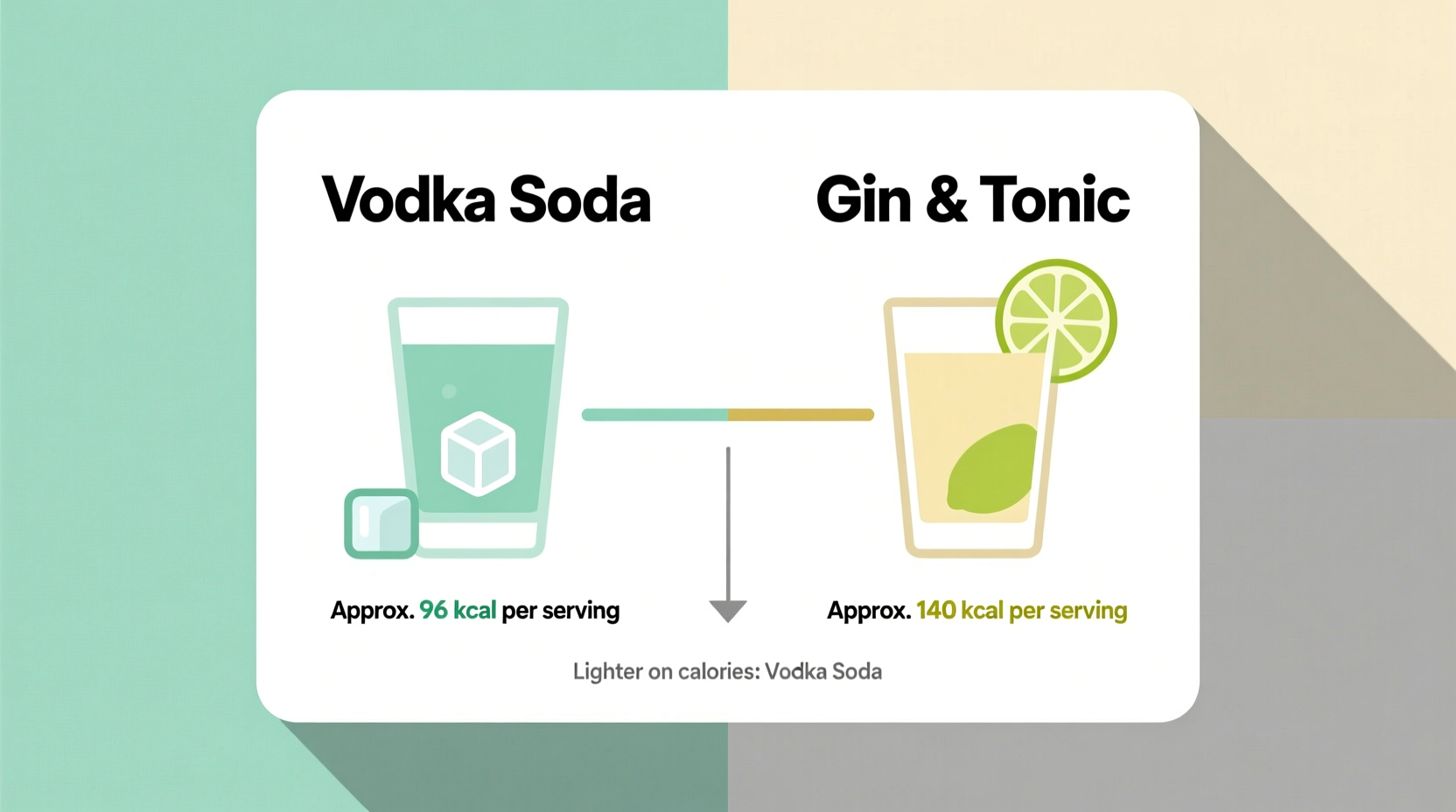
A 1.5-ounce (44 mL) shot of 80-proof distilled spirit contains roughly 97 calories—regardless of whether it’s vodka or gin. Both are nearly pure ethanol and water, with negligible carbohydrates, fat, or protein. So where does the calorie gap emerge? Exclusively in the mixer—and how much of it you use.
Vodka soda combines vodka with unsweetened carbonated water—typically club soda or seltzer. That means zero added sugar, zero calories from the mixer. A standard pour—1.5 oz vodka + 6 oz soda—delivers only ~97 calories.
Gin and tonic, by contrast, relies on tonic water—a historically medicinal beverage now mass-produced with high-fructose corn syrup or cane sugar. A typical 6-ounce serving of regular tonic water contributes 75–85 calories and 19–21 grams of sugar—equivalent to nearly five teaspoons. Add the same 1.5 oz gin, and the total jumps to ~175–185 calories per serving.
But here’s the critical nuance: not all tonics are created equal. Diet or “zero-sugar” tonics exist—but they often contain artificial sweeteners like aspartame or sucralose, which may influence insulin response or cravings in sensitive individuals. And many bars still default to full-sugar versions unless specifically asked otherwise.
Real-World Serving Sizes: Why Your Glass May Hold More Than You Think
Standard drink guidelines assume precise measurements: 14 grams of pure alcohol (≈ 0.6 fluid ounces), delivered via 1.5 oz of 40% ABV spirit. Yet observational studies show that 72% of poured drinks in casual bars exceed this amount—often by 25–40%. A bartender’s free-pour of gin may land at 1.75–2.0 oz, adding 15–25 extra calories before the mixer even hits the glass.
Equally impactful is mixer volume. While recipes call for 4–6 oz of soda or tonic, many servers top glasses generously—especially when using tall highball or Collins glasses. A 10-oz pour of tonic water adds ~140 calories *just from the mixer*, pushing the total well over 230 calories. Meanwhile, a similarly topped vodka soda remains at ~97–115 calories—because club soda contributes nothing.
This discrepancy explains why calorie calculators often mislead: they assume ideal conditions. In reality, context matters more than chemistry alone.
Ingredient Quality & Hidden Contributors
Not all vodkas or gins are calorically identical—but differences are marginal. Flavored vodkas (e.g., citrus, vanilla, or cake batter) frequently contain added sugars or glycerin, increasing calories by 20–50 per serving. Likewise, some craft gins include botanical infusions preserved with small amounts of ethanol or glycerol—but these rarely add more than 2–3 calories per 1.5 oz pour.
The bigger variable lies in tonic water brands. Here’s how common options compare per 6 oz (177 mL) serving:
| Tonic Water Brand | Calories (per 6 oz) | Sugar (g) | Notes |
|---|---|---|---|
| Schweppes Regular | 83 | 21.0 | High-fructose corn syrup base; most widely available |
| Q Tonic (Original) | 70 | 17.5 | Cane sugar; slightly less sweet, cleaner finish |
| Fever-Tree Refreshingly Light | 15 | 3.5 | Reduced sugar (agave + stevia); 80% fewer calories than regular |
| Diet Tonic (Coca-Cola or Canada Dry) | 0 | 0 | Aspartame or acesulfame K; no calories, but metabolic effects vary |
Even premium “craft” tonics aren’t inherently lower-calorie—many prioritize flavor intensity over sugar reduction. Always check the label: if “sugar” or “cane sugar” appears in the first three ingredients, assume it’s calorie-dense.
Tip: Ask for “tonic on the side” when ordering gin and tonic—this lets you control the exact amount poured and avoid over-topping. One tablespoon (15 mL) adds only ~5 calories; most people use far less than the standard 6 oz.Metabolic Impact Beyond Calories
Calories matter—but so does how your body processes them. Sugar-laden mixers trigger sharper blood glucose and insulin spikes than unsweetened alternatives. A 2022 randomized crossover study published in The American Journal of Clinical Nutrition found that participants consuming alcohol with high-glycemic mixers experienced 38% greater postprandial insulin secretion and reported higher hunger ratings two hours later compared to those drinking the same alcohol with sparkling water.
That matters for satiety and next-day energy. Gin and tonic’s sugar load doesn’t just add calories—it may amplify cravings, disrupt sleep architecture (due to blood sugar volatility overnight), and blunt fat oxidation during recovery. Vodka soda avoids these secondary metabolic costs entirely.
That said, moderation remains non-negotiable. Alcohol itself suppresses fat metabolism regardless of mixer: the liver prioritizes breaking down ethanol over fatty acids, temporarily halting fat burning for up to 12 hours after consumption. So while vodka soda is lighter, it isn’t “healthy”—it’s simply *less metabolically disruptive*.
“The biggest myth is that ‘low-calorie’ means ‘metabolically neutral.’ Alcohol is always processed as a toxin first. But choosing unsweetened mixers reduces glycemic stress, supports better sleep continuity, and makes portion discipline easier to maintain.” — Dr. Lena Torres, Registered Dietitian and Alcohol Health Researcher at Johns Hopkins Bloomberg School of Public Health
Practical Decision Framework: Choosing Wisely in Real Life
Deciding between vodka soda and gin and tonic shouldn’t hinge on rigid rules—but on intention, context, and consistency. Use this step-by-step framework before your next order:
- Clarify your goal: Are you prioritizing immediate calorie reduction? Long-term metabolic stability? Social enjoyment without guilt? Or minimizing next-day fatigue?
- Assess the venue: At a high-volume bar with inconsistent pours, default to vodka soda—it’s far more forgiving if the spirit is over-poured. At a craft cocktail bar with measured jiggers and house-made low-sugar tonic, gin and tonic becomes a viable, flavorful option.
- Verify the mixer: Don’t assume “tonic” means full-sugar—or “diet” means calorie-free. Ask: “Is this made with regular, light, or zero-sugar tonic?” If unsure, request club soda instead.
- Control the garnish: A lime wedge adds ~1 gram of sugar (4 calories). A lemon twist? Negligible. But avoid sugared rims, maraschino cherries, or candied ginger—they can add 20–60+ hidden calories.
- Track your pattern: If you regularly choose gin and tonic, swap one weekly serving for vodka soda. Observe changes in afternoon energy, morning clarity, or waistband comfort over four weeks. Small shifts compound.
Mini Case Study: Sarah’s Switch and What It Revealed
Sarah, 34, a project manager in Chicago, enjoyed two cocktails most evenings: usually a gin and tonic during weeknight wind-downs, and occasionally a vodka soda when dining out. She tracked her intake for three weeks using a food logging app and noticed consistent patterns: on gin-and-tonic nights, she reported lower energy the following afternoon and slightly higher evening hunger. Her average daily calorie intake from drinks alone was 320—nearly the equivalent of a small meal.
She didn’t eliminate gin and tonic entirely. Instead, she implemented two changes: (1) switched to Fever-Tree Refreshingly Light tonic at home, cutting mixer calories from 83 to 15 per drink; and (2) ordered vodka soda at restaurants unless she confirmed the bar used a low-sugar tonic. Within 10 days, her afternoon slumps diminished. Over six weeks, she lost 1.8 pounds—not from restriction, but from reduced glycemic load and improved sleep efficiency. As she noted in her journal: “It wasn’t about deprivation. It was about precision—and realizing how much the mixer shaped how I felt.”
What About Alternatives? A Quick Reality Check
Some readers ask: “What about whiskey neat? Or a dry martini?” While those contain no added sugar, they’re typically higher in alcohol per serving (2 oz bourbon = ~130 calories; 2.5 oz martini = ~160 calories), and the alcohol density increases metabolic burden. Light beer (100–120 calories) or dry wine (120–125 calories per 5 oz) offer different trade-offs: lower ABV but added carbs. Neither matches the ultra-low baseline of vodka soda—unless you’re prioritizing botanical complexity or tradition over minimalism.
FAQ
Does “light” or “slim” gin have fewer calories than regular gin?
No. “Light” gin refers to a lighter flavor profile—not lower calories. All unflavored 40% ABV gins contain ~97 calories per 1.5 oz. The term is marketing, not nutritional labeling.
Can I make my own low-sugar tonic to cut calories further?
Yes—but with caveats. Homemade versions using cinchona bark extract, citrus oils, and minimal sweetener (e.g., ½ tsp agave per 12 oz) can drop calories to ~10–15 per serving. However, true quinine content is difficult to replicate safely at home, and over-extraction can cause bitterness or GI upset. For reliability, stick with verified low-sugar commercial brands.
Does drinking either cocktail on an empty stomach change the calorie impact?
Not the total calories—but absorption accelerates, leading to faster blood alcohol rise and greater suppression of fat oxidation. Pairing either drink with protein or fiber-rich food (e.g., nuts, olives, grilled vegetables) slows gastric emptying and mitigates glucose spikes—especially important with gin and tonic.
Conclusion
Vodka soda is objectively lighter on calories than gin and tonic—in almost every realistic scenario. Its advantage isn’t theoretical; it’s structural. With no added sugar, no hidden sweeteners, and no metabolic penalty beyond alcohol itself, it offers the cleanest possible expression of a spirit-forward drink. Gin and tonic brings botanical depth, cultural resonance, and sensory pleasure—but that richness comes at a caloric and metabolic cost most drinkers underestimate. The smarter choice isn’t about banning one or the other. It’s about aligning your selection with your goals: reach for vodka soda when clarity, consistency, and minimalism matter most; choose gin and tonic intentionally—when you’ve confirmed the mixer, controlled the pour, and savored it as a deliberate ritual rather than background noise.
Your drink choices are part of your broader relationship with energy, focus, and self-care. They don’t define you—but they do reflect your awareness. Start tonight: order the vodka soda, taste it slowly, notice how you feel tomorrow. Then decide—not based on habit, but on evidence your body gives you.
💬 Have you made the switch—or discovered a low-sugar tonic that changed everything? Share your experience, brand recommendations, or real-world tips in the comments. Your insight could help someone else drink more mindfully tonight.








