On the surface, *Sausage Party* appears to be a raunchy animated comedy about grocery items discovering the truth about their existence. Beneath the crude jokes and anthropomorphized food lies a layered satire that uses drug humor not merely for shock value, but as a narrative device to explore belief systems, enlightenment, and societal control. The film’s use of narcotics—particularly marijuana and LSD—is neither random nor gratuitous. Instead, it functions as a metaphorical language through which the story critiques organized religion, questions authority, and illustrates the disorienting process of cognitive awakening. Understanding the role of drug humor in *Sausage Party* reveals how subversive comedy can serve philosophical inquiry, making the film a surprising vehicle for existential commentary disguised as juvenile animation.
Definition & Overview
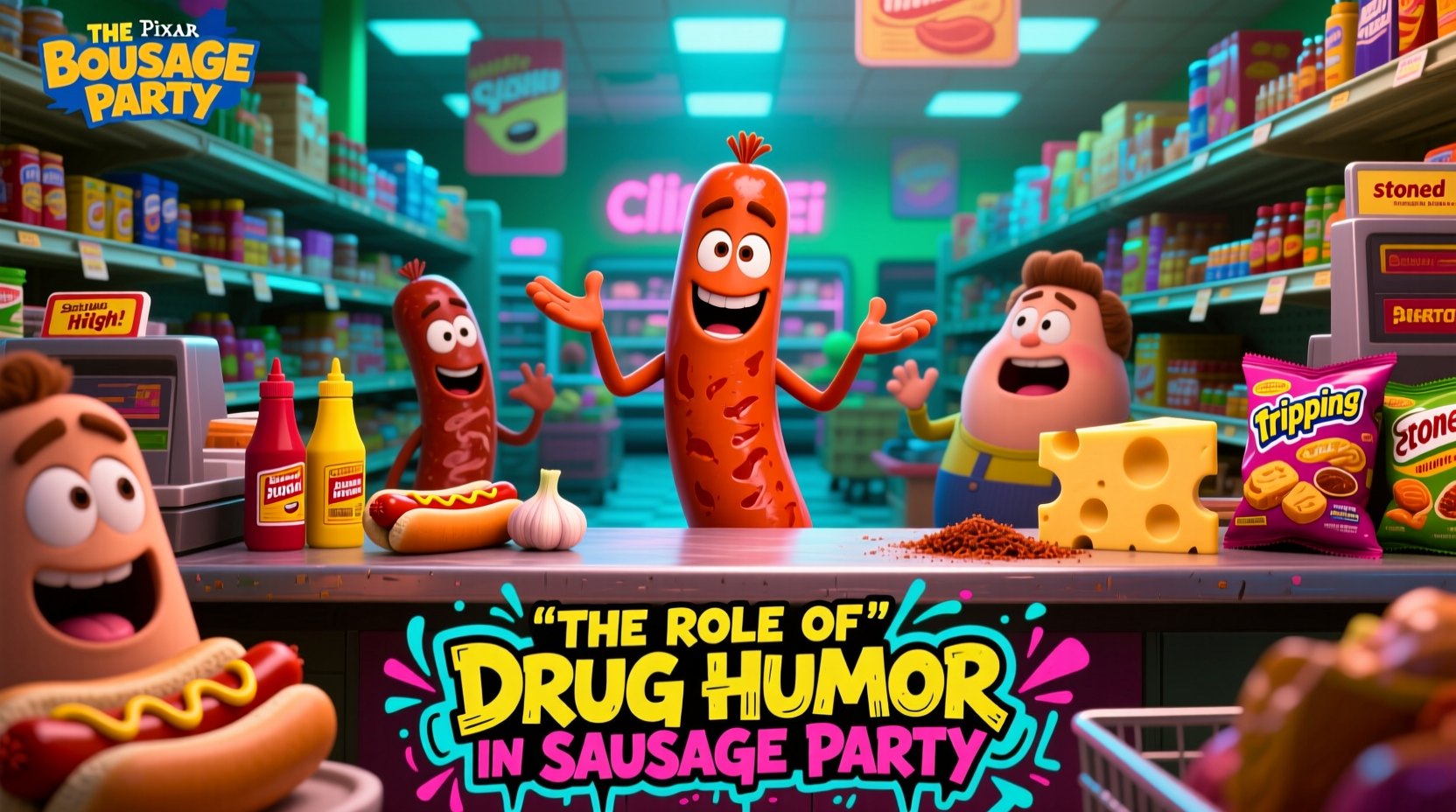
Drug humor refers to comedic content centered around the use, effects, or culture of psychoactive substances such as cannabis, hallucinogens, stimulants, and depressants. In film and television, it often manifests in exaggerated depictions of intoxication, paranoia, euphoria, or altered perception. Within *Sausage Party* (2016), directed by Conrad Vernon and Greg Tiernan and co-written by Seth Rogen, Evan Goldberg, and others, drug humor is woven into the world-building of a sentient supermarket. Food items live under the illusion that being purchased by humans leads to a utopian “Great Beyond,” a belief system enforced by religious-like dogma.
The turning point occurs when Frank, a sausage voiced by Seth Rogen, begins to question this doctrine. His journey toward truth is catalyzed not by logic alone, but through literal exposure to drugs—specifically when he consumes marijuana and later witnesses LSD ingestion. These sequences are presented with vivid, surreal animation styles distinct from the rest of the film, signaling a shift in consciousness. The humor derived from these scenes operates on multiple levels: slapstick exaggeration, visual gags, and allegorical resonance. More than just comic relief, the drug sequences symbolize epiphany, confusion, and the destabilization of accepted reality—core themes in both psychedelic experiences and spiritual awakenings.
Key Characteristics of Drug Humor in Sausage Party
- Metaphorical Function: Drug use represents the breakdown of indoctrinated beliefs and the painful emergence of truth.
- Visual Distortion: Hallucinogenic sequences employ swirling colors, morphing shapes, and distorted perspectives to simulate altered states.
- Exaggerated Behavior: Characters exhibit extreme paranoia, euphoria, and nonsensical dialogue typical of stoner comedy tropes.
- Religious Parody: Drugs disrupt the “faith” system of the grocery store, paralleling how psychedelics have historically challenged institutional religion.
- Narrative Catalyst: Intoxication triggers key plot developments, including revelations about the Great Beyond and the true fate of consumed food.
- Tonal Contrast: The absurdity of food items getting high contrasts sharply with the dark implications of their eventual consumption.
Insight: Unlike most films where drug humor exists solely for laughs, in *Sausage Party*, it serves a structural and thematic purpose—acting as the mechanism through which characters access forbidden knowledge.
Practical Usage: How Drug Humor Advances the Narrative
In traditional storytelling, the protagonist’s realization often comes through introspection, mentorship, or dramatic events. In *Sausage Party*, enlightenment is achieved through chemical disruption. When Frank eats marijuana, his perception fractures. Walls breathe, lights pulse, and voices echo. This sequence isn’t just comedic—it visually communicates the collapse of cognitive stability. He begins to see cracks in the supermarket’s reality, questioning why certain foods disappear and never return.
Likewise, the LSD trip experienced by a supporting character—a gummi bear named Barry—serves as a pivotal moment. After consuming acid, Barry sees grotesque visions of human mouths, teeth, and digestive tracts. These images, rendered in grotesque detail, represent the repressed truth: the Great Beyond is not paradise, but digestion. The humor arises from the contrast between childish animation and horrifying realism, yet the underlying message is clear: only through radical perceptual distortion can one confront unbearable truths.
From a screenwriting perspective, drug humor here replaces conventional exposition. Instead of a wise elder explaining the mechanics of consumerism and mortality, the audience learns alongside the characters during chemically induced breakdowns. This method aligns with the film’s broader strategy of using excess to expose deeper meanings—much like how satire amplifies flaws to critique them.
Cooking analogy: Consider how heat transforms raw ingredients. Similarly, drugs act as a thermal catalyst in the narrative, accelerating transformation. Just as sautéing onions brings out sweetness through controlled burning, drug-induced chaos reveals emotional and philosophical truths buried beneath complacency.
Step-by-Step Breakdown of Drug Humor as Plot Device
- Dogma Established: Foods believe in the Great Beyond, taught by sacred texts (labels) and prophets (packages).
- Doubt Introduced: Frank encounters a returned jar of honey mustard who speaks of horror beyond.
- Chemical Trigger: Frank consumes marijuana, leading to sensory overload and cognitive dissonance.
- Perceptual Shift: Visual distortions mirror the instability of previously held beliefs.
- Truth Revelation: Barry’s LSD trip unveils the biological reality of consumption.
- Action Initiated: Armed with new understanding, the protagonists seek escape and resistance.
Variants & Types of Drug Humor in the Film
While marijuana and LSD dominate, *Sausage Party* features several forms of substance-related comedy, each serving a different narrative or tonal function:
| Substance | Type of Humor | Narrative Role | Example Scene |
|---|---|---|---|
| Marijuana (Smoked by a joint-wielding tortilla chip) | Stoner comedy, paranoia, slowed cognition | Introduces doubt; destabilizes groupthink | Chip whispers conspiracy theories while staring at flickering lights |
| LSD (Consumed by Barry the gummi bear) | Psychedelic surrealism, body horror | Reveals the truth of digestion and death | Barry sees giant human mouths chewing food like hellscapes |
| Alcohol (Implied in wine bottles) | Social lubricant, emotional release | Facilitates confessions and bonding | Wine bottles cry about their impending separation |
| Caffeine (Embodied by coffee beans) | Hyperactivity, anxiety, mania | Represents overstimulation and information overload | Coffee beans scream warnings in rapid succession |
Each variant contributes to the film’s larger commentary on altered states as gateways to awareness. The marijuana scene mocks the passivity of countercultural escapism, while the LSD sequence embraces the terror and clarity of full revelation. Alcohol enables vulnerability, and caffeine mirrors digital-age anxiety—collectively forming a spectrum of mental states that reflect modern responses to existential dread.
Comparison with Similar Films Using Drug Humor
Many comedies incorporate drug use for laughs, but few integrate it so centrally into their thematic architecture. A comparison highlights *Sausage Party*’s unique approach:
| Film | Role of Drug Humor | Thematic Depth | Use in Plot |
|---|---|---|---|
| Pineapple Express (2008) | Central to character behavior and action set pieces | Minimal; focuses on buddy dynamics and chase comedy | Drives plot via mistaken identity and pursuit |
| Half Baked (1998) | Primary source of gags and situational absurdity | Low; celebrates stoner culture without critique | Incidental; used for comedic scenarios |
| Enter the Void (2009) | Visual and structural foundation of the film | High; explores death, rebirth, and consciousness | Essential; entire narrative unfolds through DMT trip |
| Sausage Party (2016) | Metaphor for enlightenment and religious deprogramming | High; critiques faith, consumerism, and mortality | Crucial; enables central revelation and rebellion |
Unlike *Pineapple Express* or *Half Baked*, where drugs create chaos but don’t transform worldview, *Sausage Party* positions intoxication as a necessary step toward truth. It shares more DNA with arthouse films like *Enter the Void* than with mainstream stoner comedies—albeit wrapped in profane animation and food puns.
“We wanted the drug sequences to feel like real trips—not just goofy stoner stuff, but genuinely disorienting. That’s where the fear comes in. That’s where the ideas come alive.” — Evan Goldberg, co-writer of *Sausage Party*
Practical Tips & FAQs
Q: Is the drug humor in Sausage Party glorifying substance use?
A: No. The film uses drug experiences satirically and symbolically. While characters consume substances, the focus is not on recreation but on the psychological rupture they cause. The humor derives from the contrast between innocence (animated food) and grim reality (digestion), not from promoting drug use.
Q: Why use drugs instead of a more conventional way to reveal the truth?
A: Drugs serve as a shortcut to bypass indoctrination. In a world where all food is conditioned to accept blind faith, rational argument fails. Only a radical, involuntary shift in perception—like a psychedelic episode—can shatter delusion. This mirrors real-world accounts of people abandoning religious beliefs after profound personal experiences, including those induced by psychedelics.
Q: How does the film handle the ethics of depicting drugs in an animated format?
A: By exaggerating consequences and context. The drugs aren’t glamorized; they’re portrayed as chaotic, frightening, and transformative. The LSD sequence, in particular, is nightmarish rather than pleasurable. Moreover, the R-rating ensures the content targets adults, avoiding inappropriate exposure to children despite the cartoonish style.
Q: Can drug humor be educational or philosophical?
A: Yes, when used intentionally. *Sausage Party* demonstrates that even crude comedy can engage with complex ideas—existentialism, epistemology, institutional manipulation—if structured with purpose. The film invites viewers to reflect on how belief systems are maintained and what it takes to break free from them.
Q: What real-world parallels exist for the film’s portrayal of drug-induced awakening?
A: Psychedelics have been used for centuries in shamanic traditions to induce visions and spiritual insights. Modern research also shows psilocybin and LSD can help treat depression, PTSD, and addiction by disrupting entrenched thought patterns. The film taps into this legacy, portraying the drug experience not as escape, but as confrontation.
Pro Tip: When analyzing satirical films, look beyond surface-level jokes. Often, the most absurd elements carry the deepest critiques. In *Sausage Party*, the food orgy isn’t just shock humor—it underscores the hypocrisy of a society that celebrates pleasure while denying death.
Cultural Context & Satirical Intent
*Sausage Party* emerged during a resurgence of adult-oriented animated films (*South Park: Bigger, Longer & Uncut*, *Team America: World Police*) that use cartoons to tackle taboo subjects. By setting its satire in a supermarket—a space associated with routine, safety, and childhood familiarity—the film maximizes the impact of its transgressive content. The inclusion of drug humor fits within this framework: it shocks, amuses, and ultimately provokes reflection.
The film’s writers, known for their work on *Superbad* and *The Interview*, leverage Seth Rogen’s signature stoner persona to ground the absurdity. Yet unlike earlier projects, *Sausage Party* transcends mere irreverence. Its depiction of a cult-like grocery hierarchy echoes real-world concerns about misinformation, blind faith, and the difficulty of critical thinking in closed systems.
Drug humor becomes the key that unlocks this critique. In societies where questioning authority is punished, altered states—whether through meditation, trauma, or chemicals—often serve as entry points to dissent. The film suggests that sometimes, only when the mind is unhinged from normalcy can it perceive the truth.
Summary & Key Takeaways
The role of drug humor in *Sausage Party* extends far beyond crude comedy. It functions as a narrative engine, a philosophical tool, and a satirical weapon. Far from being gratuitous, the film’s portrayal of marijuana and LSD use is carefully aligned with its central themes: the fragility of belief, the violence of consumerism, and the painful journey toward self-awareness.
- Drug sequences symbolize cognitive dissonance and enlightenment, not just comic relief.
- Visual hallucinations mirror the psychological process of deprogramming from false ideologies.
- The film uses stoner tropes to subvert expectations, embedding existential questions within juvenile humor.
- Compared to other comedies, *Sausage Party* treats drug experiences as transformative, not merely recreational.
- Its satire resonates with contemporary debates about truth, authority, and mental autonomy.
Next time you watch *Sausage Party*, pay attention not just to the jokes, but to the moments of distortion and fear. Those are not digressions—they are the heart of the film’s message. True freedom begins not with certainty, but with the unsettling realization that everything you believed might be wrong.









