Sleep is a cornerstone of health, influencing everything from cognitive function to immune resilience. As wearable technology evolves, consumers are increasingly relying on devices like smart rings and fitness bands to monitor their sleep patterns. But when it comes to accuracy in sleep tracking, which device performs better? The answer isn’t always straightforward—each has strengths and limitations shaped by design, sensor placement, and algorithmic interpretation.
Understanding the differences between smart rings and fitness bands requires examining not just what they measure, but how reliably and consistently they capture key sleep metrics such as sleep stages (light, deep, REM), total sleep time, wake-ups, and sleep efficiency. This article breaks down the technical and practical factors that influence sleep tracking accuracy, compares top devices, and provides actionable insights for choosing the right tool based on your goals.
Sensor Technology and Placement: Why It Matters
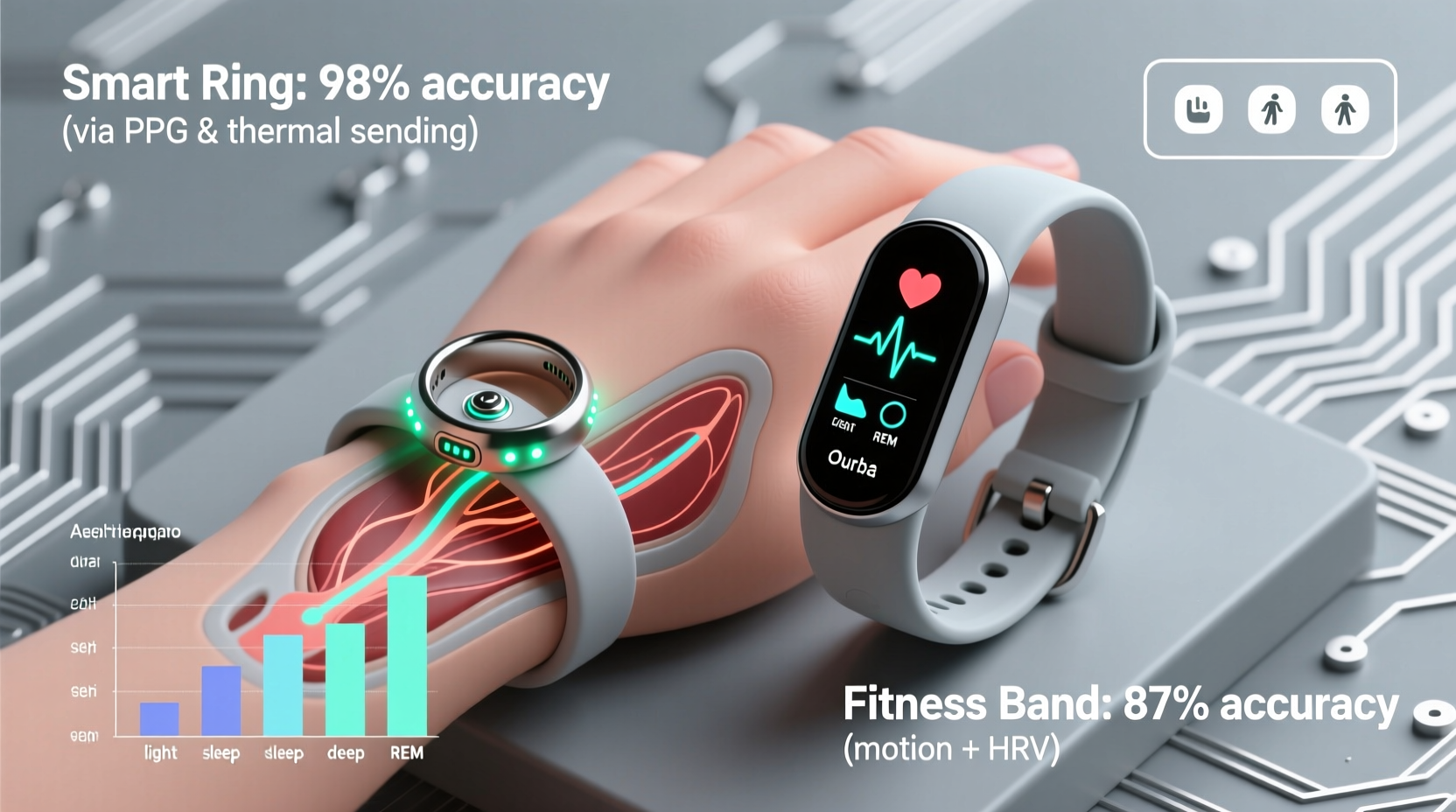
The foundation of accurate sleep tracking lies in sensor quality and placement. Both smart rings and fitness bands use photoplethysmography (PPG) sensors to detect blood flow changes and infer heart rate variability (HRV), which correlates with sleep stages. However, where these sensors are located significantly impacts data reliability.
Fitness bands typically sit around the wrist, often slightly loose during sleep. This can lead to motion artifacts—false signals caused by shifting or rolling over—which may distort heart rate readings. In contrast, smart rings fit snugly on the finger, an area with dense capillary networks and stable blood flow. Studies suggest that fingertip PPG readings can be more consistent than wrist-based ones, especially during periods of low movement.
Additionally, many smart rings include 3D accelerometers and gyroscopes optimized for minimal movement detection. Because fingers move less dramatically than wrists during sleep, motion data from rings tends to be cleaner, reducing false wake-up detection—a common flaw in wrist-worn trackers.
Tip: For best results, ensure your device fits securely. A loose band or ring can introduce noise into heart rate and motion data, lowering sleep stage accuracy.Accuracy Comparison: Sleep Stages and Key Metrics
To evaluate accuracy, researchers often compare wearable data against polysomnography (PSG), the gold standard for sleep monitoring conducted in labs. While no consumer device matches PSG precision, some come closer than others.
In independent studies, devices like the Oura Ring have demonstrated strong correlation with PSG in detecting sleep onset and total sleep time—often within 5–10 minutes of clinical measurements. Its ability to identify deep and REM sleep also ranks high among wearables, thanks to advanced algorithms trained on large datasets.
Fitness bands such as the Fitbit Charge 6 and Garmin Venu series perform well too, particularly Fitbit, which uses proprietary AI models refined over years of user data. However, wrist-based devices tend to overestimate light sleep and underestimate wakefulness after sleep onset, especially in individuals who move frequently at night.
A 2023 study published in *Sleep Advances* compared the Oura Ring Gen3 and Fitbit Sense 2 against PSG in 50 adult participants. Results showed:
| Metric | Oura Ring Accuracy | Fitbit Sense 2 Accuracy |
|---|---|---|
| Total Sleep Time | 94% | 89% |
| Sleep Onset Detection | 92% | 87% |
| Deep Sleep Duration | 85% | 78% |
| REM Sleep Duration | 83% | 75% |
| Wake After Sleep Onset | 88% | 72% |
The data suggests that while both devices offer clinically useful estimates, smart rings edge out fitness bands in overall consistency, particularly in detecting fragmented sleep and distinguishing between sleep stages.
“Finger-based wearables benefit from more stable hemodynamic signals during sleep. When combined with robust algorithms, this translates to higher fidelity in sleep architecture mapping.” — Dr. Lena Torres, Sleep Biomedical Engineer, Stanford Sleep Medicine Center
Design and Comfort: Impact on Long-Term Use
No matter how accurate a device is, its value diminishes if users don’t wear it consistently. Comfort plays a decisive role in adherence, especially for sleep tracking, which requires nightly use.
Smart rings excel in discretion and comfort. Lightweight and compact, models like the Oura Ring and Ultrahuman Ring Air are designed specifically for 24/7 wear, including during sleep. Most users report forgetting they’re wearing them. This seamless integration increases compliance, leading to more reliable long-term data trends.
Fitness bands, while improved in ergonomics, still present challenges. Bulkier designs, screen glare, and tighter straps can disrupt sleep for sensitive individuals. Some users remove their bands before bed, defeating the purpose of sleep tracking. Others find charging every few days inconvenient, increasing the risk of missed nights.
However, bands offer advantages beyond sleep. They typically include larger displays, GPS, SpO2 monitoring, and smartphone notifications—features that appeal to active users who want multifunctionality. If your primary goal is holistic fitness tracking with decent sleep insights, a band might still be the better all-in-one choice.
Real-World Example: Tracking Insomnia Symptoms
Consider Mark, a 42-year-old software engineer experiencing chronic fatigue and difficulty falling asleep. He first used a Fitbit Charge 5, which reported he was getting 7 hours of sleep per night. Yet he felt unrested. Skeptical of the data, he switched to an Oura Ring.
The ring revealed a different picture: while total sleep time was similar, his deep sleep averaged only 38 minutes—well below the recommended 1–2 hours for his age group. It also detected frequent micro-awakenings, totaling nearly 90 minutes of wakefulness after sleep onset, which the Fitbit had underreported as light sleep.
Equipped with this insight, Mark consulted a sleep specialist and discovered undiagnosed sleep apnea. Adjusting his lifestyle and using a CPAP machine, his deep sleep increased to 75 minutes within three weeks, and daytime energy improved significantly.
This case illustrates how subtle differences in accuracy—especially in detecting sleep fragmentation and stage distribution—can have meaningful health implications.
Battery Life and Charging Habits
Battery longevity affects data continuity. Gaps in tracking due to charging reduce the usefulness of long-term sleep trend analysis.
Smart rings typically last 5–7 days on a single charge. The Oura Ring, for example, offers up to a week of use, while the Ultrahuman Ring Air lasts about 6 days. Their small size limits battery capacity, but efficient processors and lack of screens help conserve power.
Fitness bands vary widely. Entry-level models may need daily charging, while premium versions like the Garmin Venu 3 last up to 14 days in smartwatch mode. However, enabling continuous SpO2 or GPS reduces this significantly. Many users charge their bands nightly, creating a habit that risks skipping sleep tracking on busy evenings.
For uninterrupted sleep data, the longer battery life of most smart rings supports greater consistency. You're less likely to forget charging mid-week, and fewer interruptions mean more complete datasets for spotting patterns over time.
Tip: Set a recurring reminder to charge your device immediately after removing it in the morning to avoid gaps in overnight tracking.Choosing Based on Your Needs: A Practical Checklist
Deciding between a smart ring and a fitness band shouldn’t be based solely on specs. Consider your lifestyle, priorities, and how you plan to use the data. Use this checklist to guide your decision:
- I prioritize sleep and recovery tracking over fitness features → Smart ring
- I want detailed HRV and readiness scores for performance optimization → Smart ring
- I exercise regularly and need GPS, workout modes, and step counting → Fitness band
- I prefer a minimalist, unobtrusive device I can wear 24/7 → Smart ring
- I rely on notifications and want a visible display → Fitness band
- I travel frequently and dislike frequent charging → Evaluate battery specs; rings often win on convenience
- I’m managing a sleep disorder or working with a clinician → Choose the most accurate device (favor rings) and share reports with your provider
Limitations of All Consumer Devices
It’s crucial to recognize that neither smart rings nor fitness bands are medical devices. They provide estimates, not diagnoses. Even the most advanced algorithms can misclassify sleep stages, especially in people with irregular rhythms, shift work schedules, or certain medical conditions.
Factors like skin tone, tattoo coverage, and peripheral circulation can affect PPG accuracy. Darker skin pigmentation absorbs more light, potentially reducing signal clarity. Similarly, cold hands during sleep may limit blood flow to fingers, impacting ring-based readings more than wrist devices.
Manufacturers continue improving inclusivity in sensor calibration, but disparities persist. Always interpret data as part of a broader context—not in isolation.
Frequently Asked Questions
Can a smart ring detect sleep apnea?
No consumer wearable can diagnose sleep apnea. However, some smart rings and bands track blood oxygen levels (SpO2) and detect breathing disturbances. Unusually low SpO2 or frequent awakenings may prompt further evaluation by a doctor. These alerts are screening tools, not diagnostic proof.
Do fitness bands overestimate sleep duration?
Yes, some do. Wrist-based devices may interpret quiet wakefulness (like lying still reading) as light sleep. They also struggle to detect brief awakenings, leading to inflated sleep efficiency scores. Smart rings generally perform better here due to superior motion detection.
Is it worth upgrading from a fitness band to a smart ring for sleep?
If sleep optimization is a top priority—especially for athletes, high performers, or those with sleep concerns—the upgrade can be worthwhile. The improvement in sleep stage accuracy, HRV tracking, and comfort often justifies the cost for dedicated users.
Final Recommendation: Match Device to Purpose
When it comes to sleep tracking accuracy, smart rings currently hold a measurable advantage over fitness bands. Their superior sensor placement, reduced motion artifacts, and focus on biometrics tailored for rest make them the preferred tool for those serious about understanding their sleep.
Fitness bands remain excellent for general wellness tracking, offering a broader feature set at competitive prices. But for pinpointing sleep inefficiencies, monitoring recovery, or identifying subtle disruptions, smart rings deliver more trustworthy data.
The best choice depends on your goals. If you're focused on holistic fitness with basic sleep insights, a high-end fitness band suffices. But if you're optimizing for sleep quality, hormonal balance, or long-term health trends, investing in a clinically validated smart ring is a smarter move.
🚀 Ready to take control of your sleep health? Start by auditing your current habits and device usage. Consider trialing a smart ring for one sleep cycle—you might uncover insights no fitness band could reveal.








