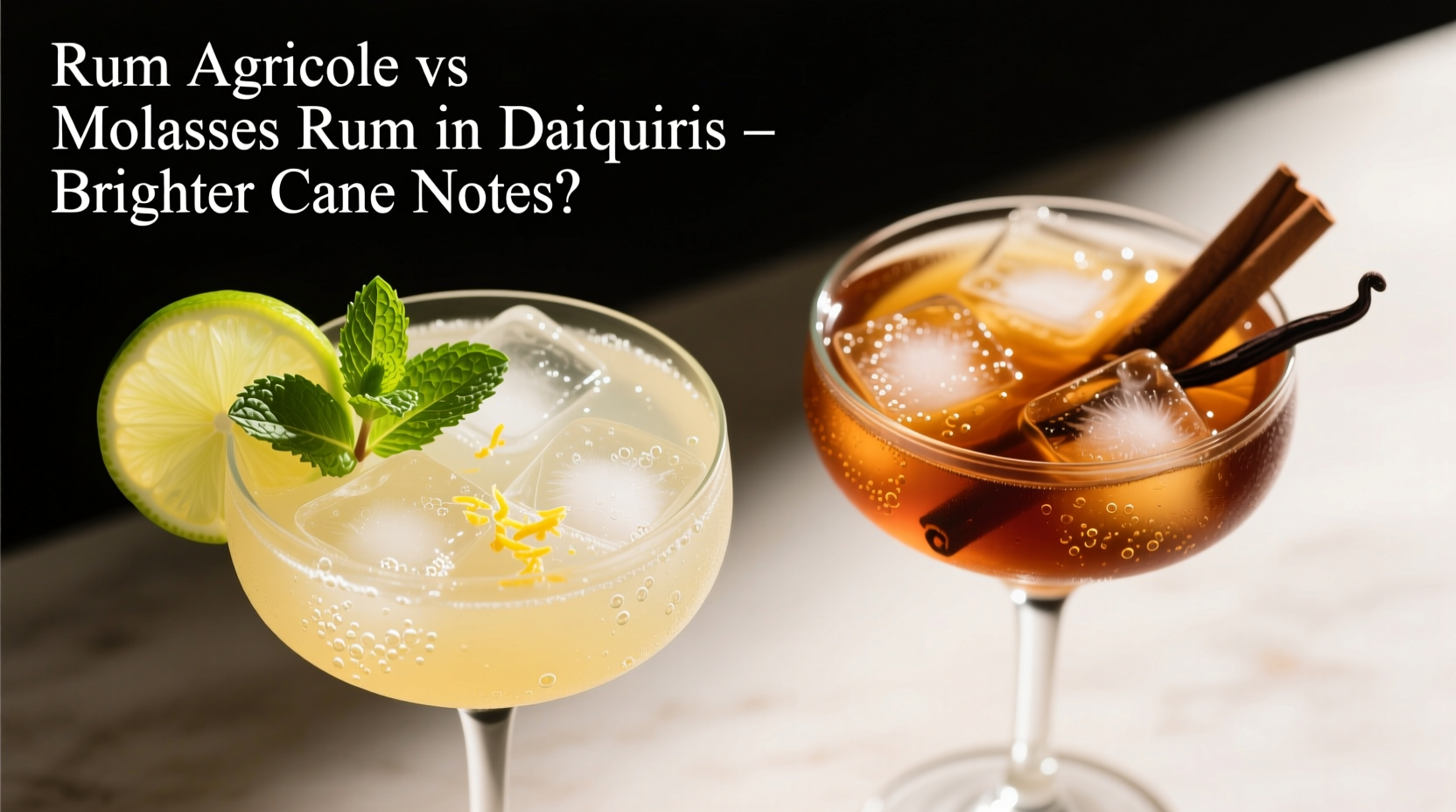
The daiquiri—deceptively simple, brutally unforgiving—is the ultimate litmus test for rum. Three ingredients: rum, lime juice, simple syrup. No modifiers, no dilution tricks, no smoke and mirrors. What emerges is pure expression: the rum’s character, its texture, its aromatic honesty. And when it comes to brightness—the vivid, grassy, vegetal, almost green-cane snap that lifts a daiquiri from refreshing to revelatory—two rum categories stand apart: Martinique rum agricole and traditional molasses-based rums. But which one truly delivers brighter cane notes? Not just “cane-forward,” but *brighter*: zesty, high-frequency, sun-warmed and freshly crushed. The answer isn’t categorical—it’s contextual, technical, and deeply rooted in how each rum is made, aged, and interpreted by the palate. This isn’t about superiority; it’s about precision.
Why Brightness Matters—And Why the Daiquiri Exposes It
Brightness in rum refers to volatile, top-note aromas and flavors: fresh-cut sugarcane stalks, crushed mint, green apple skin, wet limestone, white pepper, and saline citrus zest. These notes sit high on the aromatic spectrum—lighter, sharper, more immediate than deeper, richer elements like brown sugar, oak tannin, or dried fruit. In a daiquiri, brightness functions as structural lift. It cuts through the acidity of lime without clashing, harmonizes with the sweetness of syrup without cloying, and creates a mouthwatering, almost electric finish. A dull daiquiri tastes flat and monolithic; a bright one vibrates on the tongue.
Crucially, brightness is not the same as “lightness” in body. A heavy, unaged agricole can be explosively bright. Conversely, a light-bodied, column-distilled molasses rum can taste muted and neutral if stripped of congeners during production. Brightness arises from specific esters (ethyl acetate, isoamyl acetate), aldehydes (acetaldehyde), and terpenes preserved—or deliberately encouraged—during fermentation and distillation. The daiquiri’s minimalism makes these compounds impossible to hide.
How They’re Made: The Root of the Difference
The divergence begins at the field—not the still.
- Rum agricole is made exclusively from freshly pressed sugarcane juice (vesou), fermented rapidly (often 24–48 hours) with wild or selected yeasts, then distilled in single-column copper stills (typically Creole-style). By law in Martinique AOC, it must be produced within 24 hours of harvest to prevent spoilage and preserve volatile top notes. No molasses, no refiner’s syrup, no caramel coloring, no added sugar. It’s agricultural rum—terroir-driven, seasonal, and emphatically vegetal.
- Molasses rum starts with molasses—a thick, dark byproduct of sugar refining. Fermentation is typically longer (48–96+ hours), often using cultured yeast strains selected for efficiency and consistency. Distillation varies widely: pot stills (Jamaica, Barbados), multi-column stills (Puerto Rico, Trinidad), or hybrid setups. Molasses carries concentrated sugars but also residual minerals, ash, and Maillard-derived compounds from the sugar-boiling process—imparting depth, funk, and richness, but often at the expense of raw cane freshness.
This fundamental difference shapes the entire sensory profile. Agricole captures the plant *before* industrial transformation; molasses rum captures the residue *after*. One is a snapshot of the field; the other, an interpretation of the refinery.
Tip: For maximum brightness in a daiquiri, use unaged (blanc) agricole—especially from Martinique’s northern volcanic soils (e.g., Neisson, Clément, La Favorite). Avoid aged agricoles unless you specifically want oak influence to temper the vibrancy.Direct Comparison: Sensory Breakdown in the Daiquiri
We conducted side-by-side tastings of six classic daiquiris (1.5 oz rum, 0.75 oz fresh lime juice, 0.5 oz 1:1 simple syrup, shaken hard, double-strained into chilled coupe) using benchmark rums. Below is a distilled summary of what consistently emerged:
| Rum Type & Example | Aroma Profile (Daiquiri) | Palate Impact | Brightness Verdict |
|---|---|---|---|
| Agricole Blanc (Martinique) Neisson Réserve Spéciale |
Grass clippings, crushed sugarcane, green mango, wet stone, white pepper, faint banana leaf | Electric acidity, crisp mid-palate, clean finish with lingering lime-zest and mineral snap | ★★★★★ (Highest frequency, most persistent top notes) |
| Agricole Blanc (Martinique) Clément Canne Bleue |
Fresh-cut bamboo, green apple skin, sea spray, chalk, faint anise | Lean, linear, intensely focused; brightness feels architectural | ★★★★☆ (Slightly less aggressive than Neisson, but more elegant) |
| Pot Still Molasses (Jamaica) Wray & Nephew Overproof |
Overripe banana, pineapple core, damp earth, clove, fermented cane | Thick, funky, viscous; brightness present but muffled by esters and phenols | ★★★☆☆ (Brightness exists—but as background hum, not lead voice) |
| Column Still Molasses (Puerto Rico) Don Q Cristal |
Neutral cane sugar, faint citrus, soft vanilla, minimal complexity | Smooth, round, easy-drinking; lacks piercing top notes | ★☆☆☆☆ (Functional, not expressive; brightness is absent or suppressed) |
| Hybrid Molasses (Barbados) Foursquare Premise |
Caramelized pear, toasted coconut, honey, baked lime | Rich, layered, warm; brightness appears only as a fleeting citrus echo | ★★☆☆☆ (Depth dominates; brightness is secondary and rounded) |
| “Cane Juice” Rum (Non-AOC) Hampden Estate Rum Fire |
Green cane, fermented pineapple, petrol, black pepper | Aggressively funky, high-ester; brightness is sharp but chaotic, not clean | ★★★☆☆ (Bright, yes—but unrefined and distracting in a daiquiri) |
The pattern is clear: unaged Martinique agricole blanc consistently delivers the brightest, most coherent cane expression. Its volatility—often criticized as “harsh” in sipping contexts—becomes an asset in the daiquiri, where rapid evaporation and acid interaction amplify those top notes. Molasses rums, even exceptional ones, prioritize density, ester complexity, or barrel integration over raw, green vibrancy.
Expert Insight: Terroir, Technique, and Tension
This isn’t theoretical. Distillers and bartenders who work daily with both categories confirm the distinction is structural, not stylistic.
“Molasses is cooked sugar—it’s already lost its green soul. Agricole is the plant, alive and breathing. When you shake it with lime, you’re not mixing flavors—you’re triggering a reaction. That acetaldehyde from fast fermentation? It binds with citric acid and creates this shimmering, almost metallic lift. You don’t get that from molasses, no matter how well it’s distilled.” — Jean-Pierre Chabrol, Master Blender, Rhum Clément, Martinique
“In a daiquiri, I reach for agricole when I want the drink to feel like biting into a stalk of sugarcane on a hot afternoon. With molasses rum, I’m after comfort, warmth, history. Neither is better—but confusing their roles leads to muddy drinks. Brightness isn’t volume; it’s clarity of pitch.” — Ivy Mix, Founder, Leyenda, NYC & Author, Spirits of Latin America
The science supports this: agricole’s shorter fermentation preserves higher concentrations of acetaldehyde and ethyl acetate—compounds directly linked to green, fruity, and solvent-like top notes (in controlled amounts, they read as “fresh”). Molasses ferments longer, allowing yeast to metabolize many of these early volatiles, while producing heavier esters (ethyl hexanoate, ethyl octanoate) associated with ripe fruit and creaminess.
Practical Guide: Choosing & Using for Maximum Brightness
Not all agricoles are equal—and not all molasses rums are dim. Here’s how to navigate reality:
- Seek AOC Certification: Only Martinique AOC agricoles guarantee adherence to strict vesou-only, 24-hour harvest, and single-column distillation rules. Labels like “rhum agricole” from Guadeloupe or Haiti lack the same regulatory rigor and often blend or age inconsistently.
- Read the Age Statement: “Blanc” means unaged (<6 months). “Vieux” (aged ≥3 years) adds oak tannin and vanilla, muting brightness. For peak vibrancy, blanc is non-negotiable.
- Check the Producer’s Philosophy: Some producers (e.g., Bielle, Dillon) emphasize floral, delicate profiles; others (e.g., J.M., Habitation Clément) lean into robust, peppery intensity. Taste before committing to a whole bottle.
- Respect the Lime: Brightness collapses with bottled juice. Use Key limes for higher acidity and floral notes, or Persian limes for cleaner citric punch. Roll limes firmly before juicing to maximize yield and oil release.
- Chill Everything: Cold glassware, cold rum, cold lime juice. Volatile compounds dissipate faster at room temperature—chilling locks in the top notes until the first sip.
Mini Case Study: The Parisian Bar Shift
At Candelaria in Paris—a bar renowned for its rigorous cocktail philosophy—the daiquiri evolved dramatically in 2019. Their original version used a well-regarded Jamaican pot still rum. Guests praised its depth but frequently described it as “rich” or “spicy”—never “bright.” Bartender Léa Dubois began experimenting with agricoles during a trip to Martinique. Back in Paris, she substituted Neisson Réserve Spéciale. The change was immediate and polarizing: regulars either loved the startling, almost medicinal clarity or missed the rum’s comforting weight. Within three months, the agricole version became the default. “It wasn’t about being ‘better,’” Dubois explains. “It was about matching the drink’s intention. The daiquiri isn’t a hug. It’s a wake-up call. Agricole delivers the alarm.” Sales of agricole bottles in their retail shop rose 220% that year.
FAQ
Can I blend agricole and molasses rum for brightness?
Yes—but with caution. A 70/30 split (agricole/moles) can add lift without losing body. However, blending risks muddying the very clarity you seek. Start with 100% agricole, then adjust downward only if the brightness feels abrasive rather than invigorating.
Does aging ever enhance brightness in agricole?
Rarely. Even short aging in stainless steel can mute top notes. Oak aging introduces vanillin, lactones, and tannins that soften and round the profile. For brightness, unaged is definitive. Some producers use “finishing” in ex-citrus or ex-sake casks to reintroduce top notes—but results are inconsistent and often gimmicky.
Are there any molasses rums that come close to agricole brightness?
A few outliers exist: unaged, pot-distilled rums from small Brazilian cachaca producers (e.g., Avuá Prata) or certain Filipino rums made from fresh juice *and* molasses blends (e.g., Don Papa Unaged). But none match the consistent, legally enforced vibrancy of Martinique AOC agricole blanc. They’re exceptions that prove the rule.
Conclusion: Embrace the Green Edge
Brightness in a daiquiri isn’t a flourish—it’s fidelity. It’s the taste of sugarcane as it grows, not as it’s processed. Rum agricole, born from soil, sun, and urgency, delivers that truth with unmatched precision. Molasses rum offers history, depth, and soul—but not that particular, electric green spark. Choosing agricole for your daiquiri isn’t trend-chasing; it’s choosing authenticity over familiarity, clarity over comfort, and the field over the factory. It asks more of the drinker—attention, presence, a willingness to taste something uncompromising. And in return, it gives a daiquiri that doesn’t just refresh, but recalibrates.
💬 Your turn: Try a 100% Martinique agricole blanc daiquiri tonight—no substitutions, no shortcuts. Then tell us: did the brightness surprise you? Share your tasting notes, your favorite bottle, or your biggest daiquiri revelation in the comments below. Let’s keep the conversation as crisp as a perfectly shaken drink.








