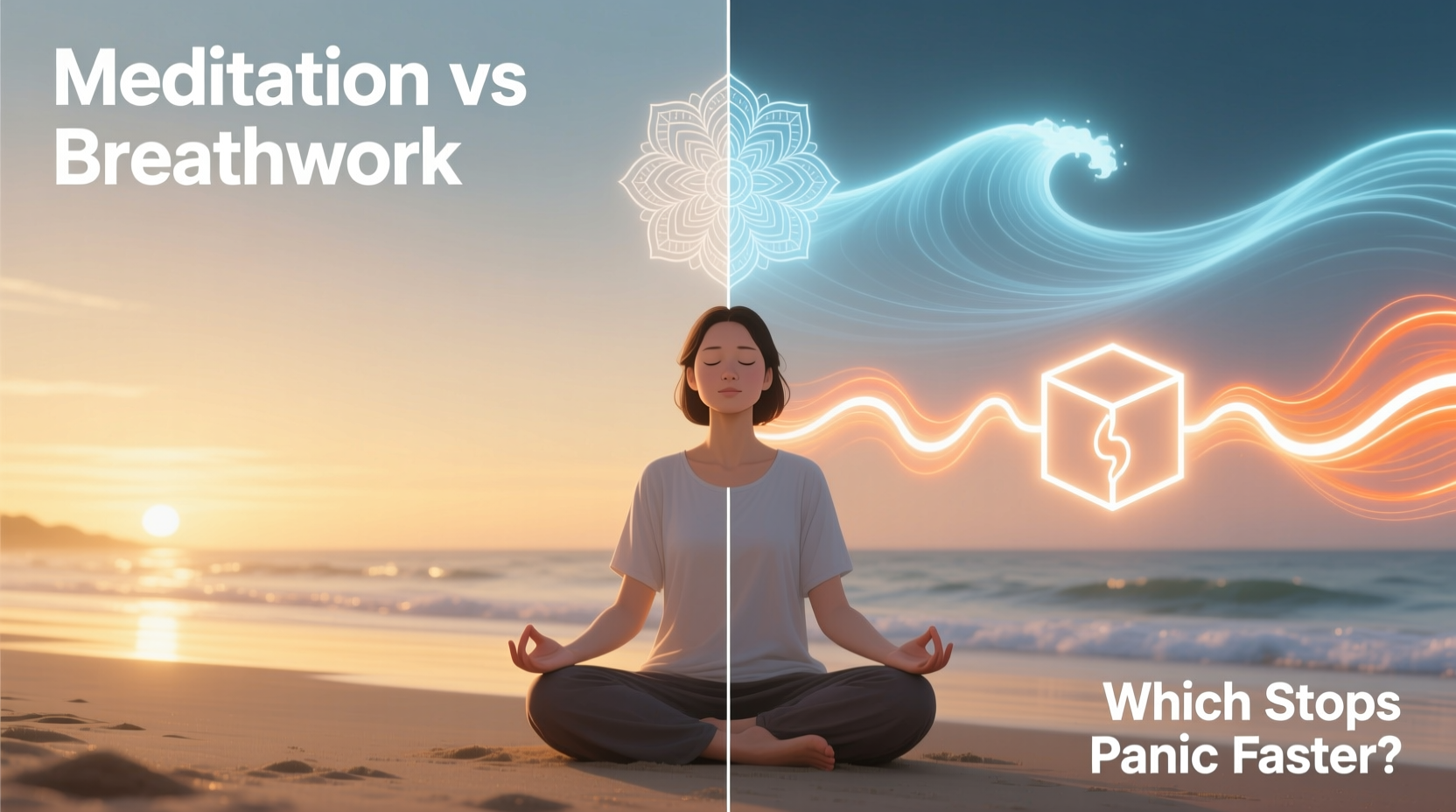
When a panic attack strikes, time slows down. Heart racing, chest tightening, thoughts spiraling—every second feels like an eternity. In those moments, the difference between relief and escalation often comes down to one question: what tool works fastest? Two widely recommended practices—meditation and breathwork—are frequently suggested for managing anxiety. But when seconds count, which delivers faster, more reliable results?
While both meditation and breathwork are grounded in mindfulness and nervous system regulation, they operate differently in terms of onset, accessibility, and physiological impact. Understanding these distinctions can make all the difference during a crisis. This article breaks down how each method affects the body and mind during a panic episode, compares their effectiveness, and offers practical guidance for immediate use.
Understanding Panic Attacks: The Physiology Behind the Fear
A panic attack is not just emotional distress—it’s a full-body event driven by the autonomic nervous system. When triggered, the sympathetic nervous system activates the “fight-or-flight” response. Adrenaline surges, breathing becomes rapid and shallow (hyperventilation), heart rate spikes, and muscles tense. Blood flow shifts away from non-essential functions like digestion and toward large muscle groups, preparing the body for action—even if no real threat exists.
The parasympathetic nervous system, responsible for calming the body, often struggles to regain control during an attack. This imbalance is where interventions like meditation and breathwork come into play. Both aim to activate the vagus nerve—the main component of the parasympathetic system—but through different pathways and with varying speed.
“During a panic attack, the brain misinterprets internal signals as danger. Breathwork directly interrupts this loop by altering CO₂ levels and signaling safety.” — Dr. Lena Patel, Clinical Psychologist & Anxiety Specialist
Meditation: Depth Over Speed
Meditation is a broad term encompassing techniques that train attention and awareness. Common forms include mindfulness meditation, body scans, and loving-kindness practices. These methods cultivate long-term resilience by increasing gray matter in brain regions linked to emotional regulation and decreasing activity in the amygdala, the fear center.
However, during an acute panic attack, traditional meditation faces limitations. It typically requires sustained focus, mental stillness, and a degree of detachment—qualities that are nearly impossible to access mid-episode. While experienced practitioners may use mindfulness to observe sensations without reacting, beginners often find it difficult to concentrate when overwhelmed by physical symptoms.
That said, certain types of meditation, such as guided grounding or sensory anchoring (e.g., focusing on sounds or touch), can be adapted for crisis moments. These approaches help redirect attention from internal chaos to external stability, but they usually take longer to produce noticeable effects compared to breath-based techniques.
Tip: If you're using meditation during a panic attack, choose a short, voice-guided session focused on present-moment awareness rather than silent sitting.Breathwork: Fast-Acting Nervous System Reset
Breathwork refers to intentional breathing patterns designed to influence mental and physical states. Unlike passive breathing, breathwork actively manipulates respiratory rate, depth, and rhythm to shift the balance from sympathetic to parasympathetic dominance.
What makes breathwork uniquely effective during a panic attack is its immediacy. Breathing is both automatic and voluntary—meaning you can consciously override your current pattern even while distressed. By slowing and deepening the breath, you increase carbon dioxide retention, which calms overactive neural firing and reduces dizziness and tingling caused by hyperventilation.
Techniques like diaphragmatic breathing, box breathing, and extended exhale breathing (e.g., 4-7-8 method) have been shown in clinical settings to reduce anxiety within minutes. Because breath is always accessible and doesn’t require mental clarity to initiate, it serves as a reliable anchor during disorientation.
Step-by-Step Guide: Using Breathwork to Stop a Panic Attack
- Pause and recognize: Acknowledge that you’re having a panic attack. Say silently: “This is temporary. I am safe.”
- Sit or stand comfortably: Keep spine straight but relaxed. Place one hand on chest, one on belly.
- Begin diaphragmatic breathing: Inhale slowly through the nose for 4 seconds, letting the belly rise. Chest should move minimally.
- Exhale through pursed lips: Release breath slowly for 6–8 seconds. Focus on making the exhale longer than the inhale.
- Repeat for 2–5 minutes: Continue until heart rate slows and mental fog lifts.
- Reassess: If symptoms persist, repeat or combine with grounding techniques (e.g., naming 5 things you see).
This sequence leverages the respiratory sinus arrhythmia effect—where controlled exhalation naturally lowers heart rate—making it one of the fastest ways to signal safety to the brain.
Comparative Analysis: Meditation vs Breathwork During Acute Episodes
| Factor | Meditation | Breathwork |
|---|---|---|
| Onset of Effect | Slower (3–10+ minutes) | Faster (1–3 minutes) |
| Cognitive Demand | High (requires focus) | Low (simple pattern) |
| Physical Accessibility | Requires stillness | Can be done anywhere, anytime |
| Learning Curve | Moderate to high | Low (easy to learn) |
| Best For | Prevention, long-term regulation | Immediate symptom interruption |
| Scientific Support for Panic | Strong for prevention | Strong for acute reduction |
The data clearly favors breathwork for rapid intervention. A 2020 study published in *Frontiers in Psychology* found that participants using paced breathing at 6 breaths per minute showed significant reductions in subjective anxiety and physiological arousal within 90 seconds—faster than any meditation group tested under similar conditions.
Real-World Application: A Mini Case Study
Sarah, a 32-year-old graphic designer, had struggled with panic attacks since her early twenties. She practiced mindfulness meditation daily and found it helpful for general stress management. However, during a presentation at work, her heart suddenly pounded, vision blurred, and she felt detached from her body—a classic panic onset.
She tried to meditate internally, repeating “I am calm,” but couldn’t focus. Then, remembering a breathwork technique from therapy, she subtly placed her feet flat on the floor, dropped her shoulders, and began slow, deep belly breaths—inhaling for four counts, exhaling for six. Within two minutes, her heartbeat slowed. By the third cycle, she could refocus on her slides. Afterward, she rated the breathwork as “the only thing that worked when I needed it most.”
Sarah continues meditating daily but now keeps a printed card in her wallet with the 4-6 breathing pattern. “Meditation builds my baseline resilience,” she says, “but breathwork saves me in the moment.”
Complementary Roles: Why You Need Both
While breathwork wins for speed, meditation remains essential for long-term progress. Think of breathwork as the emergency brake and meditation as routine maintenance. Regular meditation strengthens neural pathways that reduce overall anxiety sensitivity, making panic attacks less frequent and less intense over time.
Research shows that people who combine both approaches experience better outcomes than those who rely on one alone. For example, a 2021 meta-analysis in *JAMA Internal Medicine* concluded that while breath-focused interventions provided quicker symptom relief, mindfulness training led to greater reductions in panic recurrence over six months.
Tip: Practice breathwork daily—even when calm—to build muscle memory. During panic, familiar patterns are easier to recall.Checklist: Building Your Panic Response Toolkit
- ✅ Learn one simple breathwork technique (e.g., 4-7-8 or box breathing)
- ✅ Practice it daily for 3–5 minutes to build automaticity
- ✅ Save a short guided breathwork audio on your phone for emergencies
- ✅ Combine with grounding cues (e.g., “5-4-3-2-1” method) if breath alone isn’t enough
- ✅ Use meditation regularly to lower baseline anxiety and improve emotional regulation
- ✅ Avoid caffeine and alcohol, which can trigger or worsen panic episodes
Frequently Asked Questions
Can meditation stop a panic attack once it starts?
For experienced practitioners, yes—especially mindfulness-based techniques that encourage non-judgmental observation of symptoms. However, most people find it difficult to focus during peak intensity. Meditation is more effective as a preventive practice than an acute intervention.
Is breathwork safe for everyone?
Most breathwork techniques are safe, but individuals with respiratory conditions (like COPD or asthma) or cardiovascular issues should consult a doctor before practicing advanced methods. Simple diaphragmatic breathing is generally safe for all.
How long does it take for breathwork to work during a panic attack?
Many people feel relief within 60–120 seconds of starting slow, controlled breathing. The key is consistency: continue for at least 2–3 minutes even if initial attempts feel ineffective.
Conclusion: Choose Breathwork First, Meditation for Longevity
When facing a panic attack, speed matters. Breathwork provides the fastest, most accessible way to interrupt the escalating cycle of fear and physiological arousal. Its direct influence on the vagus nerve and ease of execution make it the superior choice for immediate relief.
Meditation, while invaluable, functions best as a long-term strategy. It reshapes your relationship with anxiety but lacks the immediacy required in crisis moments. The most resilient approach combines both: use breathwork to regain control in the heat of the moment, and meditation to reduce future vulnerability.
If you’ve been relying solely on meditation during panic episodes and finding it insufficient, consider integrating structured breathwork into your toolkit. With minimal practice, you can gain a powerful, portable skill that responds instantly when anxiety strikes.
🚀 Start today: Spend 3 minutes practicing 4-second inhales and 6-second exhales. Save this page, share it with someone who struggles with anxiety, or leave a comment about your experience with breathwork or meditation during panic.








