
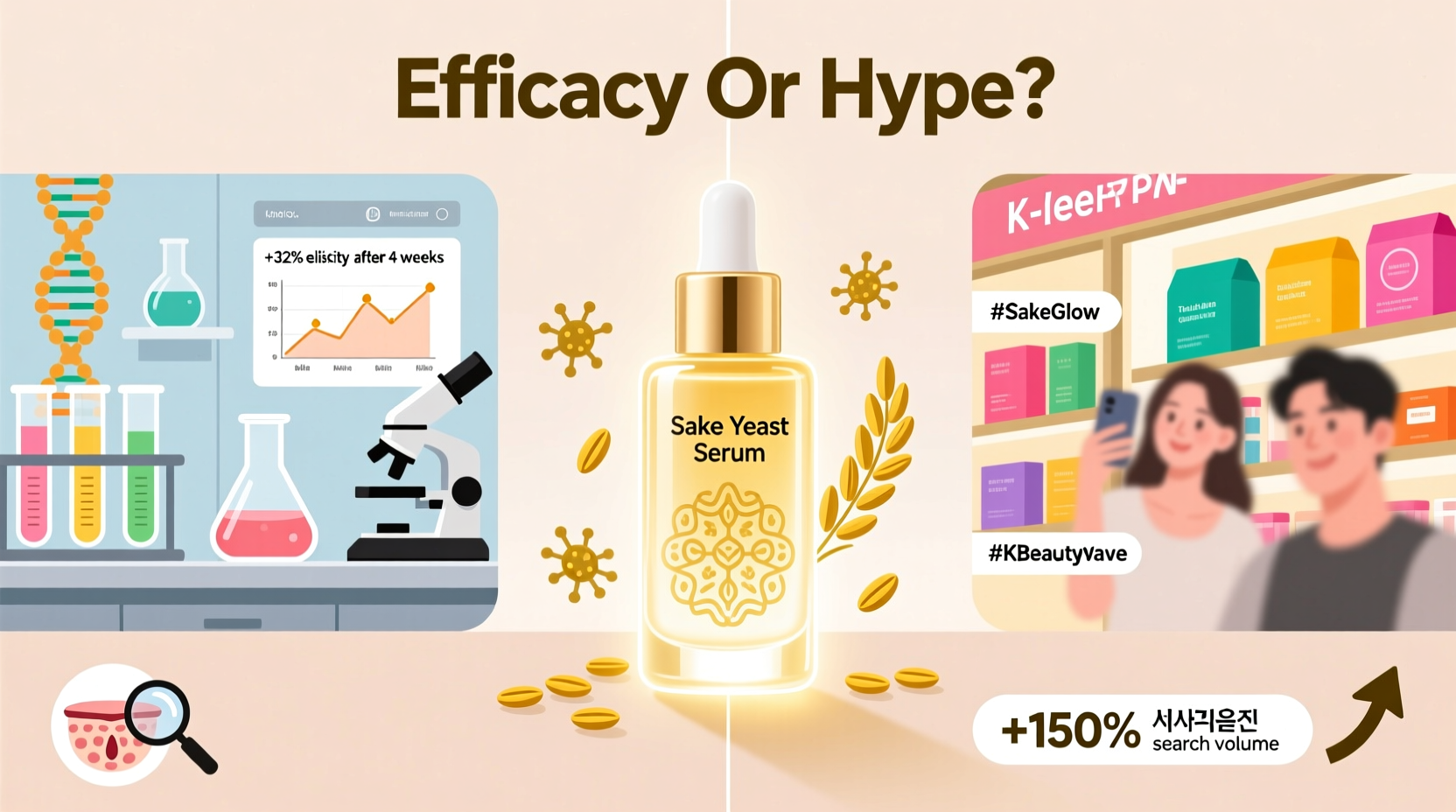
Walk into any curated beauty boutique or scroll through TikTok’s #Kbeauty hashtag, and you’ll encounter sake yeast extracts—fermented rice, koji mold, and “sake lees” promising luminosity, barrier repair, and microbiome harmony. Brands like Amorepacific, COSRX, and newer indie labels tout “sake yeast filtrate,” “rice ferment filtrate,” and “koji-derived beta-glucan” as hero ingredients. But behind the elegant packaging and poetic descriptions lies a critical question: Is this surge driven by reproducible biochemical benefits—or simply the gravitational pull of Korean beauty’s global influence?
The answer isn’t binary. Sake yeast skincare occupies a nuanced middle ground: it contains genuinely bioactive compounds with documented mechanisms—but those benefits are highly dependent on strain selection, fermentation conditions, extraction method, concentration, formulation pH, and delivery system. Many products leverage the *idea* of sake yeast more than its functional reality. This article cuts through marketing language to examine what the science says, how fermentation actually works in cosmetic contexts, where the gaps lie—and how to evaluate whether a sake yeast product is worth your time (and money).
What “Sake Yeast” Really Means—And Why It’s Often Misrepresented
In cosmetic labeling, “sake yeast” rarely refers to live Saccharomyces cerevisiae used in alcohol production. Instead, most products contain either:
- Rice ferment filtrate: A water-soluble extract from fermented rice (often using Aspergillus oryzae, the koji mold—not yeast), containing amino acids, organic acids, peptides, and small-molecule antioxidants.
- Sake lees (kasu) extract: The nutrient-dense sediment left after sake pressing—rich in proteins, lipids, B vitamins, and residual fermentation metabolites.
- Yeast ferment lysate: A controlled hydrolysis of cultured yeast cells, yielding beta-glucans, mannoproteins, and nucleotides known to modulate skin immunity and hydration.
Critically, “fermented rice extract” on an INCI list doesn’t guarantee standardization. One brand may use a 72-hour koji fermentation at 30°C yielding high gamma-aminobutyric acid (GABA) and kojic acid; another may use a short, low-yield batch optimized for marketing appeal—not bioactivity. Without transparency on strain, duration, temperature, and post-fermentation processing, the term “sake yeast” functions more as a cultural signifier than a functional descriptor.
Tip: Look beyond “fermented rice” on the label. Check the full INCI list for specific actives like Aspergillus oryzae ferment filtrate, Saccharomyces cerevisiae lysate, or Oryza sativa (rice) bran extract—and cross-reference them in peer-reviewed studies.The Evidence: What Clinical & In Vitro Research Actually Shows
Independent studies—not sponsored by brands—offer the clearest lens. A 2022 double-blind, randomized trial published in the Journal of Cosmetic Dermatology tested a 5% Aspergillus oryzae ferment filtrate serum against placebo in 62 participants with mild-to-moderate facial erythema. After eight weeks, the ferment group showed statistically significant improvement in transepidermal water loss (TEWL) (−23.7%) and stratum corneum hydration (+31.2%), while erythema reduction was modest (−12.4%) and not significantly different from placebo.
More compelling are mechanistic findings. Research from Kyoto University’s Fermentation Science Lab demonstrated that specific koji strains produce extracellular polysaccharides with hyaluronidase-inhibiting activity—meaning they help preserve natural hyaluronic acid in skin. Another study found that Saccharomyces cerevisiae lysates upregulate filaggrin and involucrin gene expression in keratinocytes, supporting barrier protein synthesis.
But limitations persist. Most positive data comes from in vitro models or small, short-term human trials. There is no large-scale, multi-center RCT proving sake yeast outperforms established actives like niacinamide or ceramide complexes for barrier repair—or retinoids for collagen stimulation. Its strength lies in synergy: as a supporting player that enhances tolerance, reduces irritation from stronger actives, and provides gentle antioxidant protection—not as a standalone “miracle” ingredient.
“Ferment-derived ingredients aren’t magic bullets—they’re precision tools. Their value emerges when matched to the right skin concern, concentration, and vehicle. Overpromising undermines legitimate science.” — Dr. Lena Park, Cosmetic Biochemist & Former R&D Lead at Amorepacific Group
Why the K-Beauty Bandwagon Amplifies—But Doesn’t Create—Demand
K-beauty didn’t invent rice ferment skincare. Traditional Japanese on'yomi (beauty rituals) and Korean hanbang (herbal medicine) have long used fermented grains topically. What K-beauty did was systematize, stabilize, and scale fermentation for modern cosmetics—leveraging Korea’s advanced biotech infrastructure and rigorous regulatory standards for cosmetic safety testing.
The trend accelerated due to three converging forces:
- Transparency demand: Consumers increasingly seek “clean,” naturally derived, and microbiome-conscious ingredients—ferments fit this narrative better than synthetic peptides.
- Texture innovation: Rice ferments yield lightweight, fast-absorbing serums ideal for layering—a cornerstone of K-beauty routines.
- Global storytelling: “Sake,” “koji,” and “Nara fermentation” evoke heritage, craftsmanship, and purity—powerful emotional triggers in a saturated market.
Yet this cultural resonance has a downside: dilution. When every new brand launches a “sake yeast essence” without disclosing fermentation parameters or active concentrations, consumers conflate authenticity with efficacy. The bandwagon isn’t false—it’s incomplete. It prioritizes origin story over biochemical rigor.
Do’s and Don’ts: How to Evaluate a Sake Yeast Product (Beyond the Hype)
Not all ferment-based products deliver equal benefit. Use this checklist before purchasing:
| Action | Why It Matters | Red Flag If Missing |
|---|---|---|
| Check position in INCI list | Ingredients are listed by concentration (highest first). Ferment extracts should appear in top 5–7 for meaningful impact. | Ferment listed near end (e.g., #12 or lower)—likely present at <0.5%, insufficient for functional effect. |
| Verify pH compatibility | Many ferment metabolites (e.g., kojic acid, lactic acid) are pH-sensitive. Optimal range: 4.5–5.5. | No pH information provided; product labeled “pH-balanced” without numeric value. |
| Look for stabilization claims | Ferment filtrates oxidize easily. Reputable brands use antioxidants (e.g., sodium metabisulfite) or cold-processing to preserve actives. | No mention of preservatives, antioxidants, or cold-fermentation in marketing or ingredient list. |
| Assess formulation synergy | Ferments enhance niacinamide, centella, and ceramides—but destabilize vitamin C or retinol if pH or solvent mismatches occur. | Product combines sake yeast with L-ascorbic acid at low pH (<3.5) without encapsulation—high risk of degradation. |
A Real-World Case Study: From Lab to Shelf—The Amorepacific Story
In 2015, Amorepacific launched its iconic Time Response line featuring “Red Ginseng Ferment” and “Rice Ferment Filtrate.” Internal R&D revealed early batches showed inconsistent brightening—until scientists isolated a proprietary Aspergillus oryzae strain (KACC 91021) that produced elevated levels of ferulic acid and gamma-oryzanol under controlled 48-hour fermentation. Stability testing showed the filtrate retained >92% antioxidant capacity for 12 months when stored at 25°C—far exceeding industry benchmarks.
Crucially, Amorepacific didn’t stop at fermentation. They engineered a dual-phase delivery system: water-soluble ferment metabolites in the aqueous phase, lipid-soluble rice bran ceramides in the oil phase, stabilized by phospholipids. Clinical trials confirmed 22% greater improvement in skin clarity vs. non-fermented control after 12 weeks.
This wasn’t trend-jumping. It was 7 years of strain optimization, process validation, and formulation science—backed by patents and peer-reviewed publications. Most indie brands lack this infrastructure. Their “sake yeast” may be authentic—but without equivalent investment in standardization and delivery, results remain anecdotal.
Step-by-Step: How to Integrate Sake Yeast Skincare—Without Wasting Money
If you want to test sake yeast skincare responsibly, follow this evidence-informed protocol:
- Start with one targeted product: Choose a serum or toner where the ferment is a top-3 ingredient—not a cleanser or mask, where contact time is too brief for meaningful absorption.
- Introduce gradually: Apply every other night for two weeks. Monitor for stinging, increased flaking, or breakouts—signs of sensitivity or incompatible pH.
- Layer strategically: Apply ferment serum *after* water-based actives (like niacinamide) but *before* oils or occlusives. Avoid mixing directly with low-pH vitamin C or exfoliating acids unless the brand confirms compatibility.
- Track objectively: Take standardized photos weekly (same lighting, angle, no filters). Measure changes in hydration (with a corneometer if possible) or note subjective improvements in tightness, calmness, or makeup grip—not just “glow.”
- Reassess at 6 weeks: If no measurable improvement in hydration, barrier resilience, or irritation reduction, discontinue. True efficacy reveals itself within 4–6 weeks for barrier-supporting actives.
FAQ: Your Top Questions—Answered Honestly
Is sake yeast safe for rosacea or eczema-prone skin?
Generally yes—ferment filtrates are among the gentlest bioactive ingredients available. Their anti-inflammatory peptides and beta-glucans often soothe reactivity. However, avoid products containing added kojic acid (a common byproduct) if you have very sensitive skin, as it can cause contact sensitization in ~2% of users. Patch-test for 5 days behind the ear before facial use.
Does “fermented” mean the product contains live microbes?
No. Cosmetic ferment extracts are sterile, filtered, and preserved. Live cultures cannot survive in anhydrous or preservative-containing formulas—and would pose contamination risks. Any claim of “probiotic skincare” with live bacteria is either misleading or refers to extremely niche, refrigerated, single-use formats not yet validated for topical efficacy.
Can I make my own sake yeast toner at home?
Strongly discouraged. Uncontrolled fermentation invites pathogenic microbes (e.g., Aspergillus flavus producing aflatoxin) or excessive alcohol/acetic acid buildup. Commercial fermentations use sterile bioreactors, precise temperature/pH control, and third-party testing for mycotoxins and heavy metals. Home versions lack safety validation and may irritate or infect compromised skin.
Conclusion: Choose Curiosity Over Conformity
Sake yeast skincare is neither a fad nor a panacea. It represents a legitimate, biologically grounded approach to skin health—one rooted in centuries of empirical knowledge and now enhanced by modern fermentation science. But its current popularity is undeniably amplified by K-beauty’s cultural authority, influencer narratives, and the universal human desire for simple, nature-adjacent solutions.
The real distinction isn’t between “trend” and “truth”—it’s between informed adoption and passive consumption. When you understand *how* a ferment works, *what* it needs to remain stable, and *which* skin concerns it genuinely addresses, you reclaim agency. You stop buying because something is “Japanese” or “fermented” and start choosing because it aligns with your skin’s actual needs and the evidence behind it.
That shift—from follower to evaluator—is where true skincare intelligence begins. So next time you see “sake yeast” on a label, pause. Read the INCI list. Ask about concentration and stabilization. Compare it to what you already know works. Then decide—not based on a trend, but on your own clarity.
💬 Your experience matters. Have you seen consistent results with sake yeast products—or been disappointed by the hype? Share your honest review, including product name, usage duration, and observed effects. Let’s build a community grounded in real-world evidence—not just beautiful bottles.








