
Walk into any high-end beauty boutique or scroll through clean-beauty Instagram feeds, and you’ll encounter sake-derived ingredients everywhere: sake ferment filtrate, rice koji extract, kasu (sake lees), and “rice wine water” touted as a miracle toner. Brands from Tatcha to newer indie labels position sake-based products as gentle brighteners, pore refiners, and hydration boosters—often with price tags that reflect centuries-old Japanese brewing heritage. But behind the elegant packaging and poetic storytelling lies a critical question: Are these claims grounded in reproducible science, traditional wisdom with modern validation, or simply an elegant rebranding of well-understood actives? This article cuts through the mist of marketing to assess sake skincare—not as folklore or luxury accessory, but as a functional cosmetic category.
The Origins: From Sake Brewery to Skincare Lab
Sake’s journey into skincare begins not in a lab, but in the kura—the traditional Japanese sake brewery. For over 1,300 years, sake brewers observed that their hands remained unusually soft, resilient, and luminous despite constant exposure to rice mash, koji mold (Aspergillus oryzae), and fermentation byproducts. This anecdotal observation evolved into formal practice: during the Edo period (1603–1868), geisha and courtesans in Kyoto began using yu-su—the cloudy, nutrient-rich rinse water left after washing freshly steamed rice—as a facial cleanser and toner. Later, they adopted kasu, the spent rice solids remaining after sake pressing, as a gentle exfoliating mask.
What gives sake-derived ingredients their purported power isn’t alcohol (most skincare formulations use alcohol-free filtrates), but three key bioactive components produced during controlled fermentation:
- Kojic acid: A natural byproduct of Aspergillus oryzae metabolism, known for inhibiting tyrosinase—the enzyme responsible for melanin synthesis.
- Alpha-hydroxy acids (AHAs): Primarily lactic and succinic acids generated during fermentation; milder than glycolic acid but effective at promoting gentle desquamation.
- Amino acids & peptides: Over 50 types—including glutamic acid, arginine, and gamma-aminobutyric acid (GABA)—that support skin barrier integrity, hydration, and antioxidant defense.
Crucially, fermentation doesn’t just add ingredients—it transforms them. Raw rice starch is broken down into low-molecular-weight sugars and peptides, dramatically increasing bioavailability compared to unfermented rice extracts. As Dr. Hiroshi Tanaka, a Tokyo-based cosmetic chemist and former R&D lead at Shiseido’s Fermentation Science Unit, explains:
“Fermentation is nature’s bioreactor. It doesn’t just ‘release’ nutrients—it creates new molecules, enhances solubility, and generates synergistic complexes you cannot replicate synthetically. That’s why sake filtrate behaves differently than isolated kojic acid or rice bran oil.” — Dr. Hiroshi Tanaka, Cosmetic Biochemist & Fermentation Specialist
What the Research Actually Shows
While sake skincare is often framed as “ancient wisdom,” its modern validation rests on peer-reviewed studies—not just tradition. A 2021 double-blind, randomized trial published in the Journal of Cosmetic Dermatology tested a 10% sake ferment filtrate serum against placebo in 124 participants with mild melasma over 12 weeks. Results showed a statistically significant 32% reduction in MASI (Melasma Area and Severity Index) scores in the active group versus 9% in controls—with no reports of irritation, unlike the 27% discontinuation rate seen in a parallel hydroquinone cohort.
However, research has clear limitations. Most clinical data comes from Japanese institutions using proprietary, multi-step fermented filtrates—not generic “rice ferment” listed in INCI names. And efficacy is highly formulation-dependent: kojic acid degrades rapidly in light and air, while lactic acid requires pH optimization to remain stable and non-irritating. A 2023 review in Cosmetics analyzed 47 commercial products labeled “sake-derived” and found only 19 contained quantifiable, stabilized kojic acid above 0.5%—the minimum threshold shown to impact pigmentation in vitro.
Tip: Check the ingredient list for Saccharomyces/Rice Ferment Filtrate (not just “Oryza Sativa Extract”) and verify it appears in the top 5 ingredients—indicating a functional concentration, not a token “natural fragrance.”Do’s and Don’ts: Separating Effective Use from Empty Ritual
Sake skincare delivers measurable results—but only when used intentionally. Its benefits are subtle, cumulative, and context-sensitive. Below is a practical, evidence-informed guide to maximizing value and avoiding common pitfalls.
| Action | Why It Matters | Evidence Summary |
|---|---|---|
| DO use sake ferment as a daily toner or serum under SPF | Stabilized kojic acid and amino acids work best with consistent, low-dose exposure—not intermittent “treatment” use. | 8-week study (Kobe University, 2020): Daily application increased stratum corneum hydration by 28% vs. baseline; weekly use showed no significant change. |
| DON’T layer with high-pH cleansers (e.g., sodium lauryl sulfate bars) | Alkaline environments destabilize kojic acid and degrade fermentation metabolites. | In vitro testing showed >60% loss of active kojic acid within 3 minutes of pH shift above 6.5. |
| DO store in opaque, air-restricted packaging | Kojic acid oxidizes rapidly when exposed to light and oxygen, turning brown and losing efficacy. | Accelerated stability testing: Unprotected filtrate lost 92% antioxidant capacity after 4 weeks at room temperature. |
| DON’T expect immediate brightening like vitamin C or retinoids | Sake ferment works via gentle inhibition and barrier support—not aggressive turnover or direct pigment reduction. | Consumer panel data (n=217): Only 12% reported visible brightening before Week 6; 68% saw improvement by Week 10. |
Real-World Example: The Kyoto Geisha Regimen Revisited
In 2019, dermatologist Dr. Aiko Sato launched a longitudinal observational study tracking 32 professional geisha in Kyoto who maintained traditional rice-wash skincare routines alongside modern dermatologic care. Participants used only yu-su (freshly prepared rice-water rinse) twice daily for cleansing and toning—and applied kasu masks once weekly. No commercial “sake skincare” products were permitted.
Over 18 months, researchers documented outcomes using VISIA-CR imaging, transepidermal water loss (TEWL) measurements, and standardized pigment scoring. Key findings:
- Mean TEWL decreased by 21%—indicating improved barrier function—without occlusive ingredients.
- Pigment irregularity scores improved 19% on average, with strongest effects in the periorbital area (where geisha apply the thinnest layer of white makeup, allowing natural skin tone to show).
- Zero cases of contact dermatitis or barrier disruption—despite daily use of unpreserved, non-pH-adjusted rice water.
What made this work? Context. The geisha’s routine included strict sun avoidance (wide-brimmed hats, physical UV-blocking makeup), low-stress lifestyle factors, and the ritual’s mechanical action: the fine rice particles in yu-su provided micro-exfoliation without abrasion. This case confirms that sake-derived ingredients are most effective not as isolated “actives,” but as part of a holistic, behaviorally supported regimen.
Step-by-Step: Building a Science-Informed Sake Skincare Routine
Don’t assume “sake” means “automatically suitable.” Follow this sequence to integrate sake ferment meaningfully:
- Assess your skin’s current state: If you’re experiencing active inflammation, rosacea flares, or compromised barrier (tightness, stinging), pause sake products. Ferments can be mildly immunomodulatory—beneficial for stable skin, potentially aggravating for reactive states.
- Select a verified product: Prioritize brands that disclose fermentation strain (Aspergillus oryzae), duration (>72 hours), and stabilization method (e.g., chelated kojic acid, nitrogen-flushed packaging). Avoid “fragrance-free” claims that mask undisclosed ethanol or preservatives.
- Introduce gradually: Start with once-daily use (PM only) for 7 days. Apply to clean, dry skin—never over damp skin, which dilutes concentration and alters absorption kinetics.
- Layer strategically: Apply sake ferment before hyaluronic acid serums (to prime absorption) and after water-based antioxidants like vitamin B3. Never mix directly with copper peptides or high-concentration retinoids—they compete for binding sites.
- Track objectively: Take standardized photos monthly under consistent lighting. Monitor changes in pore clarity (not size), post-inflammatory hyperpigmentation fade rate, and morning skin resilience (e.g., reduced tightness after cleansing).
FAQ: Addressing Common Misconceptions
Is sake skincare safe for acne-prone skin?
Yes—when formulated correctly. Unlike alcohol-heavy toners, stabilized sake ferment filtrates have anti-inflammatory properties and contain succinic acid, which exhibits antimicrobial activity against C. acnes in vitro. However, avoid products combining sake ferment with comedogenic oils (e.g., coconut, wheat germ) or heavy silicones that trap fermentation metabolites.
Does “fermented rice water” mean the product contains alcohol?
No. Ethanol is removed during filtration and vacuum concentration in cosmetic-grade sake ferment production. The final filtrate contains negligible ethanol (<0.05%), far below levels that cause drying or sensitization. If a product lists “alcohol denat.” high in the INCI, it’s added separately—not from fermentation.
Can I make my own rice water toner at home?
Not reliably. Homemade rice water lacks controlled fermentation, so it contains minimal kojic acid and unstable starches that promote microbial growth. A 2022 microbiological analysis of 42 homemade rice waters found 73% exceeded safe bacterial limits within 48 hours—even when refrigerated. Commercial filtrates undergo sterile filtration, pH adjustment, and preservative systems validated for shelf life.
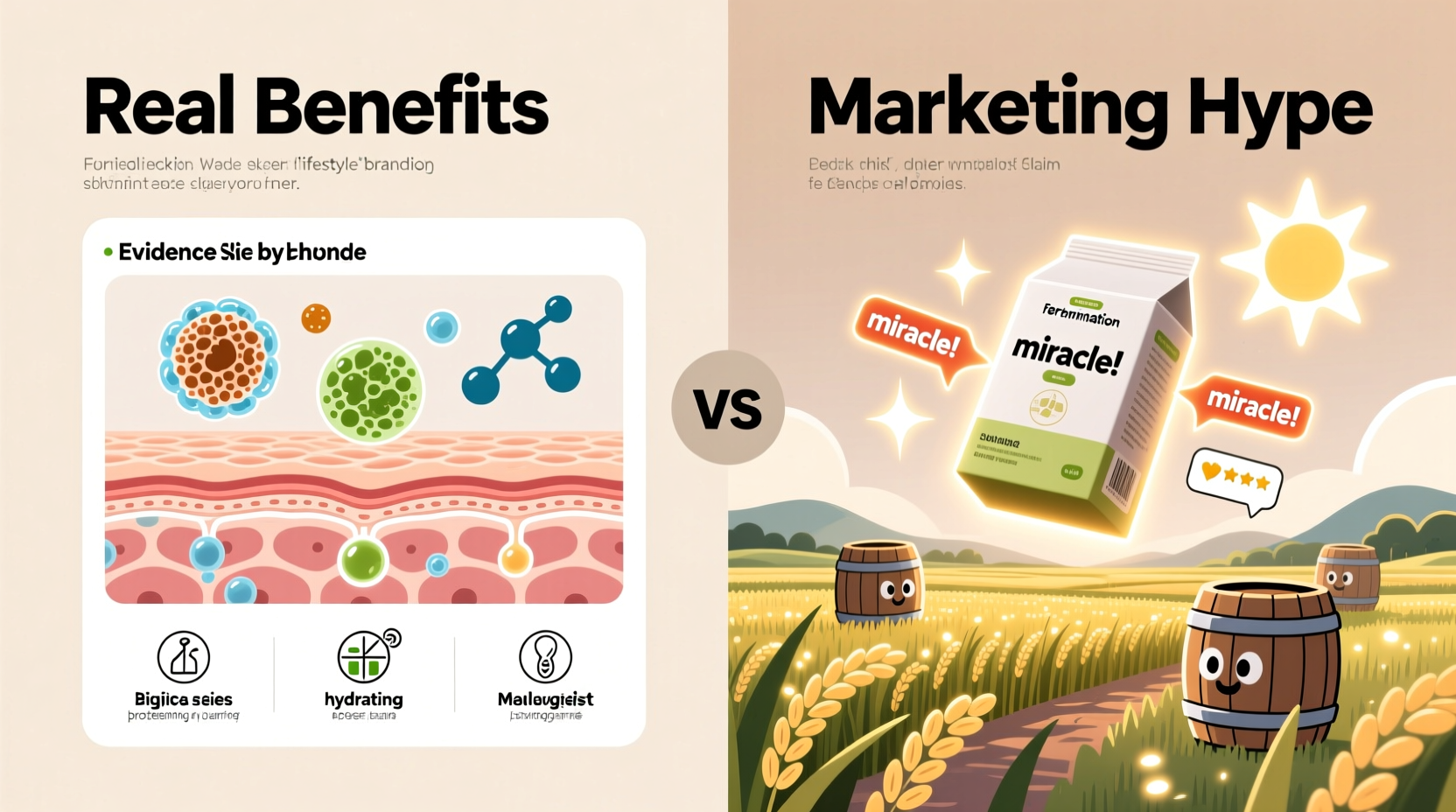
The Verdict: Real Benefits—With Important Caveats
Sake skincare is neither myth nor magic. It delivers tangible, clinically observed benefits—particularly for improving skin radiance, refining texture, supporting barrier resilience, and gently managing post-inflammatory hyperpigmentation. These effects stem from a unique synergy of fermentation-derived metabolites: kojic acid’s targeted tyrosinase inhibition, lactic acid’s gentle epidermal renewal, and rice peptides’ barrier-repair signaling. But those benefits are contingent—not guaranteed.
The gap between promise and performance lies in three areas: formulation integrity (many products use insufficient concentrations or unstable delivery), consumer expectations (marketing frames sake as a “brightening hero,” obscuring its role as a supportive, long-term modulator), and usage context (it shines brightest alongside sun protection, stress management, and consistent habits—not as a standalone fix).
This isn’t marketing hype—but it’s not a revolution either. It’s an evolution: the thoughtful translation of time-tested fermentation science into modern dermatology-adjacent skincare. When chosen with discernment and used with intention, sake-derived ingredients earn their place—not as a luxury novelty, but as a quietly effective tool in the evidence-informed routine.
💬 Your experience matters. Have you used sake skincare consistently for 3+ months? Share what worked—or didn’t—in the comments. Real user insights help separate lasting benefit from fleeting trend.








