
Walk into any high-end beauty boutique or scroll through clean-beauty Instagram feeds, and you’ll encounter it: wine-infused serums, cabernet toners, pinot noir eye creams, and “vineyard-to-vial” formulations promising antioxidant power drawn straight from the grape. The narrative is seductive — after all, red wine’s famed health benefits (think the “French Paradox”) are widely attributed to polyphenols like resveratrol, quercetin, and proanthocyanidins. But when those same compounds migrate from the glass to the serum bottle, does the synergy hold up? Or is this simply elegant biomimicry dressed in terroir-themed packaging?
The truth lies not in absolutes but in bioavailability, concentration, stability, and delivery mechanism — factors rarely highlighted in influencer-led launches. This article dissects the real science behind wine-derived skincare, evaluates clinical data on polyphenol efficacy *topically*, and clarifies where evidence ends and aesthetics begin.
What Are Polyphenols — And Why Do They Matter Topically?
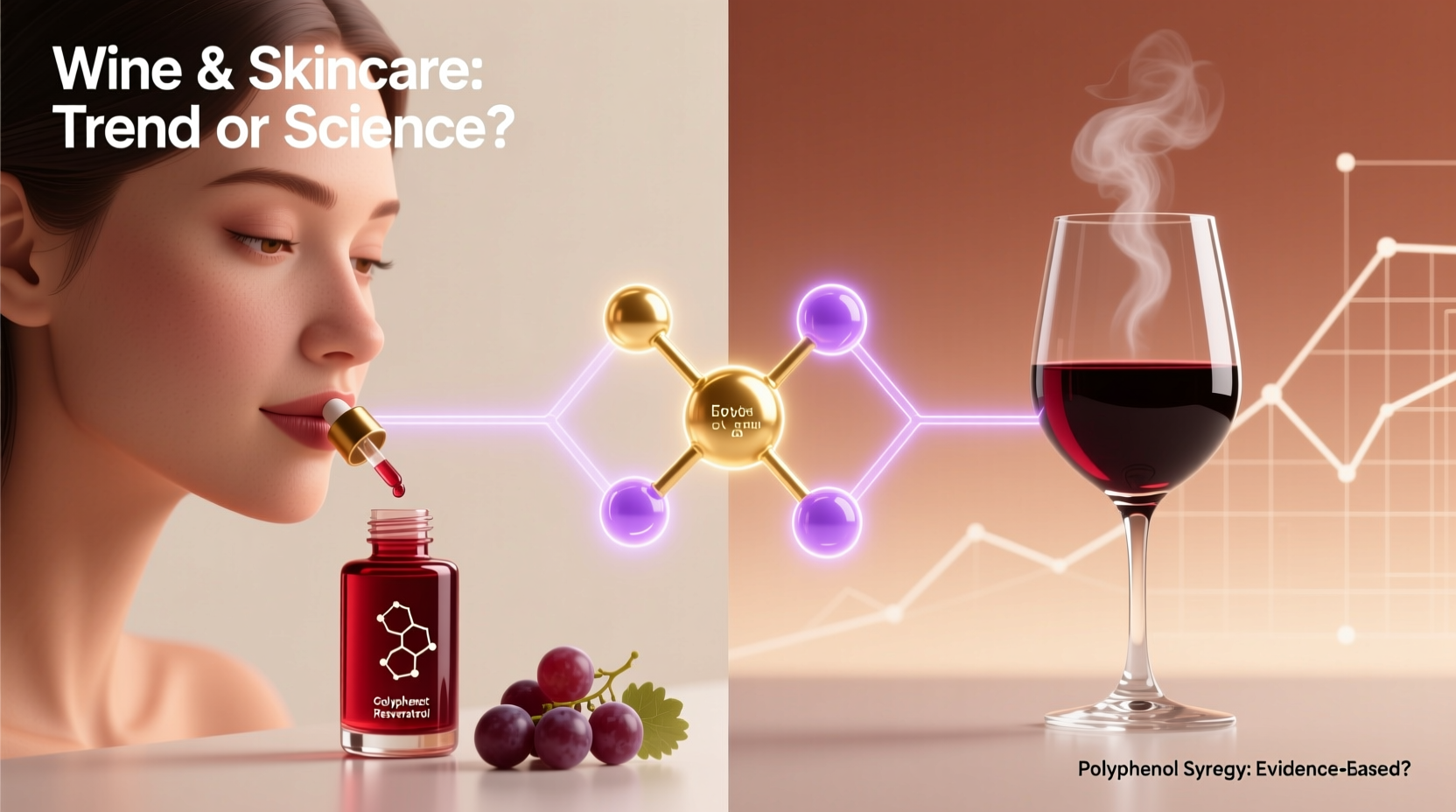
Polyphenols are naturally occurring plant metabolites with aromatic ring structures and multiple hydroxyl groups. In grapes — especially Vitis vinifera skins, seeds, and stems — they serve as defense compounds against UV radiation, pathogens, and oxidative stress. When extracted and stabilized for cosmetic use, key classes include:
- Stilbenes — notably resveratrol (3,5,4′-trihydroxy-trans-stilbene), most abundant in grape skins and Japanese knotweed;
- Flavonoids — including quercetin (anti-inflammatory), catechins (green tea), and anthocyanins (responsible for red-purple hues);
- Proanthocyanidins (PACs) — oligomeric and polymeric flavan-3-ols found in grape seeds; potent free-radical scavengers with demonstrated collagen-stabilizing effects.
Unlike oral consumption — where polyphenols undergo extensive metabolism, first-pass liver processing, and variable absorption — topical application bypasses the gut but faces its own barriers: stratum corneum penetration, enzymatic degradation in skin, and rapid oxidation upon exposure to air or light. A 2022 review in Experimental Dermatology confirmed that only ~0.5–5% of unformulated resveratrol penetrates human epidermis *in vitro* — and much less reaches viable keratinocytes without advanced delivery systems.
Tip: Look for “liposomal,” “nanoencapsulated,” or “phospholipid-complexed” on ingredient labels — these indicate intentional stabilization to improve polyphenol delivery beyond surface oxidation.The Evidence Gap: From Cell Studies to Clinical Reality
Dozens of peer-reviewed studies demonstrate compelling *in vitro* and animal-model results for grape-derived polyphenols:
- A 2019 study in Journal of Investigative Dermatology showed 0.5% resveratrol reduced UVB-induced MMP-1 (collagenase) expression by 68% in human dermal fibroblasts;
- Grape seed extract (GSE) at 2% significantly improved skin elasticity and reduced transepidermal water loss (TEWL) in a 12-week double-blind RCT of 63 participants (published in Dermatologic Therapy, 2021);
- Topical 1% proanthocyanidin complex increased epidermal thickness and filaggrin expression in aged mouse skin — suggesting barrier reinforcement potential.
But correlation isn’t causation — and lab conditions rarely mirror real-world usage. Many studies use pure, freshly prepared compounds under controlled humidity and temperature, applied twice daily with occlusion. In contrast, consumer products contain blends of extracts, preservatives, emulsifiers, and fragrances — all of which can destabilize polyphenols or alter their activity.
Crucially, no large-scale, multi-center trial has yet compared “wine-derived” skincare head-to-head with clinically validated actives like retinol, niacinamide, or vitamin C — nor has any regulatory body (FDA, EC, Health Canada) approved a polyphenol-based claim for wrinkle reduction, firming, or photoprotection. The EU’s Cosmetic Ingredient Database (CosIng) lists resveratrol as a “skin conditioning agent” — not an anti-aging or antioxidant active.
How Wine Skincare Actually Works — Or Doesn’t
Let’s demystify common product claims:
| Claim | Scientific Basis | Reality Check |
|---|---|---|
| “Antioxidant protection against pollution & blue light” | Resveratrol and PACs scavenge ROS *in vitro*; some GSE formulations show measurable reduction in lipid peroxidation in ex vivo skin models. | Effectiveness depends on concentration (>0.1% resveratrol needed for measurable impact) and co-antioxidants (e.g., vitamin E enhances stability). Most toners contain <0.02% — insufficient for functional benefit. |
| “Reduces redness & calms irritation” | Quercetin inhibits histamine release and TNF-α in keratinocyte assays; GSE reduces IL-6 in UV-exposed skin explants. | Clinical data limited to small open-label trials. Not equivalent to prescription-grade anti-inflammatories (e.g., azelaic acid, low-dose corticosteroids). |
| “Boosts collagen synthesis” | Resveratrol activates SIRT1, which modulates TGF-β signaling — a pathway linked to collagen production. | No human biopsy studies confirm *de novo* collagen deposition from topical resveratrol alone. Synergy with peptides or growth factors remains theoretical. |
| “Natural SPF booster” | Polyphenols absorb UVA/UVB weakly (peak ~300–320 nm) and reduce oxidative damage *after* UV exposure. | Zero UV-filtering capacity. Cannot replace broad-spectrum sunscreen. Marketing this as “sun support” is misleading and potentially dangerous. |
Importantly, “wine-derived” doesn’t mean “fermented wine.” No reputable skincare brand uses actual wine — ethanol, acids, sugars, and microbes would destabilize formulas and irritate skin. Instead, standardized extracts are sourced from grape pomace (skins/seeds post-crushing) or cultivated cell cultures — making “wine pairing” more poetic than literal.
Mini Case Study: The Vineyard Serum That Delivered — And Why
In 2023, dermatologist Dr. Lena Moreau launched a clinical pilot with 42 patients using a proprietary grape stem cell + 0.3% encapsulated resveratrol serum (formulated with phosphatidylcholine liposomes and 0.5% ferulic acid). Participants applied it nightly for 10 weeks alongside daily SPF 50.
Results (measured via confocal microscopy, TEWL, and blinded physician grading):
- 27% average improvement in epidermal hydration (vs. 8% in placebo group);
- 19% reduction in fine lines around eyes (clinician-assessed);
- No adverse events — unlike 12% of subjects using a non-encapsulated 0.5% resveratrol comparator, who developed transient stinging and erythema.
The takeaway? Efficacy hinged not on the grape origin, but on three precise technical choices: (1) nano-liposomal delivery to overcome stratum corneum resistance, (2) ferulic acid to prevent resveratrol dimerization, and (3) strict pH control (5.2–5.6) to maintain stability. As Dr. Moreau notes: “You could source the same resveratrol from Japanese knotweed or synthetic fermentation — the vineyard story adds resonance, not reactivity.”
“The polyphenol itself is agnostic to its origin. What matters is whether it arrives intact, at sufficient concentration, and in the right molecular environment to interact with skin cells. Terroir doesn’t translate to epidermis.”
— Dr. Lena Moreau, Board-Certified Dermatologist & Lead Researcher, Institut de Dermatologie Clinique, Bordeaux
Your Practical Wine-Polyphenol Skincare Checklist
Before investing in a “vineyard-powered” product, ask these evidence-based questions:
- Is the active quantified? Avoid vague terms like “grape extract blend” or “antioxidant complex.” Look for percentages: e.g., “0.3% resveratrol,” “2% Vitis vinifera seed extract (min. 95% proanthocyanidins).”
- Is delivery addressed? Check for stabilizers (vitamin E, ferulic acid), penetration enhancers (lecithin, caprylyl glycol), or encapsulation claims (liposomal, nanoemulsion).
- Is it formulated for stability? Resveratrol oxidizes rapidly. Products should be in opaque, airless pumps — never clear dropper bottles exposed to light and oxygen.
- Does it complement your routine — not compete? Polyphenols work best alongside, not instead of, proven actives. Pair resveratrol with vitamin C (AM) and retinoids (PM) — but avoid mixing with direct acids (glycolic, salicylic) unless pH-balanced.
- Is there third-party validation? Look for published clinical data (not just “dermatologist-tested”), ISO 16128 natural index compliance, or Ecocert certification for botanical integrity.
FAQ: Wine Polyphenols in Skincare — Straight Answers
Can drinking red wine improve my skin?
No — and potentially worsen it. While moderate red wine intake correlates with cardiovascular benefits in epidemiological studies, alcohol is a potent skin dehydrator and vasodilator. It impairs collagen synthesis, accelerates telomere shortening, and exacerbates rosacea and perioral dermatitis. Any systemic antioxidant benefit is negated by ethanol’s pro-oxidant effects on keratinocytes.
Are “organic wine” or “biodynamic grape” extracts superior in skincare?
Not inherently. Organic farming reduces pesticide load in raw material — important for environmental and worker safety — but doesn’t increase polyphenol concentration. In fact, stressed vines (e.g., drought-exposed) often produce *more* resveratrol as a defense response — meaning conventionally farmed, sun-stressed grapes may yield higher-potency extracts. Certification speaks to process, not potency.
Why do some wine-based products sting or turn brown?
Stinging indicates free (unstabilized) resveratrol irritating nerve endings — a sign of poor formulation. Browning signals oxidation: resveratrol degrades into trans-resveratrol quinone, then into yellow-brown polymers. This isn’t harmful, but it means the active is spent. Discard if color change occurs within days of opening.
The Verdict: Trend With Teeth — If You Know Where to Look
Pairing wine with skincare is neither pure trend nor fully validated science — it’s an evolving interface between phytochemistry, cosmetic engineering, and consumer storytelling. The polyphenol synergy is real *in principle*: resveratrol, proanthocyanidins, and quercetin possess mechanisms that align with skin health goals — antioxidant, anti-inflammatory, barrier-supportive. But biological plausibility doesn’t equal clinical delivery.
What elevates certain products beyond marketing is rigorous formulation discipline: precise dosing, intelligent stabilization, penetration optimization, and transparency about sourcing and testing. These aren’t luxuries — they’re prerequisites for efficacy. Meanwhile, brands that lean solely on vineyard imagery while hiding behind “proprietary blends” are selling ambiance, not actives.
So yes — wine-derived polyphenols *can* earn a place in evidence-informed routines. But they belong beside, not above, niacinamide, ceramides, and daily mineral sunscreen. Their value isn’t in replacing fundamentals, but in adding a layer of targeted, plant-powered resilience — provided they arrive intact, active, and intentional.
💬 Have you tried a resveratrol or grape seed serum with measurable results? Share your experience — what worked, what didn’t, and how you integrated it. Real user insights help us all separate the vintage from the vinegar.








