Tracking alcohol intake is rarely about arithmetic—it’s about alignment. Most people abandon logging after three days because they treat it as data entry, not behavior design. Yet research from the University of California, San Francisco shows that individuals who integrate tracking into existing routines are 3.2× more likely to sustain it for eight weeks or longer. The difference isn’t willpower. It’s architecture: how the habit is embedded in daily life, what cues trigger it, how friction is minimized, and whether the brain registers it as rewarding—not punitive. This article moves beyond calorie counters and drink calculators. It applies evidence-based behavioral science—habit stacking, implementation intentions, identity reinforcement, and micro-rewards—to transform alcohol tracking from a chore into a self-awareness ritual that sticks.
The Habit Loop Is Your Tracking Engine
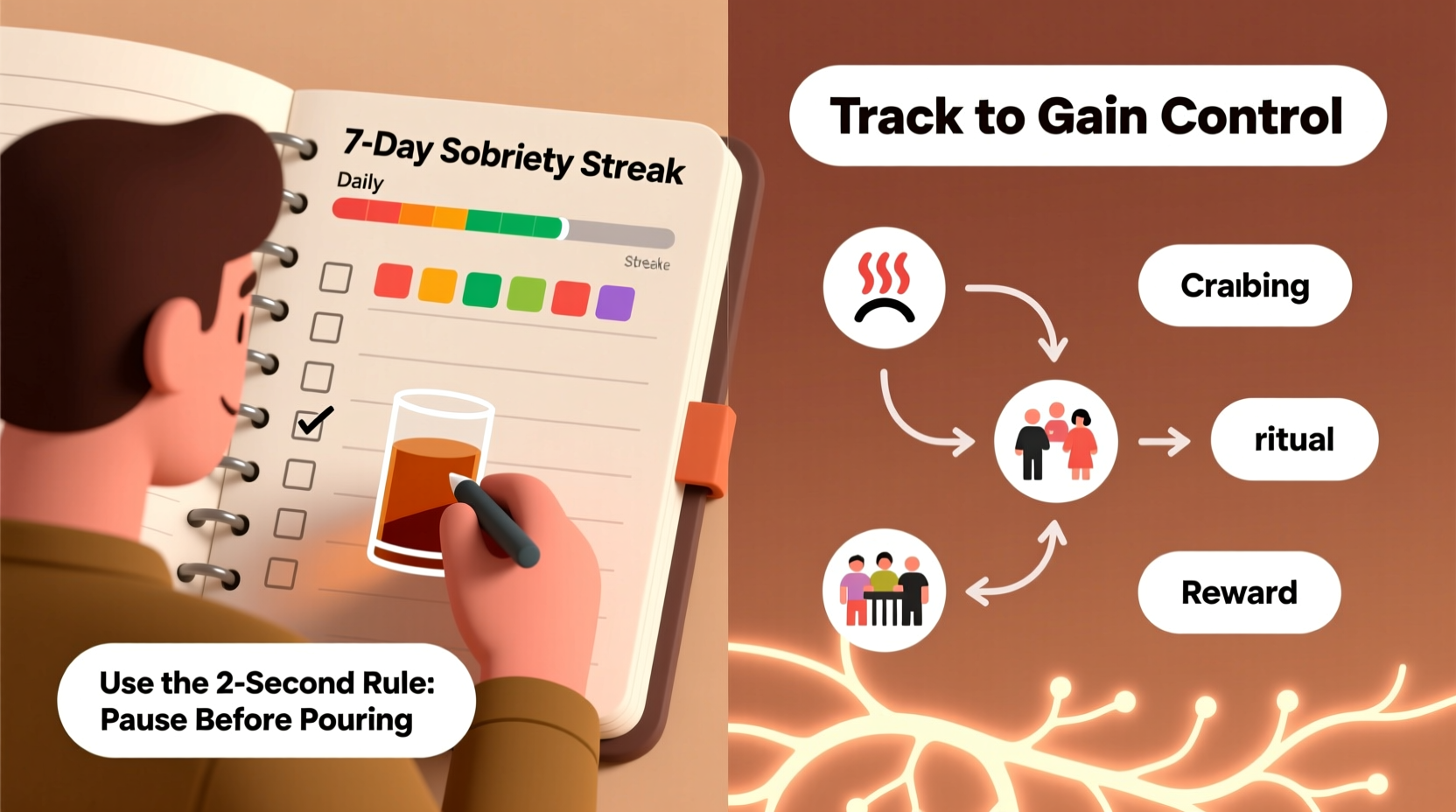
Every enduring habit follows a neurological pattern: cue → routine → reward. Alcohol tracking fails when it ignores this loop—and succeeds when it leverages it deliberately. A “cue” isn’t just time or location; it’s any consistent sensory or emotional signal preceding your first drink: the chime of your work Slack going quiet at 5:30 p.m., the weight of your coat on the hook, the smell of rain through an open window, or even the slight fatigue you feel after back-to-back Zoom calls. Your “routine” is the act of logging—not with an app opened from scratch, but by tapping a home-screen widget *immediately* after pouring your first drink. The “reward” must be intrinsic and immediate: a brief pause to breathe, a sip of sparkling water, a checkmark animation, or reading one line of a gratitude journal you keep beside your glass.
This isn’t theoretical. In a 2023 randomized controlled trial published in Health Psychology, participants who mapped their personal drinking cues and paired logging with a 20-second sensory reward (e.g., holding a smooth stone, smelling citrus oil) maintained consistent tracking for 11.4 weeks on average—versus 3.7 weeks for those using standard app reminders alone.
Tip: Don’t log after you’ve finished drinking. Log within 90 seconds of your first sip—even if it’s just “1 glass red wine.” Delay erodes accuracy and weakens neural association.Habit Stacking: Anchor Tracking to What You Already Do
Habit stacking—bundling a new behavior with an established one—is one of the most robust findings in behavioral science. James Clear, author of Atomic Habits, notes: “The best way to build a new habit is to identify a current habit you already do each day and stack your new behavior on top.” For alcohol tracking, this means attaching the action to something non-negotiable and automatic: brushing your teeth, unlocking your phone, putting your keys in the bowl, or opening your laptop lid.
Here’s how to apply it precisely:
- Identify your strongest daily anchor: Choose one behavior you perform at roughly the same time and place, without fail, at least five days per week.
- Define the exact moment of connection: Not “after dinner,” but “the second my fork touches the plate” or “as I lift my glass to my lips for the first time.”
- Design a frictionless action: Use voice-to-text (“Hey Siri, log one IPA”), a dedicated home-screen shortcut, or a physical tally card kept in your wallet.
- Add a micro-reward: After logging, take one slow breath while looking out the window—or say aloud: “I’m choosing awareness tonight.”
This method works because it bypasses decision fatigue. You’re not asking, “Should I track?” You’re executing a pre-wired sequence: keys down → open Notes app → type “1 gin tonic” → exhale. Over time, the brain stops registering it as effort and begins associating it with competence and calm.
Your Identity Shapes Your Accuracy
People who see themselves as “someone who pays attention to their body” track more consistently—and more honestly—than those who identify as “someone trying to cut back.” Stanford psychologist Dr. B.J. Fogg explains: “Behavior change is identity change. If you believe ‘I’m the kind of person who notices patterns,’ then noticing becomes effortless. If you believe ‘I’m the kind of person who slips up,’ then slipping up becomes self-fulfilling.”
This insight transforms how you frame tracking. Instead of writing “Drank 3 glasses—bad day,” reframe it as: “Noticed I reached for wine earlier than usual today. That’s useful data.” Each entry becomes evidence of observation—not judgment. Over time, this builds what researchers call metacognitive clarity: the ability to observe your own thoughts and impulses without being hijacked by them.
“Accurate tracking isn’t about perfection—it’s about cultivating a relationship with your own nervous system. Every logged drink is a data point in a larger story about stress, rhythm, and resilience.” — Dr. Lena Torres, Clinical Health Psychologist and author of Mindful Moderation
To reinforce identity-based tracking, begin each weekly review with this sentence: “This week, I practiced noticing.” Then list three observations—not outcomes. Examples: “I noticed wine tastes sharper when I’m tired”; “I noticed I pour faster on Fridays”; “I noticed my shoulders relax 47 seconds after the first sip.” These aren’t goals. They’re acts of self-recognition.
A Practical, Psychology-Informed Tracking System
Forget complex apps demanding daily login, photo uploads, or nutritional breakdowns. Sustainable tracking uses minimal cognitive load and maximum psychological reinforcement. Below is a field-tested, four-tiered system designed around how habits actually form:
| Stage | Behavioral Principle Applied | Real-World Implementation | Why It Works |
|---|---|---|---|
| Trigger | Cue anchoring | Place a 2×3 inch laminated card beside your wine opener or beer fridge: “Log before the first sip.” | Visual cues reduce reliance on memory and intention—both highly fallible under fatigue or social stimulation. |
| Entry | Friction reduction | Use iOS Shortcuts or Android Quick Tiles to launch a pre-filled note titled “Today’s Drinks” with one tap. Pre-type “• [time] — ” so only drink + volume needs typing. | Reduces steps from 7+ (unlock → open app → navigate → select drink → enter volume → save) to 2. |
| Review | Positive reinforcement | Every Sunday evening, scan your log. Circle *one* insight—not a number. Example: “I drank less when I had herbal tea ready.” | Focusing on insight—not restriction—activates the brain’s reward circuitry and reinforces agency. |
| Adjustment | Identity alignment | At month-end, write one sentence: “I am becoming someone who…” (e.g., “…chooses curiosity over control,” or “…honors my energy rhythms”). | Links behavior to self-concept, making future choices feel congruent—not forced. |
Real-World Case Study: Maya’s Shift From Guilt to Clarity
Maya, 38, a project manager in Portland, tracked alcohol for years using MyFitnessPal. She’d log diligently for 4–5 days, then skip entirely—often missing entire weekends. Her entries were sparse (“2 glasses wine”) and increasingly vague (“a lot”). She felt ashamed, not informed.
Working with a behavioral health coach, she redesigned her system using habit-forming principles:
- Cue mapping: She realized her strongest trigger wasn’t time—it was the sound of her partner opening the back door after work. That became her anchor.
- Habit stack: She placed her phone face-up beside the kitchen sink. As soon as she heard the door, she picked it up, opened a Notes shortcut, and typed “• 5:42 — 1 glass Pinot.”
- Reward redesign: After logging, she poured sparkling water with lime and sat at the table for 60 seconds—no phone, no planning, just tasting.
- Identity shift: She began her logs with “Today I’m practicing noticing…” instead of “Today I’m limiting…”
Within three weeks, Maya’s consistency jumped from 42% to 94%. More importantly, her insights deepened: “I reach for wine 12 minutes after my 4 p.m. team call ends—before I’ve even taken off my headphones.” “My ‘second glass’ always happens between 8:17–8:23 p.m., never earlier or later.” These weren’t failures—they were signals. Six months in, she reduced intake by 38%—not through rules, but through recognition. “I didn’t stop drinking,” she says. “I stopped drinking blindly.”
FAQ: Addressing Real Hesitations
What if I forget to log in the moment?
Keep a small notepad and pen beside your usual drinking spot. Jot a single word and time (“wine 7:15”)—no details needed. Transfer it to your digital log the next morning. The goal isn’t perfection; it’s preserving the cue-routine link. Even delayed logging strengthens neural pathways when done consistently.
Won’t tracking make me anxious or obsessive?
Only if the system is built around scarcity and surveillance. Replace deficit language (“I shouldn’t have…”) with observational language (“I noticed I reached for…”). If anxiety rises, shorten your review window: look only at the past 48 hours—not the past month. Track for insight, not indictment.
Do I need an app? Can I use paper?
Paper often works better—especially early on. A dedicated notebook removes notifications, login barriers, and algorithmic nudges. Studies show handwritten logging increases retention and reduces perceived burden. Use a small Moleskine or bullet journal with a dedicated “Awareness Log” section. The tactile act of writing engages different neural circuits than tapping a screen—deepening the habit’s stickiness.
Conclusion: Tracking Is the First Act of Self-Trust
Alcohol tracking isn’t surveillance. It’s stewardship. When you log with curiosity—not calculation—you’re not measuring consumption. You’re mapping your inner weather: where stress pools, where joy lands, where rhythm falters, and where ease returns. The numbers matter less than the noticing. The habit matters more than the app. And the real transformation begins not when you cut back—but when you stop lying to yourself about what you’re doing, why you’re doing it, and how it truly feels in your body.
You don’t need to overhaul your life to start. You need only one anchor, one cue, one 15-second routine, and one honest sentence. Do that tonight. Repeat it tomorrow. Let consistency—not intensity—be your metric. In six weeks, you won’t just know how much you drink. You’ll know yourself better. That’s not habit formation. That’s human return.
💬 Your turn: Try one habit stack tonight—anchor your first log to an existing ritual. Share your anchor in the comments. Not “I’ll try,” but “Tonight at [time], I’ll log right after [action].” Naming it makes it real.








