
Losing weight doesn’t have to be a guessing game. The foundation of fat loss lies in one simple principle: energy balance. When you consume fewer calories than your body needs to maintain its current weight, you create a calorie deficit—and that’s when fat loss begins. But not all deficits are created equal. Too small, and progress stalls. Too aggressive, and you risk muscle loss, fatigue, and rebound weight gain. The key is precision: calculating a deficit that’s effective, sustainable, and tailored to your body.
Determine Your Total Daily Energy Expenditure (TDEE)
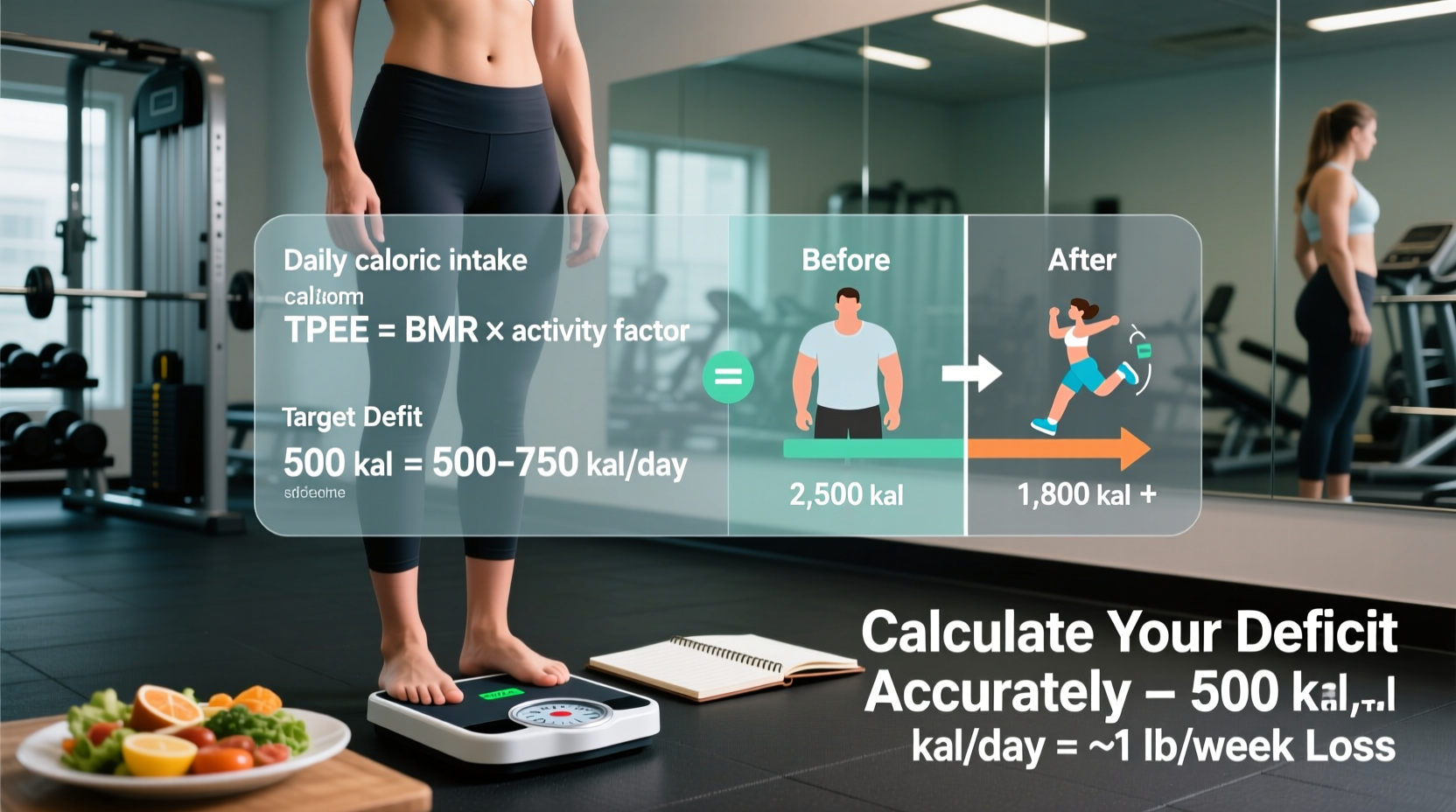
Your Total Daily Energy Expenditure (TDEE) is the total number of calories your body burns in a day, including all activity—from breathing to intense workouts. To begin, estimate your TDEE using your Basal Metabolic Rate (BMR), which is the energy required to keep your body functioning at rest, and then adjust it based on your activity level.
A widely accepted formula for BMR is the Mifflin-St Jeor Equation:
- For men: BMR = 10 × weight (kg) + 6.25 × height (cm) – 5 × age (years) + 5
- For women: BMR = 10 × weight (kg) + 6.25 × height (cm) – 5 × age (years) – 161
Once you have your BMR, multiply it by an activity factor:
| Activity Level | Description | Multiplier |
|---|---|---|
| Sedentary (little or no exercise) | Office job, minimal walking | BMR × 1.2 |
| Lightly active | Light exercise 1–3 days/week | BMR × 1.375 |
| Moderately active | Exercise 3–5 days/week | BMR × 1.55 |
| Very active | Hard exercise 6–7 days/week | BMR × 1.725 |
| Extra active | Very hard exercise, physical job, training twice daily | BMR × 1.9 |
For example, a 35-year-old woman weighing 70 kg (154 lbs), 165 cm (5’5”) tall, who exercises moderately three times a week would calculate her TDEE as follows:
- BMR = (10 × 70) + (6.25 × 165) – (5 × 35) – 161 = 700 + 1031.25 – 175 – 161 = 1,395 kcal
- TDEE = 1,395 × 1.55 ≈ 2,162 kcal/day
Establish a Realistic Calorie Deficit
With your TDEE estimated, subtract calories to create a deficit. A common recommendation is a 500–750 kcal deficit per day, which typically leads to 0.5–1 kg (1–2 lbs) of weight loss per week—a rate proven to be sustainable and less likely to trigger metabolic slowdown.
Using the previous example:
- TDEE: ~2,162 kcal
- Target intake for 500 kcal deficit: 1,662 kcal/day
- Target intake for 750 kcal deficit: 1,412 kcal/day
However, avoid dropping below 1,200 kcal for women or 1,500 kcal for men without medical supervision. Severe restriction can impair hormone function, reduce energy levels, and increase muscle loss.
“Sustainable weight loss isn’t about the fastest drop—it’s about creating a deficit you can maintain while preserving lean mass.” — Dr. Lena Patel, Registered Dietitian and Metabolism Researcher
Track and Adjust Based on Real-World Results
Calculations are just estimates. Your actual energy needs may vary due to genetics, metabolism, NEAT (non-exercise activity thermogenesis), and even gut health. That’s why tracking is essential.
Follow this adjustment timeline over four weeks:
- Week 1–2: Consume your calculated deficit calories daily. Weigh yourself every morning after using the bathroom, and average the weekly result.
- Week 3: If weight is stable, reduce intake by 100–150 kcal/day or increase activity slightly (e.g., 2,000 extra steps).
- Week 4: Reassess. Are you losing 0.5–1% of body weight per week? If yes, continue. If not, recalculate TDEE—your maintenance level may have changed.
Remember, water retention, digestion, and hormonal fluctuations can mask fat loss. Focus on trends over time, not daily scale changes.
Preserve Muscle While Losing Fat
A calorie deficit doesn’t mean sacrificing muscle. In fact, maintaining lean mass is critical for long-term success because muscle burns more calories at rest and improves body composition.
To protect muscle:
- Prioritize protein: Aim for 1.6–2.2 grams of protein per kilogram of body weight daily. For a 70 kg person, that’s 112–154 grams of protein.
- Strength train 2–4 times per week: Resistance training signals your body to retain muscle even in a deficit.
- Don’t skip meals: Spreading protein intake across 3–4 meals enhances muscle protein synthesis.
Common Pitfalls and How to Avoid Them
Even with accurate calculations, many people stall due to hidden mistakes. Here are frequent issues and solutions:
| Pitfall | Why It Happens | Solution |
|---|---|---|
| Underestimating calorie intake | Portion distortion, untracked condiments, drinks | Weigh food with a kitchen scale; log everything immediately |
| Overestimating activity level | Assuming “moderately active” without enough movement | Be honest about exercise frequency; use step count as a guide (aim for 7,000–10,000 steps) |
| Ignoring metabolic adaptation | Body becomes more efficient over time, lowering TDEE | Recalculate TDEE every 5–10% weight loss; consider diet breaks |
| Setting too aggressive a deficit | Belief that faster is better | Stick to 15–25% deficit; prioritize consistency over speed |
Mini Case Study: Mark’s Sustainable Weight Loss Journey
Mark, 42, weighed 98 kg (216 lbs) with a goal to lose 15 kg. He calculated his TDEE at 2,600 kcal using the Mifflin-St Jeor equation and a “moderately active” multiplier. Starting with a 600 kcal deficit (2,000 kcal/day), he also began strength training three times a week and increased his protein intake to 140 grams daily.
After four weeks, he lost 3.2 kg—slightly faster than expected. However, weeks 5–8 saw only 0.8 kg lost. Recognizing potential metabolic adaptation, Mark recalculated his new TDEE at ~2,400 kcal and adjusted his intake to 1,800 kcal. He also added daily walks. Over the next ten weeks, he lost another 5.5 kg steadily. By listening to his body and adjusting intelligently, Mark reached his goal in six months—without burnout or muscle loss.
Frequently Asked Questions
How do I know if my deficit is too large?
If you’re experiencing constant fatigue, irritability, disrupted sleep, or losing more than 1% of your body weight per week consistently, your deficit may be too aggressive. Scale back to a more moderate reduction and ensure adequate protein and micronutrients.
Can I lose fat without counting calories?
Yes, but it’s less precise. Strategies like portion control, mindful eating, and prioritizing whole foods can create a natural deficit. However, for accurate, consistent results—especially if you’ve plateaued—tracking intake provides clarity and accountability.
Should I take a diet break during prolonged fat loss?
Yes, especially after 8–12 weeks of continuous deficit. A diet break—eating at maintenance for 1–2 weeks—can help reset hunger hormones (like leptin), improve adherence, and prevent metabolic slowdown. This strategy is supported by clinical studies on long-term weight management.
Final Checklist for Success
- Calculate your BMR using the Mifflin-St Jeor equation.
- Multiply BMR by activity factor to estimate TDEE.
- Apply a 500–750 kcal deficit for steady fat loss.
- Track food intake with a reliable app (e.g., Cronometer, MyFitnessPal).
- Weigh yourself weekly and average results for trend analysis.
- Adjust intake every 4–6 weeks based on progress.
- Consume adequate protein and lift weights regularly.
- Reassess TDEE after losing 5–10% of your starting weight.
Take Action Today
Accurate calorie deficit calculation transforms weight loss from guesswork into a repeatable science. Start by measuring your current habits, apply the formulas, and commit to consistent tracking. Small, informed adjustments compound into lasting change. Don’t aim for perfection—aim for progress. Your body responds not to extreme measures, but to sustained effort, intelligent planning, and respect for its needs.
🚀 Ready to begin? Grab a notebook or open a tracking app, plug in your numbers, and eat your first deficit meal with confidence. Share your goals in the comments—accountability starts now.








