
When you're dealing with a headache, muscle soreness, or a fever, reaching for an over-the-counter pain reliever like ibuprofen is second nature. But as you stand in front of the pharmacy aisle, you’re faced with two nearly identical-looking bottles: one labeled \"Ibuprofen\" with a plain white label, the other branded as Advil® with sleek packaging. The price difference can be stark—sometimes up to 70% less for the generic version. So, the question arises: is there actually a difference in effectiveness between generic and brand-name ibuprofen?
The answer, backed by decades of pharmaceutical regulation and clinical evidence, is generally no. But understanding why requires looking beyond marketing and into the science of drug formulation, regulatory standards, and real-world performance.
What Are Generic and Brand-Name Drugs?
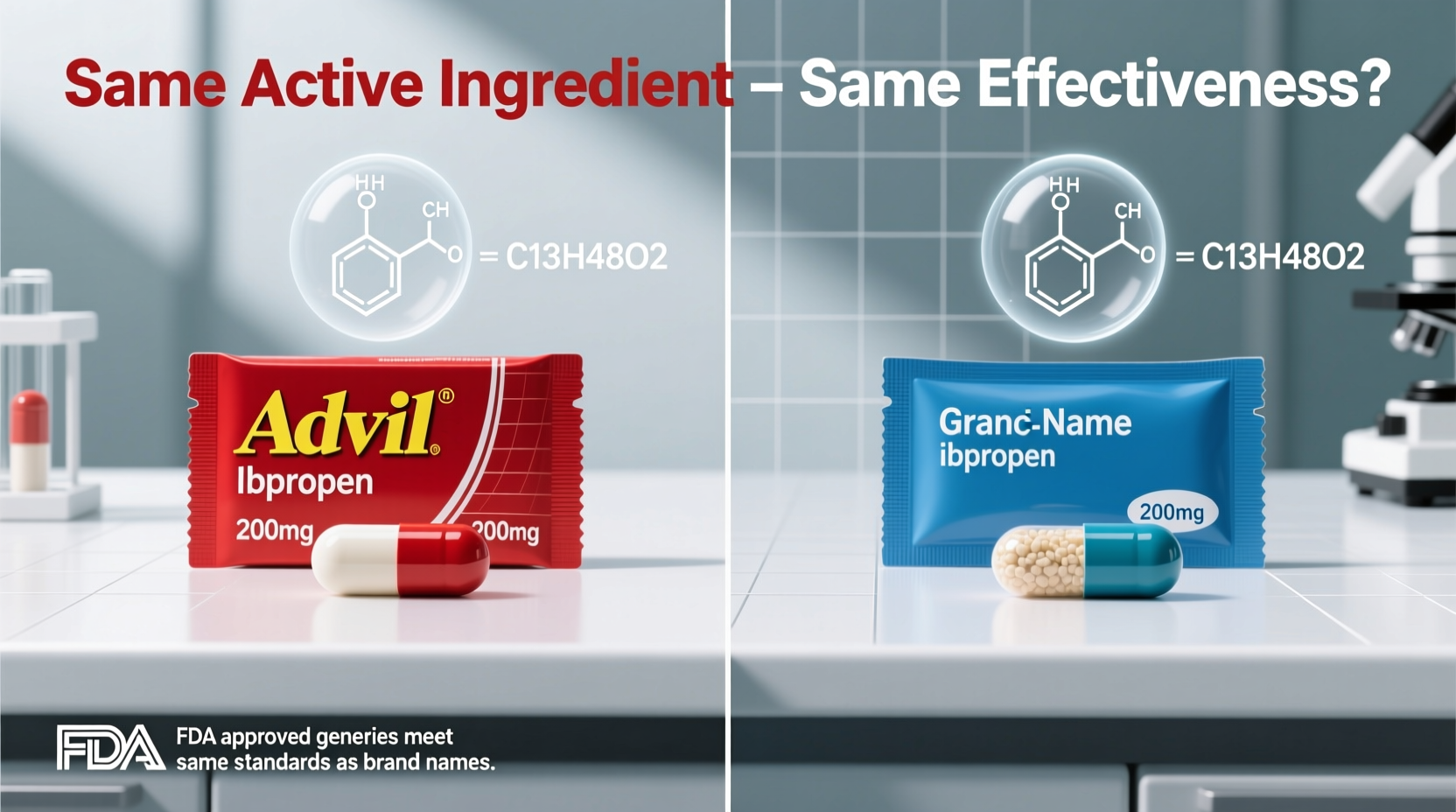
Brand-name drugs are medications developed and marketed by pharmaceutical companies after extensive research, clinical trials, and patent protection. Advil®, for example, was first introduced by Pfizer (via its subsidiary Upjohn) and became synonymous with ibuprofen for many consumers. During the patent period, only the original manufacturer can sell the drug, allowing them to recoup development costs.
Once the patent expires, other manufacturers can produce and sell the same active ingredient under a generic name—“ibuprofen” in this case. These generics must meet strict criteria set by regulatory bodies like the U.S. Food and Drug Administration (FDA) to ensure they are equivalent to the brand-name product.
Tip: The active ingredient is what makes the drug work. Whether it's from a brand or generic source, if it's ibuprofen, it’s chemically identical.Regulatory Standards: How Generics Are Approved
In the United States, the FDA requires that generic drugs be bioequivalent to their brand-name counterparts. This means they must deliver the same amount of active ingredient into a patient’s bloodstream in the same timeframe as the brand-name version. To gain approval, generic manufacturers must conduct studies demonstrating this equivalence.
Bioequivalence doesn’t mean the drugs are *exactly* identical in every way—they may differ in inactive ingredients like fillers, binders, dyes, or preservatives—but these differences do not affect the therapeutic outcome. The FDA allows a small variance in absorption (typically within ±20%), but in practice, most generics fall well within a much tighter range.
“The FDA requires generic drugs to have the same quality, strength, purity, and stability as brand-name drugs. Patients can be confident they are getting the same clinical effect.” — Dr. Janet Woodcock, Former Director, Center for Drug Evaluation and Research, FDA
Effectiveness: What the Science Says
Multiple studies have evaluated whether generic ibuprofen performs differently than brand-name versions. A 2015 meta-analysis published in the Journal of Generic Medicines reviewed 38 clinical trials comparing generic and brand NSAIDs (nonsteroidal anti-inflammatory drugs), including ibuprofen. The conclusion? No clinically significant differences in pain relief, onset time, or side effects.
Another study conducted at the University of Maryland School of Pharmacy tested five different generic ibuprofen tablets against Advil® using dissolution testing—a method that measures how quickly the drug breaks down and becomes available for absorption. All generics met pharmacopeial standards, with dissolution profiles nearly identical to the brand.
Even in hospital settings where precise dosing matters, generic ibuprofen is routinely used without concern. In fact, most hospitals and insurance formularies prefer generics to reduce costs without sacrificing care.
Inactive Ingredients: The Real Difference
While the active ingredient—ibuprofen—is identical, the inactive components can vary. These include:
- Fillers (e.g., microcrystalline cellulose)
- Binders (e.g., povidone)
- Disintegrants (e.g., croscarmellose sodium)
- Coatings or dyes
For most people, these differences are irrelevant. However, individuals with allergies or sensitivities may react to certain dyes or additives. For example, some brand-name Advil® products contain red dye #40, while certain generics may use alternative coloring agents or none at all. If you have a known sensitivity, checking the inactive ingredients on the label is wise.
Tip: If you experience stomach upset or allergic reactions with one version but not another, review the inactive ingredients—it might not be the ibuprofen causing the issue.Cost Comparison: Why Price Varies So Much
The most noticeable difference between generic and brand-name ibuprofen is cost. A 200-count bottle of store-brand ibuprofen (e.g., Walmart’s “Equate” or CVS Health) can cost as little as $4, while the same quantity of Advil® may run $12–$15. That’s a 60–70% markup for the brand.
This price gap exists because brand-name manufacturers spend heavily on advertising, branding, and consumer loyalty. They also maintain higher profit margins due to perceived value. Generics, on the other hand, compete primarily on price, leading to lower costs for consumers.
Insurance plans and pharmacy benefit managers often incentivize generic use. Many co-pays for OTC-equivalent medications are lower when the generic is selected, even if purchased without insurance.
| Product Type | Average Cost (200 tablets) | Active Ingredient | Common Inactive Differences |
|---|---|---|---|
| Brand-Name (Advil®) | $12–$15 | Ibuprofen 200mg | Dyes, flavorings, proprietary coatings |
| Generic (Store Brand) | $4–$6 | Ibuprofen 200mg | Fewer dyes, simpler excipients |
| Pharmacy Chain Generic (e.g., CVS, Walgreens) | $5–$7 | Ibuprofen 200mg | Slight variations in disintegrants |
Real-World Example: Sarah’s Headache Dilemma
Sarah, a 34-year-old teacher, has suffered from tension headaches for years. She always reached for Advil® because it was the brand her mother used and the commercials made it seem more effective. When her insurance began charging more for branded OTC meds, she switched to her pharmacy’s generic ibuprofen to save money.
At first, she was skeptical. “It felt like I was buying a knockoff,” she said. But after using the generic for several months, she noticed no difference in how quickly her headaches subsided or how long the relief lasted. In fact, she realized she was saving over $200 a year—money she redirected toward her gym membership.
“It was a mindset shift,” Sarah explained. “Once I learned that the medicine inside was the same, I stopped paying for the logo.”
When Brand Might Matter: Special Formulations
While standard tablet forms of ibuprofen show no meaningful difference, some specialized formulations may justify the brand premium. Examples include:
- Advil® Migraine: Contains the same 200mg ibuprofen but is marketed in combination with caffeine in some countries (though not in the U.S. version).
- Liquid-gel capsules: Some brands claim faster absorption due to their gel-based delivery. While studies show liquid-filled capsules may act slightly faster (by about 10–15 minutes), generic softgels offer similar performance at lower prices.
- Coated tablets: Enteric-coated or “stomach-safe” versions may differ in release mechanism. Always compare labels carefully if you need delayed release or reduced gastric irritation.
Even in these cases, generic equivalents often exist. Pharmacists can help identify functionally equivalent alternatives.
Step-by-Step Guide: Choosing the Right Ibuprofen
Follow this practical sequence when deciding between generic and brand-name ibuprofen:
- Check the active ingredient: Confirm it’s ibuprofen (usually 200mg per tablet).
- Compare dosage forms: Tablet, caplet, liquid gel, chewable—match the form you need.
- Review inactive ingredients: Look for allergens like dyes or gluten if you have sensitivities.
- Assess cost per dose: Divide total price by number of tablets to find the cheapest option.
- Consult your pharmacist: Especially if you’re on other medications or have health conditions.
- Try the generic first: Most people find no difference. Switch back only if you notice issues.
FAQ: Common Questions About Generic Ibuprofen
Is generic ibuprofen really the same as Advil®?
Yes. Both contain the same active ingredient (ibuprofen) in the same strength and dosage form. The FDA requires generics to perform the same way in the body as brand-name drugs.
Why does generic ibuprofen sometimes look or taste different?
The appearance, coating, or slight aftertaste may differ due to inactive ingredients like dyes or binders. These don’t affect the drug’s effectiveness but can influence sensory experience.
Can switching to generic ibuprofen cause side effects?
Rarely. The ibuprofen itself is identical. However, if you’re sensitive to an inactive ingredient (e.g., a dye or preservative), you might experience a reaction. This is uncommon but worth noting if new symptoms arise.
Expert Insight: Trusting the System
Dr. Lisa Thompson, a pharmacotherapy specialist at Johns Hopkins, emphasizes that skepticism toward generics often stems from misinformation.
“Many patients think ‘generic’ means ‘lesser quality,’ but that’s a myth. These drugs go through rigorous testing. In my practice, I recommend generics 95% of the time—they’re safe, effective, and save patients real money.” — Dr. Lisa Thompson, PharmD, BCPS
Checklist: Smart Ibuprofen Shopping
Before purchasing, ask yourself:
- ✅ Is the active ingredient ibuprofen 200mg (or desired strength)?
- ✅ Does the dosage form match my needs (tablet, liquid gel, etc.)?
- ✅ Are there any inactive ingredients I should avoid (e.g., dyes, gluten)?
- ✅ Have I compared the cost per pill across brands?
- ✅ Have I consulted a pharmacist if using other medications?
- ✅ Am I choosing based on evidence, not branding?
Conclusion: Save Money Without Sacrificing Relief
The bottom line is clear: generic ibuprofen is just as effective as brand-name versions like Advil®. The science, regulatory oversight, and real-world use all support this conclusion. The only significant difference is the price—one that favors generics by a wide margin.
Choosing generic doesn’t mean compromising on quality; it means making a smart, informed decision about your health and finances. With billions of doses sold annually, generic ibuprofen has proven its reliability across diverse populations and medical settings.
🚀 Ready to save? Next time you reach for pain relief, pick the generic ibuprofen. Your body—and wallet—will thank you.








