
The smartwatch market has evolved rapidly, with fitness tracking now at the heart of what users expect. The Fitbit Sense and Samsung Galaxy Watch 4 represent two distinct philosophies in wearable design—one focused on health-first metrics, the other on integration, versatility, and advanced sensors. But as Samsung refines its software and hardware, a critical question emerges: is the Galaxy Watch 4 now not just competitive, but superior to the Fitbit Sense when it comes to fitness tracking?
This isn’t just about step counts or sleep scores. It’s about sensor accuracy, long-term health insights, real-world usability, and how well each device adapts to your lifestyle. Let’s break down where each excels—and whether Samsung has truly closed the gap.
Fitness Tracking Capabilities Compared
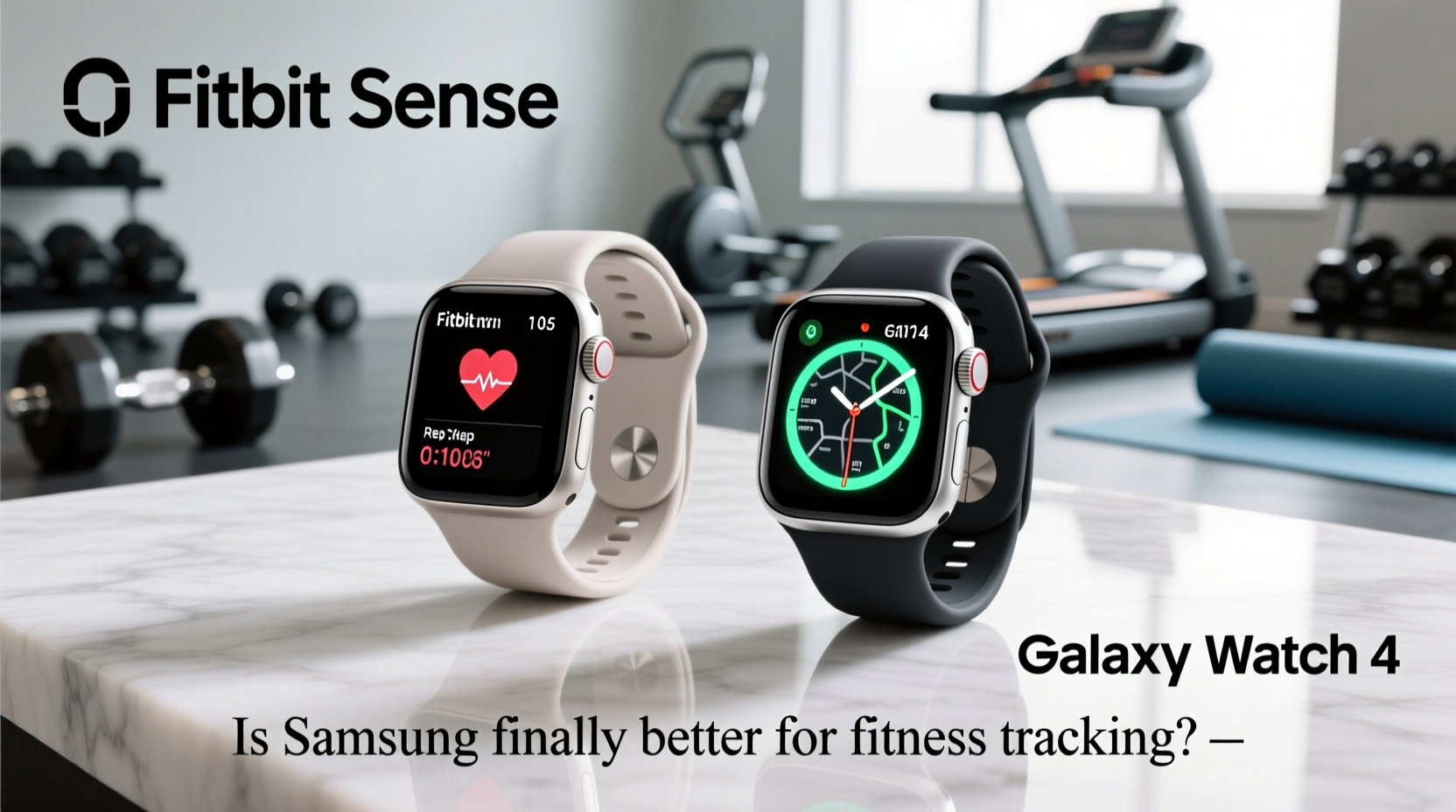
Fitness tracking goes beyond counting steps. Both watches offer 24/7 heart rate monitoring, GPS tracking, workout detection, and stress management tools. However, their approaches differ significantly.
The Fitbit Sense leans heavily into longitudinal health data. It continuously tracks heart rate variability (HRV), skin temperature (for nightly trends), SpO2 levels, and even includes an EDA (electrodermal activity) sensor to detect stress responses through sweat gland activity. These features are deeply integrated into Fitbit’s app, which delivers a “Readiness Score” based on sleep quality, recovery, and physiological signals—something athletes and health-conscious users find invaluable.
Samsung’s Galaxy Watch 4, powered by Wear OS and Samsung’s BioActive Sensor, combines three measurement types—electrical, optical, and bioelectrical impedance—into one compact array. This allows it to perform body composition analysis, measuring skeletal muscle, body fat percentage, and water levels. While this feature is innovative, its practicality depends on consistent use: you must stand barefoot on a compatible scale or input manual measurements for full context.
Tip: For accurate body composition readings on the Galaxy Watch 4, ensure consistent conditions—same time of day, hydration level, and minimal clothing.Battery Life and Daily Usability
No matter how advanced the sensors, a smartwatch that dies mid-day fails its core purpose. Here, Fitbit holds a clear advantage.
The Fitbit Sense offers up to 6 days of battery life under typical usage—sometimes stretching to 7 with power-saving modes. This means fewer charging interruptions, especially during multi-day hikes or travel without easy access to outlets.
In contrast, the Galaxy Watch 4 lasts about 1.5 to 2 days, depending on usage intensity. Heavy GPS use, LTE connectivity, or third-party apps can drain it faster. While fast charging helps, daily charging becomes necessary—a friction point for users who value set-it-and-forget-it reliability.
However, Samsung makes up for shorter battery life with richer functionality. With full support for Google apps, Spotify offline playback, and third-party fitness platforms like Strava and MyFitnessPal, the Galaxy Watch 4 functions more like a standalone mini-phone. Fitbit, while improving, still lags in app ecosystem depth.
Accuracy of Health Sensors: Real-World Performance
Accuracy matters most when making health decisions. Independent studies and user reports reveal nuanced differences.
A 2022 review by *The Quantified Scientist* found that both devices perform similarly in resting heart rate tracking, with deviations under 3% compared to medical-grade chest straps. During high-intensity interval training (HIIT), however, the Galaxy Watch 4 showed slightly faster response times in capturing peak heart rates, likely due to its higher sampling frequency.
Sleep tracking presents a different story. Fitbit continues to lead in sleep staging accuracy, correctly identifying REM, light, and deep sleep phases with over 80% consistency against polysomnography (the clinical gold standard). The Galaxy Watch 4 improved with its second-generation algorithm but still struggles with micro-awakenings and tends to overestimate deep sleep duration.
“Sensor fusion helps, but no wrist-based device matches lab equipment. That said, Fitbit’s long-term sleep modeling gives users actionable trends—not just snapshots.” — Dr. Lena Patel, Digital Health Researcher at Stanford Medicine
Detailed Comparison Table
| Feature | Fitbit Sense | Galaxy Watch 4 |
|---|---|---|
| Battery Life | Up to 6 days | 1.5–2 days |
| Heart Rate Monitoring | Continuous, with HRV & EDA | Continuous, with ECG & BP (region-limited) |
| Sleep Tracking | Advanced sleep stages + Readiness Score | Sleep coaching + snoring detection |
| Body Composition | No | Yes (BIA via BioActive Sensor) |
| GPS | Yes (built-in) | Yes (dual-band for precision) |
| Stress Management | EDA scans + guided breathing | Stress tracking + mindfulness prompts |
| App Ecosystem | Limited (growing) | Full Wear OS (Google Play support) |
| Water Resistance | 50m (swim-proof) | 50m (swim-proof) |
Real-World Example: Training for a Half-Marathon
Consider Sarah, a 34-year-old runner preparing for her first half-marathon. She uses her wearable to monitor training load, recovery, and pacing.
With the Fitbit Sense, she receives daily readiness scores. After two consecutive hard runs, her score drops to 42—below average. The app recommends active recovery. She skips her planned tempo run and opts for yoga instead. Over the next week, her HRV stabilizes, and her performance improves.
If she used the Galaxy Watch 4, she’d get detailed GPS route mapping, elevation profiles, and seamless syncing to Strava. She could also check her body fat percentage weekly to assess conditioning. However, without a comparable readiness metric, she might miss subtle signs of overtraining until fatigue sets in.
In this case, Fitbit’s holistic health view supports sustainable progress, while Samsung excels in granular workout analytics.
Actionable Checklist: Choosing the Right Watch for You
- ✅ Prioritize all-day health insights? → Lean toward Fitbit Sense
- ✅ Want detailed body composition feedback? → Galaxy Watch 4 wins
- ✅ Need multi-day battery without charging? → Fitbit is more reliable
- ✅ Use Android phone and want full app flexibility? → Galaxy Watch 4 integrates better
- ✅ Focus on sleep quality and recovery metrics? → Fitbit offers deeper analysis
- ✅ Prefer iPhone? → Fitbit works better with iOS than Galaxy Watch
Frequently Asked Questions
Can the Galaxy Watch 4 measure blood pressure accurately?
The Galaxy Watch 4 includes a blood pressure monitoring feature, but it requires initial calibration using a traditional cuff and is only available in select regions due to regulatory approval processes. Accuracy depends on proper setup and regular recalibration. It’s best used for trend tracking rather than medical diagnosis.
Does the Fitbit Sense work well with Android phones?
Yes, the Fitbit Sense is fully compatible with Android devices. While some users report minor sync delays, core features—including GPS, notifications, and health tracking—function reliably. However, Samsung’s ecosystem integration with Galaxy phones remains tighter.
Which watch is better for swimming?
Both watches are rated 5 ATM (suitable for swimming), track laps automatically, and record stroke type. The Fitbit Sense provides swim efficiency metrics and integrates swim data into its overall fitness score. The Galaxy Watch 4 logs swims effectively but lacks advanced swim-specific analytics. For serious swimmers, Fitbit edges ahead.
Final Verdict: Has Samsung Closed the Gap?
Samsung has made impressive strides. The Galaxy Watch 4 isn’t just a fashion accessory—it’s a capable fitness companion with advanced sensors, strong GPS, and meaningful health features like body composition and ECG. Its integration with Android and growing Wear OS app library makes it more versatile than ever.
Yet, Fitbit still leads in one crucial area: turning raw data into personalized, actionable health intelligence. Its algorithms, refined over years of population-level research, help users understand not just what they did, but how their body responded. For those focused on long-term wellness, stress management, and sleep optimization, the Fitbit Sense remains unmatched.
Samsung may be “better” for tech enthusiasts who want a full smartwatch experience with solid fitness tracking. But for dedicated health tracking—especially preventive care and recovery insight—Fitbit continues to set the standard.
💬 Ready to choose your next fitness tracker? Share your experience with Fitbit or Galaxy Watch in the comments below—your insights could help someone make their decision!








