Anxiety attacks can strike at any moment—during a work meeting, in a crowded space, or even while lying in bed. When the mind races and the body tenses, people often reach for tools that offer immediate sensory grounding. Two of the most popular options are fidget spinners and stress balls. Both are widely marketed as tools for calming nerves, improving focus, and managing anxiety. But when it comes to actual relief during an acute anxiety episode, which one truly performs better?
This question isn’t just about personal preference. It involves neuroscience, tactile psychology, and the mechanics of how our bodies respond to stress. While both devices occupy similar spaces on desks and in therapy bags, their methods of action differ significantly—one relies on visual and kinetic stimulation, the other on deep pressure and muscle engagement. Understanding these differences can help individuals make informed choices about what works best for their nervous system.
The Science Behind Fidgeting and Anxiety Relief
Fidgeting isn't just a nervous habit—it's a physiological response. Research shows that small, repetitive movements can help regulate the autonomic nervous system, especially during periods of heightened arousal. According to Dr. Lindsay Bira, a clinical health psychologist specializing in stress management, “The act of fidgeting provides a channel for excess nervous energy. It gives the brain a simple task to focus on, which can interrupt rumination and reduce perceived stress.”
This process is tied to the concept of *interoception*—how we perceive internal bodily signals. During anxiety, interoceptive awareness spikes, making heart rate, breathing, and muscle tension feel overwhelming. Tools like fidget spinners and stress balls introduce external sensory input, redirecting attention from internal distress to controlled physical activity.
However, not all sensory inputs are equal. The type of movement, resistance, and feedback each device provides plays a crucial role in its effectiveness during panic episodes.
Fidget Spinners: Visual Stimulation and Rhythmic Motion
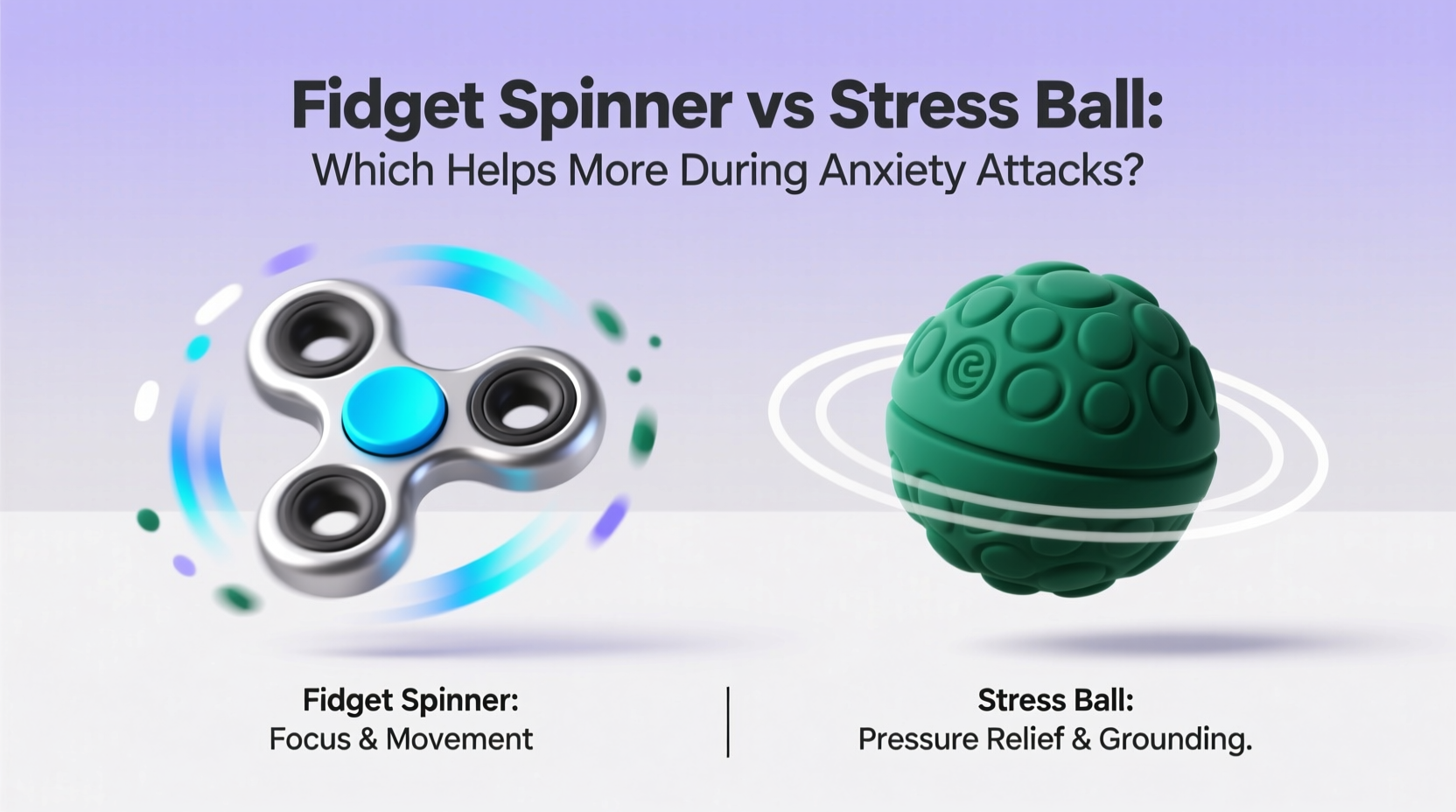
Fidget spinners gained global popularity in 2017, but their roots trace back to therapeutic tools designed for children with ADHD and autism. The core mechanism involves spinning a central bearing with finger pressure, creating smooth, continuous motion. For many users, the visual focus on the spinning arms serves as a form of *kinetic meditation*.
During mild anxiety or restlessness, this rhythmic movement can be soothing. The predictability of rotation offers a sense of control. Some studies suggest that visual tracking of moving objects activates the parietal lobe, which helps modulate attention and spatial awareness—both often impaired during anxiety.
Yet, limitations arise during full-blown panic attacks. Because spinners require coordination and visual attention, they may demand too much cognitive load when someone is already overwhelmed. If hands are shaking or vision is tunneling due to hyperventilation, manipulating a spinner becomes difficult.
Tip: Use a fidget spinner during early signs of anxiety—like rising worry or distraction—not during peak panic.Stress Balls: Deep Pressure and Muscle Engagement
Stress balls operate on a different principle: resistance-based tactile feedback. Squeezing a soft, malleable object engages the muscles in the hand and forearm, triggering a neurological loop known as the *gate control theory of pain*. This same mechanism applies to non-painful stimuli like stress—intense sensory input from squeezing can \"close the gate\" on anxious thoughts by occupying neural pathways.
More importantly, rhythmic squeezing mimics diaphragmatic breathing patterns. A 2020 study published in the *Journal of Clinical Psychology* found that participants who squeezed a stress ball in time with slow breaths (5 seconds squeeze, 5 seconds release) showed significant reductions in cortisol levels compared to controls.
Unlike fidget spinners, stress balls don’t rely on fine motor skills or visual focus. They’re intuitive—even under high stress, the action of clenching and releasing feels natural. This makes them particularly effective during acute anxiety attacks when cognitive resources are depleted.
“Deep pressure activities like squeezing engage the proprioceptive system, which has a direct calming effect on the limbic system—the brain’s emotional center.” — Dr. Rebecca Turner, Occupational Therapist & Sensory Integration Specialist
Comparative Analysis: Fidget Spinner vs Stress Ball
| Feature | Fidget Spinner | Stress Ball |
|---|---|---|
| Mechanism | Kinetic motion + visual tracking | Muscle resistance + deep pressure |
| Cognitive Demand | Medium to high | Low |
| Effectiveness During Panic | Limited (requires coordination) | High (intuitive action) |
| Sensory Input Type | Visual + tactile | Tactile + proprioceptive |
| Portability | Good (but noisy models exist) | Excellent (quiet, fits in pocket) |
| Durability | Varies (bearings wear out) | High (latex or foam lasts years) |
| Best For | Focus enhancement, mild anxiety | Panic attacks, grounding, PTSD triggers |
Real-World Application: A Case Study
Consider Maria, a 34-year-old project manager diagnosed with generalized anxiety disorder. She began using a fidget spinner at her desk to manage daily stress. While it helped during routine work hours, she noticed it was ineffective during actual panic episodes—especially during presentations when her hands trembled.
After consulting her therapist, she switched to a textured stress ball made of memory foam. Her new technique involved pairing five-second squeezes with box breathing: inhale (4 sec), hold (4 sec), exhale (4 sec), pause (4 sec). Within two weeks, she reported a 60% reduction in the duration of her anxiety attacks.
“The spinner felt like a distraction,” Maria said. “But the stress ball gave me something concrete to do with my body. It grounded me faster than anything else I’ve tried.”
This case illustrates a broader trend observed in clinical settings: tools requiring minimal cognitive effort tend to perform better during high-arousal states.
Step-by-Step Guide: Choosing and Using the Right Tool
Selecting between a fidget spinner and a stress ball shouldn’t be arbitrary. Follow this evidence-based sequence to determine what suits your needs:
- Assess Your Anxiety Pattern: Track when and how your anxiety manifests. Is it chronic low-grade stress, or sudden panic attacks? Use a journal or app for one week.
- Test Both Devices Calmly: Try each tool when relaxed. Note which feels more natural and satisfying to use.
- Simulate Mild Stress: Practice using them during mildly stressful tasks (e.g., checking email after a long break). Observe which improves focus or reduces tension.
- Implement Breathing Pairing: Combine the chosen tool with paced breathing. For stress balls: squeeze on inhale, release on exhale. For spinners: spin for four breaths, then pause.
- Evaluate During Real Episodes: After consistent use, reflect on whether either tool shortened recovery time from anxiety spikes.
- Adjust or Combine: Some users benefit from both—a spinner for daytime focus, a stress ball for emergencies.
When to Use Each Tool: A Practical Checklist
- ✅ Use a stress ball if:
- You experience rapid heartbeat or trembling during anxiety
- You need a discreet, silent tool for public settings
- You respond well to physical exertion (e.g., pacing, stretching)
- You have trouble focusing on breathing alone
- ✅ Use a fidget spinner if:
- Your anxiety presents as mental restlessness or racing thoughts
- You benefit from visual concentration (e.g., watching a flame or water)
- You're in a safe environment where you can focus on manipulation
- You use it preventively, not during peak distress
Frequently Asked Questions
Can fidget spinners worsen anxiety?
Yes, in some cases. If the spinner requires precise handling and fails to spin smoothly during a high-stress moment, it can create frustration, increasing agitation. Additionally, loud bearings or unpredictable wobbling may add sensory overload for sensitive individuals.
Are there specific types of stress balls that work better?
Textured or ribbed stress balls provide enhanced tactile feedback, which increases grounding effects. Memory foam versions offer progressive resistance, making them ideal for breath-synchronized use. Avoid overly firm balls, as they may cause hand fatigue without added benefit.
Is there a risk of becoming dependent on these tools?
Not in a harmful way. Like using a meditation app or wearing noise-canceling headphones, these are coping mechanisms, not crutches. The goal is to build self-regulation skills. Over time, many users find they rely less on the tool as their nervous system learns the calming pattern.
Final Recommendation: Match the Tool to the Moment
The answer to “fidget spinner vs stress ball” isn’t universal—it depends on context, symptom profile, and individual neurology. However, when it comes to managing acute anxiety attacks, the evidence strongly favors stress balls. Their simplicity, compatibility with breathwork, and reliance on deep pressure make them superior for moments of crisis.
Fidget spinners, meanwhile, shine in preventive and maintenance roles. They’re excellent for reducing background anxiety, improving concentration, and providing sensory variety throughout the day. Think of them as daily wellness tools, while stress balls serve as emergency responders.
Ultimately, the best approach may be integration. Carry a stress ball for emergencies and keep a spinner nearby for proactive regulation. By understanding how each tool interacts with your nervous system, you gain greater agency over your mental state.
💬 Have you found one tool more effective than the other during anxiety? Share your experience in the comments—your insight could help someone find relief.








